
Midpoint: Wah Nu and Tun Win Aung
Museum Project #14: Museum of Reunion
Midpoint is a monthly series that invites established Southeast Asian contemporary artists to take stock of their career thus far, reflect upon generational shifts and consider the advantages and challenges of working in the present day. It is part of A&M Interviews and builds upon the popular Fresh Face series.
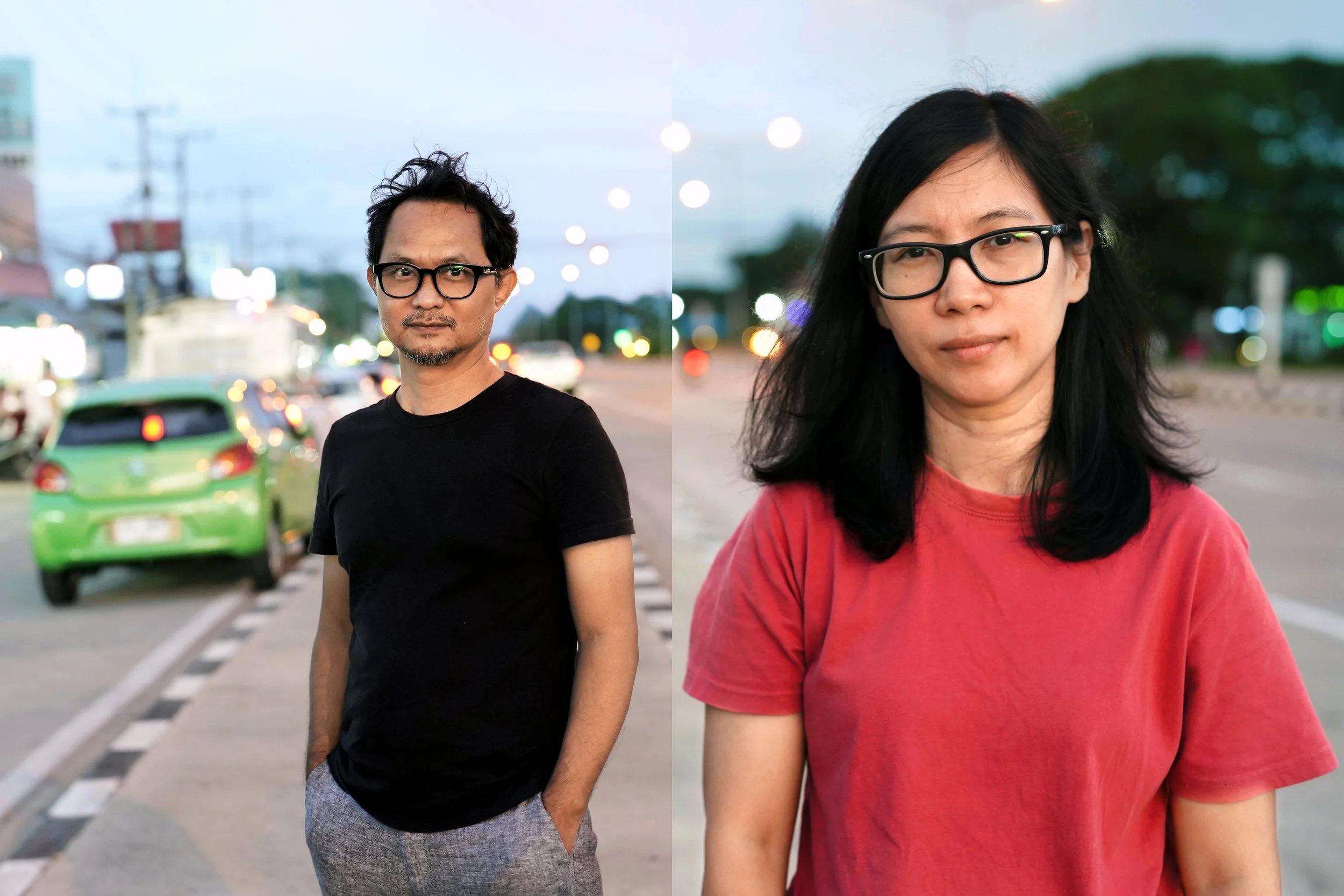
Portrait of Tun Win Aung and Wah Nu. This photograph best reflects how the artists work together as a couple. Each artist photographed the other in a reciprocal gesture. Image courtesy of NNNCL WORKSHOP.
Wah Nu (b. 1977, Yangon, Myanmar) and Tun Win Aung (b. 1975, Ywalut, Myanmar) are an artistic duo best known for expansive projects that reflect their lived experiences and social conditions in their home country. Their Museum Projects seek to introduce ideas about art and art-making to rural communities in Myanmar, through pop-up museums and experiences. In their respective individual practices, Wah Nu works in painting and film to express personal emotions, while Tun Win Aung focuses on local histories and environments. Their works have been exhibited in major institutions and biennales such as the Guggenheim Museum in New York, 21st Century Museum of Contemporary Art in Kanazawa, the 5th Singapore Biennale (2016), and the 6th Asia Pacific Triennial (2009).
In this conversation, I invite the artists to look back on their journey together in art and life, as well as their work for Thailand Biennale Phuket 2025.

Wah Nu on the opening day of the 6th Asia Pacific Triennial of Contemporary Art (2009) at QAGOMA, Brisbane. At this exhibition, the duo presented their photographic series Blurring the Boundaries. Image courtesy of NNNCL WORKSHOP.
Looking back, could you share a decision or event that marked a significant turn in your path as artistic collaborators?
Wah Nu (WN) & Tun Win Aung (TWA): Since the beginning of our relationship in 1995, art and working together have been closely intertwined for us. Even when we were presenting our work under individual names, the other was always present in the process. In fact, in some paintings and works we made as early as 1998, we had already signed both of our names together. We continued to take part in exhibitions as individual artists for many years.
Things shifted significantly when we were invited to participate in the 6th Asia Pacific Triennial (APT6) in 2009. At that moment, we had to seriously think about authorship, about how to credit the work we were showing. It no longer felt right, or even possible, to say, “this is his work” or “this is her work.” With the advice of the curators, Russell Storer and Richard Streitmatter-Tran whom we are very thankful to, we decided to officially present the work under both of our names. That moment clarified our collaboration and marked an important change in how we understood and presented our work together.
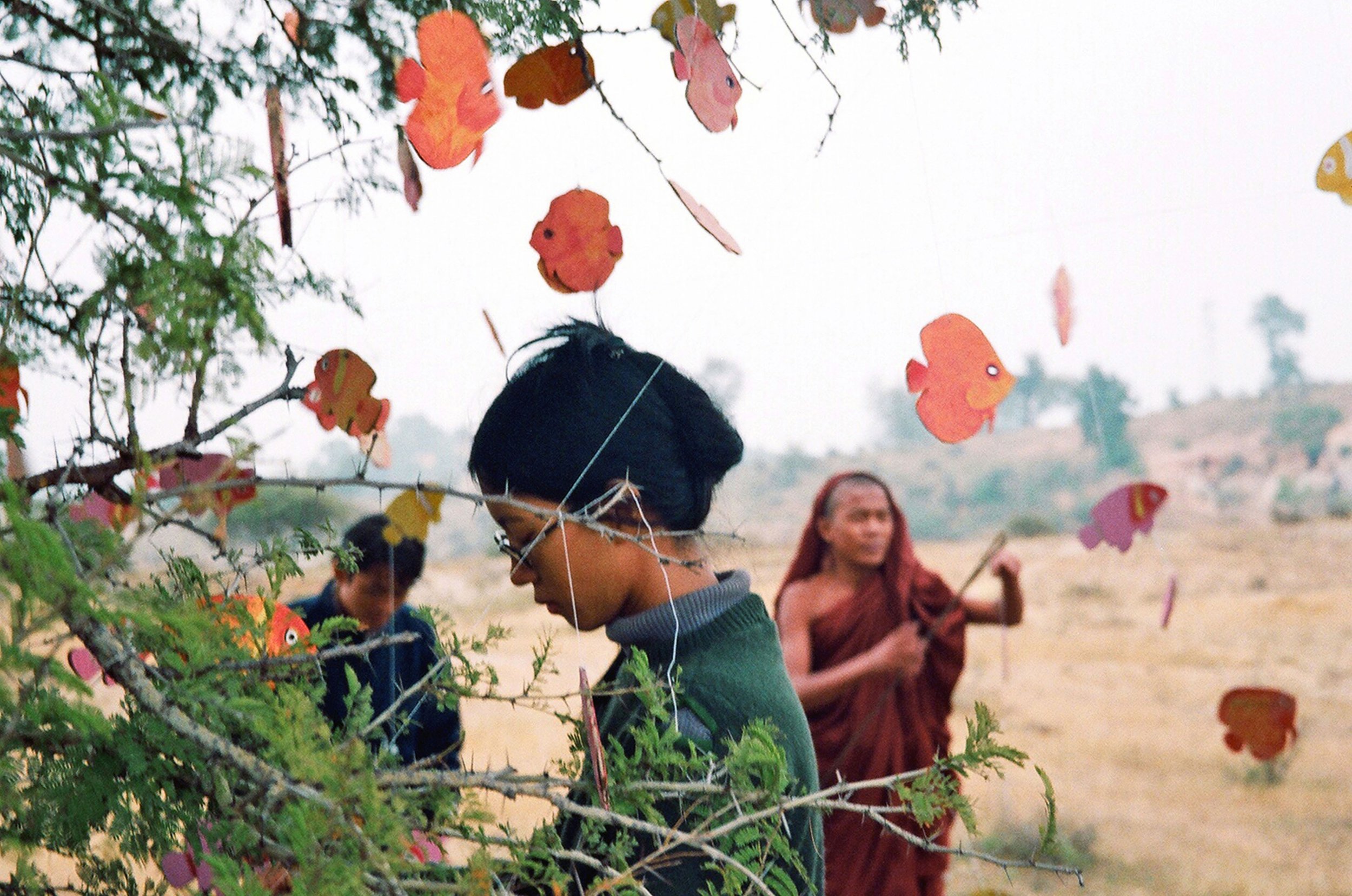
Wah Nu and residents of Wamdwin installing Tun Win Aung’s outdoor installation Seascape #3, 2002. Wamdwin, Myanmar. Image courtesy of NNNCL WORKSHOP.
What has been a milestone achievement for you, and why has it been particularly memorable?
WN & TWA: For us, a real milestone is not something tied to a single exhibition or a moment of recognition. It has more to do with how we have worked together over time. Looking back, when we begin a project, we do not ask each other to divide the work in a strict or calculated way. Instead, we willingly step in for one another, with open and warm hearts. When things do not go well, we have learned to take responsibility for ourselves. One person’s sadness becomes the other’s tears. We help each other, support each other, and move forward together.
At the same time, when any kind of success comes no matter how big or small, we welcome it with the same joy and embrace it fully. In fact, it does not even feel right to call it “sharing.” One person’s success naturally becomes the other’s success. It is a bit like how our child’s achievement feels like our own. Over time, reaching that state, where success and failure, joy and sorrow are no longer separate, became our most important achievement. That way of being and working together is what feels most meaningful and memorable to us.
“Looking back, when we begin a project, we never ask each other to divide the work in a strict or calculated way. Instead, we willingly step in for one another, with open and warm hearts.”
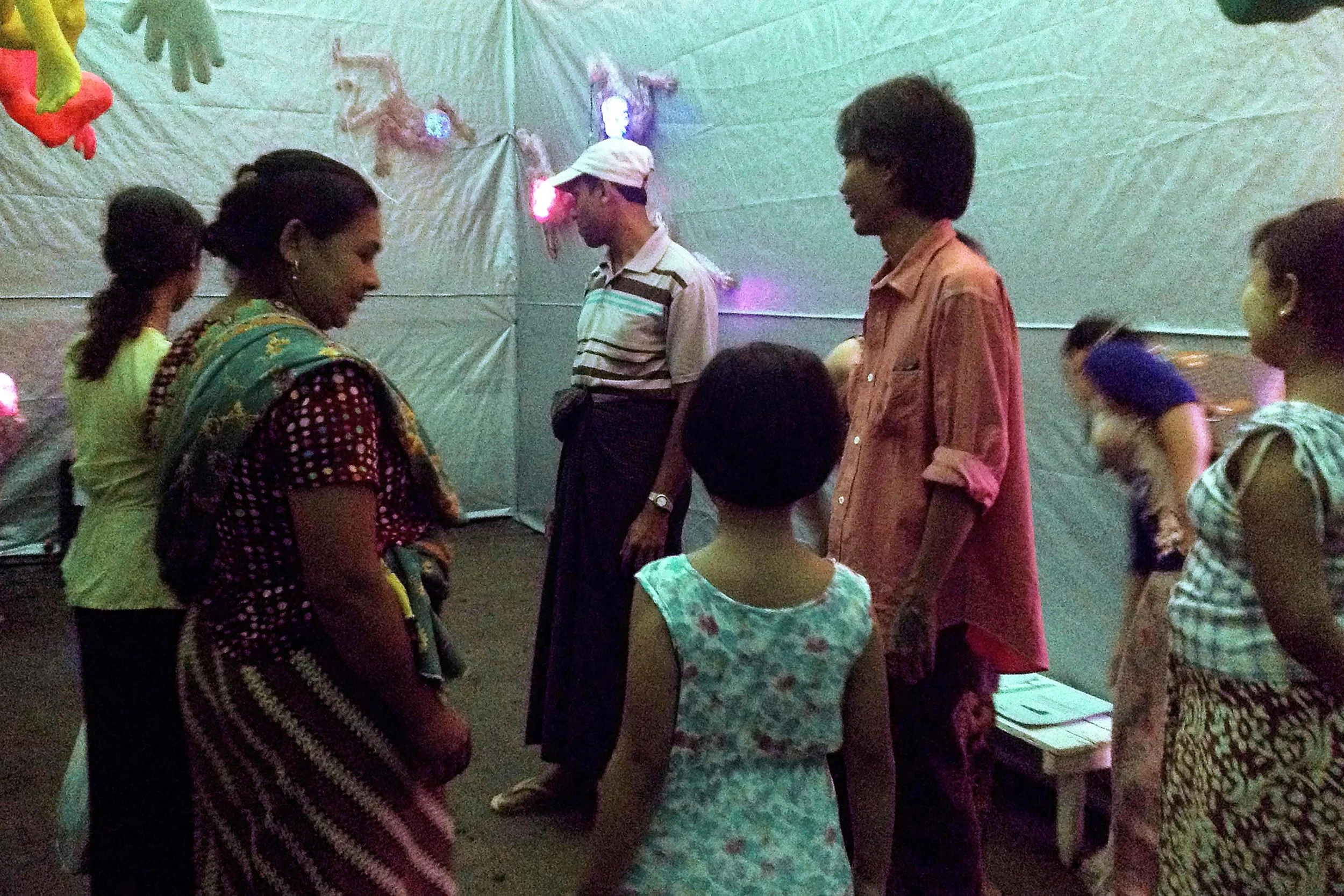
Artists and the local people. Tun Win Aung & Wah Nu, Museum Project #4: Thingangyun Museum of Contemporary Art, 2012–2013. Featuring Goblins in Wonderland (2013), a solo exhibition by Zar Min Htike; papier-mâché, DVD discs, LED lights, and mixed media. Installation dimensions variable. Held at Thardu Compound, Yangon, Myanmar. Project realised within the framework of the Flying Circus Project, with the support of the TheatreWorks Singapore. Image courtesy of NNNCL WORKSHOP.
Could you walk us through a typical work day, or a typical week? Are there routine(s) you follow to nourish yourself/your artistic practice?
WN: Since life is complicated and often out of control, no two days are the same. But for me, the day usually starts with making breakfast for our son before he goes to school. Then it is cleaning, doing the laundry, and taking care of the house. When those things are done, I think about what else needs to happen that day: where we need to go, who we need to meet, what we need to buy or order. If I have a little time, I listen to Dhamma talks while doing small bits of work. Then it is time again to hang the laundry, prepare lunch, cut vegetables, cook, and wash the dishes.
While I am doing all of this, my mind is never fully away from work. That is why the colours of vegetables, butter, or sugar caramelised in a pan start appearing in my paintings. I cannot separate my life as an artist from my life as a homemaker.
After picking up our son from school, there is more caring and feeding to do, and I also prepare things to send to our daughter. As I do these things, I am already thinking about how to adjust colors I am not satisfied with in my paintings. Mixing paints in my head. Sometimes I am also writing an essay in my mind. At the same time, I am taking care of tasks, decisions, and instructions related to the projects that both of us are in the middle of.
TWA: Following what she said, I force myself out of bed early to take our son to school. We have breakfast together and continue whatever conversation we were already having. After that, if there is something our daughter needs, we take care of it. Otherwise, I pick up whatever work is already in progress. It could be our collaborative work, my own work. Sometimes it is simply helping friends with whatever I can. While all this is happening, I am listening to Wah Nu talk, or I am talking to her, or listening to music. If I get bored, I play games. I read while using the bathroom.
But when I get some time to myself, I clean the house. For me, cleaning the house is also a way of cleaning my mind. After that, I return to my own work, in silence. Studying. Or writing. I enjoy writing things that no one reads. In the evening, we pick up our son from school. If he wants to play, we play together. And then the cycle starts again, just like the morning.
On some days, I do not work at all. We just sit somewhere, walk around, meet friends, and talk. Just like anyone else.
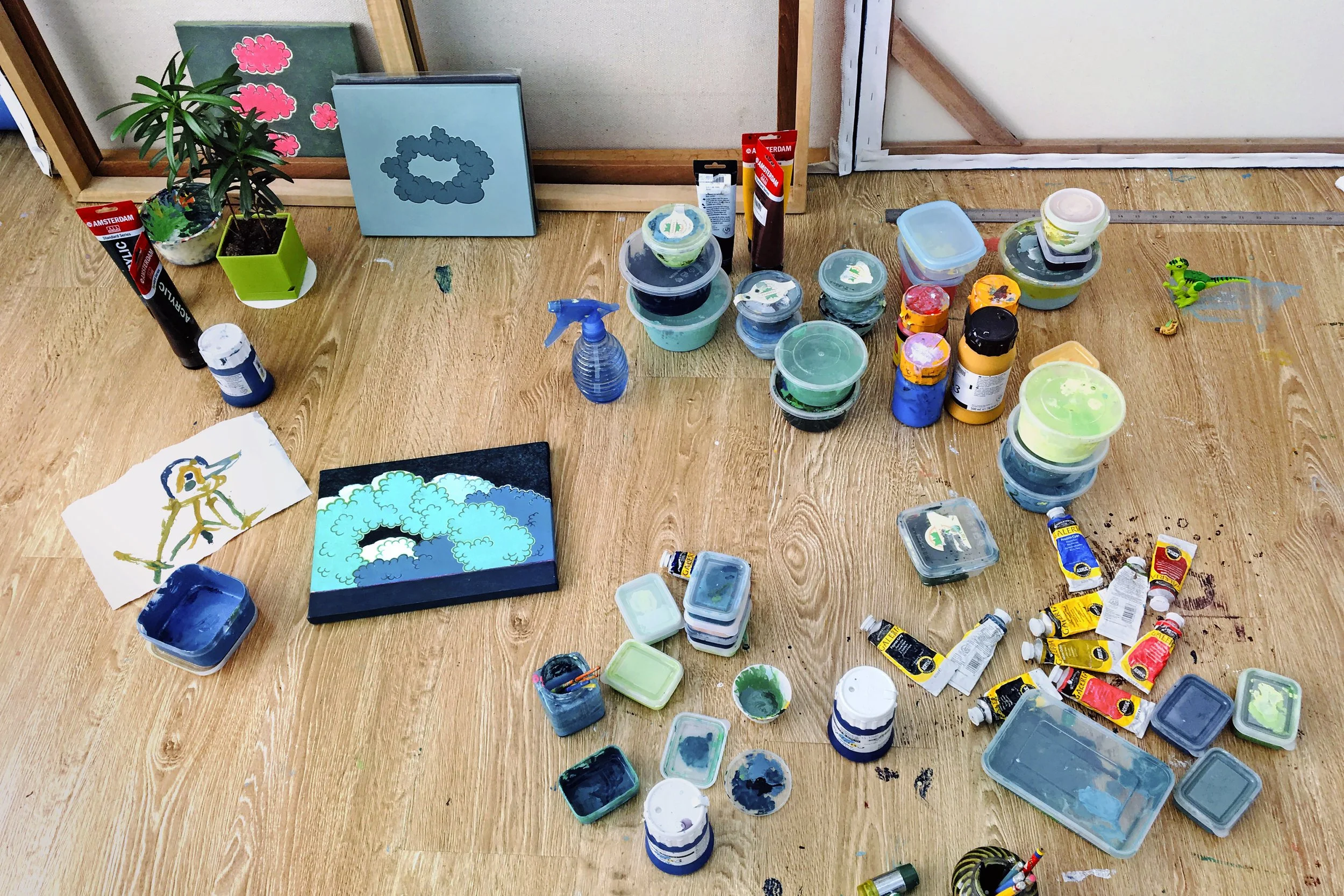
The floor of Wah Nu’s studio workspace in Yangon, during her study of the cloud paintings for an exhibition held at Richard Koh Fine Art in 2020. Image courtesy of NNNCL WORKSHOP.
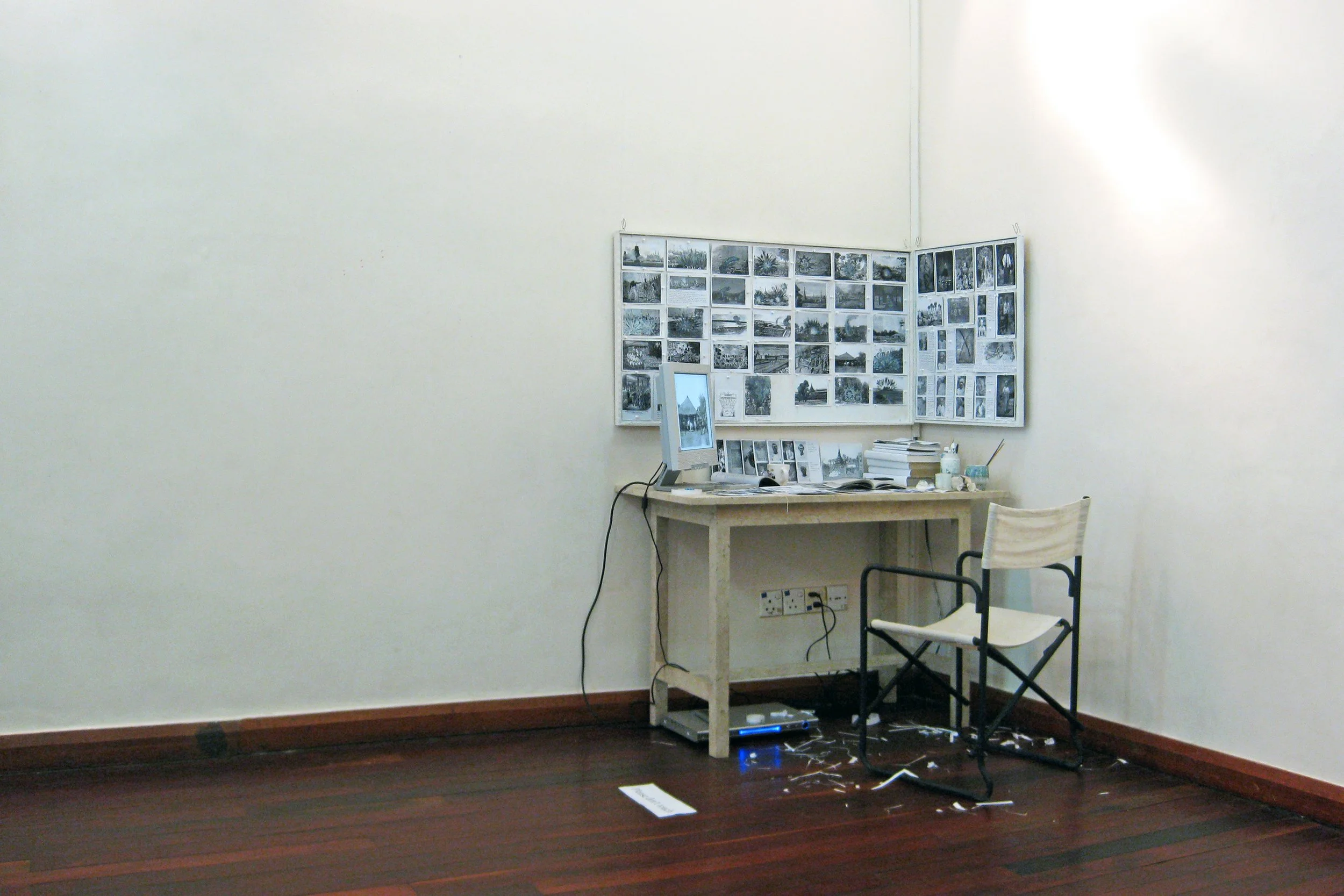
From a working space to a work of art. Tun Win Aung, On the Road from Mandalay, 2008–2009. Installation with video animation; animation Es vs the Ms by Edo Vader, Flash animation, color, silent, 13 seconds, continuous loop. Installation dimensions variable. Image courtesy of NNNCL WORKSHOP.
Could you describe your studio/ workspace? How has it evolved over the years? What do you enjoy about it, and what do you wish to improve/change?
WN: Right now, the place where I work is on the floor, near the doorway between the living room and the kitchen. The space is about ten by eight feet, and it is nothing like a studio at all. But in this house, it is actually the best and most practical place for me to work. As I move through the day doing housework, I pass that doorway repeatedly. I keep seeing what I am still working on, so I remain connected to it. When a small idea comes, or when I find even a little bit of time, I sit down in front of the painting and add a touch or two.
Sometimes, of course, I think to myself that I want to paint calmly, without interruptions. I want to sit down and finish a piece of writing in one go. But that is not possible. If I keep waiting for the perfect conditions, I will lose the best time of my life.
That is how it goes. While the soup is boiling, while the washing machine is running, I find a moment to check an edited video. Some friends tell me that my video works would be better if I used more proper equipment. I agree with them. But if I wait until I have all those tools, I will probably spend my whole life just sitting still, doing nothing.
TWA: In many ways, my workspace has always been centred around a table. That has been the case from the very beginning. Sometimes it was just a piece of plywood placed on top of a cardboard box, but most of the time I have worked on a low table or a simple desk. Our photographic series Blurring the Boundaries (2007-2009), for example, came out of working in those kinds of tabletop studio settings. My favorite table was the one in our studio in Yangon. Around it, there were bookshelves filled with books I was using for reference.
These days, though, it feels like we have gone back to the beginning again. The workspace has become smaller and more condensed. I now work with just four or five books kept close by, only what I need. And if I need more space to think or work, I just go outside and walk around. As long as my memory, my mind, and my imagination are functioning well, I feel like I can work anywhere.
“If I keep waiting for the perfect conditions, I will lose the best time of my life.”
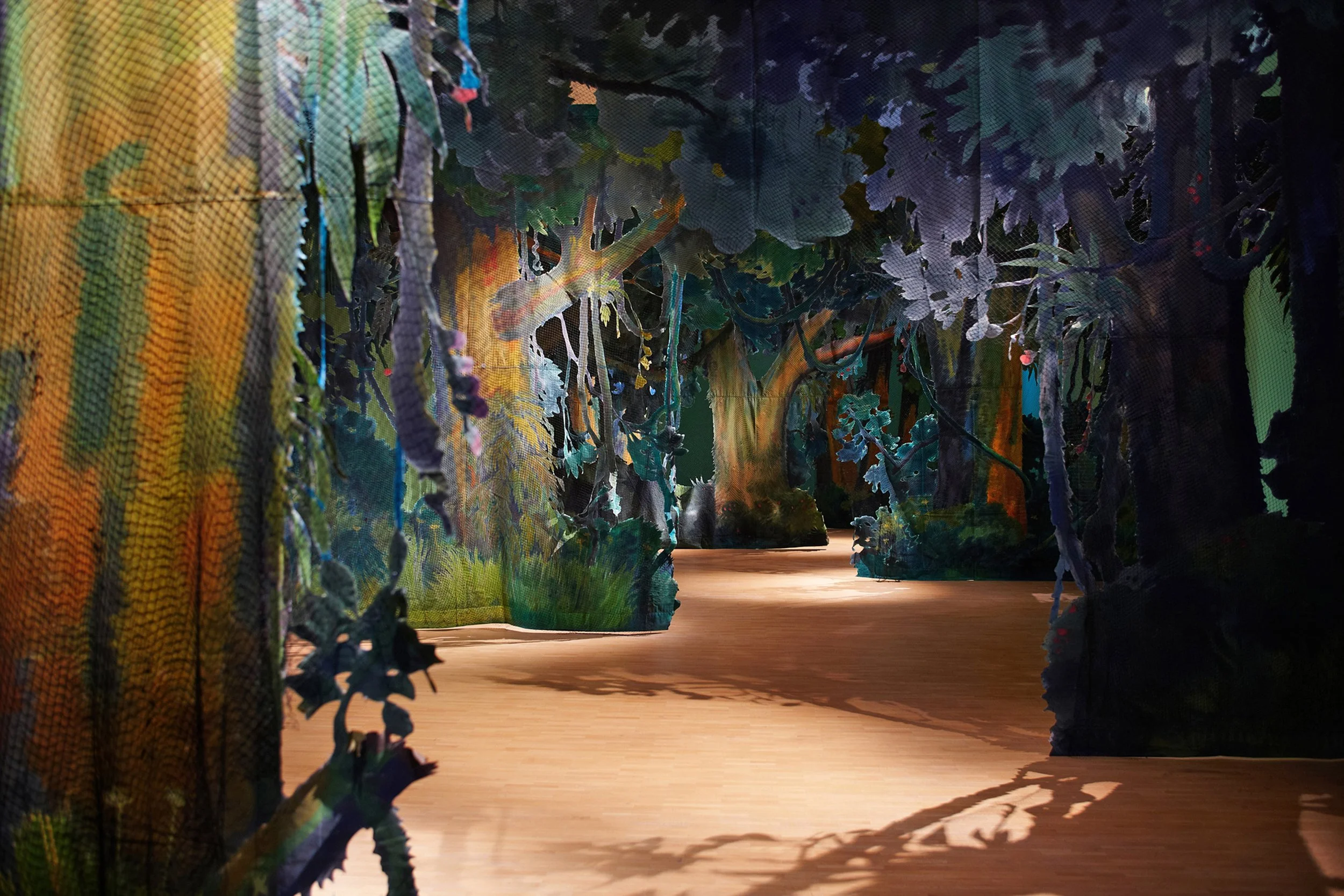
Tun Win Aung & Wah Nu, Ipso Facto, 2011–2013. Six backdrop paintings; emulsion on linen and net, 275 × 580 cm each; with video, color, sound, 20 min. 54 sec. Installation dimensions approximately 700 × 1600 × 300 cm overall. Work realised within the framework of the exhibition at the Atelier Hermès, with the support of the Fondation d’entreprise Hermès. Photo by Kiyong Nam. Image courtesy of NNNCL WORKSHOP.
What considerations do you have when working as a duo, as compared to your individual practices?
WN & TWA: Whether we are working individually or as a duo, both of us are involved in the process in some way. Even so, there are times when our ideas remain very personal, regardless of who contributed more or at which stage.
In Myanmar, there is a word people are familiar with: “Ku-paw-laung-bac.” It refers to someone who supports another person’s practice. They are not just a name or a symbolic presence. They do real work. And yet, they do not become recognised as the main author. For example, some of the data-based works come purely from Tun Win Aung’s way of working, while the large cloud paintings come from Wah Nu’s hand.
What is important to note, though, is that every collaborative work usually begins with one person’s idea. From there, the other steps in; adding to, responding to, or complementing that initial idea. Rather than dividing responsibilities, we tend to fill in for each other’s needs, gaps, or weaknesses.
In that sense, as long as one person’s conceptual thinking does not take a central or decisive place in the work, it still feels like an individual piece. But when it becomes impossible to remove one person’s thinking from the core of the work, when both ways of thinking are essential, then it becomes a collaborative work. That is when the work comes out of the meeting point between our two minds.
Viewers can often sense this quite easily. Tun Win Aung’s ideas tend to feel heavier, while Wah Nu’s ideas feel lighter. Hopefully, our collaborative works sit somewhere in between, not too heavy, not too light.
“When it becomes impossible to remove one person’s thinking from the core of the work, when both ways of thinking are essential, then it becomes a collaborative work.”
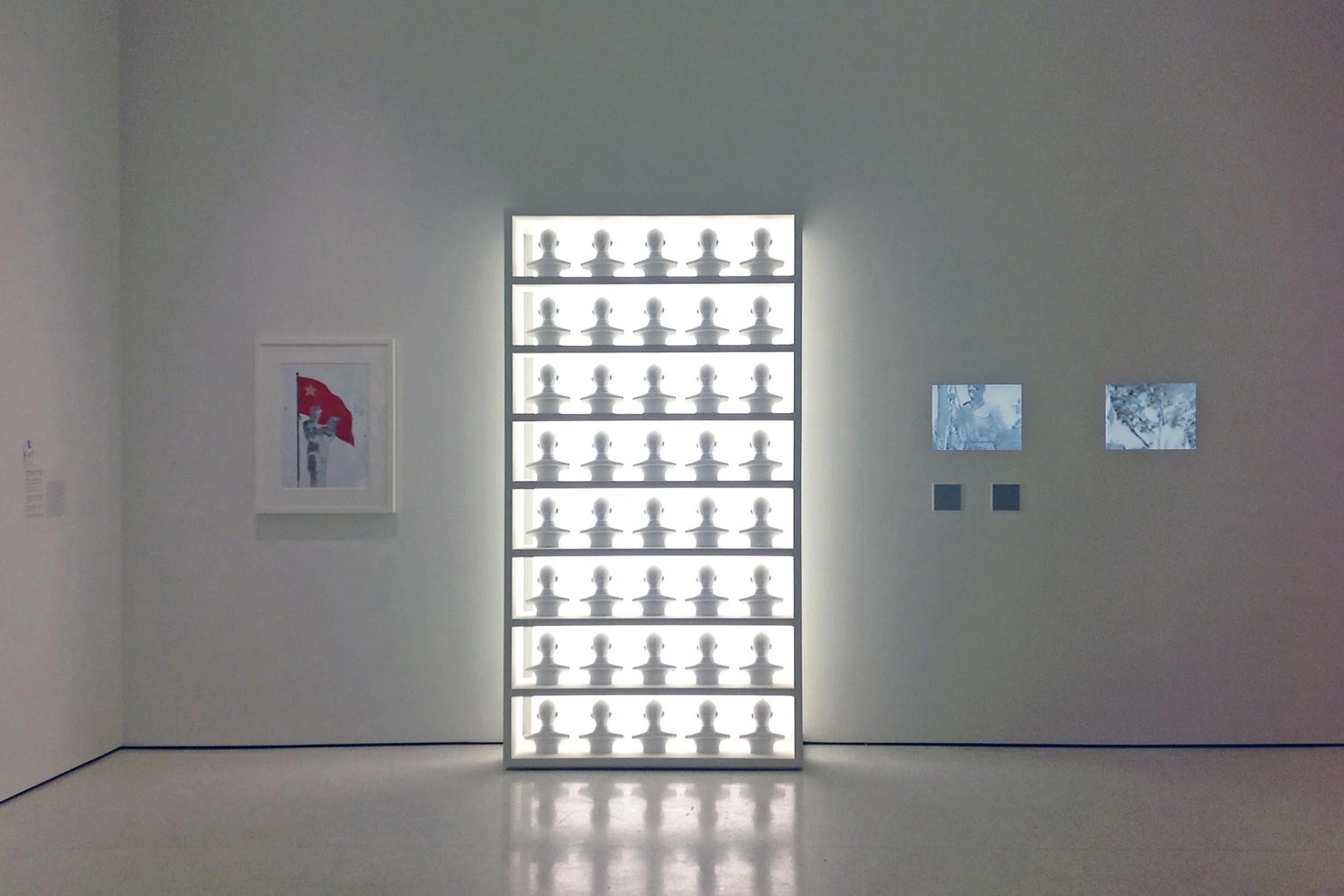
Tun Win Aung & Wah Nu, Four Pieces (of White). White Piece #0131: Forbidden Hero (Breeze Before Storm), 2012, acrylic and newspaper on canvas, 65 × 47.7 cm; White Piece #0132: Forbidden Hero (Heads), 2012, set of 40 plaster busts (20 × 9 × 23 cm each) with shelf and light box; White Piece #0134: His Last Speech We Heard from Myanma Radio on 19 July of Some Years Ago, 2012, black-and-white video, sound, 30 min. 44 sec., ed. 1 of 3; White Piece #0133: Thakin Pe Than’s Long March, 2012, black-and-white video, silent, 3 sec., continuous loop, ed. 1 of 3. Collection of the Solomon R. Guggenheim Museum. Image courtesy of NNNCL WORKSHOP.
What has become easier or more difficult to do as time has gone by?
WN & TWA: Our own small forest of ideas has grown greener over time. Like streams, ideas flow more gently and easily now. At the same time, it has become much easier to turn those ideas into reality, with access to new technologies and tools. Our circle has also expanded compared to before.
But we are careful not to be carried along by the mainstream of the art world. It is not easy, but we try to keep the direction we believe in clear.
What do you think has been/is your purpose? Has your purpose remained steadfast or evolved over the years?
WN & TWA: Our artistic purpose is quite simple. We want to contribute, in whatever way we can, to the enrichment of our art world. Even if it is only a small contribution, we want to keep adding to it: whether for ourselves, for our parents, or for the generations that come after us.
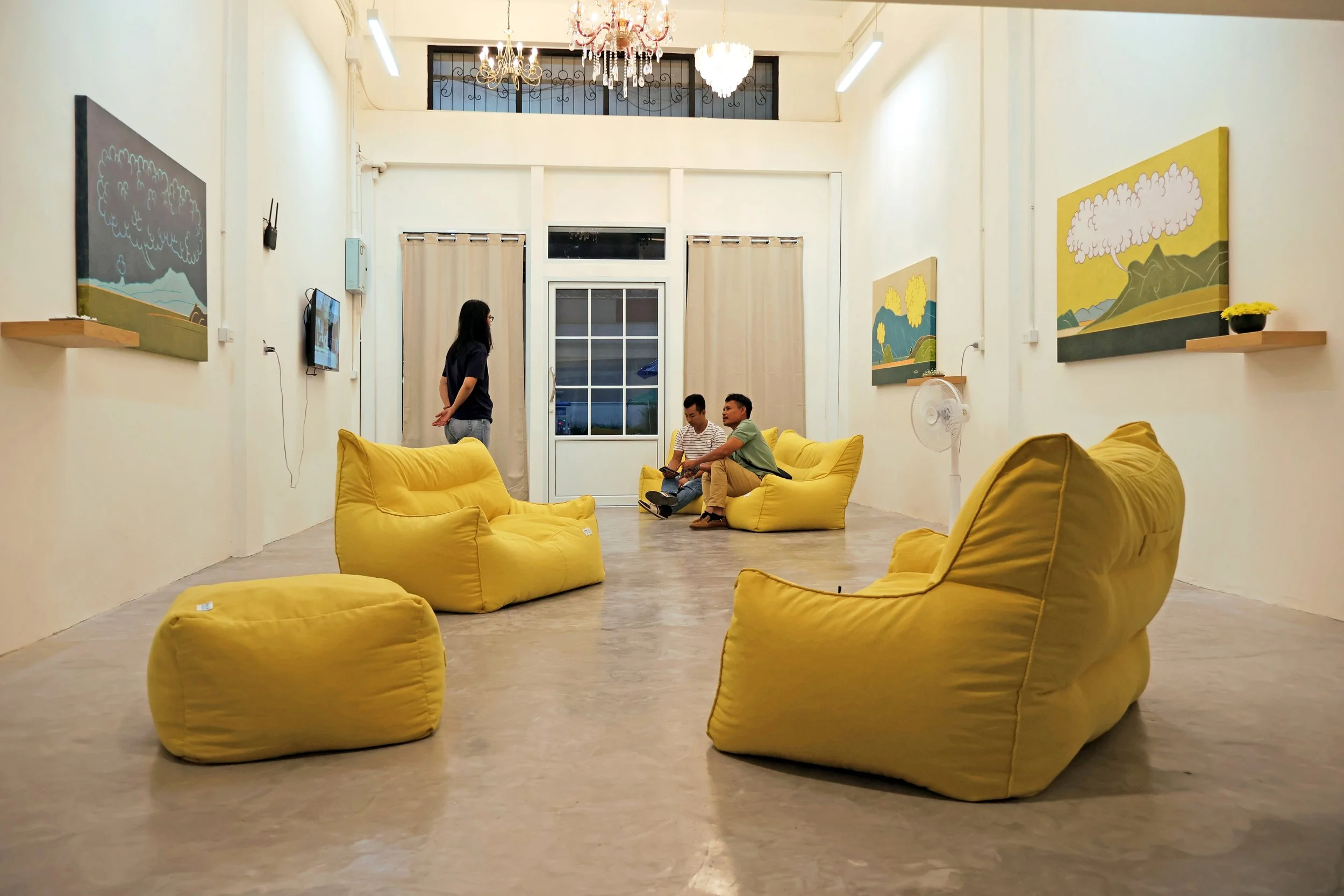
Tun Win Aung & Wah Nu, Museum Project #14: Museum of Reunion, 2025. Featuring works from Wah Nu’s Cloud over Mountain series, 2023, acrylic on canvas, 91.7 × 152 cm each; From Mountains to Plains, Rivers to the Ocean Gates, 2025, video with sound, 30 min.; From Someones to the Someones, 2025, 5,000 postcards, 10.16 × 15.24 cm each; Someone for Someone, 2025, 1,000 blank postcards, 10.16 × 15.24 cm each; and Reunion Corner, 2025, ten beanbag sofas and mixed elements. Installation dimensions variable. Museum of Reunion (except Wah Nu’s paintings) was commissioned by the Thailand Biennale Phuket 2025. Image courtesy of NNNCL WORKSHOP.
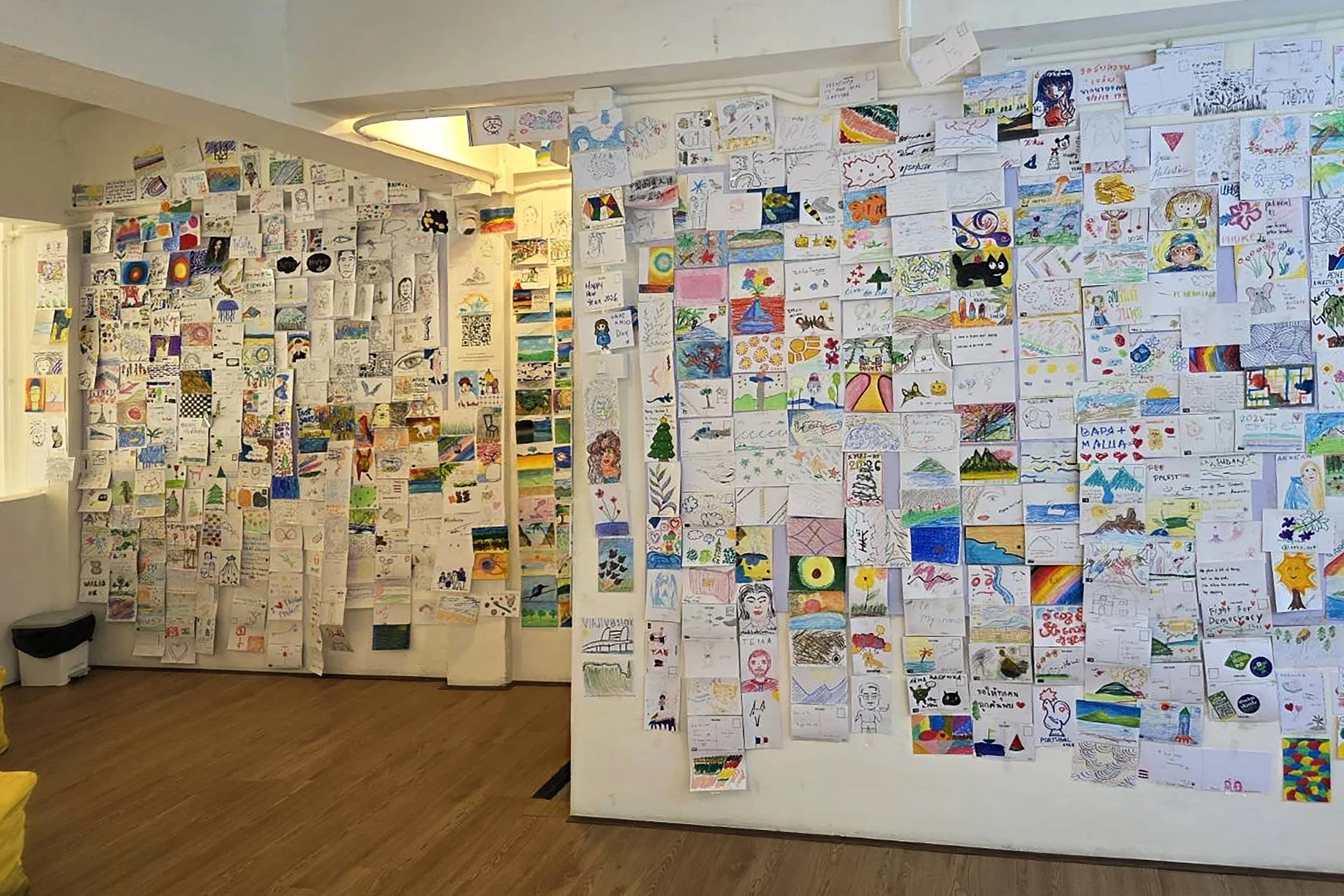
Installation view of Someone for Someone, work in progress, 2025. Blank postcards with drawings and messages by visitors, 1,000 copies, each 10.16 × 15.24 cm. Photo by Pornlapas Ruengthong. Image courtesy of NNNCL WORKSHOP.
Could you talk about your work at Thailand Biennale Phuket 2025? What aspect(s) of Phuket/ the site are you responding to or interested in?
WN & TWA: Our presentation at Thailand Biennale Phuket brings together elements from Museum Project #14: Museum of Reunion, our still-unrealised Museum Project #1, and Wah Nu’s Tea Party, presented at D-nakana in Yangon in 2023. Through this presentation, we wanted to listen to and reflect on experiences that are happening globally today: displacement, migration, resettlement, and, in some cases, disappearance, for many different reasons. At the same time, the work also carries memories of joyful childhoods, meaningful days from the past, and deeply tender moments of reconnection. At its core, this project was conceived as a form of performative art, grounded in action and shared experience.
As an overarching framework, our Art & Museum Projects explore ideas related to both art and architecture. On one side, there are concepts such as art, artwork, artistic practice and artist; on the other are notions of museum, exhibition, architecture and architect. These terms function not only as definitions or roles, but also as questions. Rather than offering fixed meanings, the Museum Projects aim to cultivate familiarity and an intuitive understanding for visitors.
Museum Project #14: Museum of Reunion reflects on reconnection: remembering, returning, and reaching out again. With this project, we hope to interweave four spheres: art, architecture, lived experience, and social life, bringing them into a quiet and meaningful balance.
We see Phuket as a city of strangers. What we mean is that historically Phuket has been home to the Moken sea nomads, a site of mining, a port for traders, a town shaped by migrant workers from the region, and a city formed through international tourism. In that sense, are we not also visiting artists in the city? Within this context, we found ourselves unexpectedly reconnecting, again and again, with old friends and fellows in Phuket. That kind of experience became an important starting point for our thinking.
The Bége, where our work was situated, felt like a place of encounter, a place to pause, to rest, and to exchange messages with one another. We are deeply grateful to the curatorial team for giving us the opportunity to realise these ideas.
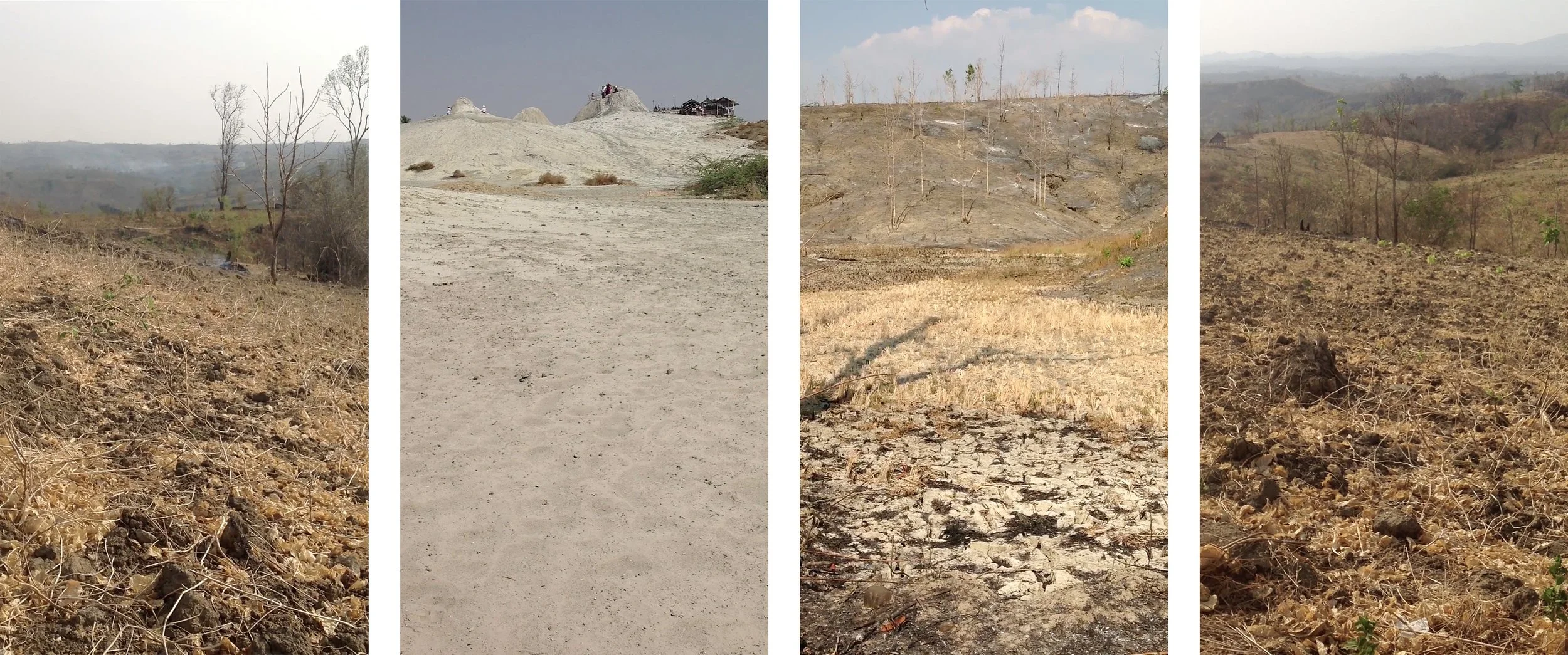
Video stills from Tun Win Aung and Wah Nu’s Mud and Ash in the Air: Between Eruption and Industry (work in progress). Images courtesy of NNNCL WORKSHOP.
Are there upcoming project(s) you wish to share?
WN & TWA: We still have many things in progress that need to be completed. For example, we aim to wrap together all the ideas, experiences, documents, and reflections related to the Museum Projects, and eventually bring them to a close. We continue realising the works from the 1000 Pieces (of White) project (2009 – ongoing). Wah Nu has been working on the painting series titled Cloud and Stars since 2020, and that will also be completed. Step by step, we will keep moving forward, one thing at a time.
This interview has been edited.
Thailand Biennale Phuket: Eternal [Kalpa] is happening from 29 November 2025 to 30 April 2026.