Midpoint: Rirkrit Tiravanija
‘SAY YES TO EVERYTHING’ at STPI
Midpoint is a monthly series that invites established Southeast Asian contemporary artists to take stock of their career thus far, reflect upon generational shifts and consider the advantages and challenges of working in the present day.

Rirkrit Tiravanija, 2022. Photo by Toni Cuhadi. Image courtesy of STPI, Singapore.
Rirkrit Tiravanija (b. 1961, Buenos Aires, Argentina) is an artist known for his artistic practice which resists easy categorisation. By offering simple experiences of living art that break down established boundaries between display and viewer, he rejects the abstracted art object to critical effect. Fluent in the strategies of institutional critique, his body of work engages with social and political issues, while embracing the wisdom of the everyday. I speak to Rirkrit at his solo exhibition Rirkrit Tiravanija: SAY YES TO EVERYTHING at STPI, where he offers insights on his personal philosophies and how he mediates his artistic agencies with the desires of institutions that house his works.

Rirkrit Tiravanija: SAY YES TO EVERYTHING, 2026, installation view. Image courtesy of STPI, Singapore.
Let us start off with the exhibition as an entry point. What does saying yes to everything mean to you?
Saying yes started with agreeing to join the STPI residency in 2012 after Executive Director Emi Eu pursued me relentlessly! But right now, saying yes to everything means that I try not to interfere too much or direct how things go. For instance, all the works in this exhibition were assembled by the STPI curatorial team. I do not wish to intervene much because I want the exhibition to be an experience, and for audiences to try and read and engage with it without providing too many explanations or context. I want people encountering the presentation to take their time and work their way through it.
In an interview with David Ross, published on the Brooklyn Rail in 2023, you said, “For me, it’s about use. It’s about usage. It’s about how people could see my work and use it for themselves.” Could you elaborate further on this approach?
Touch and change are important aspects I consider when making my works. I believe that art should always be moving. It should not be about preservation or keeping it in cold storage. Institutions and artists can have a certain intention, but how audiences deal with it may be a different matter.
In my practice, I also try to do things to ensure that my artworks stay impermanent. For example, the newspaper lining the walls in this exhibition were inspired by my daily use of them as a sustainable surface to create works on. The function of these newspapers is that they will eventually yellow with age, and that is natural. Things get old, they change, and that is part of a cycle.
Artists such as Andy Warhol and Marcel Duchamp created works that questioned authorship, while looking at how institutions direct and interpret the objects they collect. Through institutional critique, their works pointed out the fact that objects have a use which museums miss. Objects have lives beyond their sculptural forms and can exist as ideas, philosophies, and personal journeys. In my works, I want to take the pottery out of the case and reanimate it, so to speak. There tends to be a fear from institutions that audiences will want to grab objects and mess the displays up, but to me, that is the whole point. Living is messy.
“There tends to be a fear from institutions that audiences will want to grab objects and mess the displays up, but to me, that is the whole point. Living is messy.”
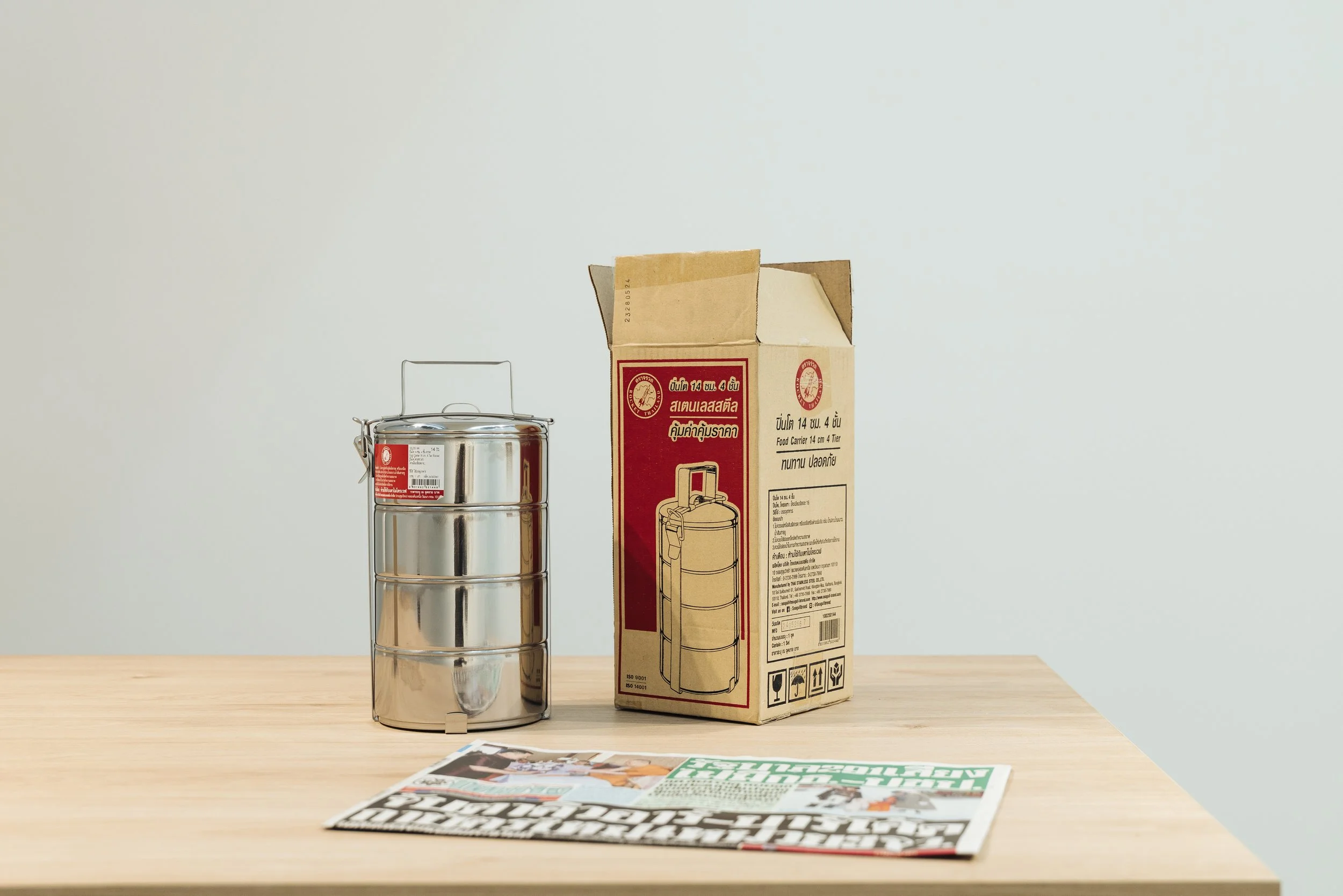
Rirkrit Tiravanija, untitled (lunch box), 1996, stainless steel container, Thai newspaper and Thai meal, 31.5 x 16 x 18 cm. © Rirkrit Tiravanija / STPI. Image courtesy of STPI, Singapore.
You have been widely exhibited at institutions such as the Museum of Modern Art, New York, Institute of Contemporary Art, London, and Haus der Kunst, Munich. At the same time, the art world has found a way to rationalise your work within its logic by calling your work “participatory”. How do you see yourself negotiating your artistic philosophies with the demands of formalised art spaces?
I find that it is important for me to do the “wrong” things, or push the “wrong” buttons. Doing so allows me to have a foot in the door to stop it from closing on the differences I am bringing. I am aware that I am acknowledged and given privilege by the Western art world, but there is still a gap where they do not fully understand what I am trying to do, or what my work entails. For instance, museums will say that they want audiences who do not typically look at art to visit, but it is not met with the realisation that in order to achieve that, they will have to open up fully and invite the mess in. Even when they apply the word “participatory” to describe my work, they are already organising and defining too much of when and how my work can be used.
At the same time, I like to view it from the perspective that all art spaces will have their own desires. With my current exhibition, STPI would undoubtedly have their own needs to address such as their focus on print, or the fact that some of the works were made here during my residency. Saying yes to everything also means that I am able to accept that different spaces have their own desires and memories. For example, with my work untitled (lunch box) (1996), I prepare and serve Thai food to visitors. When I installed this work in Los Angeles, I bought 100 tiffins and sent them to restaurants that would fill in the food and deliver them back along with the Thai newspaper for the day. In this exhibition, you can see the tiffin and a copy of the Thai newspaper. Is it for use or is it art?
The galleries I have exhibited at have had different stipulations on how the tiffins should be displayed or stored. I let them go ahead with what they wish to do, and yet it is a simple tiffin that can be purchased anywhere. Cooking and eating is also a space where people can do things together, rather than functioning solely as display.

Installation view of Rirkrit Tiravanija, untitled 2013 (the state of things), 2013, set of two traditional Thai kites, bamboo, paper, string and glue, two baskets, and a Turkish carpet, 240 x 170 cm (kite one) 88 x 77 cm (kite two). © Rirkrit Tiravanija / STPI. Image courtesy of STPI, Singapore.
Your approach to art and its inherent tensions with institutions reminds me of documenta fifteen (2022), and ruangrupa’s curatorial vision of lumbung that turned the hierarchical and object-focused Western art model on its head. Do you see your practice as also attempting to decentre forms of artistic expression?
Yes because to me it is about being able to live with differences. An issue with the world today is people not being able to understand or accept the other. It is important for us to let the other come into our space, and for us to be gentle, kind, and giving in these situations.
The West also is the predominating model that shapes countries’ and people’s desires to be “first world”. Yet we tend to forget that our way of living is so vivid and enjoyable without having to concede to Western culture and ways of thinking. ruangrupa at documenta fifteen was a fine example that you have brought up because they showed the Western art world that this is not the way the rest of the world makes art. We make art collaboratively with the young and the old, and even live together to do so. I do not want to advocate for the West to think like us because it is their prerogative to also have their own mode of thinking, but I would like them to understand that the rest of the world works differently. It is the value of being with “otherness” that is important for me.

Detail of Rirkrit Tiravanija, untitled 2020 (paradise regained II), 2023, Solar dust screenprint and archival digital print on paper, 94 x 122.8 cm. © Rirkrit Tiravanija / STPI. Image courtesy of the artist and STPI, Singapore.
You have mentioned that you give a different tour of SAY YES TO EVERYTHING each time you are asked to do it. While you want your audience to have subjective experiences of this exhibition, do you also have different interpretations and responses to your own work?
I do because I think it is important for me and others to acknowledge the modulations in life. We have to acknowledge the changes in our daily routines, how we are affected by the environment, the turbulent situation in the world, or even how it happened to rain this afternoon. It is important to feel those things and let it transform your perspective. Part of being an artist is to ceaselessly question the stimuli that are coming at me.
If you had to put up your own retrospective, how would you approach it?
How my peers and I would approach things is to try to subvert it. A retrospective is a kind of looking back and fixing things into space, so I would do the opposite of that. I did a retrospective once at the Museum Boijmans van Beuningen, Netherlands titled A Retrospective (Tomorrow Is Another Fine Day) (2004-2005). There were no works in the show. In front of empty white walls, the guide would describe the missing works. Through those descriptions, each member of the audience would have a different image they have conjured. That is how I hope my work will be remembered.

Installation view of untitled 1968 (Mr. Spock), June 2023, from Rirkrit Tiravanija, untitled 1995 (atlas V) from untitled 1997 - 2007 (atlas I - VI), 1997-2007, photographs and photocopies collaged on linen, with brass eyelets for hanging, in cardboard slipcase, 51.5 x 45.5 cm. © Rirkrit Tiravanija. Image courtesy of the artist, Klosterfelde Collection, Hamburg and Helge Mundt.
Speaking of looking back, could you share a decision or event that marked a significant turning point in your path as an artist? What set you on this path to create genre-destabilising and collaborative works?
I did not make any decisions as I tend to let things be. The first point that I stumbled into was in high school. My father was stationed in Ottawa, Canada, and it was a time in my life where I was interested in photography. As such, I made an appointment to see the college counsellor. When I stepped into his waiting room, there were shelves lined with books and one with a white spine stood out to me, so I picked it out. The book title was Ontario College of Art (now OCAD University). Out of hundreds of books I could have picked, it happened to be a book on an art college. I did not even see the counsellor. I took the address of the college down, wrote to them the next day and applied for their courses.
In hindsight, the interview only worked out because my interviewers were the “misfits” of the department working on experimental film and electronic art. I had no portfolio of works to show them, just ideas that referenced chance procedures and artists such as John Cage and Marcel Duchamp. But they understood what I was saying. When I eventually enrolled for my foundation year, I was placed in group seven, known to be the class of “misfits”. In our first drawing class, the instructor told us to make a drawing without using any paper or pencil. At that moment, everything clicked for me. I was in the right time and right place, so I let it be.
The second point was the lead-up to my work Untitled 1990 (pad thai) (1990) which was first presented in the project space of Paula Allen Gallery, in New York. At the time, I had envisioned the work to be me cooking the food, and then people would sit and eat after. So before the show was about to start, I went into Chinatown to buy the ingredients to make pad thai. I arrived back just as people were coming into the gallery. Everything was slow because there are quite a few steps in making pad thai, from soaking the noodles and boiling the ingredients. My friends decided to step in and help. From there, gallery visitors started queuing as they thought it was the catering for the main show. When I took a step back to look at everything, I realised that this is how art should be. I had five woks, my friends were helping to cook and peel shrimp, and people were enjoying the food. I did not want to be a performer cooking pad thai for people. I wanted it to be communal, with everyone coming together to put work on the art piece together. Since then I have stopped fully finishing all of my works. For instance, when a museum asks me to put on a show, I do not start work until it is almost time to open to the public. That keeps an open space for others to contribute, or for things to go wrong. My works are always ongoing.
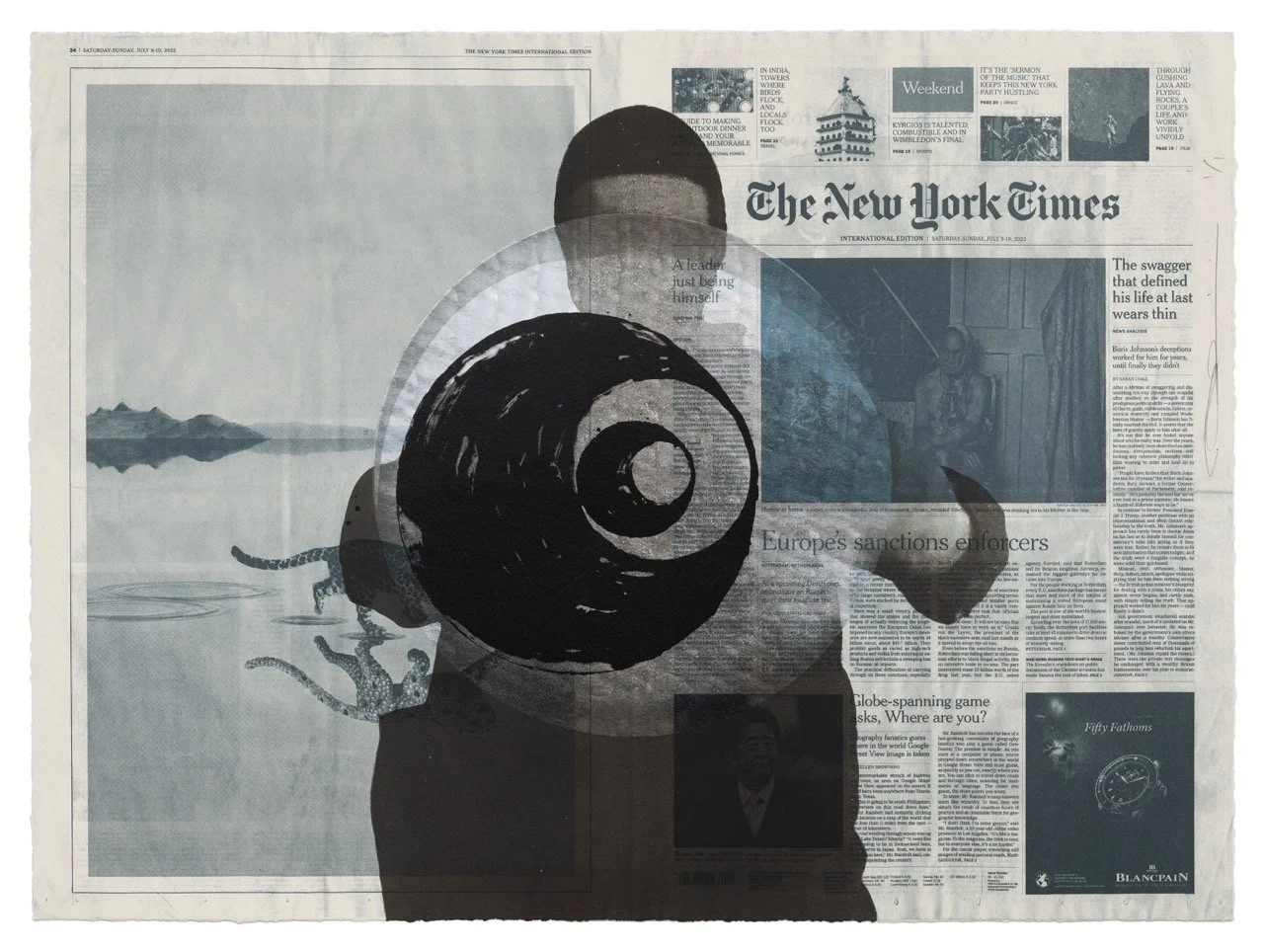
Rirkrit Tiravanija, Untitled, 2022, screenprint, silver foiling and lithograph on paper, 51.5 x 69.5 cm. © Rirkrit Tiravanija / STPI. Image courtesy of the artist and STPI, Singapore.

Rirkrit Tiravanija, untitled 2008-2011 (the map of the land of feeling) I-III, 2008-2011, scroll with digital painting, lithography, chine colle, and screenprint. © Rirkrit Tiravanija / STPI. Image courtesy of STPI, Singapore.
It seems like your working process is fairly open-ended and spontaneous. Do you have a studio you go back to and how would you describe a typical day for you?
I do not have a studio or studio hours as I move around a lot. In my work, untitled 2008-2011 (the map of the land of feeling) I-III (2008-2011), the prints were made based on my passport I had made in New York. Its contents reveal 25 years of travelling, disclosing my nomadic experience crossing borders and extending myself to various places. Early in my career, I also used to work as an assistant by driving a truck and transporting art around. There may be moments where I write some of my thoughts down but I rarely touch notebooks. Instead, I prefer to let ideas flow through my mind as the most effective way to get inspired and make things.
What nourishes you as an artist? And what advice would you give to an aspiring young artist?
What nourishes me is the unknown. I say yes to everything, but I do not need to know everything. It is why I like being with people and conversing with them. Even sitting here with you asking me questions, I have to think of how to respond and receive your questions without knowing what your thoughts or contexts are.
One thing that young artists need to ask themselves is: “what is a good life for me?” When I teach, all of my first classes will start with me asking my students what their basic philosophy is. Meaning, what do you think about or want from life? Why did you choose to become an artist? These are crucial questions that my peers and I asked ourselves everyday. Even as we did group exhibitions in big museums, we would constantly ask ourselves: “what are we doing here? Why are we making art?” We must constantly question our reason for being.
At this moment, my answer to the question of a good life is that I let things be. It may seem like giving up but it is more of a form of resistance without trying to hold onto things. I hope that this comes through in my work.
“At this moment, my answer to the question of a good life is that I let things be. It may seem like giving up but it is more of a form of resistance without trying to hold onto things. I hope that this comes through in my work.”
What has become easier for you to do as time has gone by?
What is easier is that we are living in a moment where otherness is gradually becoming more accepted. If we flip the situation around however, what may be difficult is for us as “the other”, to understand those in the ingroup enjoying cultural hegemony. There is still a gap.

Rirkrit Tiravanija. Photo by Toni Cuhadi. Image courtesy of STPI, Singapore.
Before we end this interview, I would like to understand your relationship with STPI better. Your first residency with the gallery was in 2012, which was when Emi pursued you. How has your connection with STPI evolved since?
STPI is the only studio I have. It is the only place that I come back to work in because I like the experience. There are certain impositions that I have to contend with, such as creating certain prints I do not typically do, but it makes me think of how to walk around the problem. What is great about STPI is that they encourage you to do that, while they catch whatever comes out of your process to put it all together. With their focus on print, they also highlight the idea that art is for everyone, which is important. It is an art form that can be produced in great quantities and thus, is accessible to many.
It has been a great relationship so far, and every part of STPI is like family to me. When I come here, I feel like I am coming home.
This interview is presented in partnership with STPI.
Rirkrit Tiravanija: SAY YES TO EVERYTHING is on view at STPI until 9 May 2026. More information here.