
Midpoint: Dawn Ng
Geological time and paintings as time capsules
Midpoint is a monthly series that invites established Southeast Asian contemporary artists to take stock of their career thus far, reflect upon generational shifts and consider the advantages and challenges of working in the present day. It is part of A&M Interviews and builds upon the popular Fresh Face series.
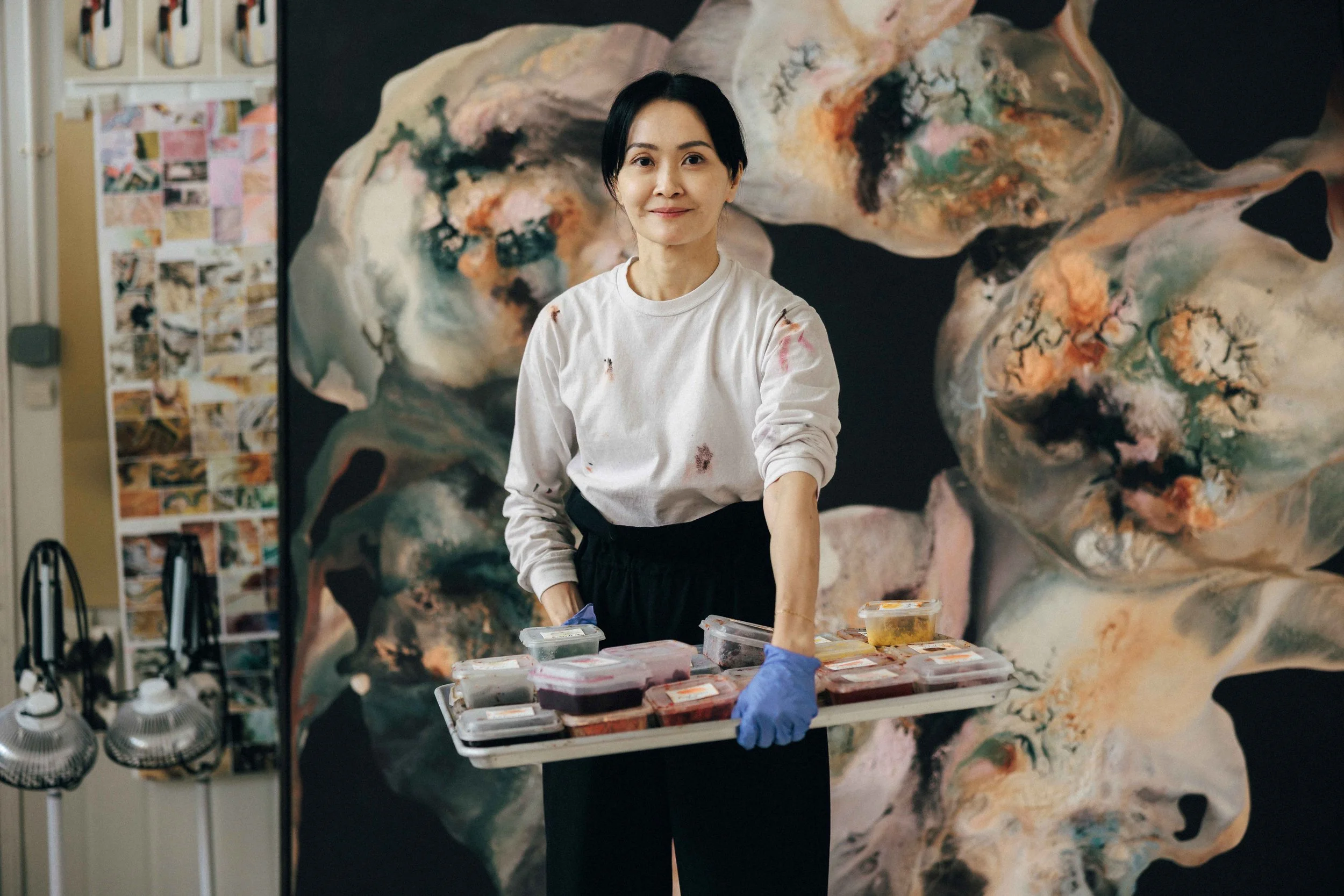
Dawn Ng. Photo by Toni Cuhadi.
Dawn Ng’s practice is an intimate exploration of time, memory, and the ephemeral. Characterised by lyricism and nuanced use of colour, her work spans a breadth of mediums and scales, including sculpture, photography, film, painting, and site-responsive installations. In this conversation, I invite Dawn to share her artistic journey, processes, and the ideas in her upcoming solo exhibition The Earth Laughs in Flowers.
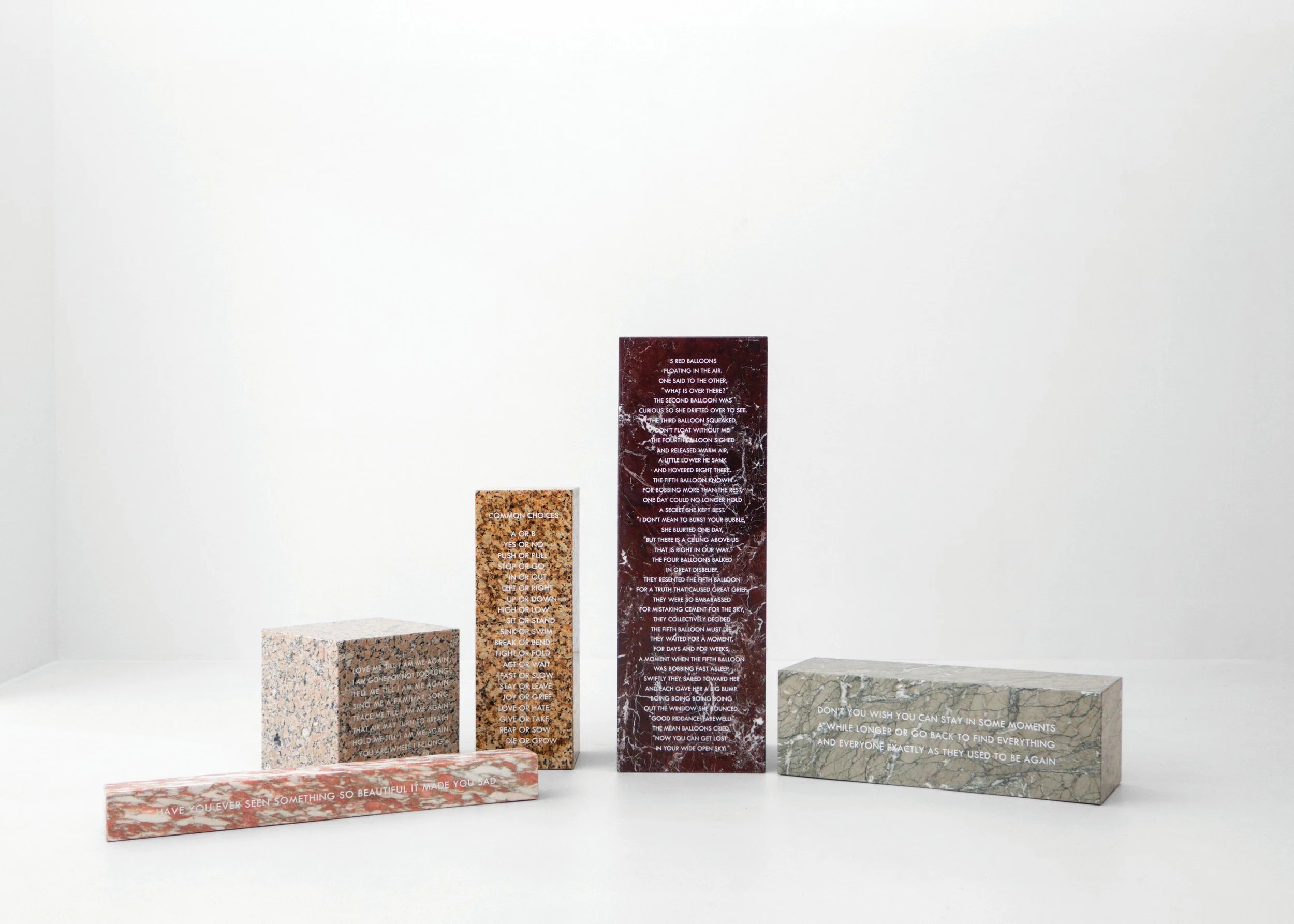
Dawn Ng, MONUMENT MOMENTO, 2019, stone engraved. Image courtesy of the artist.
Looking back, could you share a decision or event that marked a significant moment in your path as an artist?
I do not have that big moment per se. I think my path has been paved with many little steps in a certain direction.

Dawn Ng, MERRY GO ROUND, 2020, aluminium, steel, glass, polyurethane paint, 1850 x 1850 x 280cm. Photo by Jovian Lim.
What has been a milestone achievement for you, and why has it been particularly memorable?
It is less about that one museum commission or installation. For me, it has been a gradual solidification of an attitude, or a refusal to be held back by anything. It could be the lack of a grant, institutional support, or art world acknowledgement. That internal autopilot to scrape together and produce work I feel deeply for has unlocked some key projects for me over the years.
One example is the installation MERRY GO ROUND (2020), which is a massive orbit of folding mirrors and gradient hues. The work echoes the soft peeling palette of a derelict ship-repair factory, where time has collapsed on itself. The site-responsive sculpture spanned 20 metres in diameter and alluded to the celestial ring of light, encircling a black hole, as a response to how time in this space is condensed to a scintillating moment. Bigger and more technical than anything I have worked on prior, it was architecturally challenging and I had no funding for it. But I pushed on and poured two years of studio savings into realising the project.
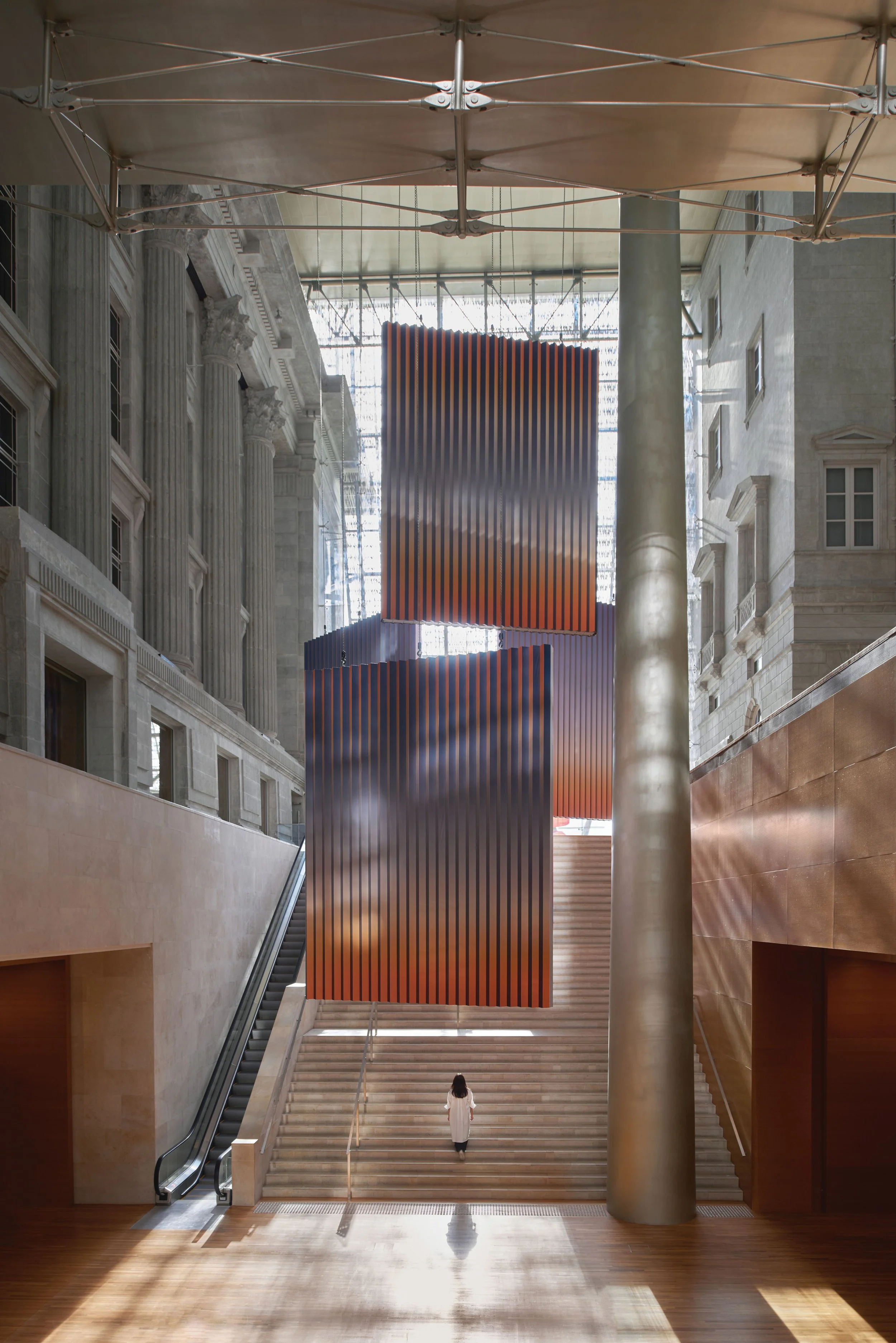
Dawn Ng, There is a Window in My Eye, 2023, steel, plywood, photographic vinyl, H5600 x L4306mm each (4 panels). Photo by Jovian Lim.
Could you walk us through a typical work day, or a typical week? Are there routine(s) you follow to nourish yourself/your artistic practice?
I consume a lot of everything from everywhere: books, music, films, architecture, design, food, fashion, and images. I am a bit of a sponge in that way. I relish poring over a piece of writing just as much as studying the particular tension between colours in a space. I love observing people. I am a sucker for the subject of time. I do not think my life or routines are particularly special. I have two kids, so there is that constant noise and switching of gears, but I do reserve a special curiosity and awareness of my environment.

Dawn’s studio, 2025. Photo by Toni Cuhadi.
Could you describe your studio? How has it evolved over the years? What do you enjoy about it, and what do you wish to improve/change?
I have moved studios three times in my life, and what they have in common is the amount and quality of natural light that fills the space. With every move, the studio has grown in size. The current one accommodates a minus-18-degrees-Celsius “serial-killer style” industrial freezer room that houses all my frozen pigments.
What has become easier or more difficult to do as time has gone by?
Easier: To accept that I do not always know what I am doing or how to do something, but if I keep at it, things will come together.
More difficult: To “rest”.

Dawn Ng, Into Air, 2022, exhibition installation view at St Cyprian's Church, London. Photo by James Retief.
You have presented the body of work Into Air (2018-) in solo exhibitions around the world. Among them, two were set in unique venues steeped in history. Here, I am referring to 2 Cavan Road in Singapore, which is a former ship repair workshop, as well as St Cyprian's Church in London. How do you engage with these spaces through the exhibition scenography/ narrative?
I take the presentation of a body of work seriously and consider it as part of the artwork. A space can be used to anchor and echo the ideas and themes of a series of works through its past, architecture, design, and atmosphere. In the case of these projects, the venues possessed a poignant sense of temporality and timelessness, which are core investigations of my works. For St Cyprian’s, the solemn, sculptural frames I designed in collaboration with London-based architect Benni Allen were inspired by mid-century church pews, stands and confession booths. They share a structural language with cabinetry found in history museums, which house precious artifacts of time, similar to my photo portraits of frozen pigment and topographical paintings made from the residue of melted paint.
What do you think has been or is your purpose?
To care deeply.
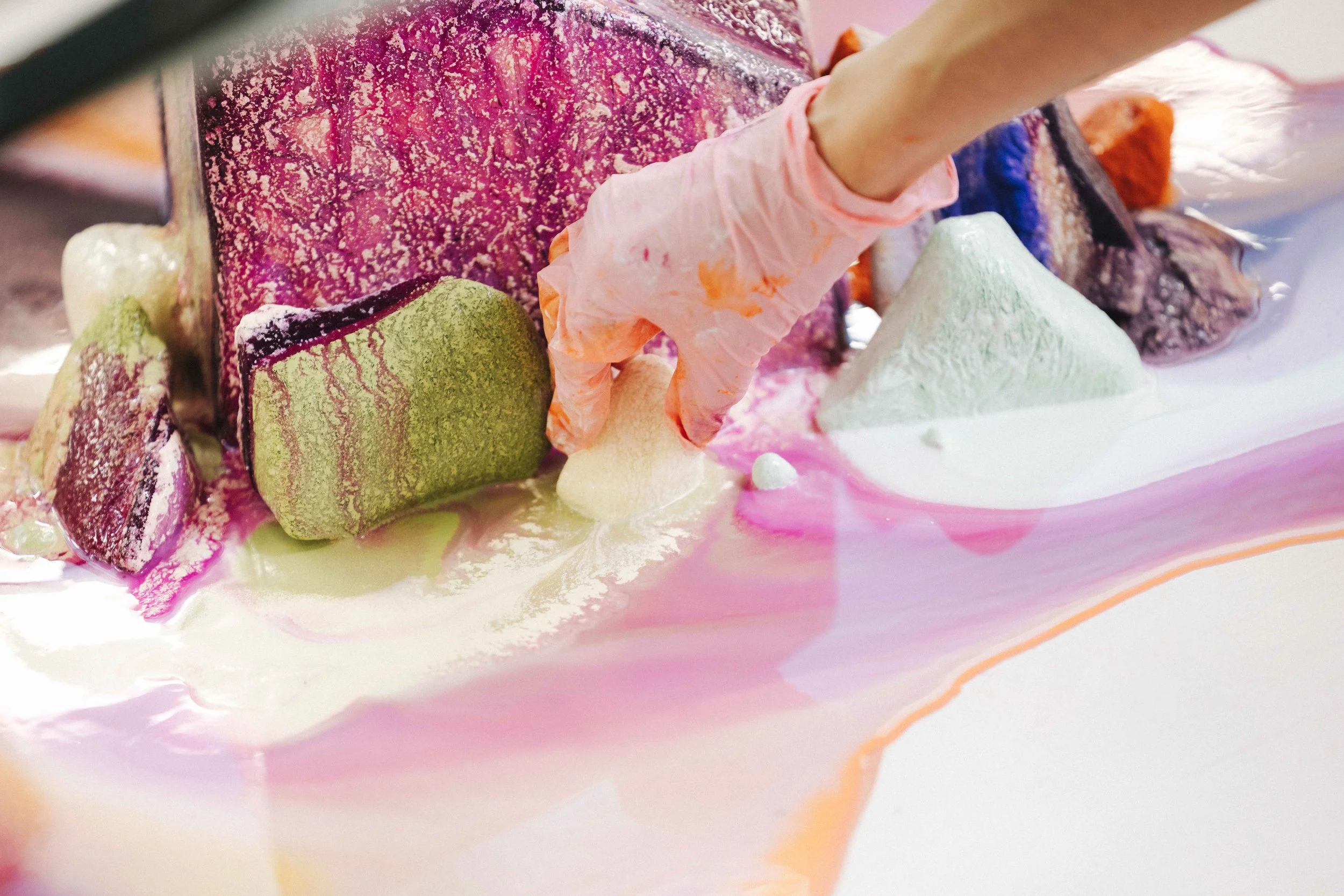
Work in progress shot of Dawn’s new paintings for her upcoming solo exhibition The Earth Laughs in Flowers (2026). Image courtesy of the artist.
You have an upcoming solo exhibition which opens in January 2026 in Singapore. Titled The Earth Laughs in Flowers, it features 12 new large-scale paintings made with frozen pigments which are allowed to melt on wooden canvases. Could you talk about how this exhibition is a development from the Into Air series, as well as the decision to focus exclusively on paintings?
Over the past two years, my research on time and temporality has led me to study geological time. Specifically, the impact of basic elemental forces such as time, heat, wind, and gravity, on forming some of the most astounding landscapes, such as mountains, canyons, and deltas. With these large paintings on wood, I sought to approach each canvas as a micro-planet, where I mirror primary forces that sculpt landforms over millennia. The process involves applying fans, stands, heat lamps, and ramps to arranged conglomerates of frozen pigment. I wanted to make paintings that were a physical result of time, process, and residue.

Dawn Ng, January, 2025, acrylic paint, dye, ink, sand on wood, 204.5 x 204.5 x 5cm. Photo by Toni Cuhadi. Image courtesy of the artist and Sullivan+Strumpf.
And what can audiences expect with the exhibition venue/ design for The Earth Laughs in Flowers?
The show will be held inside the black box stage of the Singapore Repertory Theatre. When I started on the first painting, January (2025), I could see the entire series only in darkness. This is because I had thought about time in the context of planetary movements. A year, if one is to break it down, is the path of the Earth going one full orbit around the sun. Breaking that down further, time is not just about movement, it is about the positioning of heat. This exchange of energy and tension occurs in these paintings as well.
And finally, what would be a key piece of advice to young art practitioners? What has been a way of working, a certain kind of attitude etc. they can learn from to apply to their own careers?
To have persistence, curiosity, and kindness.
This interview is presented in partnership with Sullivan+Strumpf.
Dawn Ng: The Earth Laughs in Flowers will be on view at Singapore Repertory Theatre from 21 to 31 January 2026. For more information, click here.