Inhabiting Inherited Images
Vân-Nhi Nguyễn’s ‘One Hundred Years of Happiness’
This is a winning entry from the Fresh Take 2026 writing contest. For the full list of winners and prizes, click here.
The first photograph that caught my attention in Vân-Nhi Nguyễn’s One Hundred Years of Happiness (2023), presented at PMQ in Hong Kong as part of the 2023 Hong Kong International Photo Festival (HKIPF), was an image of a bonsai seen from above. From this unfamiliar angle, the ornamental plant becomes almost grotesque: its branches open outward like a carnivorous flower or the mouth of an abyss. It remains recognisable, yet recognition no longer feels entirely secure.
The image recalled curator Apinan Poshyananda’s writing on anthropophagy and cannibalism in contemporary Asian art. In his discussion of the 1998 São Paulo Biennial, Poshyananda considers how Asia has been imagined through exoticism and seduction, and how colonial domination can itself be understood as a process of devouring. Rather than simply reversing this Orientalist logic, Nguyễn’s exhibition raises a more difficult question: how might Vietnamese identity be articulated without allowing Orientalism to continue setting the terms of representation? To answer an exoticised image of Vietnam with a supposedly “genuine” one would still preserve the same binary, defining authenticity in opposition to the very gaze it seeks to resist. One Hundred Years of Happiness instead constructs a visual language precise in its attention to particular images, objects and environments, yet indeterminate in time, space and cultural identity.

Installation view of Vân-Nhi Nguyễn’s One Hundred Years of Happiness, Hong Kong International Photo Festival 2023, PMQ H506–H507, Hong Kong, 2023. Image courtesy of the artist.
The tension between recognition and categorisation therefore becomes less a theme than a method running through the exhibition. Familiar images remain legible while their meanings are repeatedly made unstable. This process begins with the family photograph, where Nguyễn locates Vietnamese history in intimate and fragmentary images rather than in a single representative narrative.
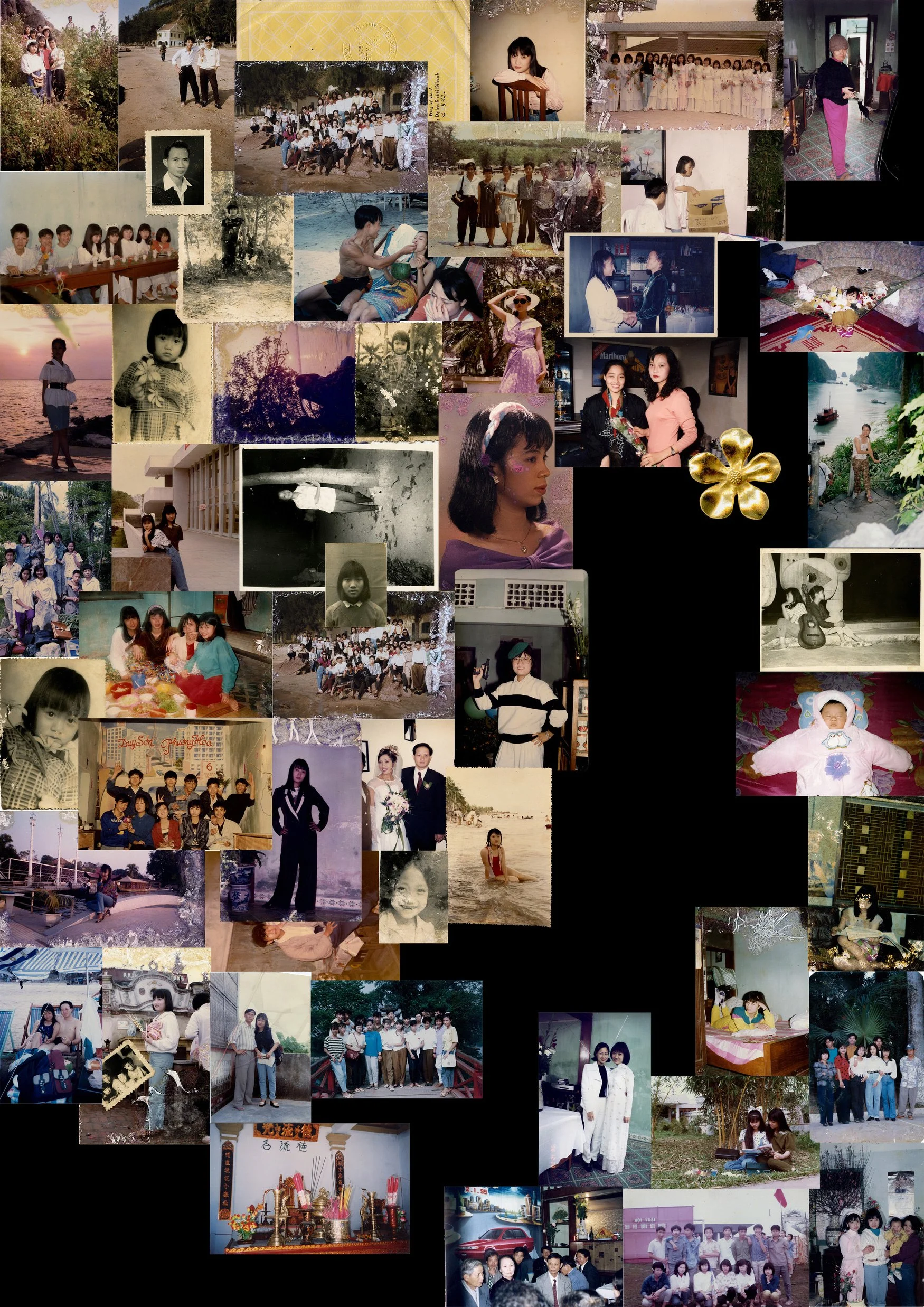
Vân-Nhi Nguyễn, Genesis, 2023. © Vân-Nhi Nguyễn. Image courtesy of the artist.
Family photographs ground the exhibition in Vietnamese history precisely by refusing to represent that history in its entirety. Nguyễn’s exhibition text notes how Vietnam can be reduced, especially from outside, to a place where a war was fought or athletic shoes are manufactured. Against such compressed narratives, the exhibition turns to a quieter and more fragmentary photographic archive. Rather than setting out to document national history, these images locate historical change within ordinary environments and material details. In one staged portrait, for instance, a young woman sits on a bed surrounded by floral bedding, painted masonry, a tropical wall mural, hanging clothes and dark wooden furniture. None of these elements claims to represent Vietnam on its own; together, however, they register a particular domestic world shaped by changing tastes, materials and ways of living. Whether drawn from archival family photographs or staged through the visual language of family photography, Nguyễn’s images locate broader historical transformations within ordinary bodies, domestic interiors and everyday environments. The exhibition therefore constructs a minor archive that is intimate, partial and incapable of claiming comprehensive authority.

Vân-Nhi Nguyễn, Untitled, 2022, from the series As You Grow Older. © Vân-Nhi Nguyễn. Image courtesy of the artist.

Vân-Nhi Nguyễn, Altar, 2022, from the series As You Grow Older. © Vân-Nhi Nguyễn. Image courtesy of the artist.
If family photographs locate broader historical transformations within intimate and fragmentary images, Nguyễn further extends that visual language into the exhibition space itself. Pink patterned wallpaper covered the gallery walls, while a photograph of an altar—shown suspended high in the corner of a yellow-wallpapered interior—is installed high against the pink gallery wall, creating a deliberate visual tension between the photographed interior and the exhibition design. Nguyễn refers to such recurring elements as “visual codes”: familiar domestic motifs that help situate the photographs within a culturally specific environment.
Yet this strategy also produces tension. The more readily such codes communicate cultural specificity, the more easily they can harden into a recognisable visual shorthand for “Vietnam.” What contextualises the exhibition may also risk essentialising it, turning domestic familiarity into an exotic or ethnographic vocabulary.
Lee Weng Choy identifies a related contradiction in his discussion of Simryn Gill’s A Small Town at the Turn of the Century. Gill photographed people around Port Dickson, Malaysia, while obscuring their faces with masks made from tropical fruits. Lee notes that the masks erase individual identity while their exaggerated tropicality simultaneously “overethnicises” the sitters. The signs that appear to locate the subjects culturally instead interfere with any claim to reveal an authentic subject behind the image.
Nguyễn’s domestic objects are quieter and more closely connected to familial memory, but they encounter a similar difficulty: how can culturally specific images remain meaningful without becoming ethnographic evidence?
Nguyễn does not respond by removing recognisable signs. Instead, she uses them again.

Vân-Nhi Nguyễn, Untitled (Girl with Pearls), 2022, from the series As You Grow Older. © Vân-Nhi Nguyễn. Image courtesy of the artist.
By incorporating altars, wallpaper, furniture and family photographs into constructed environments, Nguyễn repositions these potentially ethnographic markers as props whose meanings become contingent on staging and inhabitation. Lee Weng Choy’s notion of “inhabiting” is useful here: for Lee, inhabiting does not depend on an essential connection between a person and a cultural form, but on commitments and meaningful encounters. This becomes especially visible in a portrait of a young woman wearing a white lace top and pink-and-plaid ballet tights. She occupies an interior dominated by old-fashioned yellow wallpaper; above her hangs an altar, while an older cabinet and table lamp sit nearby. The portrait itself was displayed at a relatively small scale against the exhibition’s pink patterned wallpaper. As a contemporary staged photograph set within a deliberately Vietnamese-coded domestic environment, its placement against another decorated surface creates a second layer of framing: the image is no longer encountered in isolation, but in tension with the exhibition space that surrounds it.

Vân-Nhi Nguyễn, Ba Cô (Three Aunties), 2022, from the series As You Grow Older. © Vân-Nhi Nguyễn. Image courtesy of the artist.
This layered structure complicates any simple reading of the work as an encounter between “tradition” and “modernity”. The opposition itself becomes unstable: the supposedly traditional interior is already a reconstruction, while the contemporary figure does not simply stand outside it as the embodiment of a newer Vietnam. Nguyễn’s exhibition thus extends Lee’s notion of inhabiting into a spatial and recursive process. The woman is photographed in a reconstructed domestic environment; the photograph enters a gallery structured by similar visual codes; and the viewer, in turn, enters that exhibition environment. Inherited forms are therefore neither preserved as fixed evidence of tradition nor overcome in the name of modernity. They remain active materials whose meanings can be repeatedly entered, reframed and renegotiated in the present.
This layered inhabiting does not eliminate stereotypes; rather, it unsettles the conditions that make stereotypes appear self-evident. Once subjects, photographs and viewers are drawn into the same staged field, familiar signs no longer secure a single cultural meaning. Nguyễn’s response to Orientalist representation is therefore not to replace an exoticised Vietnam with a more “authentic” one, but to keep inherited images available for reinterpretation. At a moment when cultural identity is increasingly circulated through instantly recognisable visual codes, that openness matters. Identification may begin not with asking which images authentically represent us, but with deciding what we are still willing to do with the images we inherit.
This is a winning entry from the Fresh Take 2026 writing contest. For the full list of winners and prizes, click here.
Sources
Lee Weng Choy, “Authenticity, Reflexivity, and Spectacle; or, The Rise of New Asia Is Not the End of the World,” positions: East Asia Cultures Critique 12, no. 3 (Winter 2004): 658–59.