What Travels with an Image?
How Yancheng Art Festival Reimagines Everyday Life Through Ethical Experimentation
This is a winning entry from the Fresh Take 2026 writing contest. For the full list of winners and prizes, click here.

Timoteus Anggawan Kusno, Dismantling Nostalgia, 2024, mixed media. Acquired through Southeast Asia Collectors Circle (SEACC) 2024 Fund. Installation view: MAM Collection 022: Timoteus Anggawan Kusno, Mori Art Museum, Tokyo, 2026. Photo by Inaguchi Shunta. Image courtesy of Mori Art Museum, Tokyo.
At the Mori Art Museum in Tokyo, a young woman stood before Timoteus Anggawan Kusno’s Dismantling Nostalgia (2024) and struck a pose echoing the heroic equestrian figure at its centre. A companion raised a smartphone. She smiled, held the pose and turned the monumental image into a souvenir photograph. There was nothing malicious in the gesture. That was precisely what made it so striking.
Kusno’s work is concerned with the afterlives of colonial images: how they shape memory, desire, and ways of seeing long after colonial rule has ended. Yet here, an image constructed to unsettle heroic representation functioned once again as a heroic image—something charismatic enough to imitate.
What happens when an artwork crosses a border? Which meanings travel easily, and which require translation?
Born in Yogyakarta, Kusno works across painting, photography, film and installation, often drawing on archives. His work repeatedly returns to colonialism and historical memory, but rarely in the mode of accusation. Instead, he exposes the unstable ways in which the past survives in images, habits of looking and forms of nostalgia.
Dismantling Nostalgia, the visual anchor of MAM Collection 022, commands attention before one even enters the exhibition space. From a distance, a monumental horse and rider emerge against a patchwork of pastoral scenery. The silhouette first recalled Jacques-Louis David’s Napoleon Crossing the Alps (1801). But the longer I looked, the less stable the resemblance became: I began to see echoes of other equestrian heroes, from Joan of Arc to Prince Diponegoro. Rather than resolving into a single historical figure, the image activated a familiar visual grammar of heroism.

Timoteus Anggawan Kusno, Dismantling Nostalgia (detail), 2024, mixed media. Acquired through Southeast Asia Collectors Circle (SEACC) 2024 Fund. Installation view: MAM Collection 022: Timoteus Anggawan Kusno, Mori Art Museum, Tokyo, 2026. Photo by Inaguchi Shunta. Image courtesy of Mori Art Museum, Tokyo.
The background is composed of fragments of landscapes associated with Mooi Indië, or the “Beautiful Indies,” a pictorial tradition that idealised the Dutch East Indies as serene, fertile and picturesque. At first, I found the fragments genuinely beautiful, their pastoral calm carrying a nostalgic pull. Then I moved closer.
The heroic figure had been stitched onto the pastoral surface with conspicuous seams. The seams looked almost like wounds. Once I noticed their violence, the orderly patchwork beneath them also began to look less innocent. The landscape itself had been cut apart and reassembled. The work did not cancel my initial pleasure. It made that pleasure suspect.
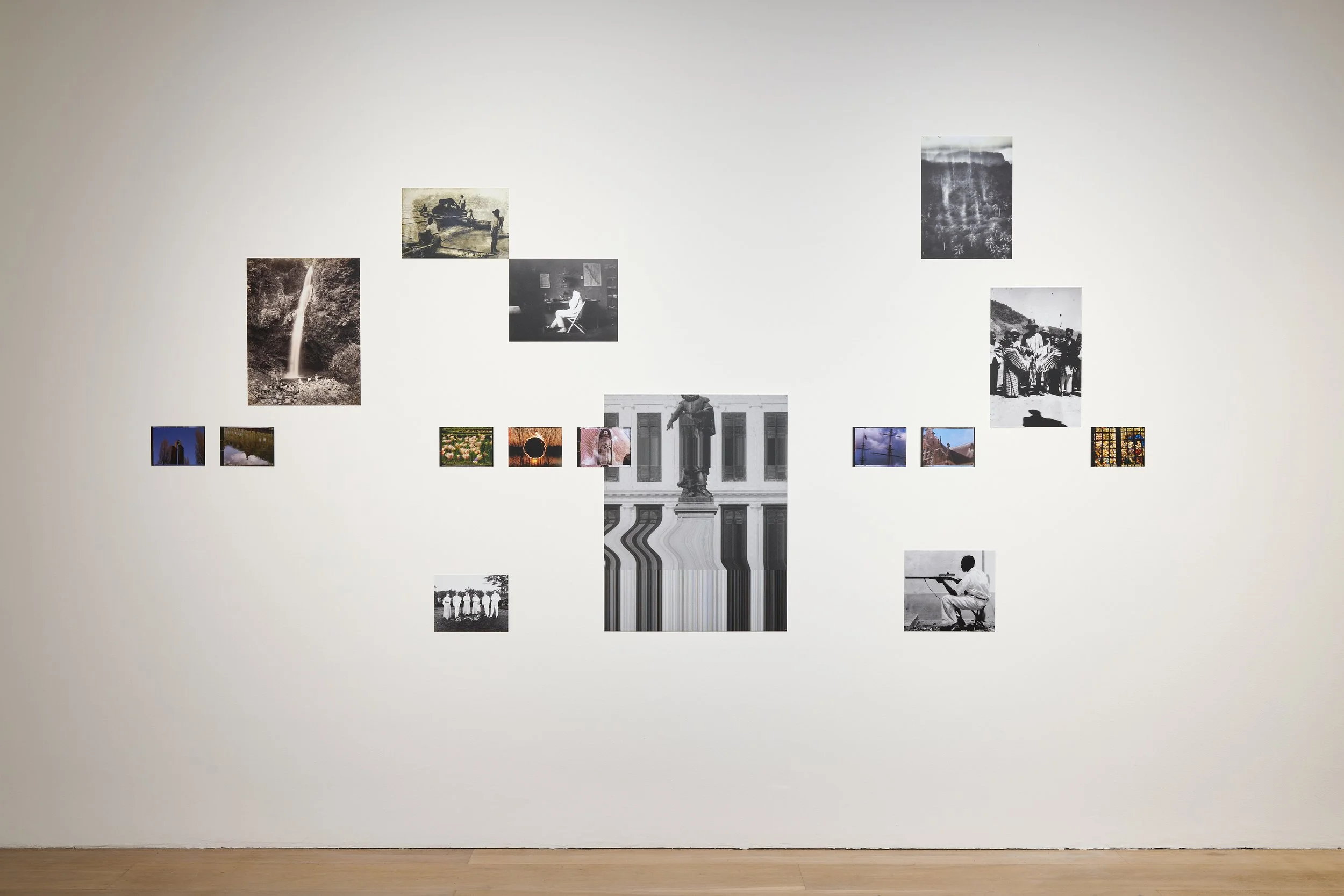
Timoteus Anggawan Kusno, Void of Time, 2024, dimensions variable. Installation view: MAM Collection 022: Timoteus Anggawan Kusno, Mori Art Museum, Tokyo, 2026. Photo by Inaguchi Shunta. Image courtesy of Mori Art Museum, Tokyo.
The two other works in the exhibition approached colonial afterlives from different directions. Void of Time (2024) brings together black-and-white photographs and small, grainy colour images. They depict landscapes, interiors, hunting scenes and architecture. None presents an immediately legible scene of colonial violence. Instead, their fragmentary arrangement makes the colonial past difficult to reconstruct from the images alone. The gaps between them point to the limits of an incomplete archive.
In the film Sola Fata (2025), a man in a white safari suit moves through an unfamiliar landscape as a colonial explorer. He later arranges masked men before his camera, directing them into contrived “native” poses and giving them vaguely ethnographic-looking props. When the contemporary film crew enters the frame, the film turns the colonial gaze back on the act of filmmaking itself, suggesting how such ways of looking can be repeated beyond the original colonial encounter.
Together, the three works do not treat colonialism simply as a historical wrong confined to the past. They examine the channels through which it remains active in the present: aesthetic pleasure, archives, memory, performance, and the gaze.
Dismantling Nostalgia combines locally specific references with a monumental form whose visual force registers immediately within the international art circuit. It was acquired by the Mori Art Museum with support from the Southeast Asia Collectors Circle (SEACC), an initiative established in 2023 to support the museum’s curatorial research and acquisitions in Southeast Asia.
Yet artworks travel more easily than contexts do. During my time in the gallery, the young woman was not the only visitor to respond to the work’s immediate visual pull. I repeatedly heard comments along the lines of “it is Napoleon” and “that is cool.” Others photographed the work and moved on. This should not simply be dismissed as misreading. I, too, had been drawn first to the beauty of the pastoral fragments and the force of the equestrian image.
The more difficult question is what happens after that attraction. A work can critically dismantle an image without neutralising the pleasures that made the image powerful in the first place. The pleasures of exoticism, grandeur and adventure can cross cultural boundaries faster than the histories that the work asks us to confront. At the Mori Art Museum, Dismantling Nostalgia’s visual appeal sometimes arrived before its critique.
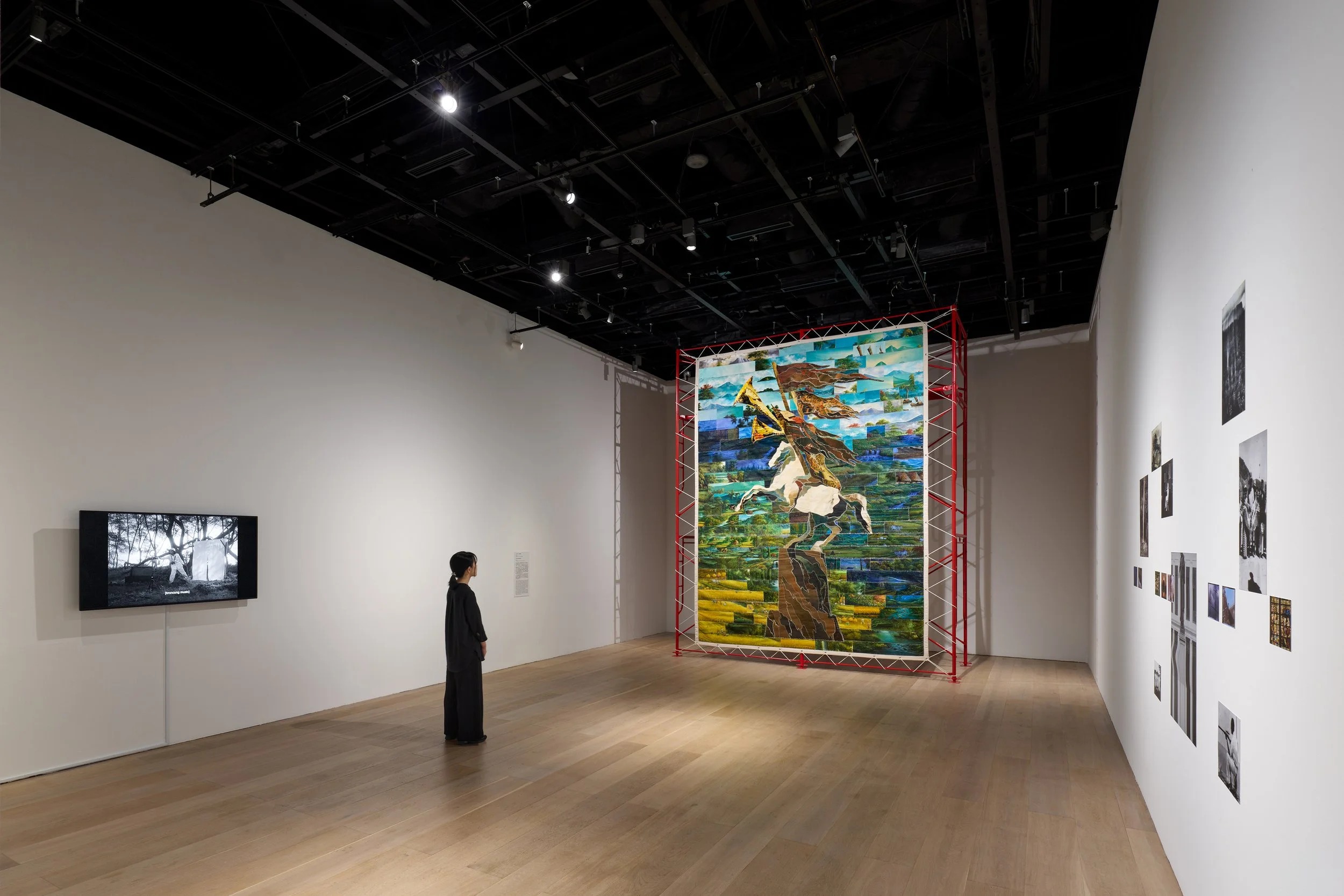
Installation view: MAM Collection 022: Timoteus Anggawan Kusno, Mori Art Museum, Tokyo, 2026. Photo by Inaguchi Shunta. Image courtesy of Mori Art Museum, Tokyo.
Here, the museum’s role as a translator comes into view. The artworks’ conceptual framing was substantially communicated, but historical context was less fully addressed. Its wall texts emphasised the power structures of official history, selective memory, the fragility of “historical truth,” and the limits of colonial representation. None of this framing is misplaced but the more basic historical grounding was surprisingly sparse. The introductory text offered no basic historical orientation to Dutch colonial rule in the Indonesian archipelago. Mooi Indië was named as a romanticised colonial vision, but the text did not clearly explain who produced such images or how colonial power shaped the way the Indies were represented.
For viewers familiar with colonial history or contemporary art discourse, these gaps may pose little difficulty. For others, the texts risked beginning several steps too far into the argument. During my visit, I watched one visitor glance at a caption, exclaim at its difficulty, and walk away. Another wondered aloud whether the caption itself was the work.
The viewing conditions offered little help either: the 22-minute-long Sola Fata had no seating, despite being shown at the end of a long exhibition route in which seating had been provided for other moving-image works.

Timoteus Anggawan Kusno, Sola Fata, 2025, 22 min. 06 sec. Installation view: MAM Collection 022: Timoteus Anggawan Kusno, Mori Art Museum, Tokyo, 2026. Photo by Inaguchi Shunta. Image courtesy of Mori Art Museum, Tokyo.
The complexity itself was not the problem. Kusno’s works are complex, and they should remain so. What mattered was where the museum chose to begin.
A revealing contrast is Fever Dream, Kusno’s 2024 solo exhibition at kohesi Initiatives, Yogyakarta, curated by Alia Swastika. In Swastika’s curatorial and catalogue texts, concrete examples of images, places and the contemporary circulation of Mooi Indië-style landscapes provided points of entry into broader questions of colonial memory and power. The theory was not simplified, it was given an entrance.
I keep returning to the woman posing before Dismantling Nostalgia. It would be easy to dismiss her gesture as a failure to understand the work. But that would miss the more interesting question: why did the heroic pose travel so effortlessly into her body?
Much of Kusno’s practice turns on questions of who records history, who reads it, and who gets to give it meaning. When these works are presented in Tokyo, those questions extend to the museum itself.
Moving an artwork is not the same as moving the conditions that make it legible.
This is a winning entry from the Fresh Take 2026 writing contest. For the full list of winners and prizes, click here.