Conversing with the said and unsaid
Notes on Geloy Concepcion’s ‘Things You Wanted to Say But Never Did’
This is a winning entry from the Fresh Take 2026 writing contest. For the full list of winners and prizes, click here.
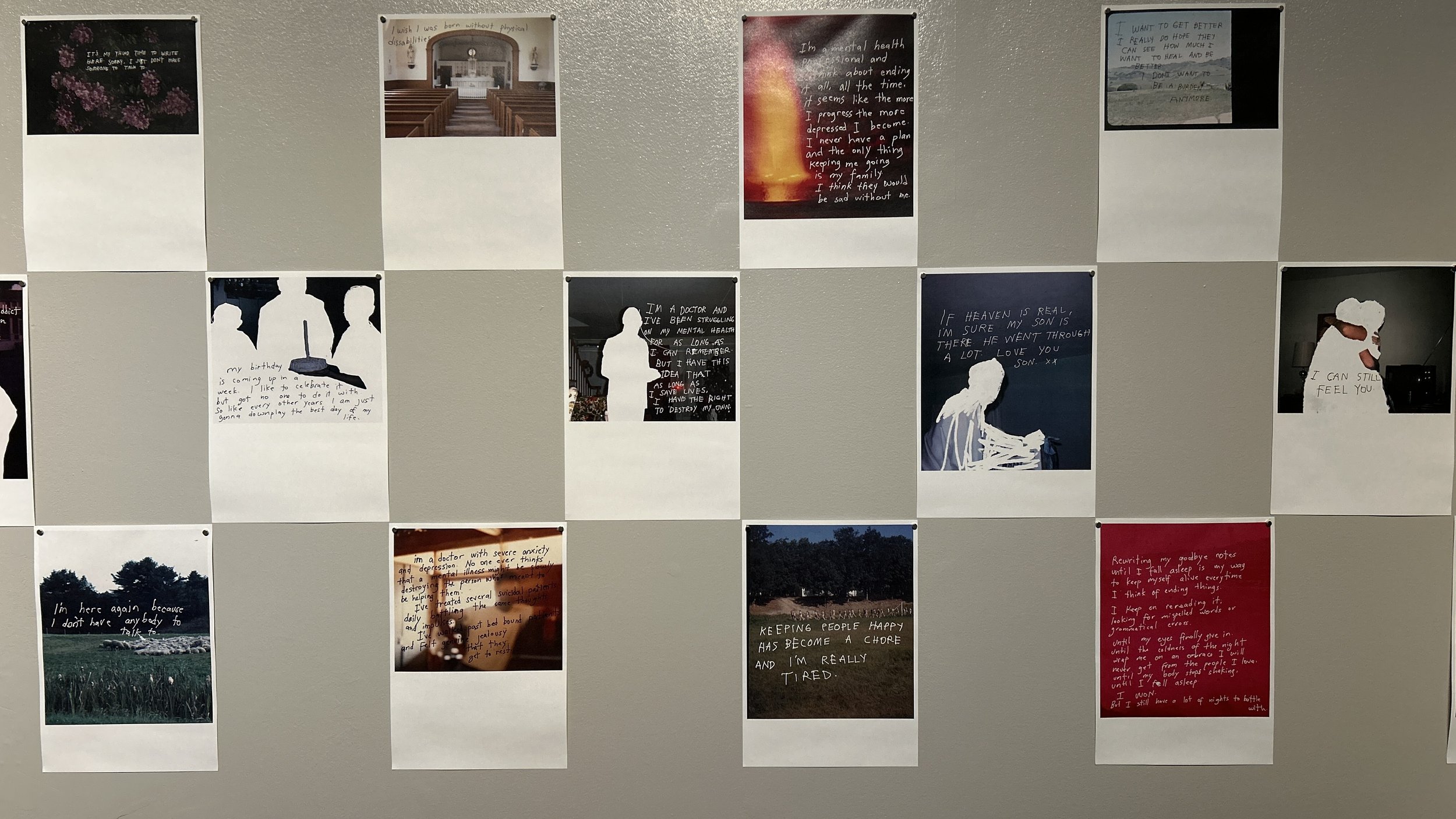
Geloy Concepcion’s printed photographic notes responding to the prompt, “What are the things you wanted to say but never did?” Image courtesy of Gian Daquiz.
In July 2026, I witnessed Geloy Concepcion’s Things You Wanted to Say But Never Did at the Ateneo Art Gallery, Manila. The show marked an endeavour to bring Concepcion’s viral digital project into an exhibitionary context, wherein he asked people all over the world to respond to the prompt: “What are the things you wanted to say but never did?” Over the course of six years, Concepcion received 300,000 anonymous messages through a Google Form, and published more than 3,000 notes online1. The project’s resonance with a wide digital public translated well in physical space, as the Ateneo Art Gallery recorded its all-time highest visitor count at 20,0002. Its immense viewership, mainly from Gen Z youth, prompts reconsidering the affective directions of what we think of as “art” and “exhibition”.

View of the exhibition’s first section. Image courtesy of Gian Daquiz.
As I entered the exhibition’s first section, I was surrounded by a meshwork of printed photographic notes that narrate experiences of abuse, addiction, heartbreak and trauma. It was a sea of pains, juxtaposed unassumingly and bereft of identification. The prints are characteristic of Concepcion’s style, where photographs of life or nature are embedded with anonymous confessions. The figures in his photographs are obscured by shades and runs of white, imbuing a sense of anonymity and pulling focus to the written confession.
In the middle of the first section, a series of notes are enlarged. They are projected onto a hanging white piña cloth, a Philippine textile often used for curtains and tableware. Taken together, the section is intense in its revelation of experiences. Yet, it withholds instructions as to the whos, whats, and whys of resonance. Concepcion’s style abstracts the photographic note’s figures, sources, and titles. The viewer thus encounters notes in abstraction, taking what resonates based on the felt rather than the known.

View of the exhibition’s second section. Image courtesy of Gian Daquiz.
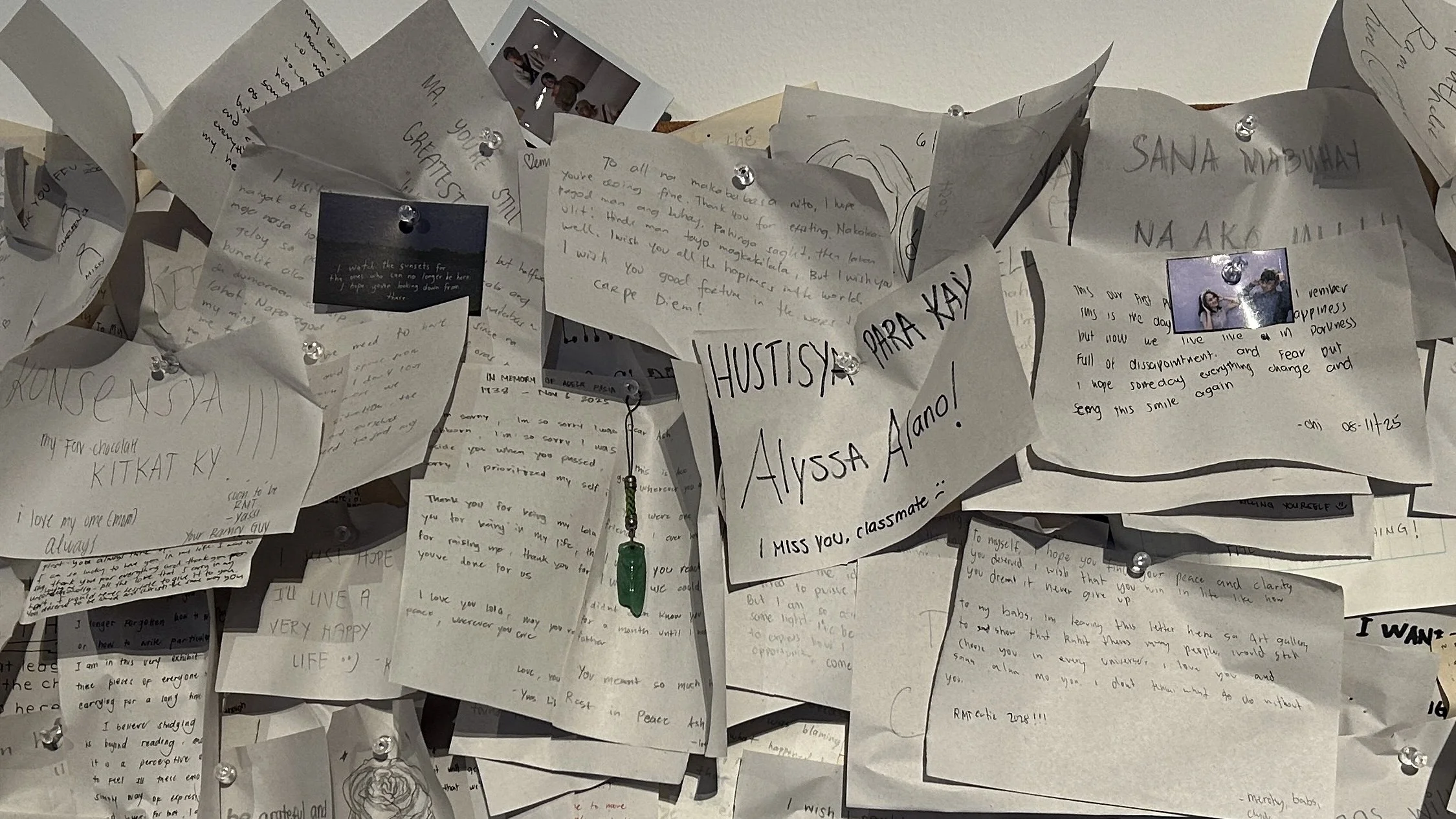
Close-up view of the wall of written notes responding to the prompt “Things You Wanted to Say.” Image courtesy of Gian Daquiz.
While the first section invites its viewers to feel, the second section permits them to translate their emotions in real time. Audiences are invited to write answers to Concepcion’s prompt "Things You Wanted to Say" on a piece of risograph paper. They then pin their written responses on the section’s surrounding walls. A collage of live responses emerges. In contrast to the sombre content of Concepcion’s works, the audience’s live notes range in affect and form. Written notes of hope and personal dedications appear alongside photographs of couples and friends, keychains, and an unopened condom packet. Audiences also intervened or replied to prior responses directly on copies of the exhibition catalogue in the space. The relational atmosphere fostered by Concepcion’s exhibition gave everyone the space to feel regardless of their background.

View of the panel of CONCEAL/REVEAL, part of Four Conversations (on things we’ve always thought of and are just learning to say). Image courtesy of Gian Daquiz.
After exiting the exhibition, one could not help but feel heavy as an affect of grief overwhelmingly burdened the space. In response to this concern, the Ateneo Art Gallery staged Four Conversations, a series of discussions that hope to aid the exhibition’s visitors in processing and decompressing their experience of Concepcion’s project. These conversations were spearheaded by Gang Capati, a Neuroscience and Traumatic Stress Research Fellow at the Boston Trauma Research Foundation. The four conversations undertook recurring themes in the exhibition, namely: luck, trauma, death and secrecy.
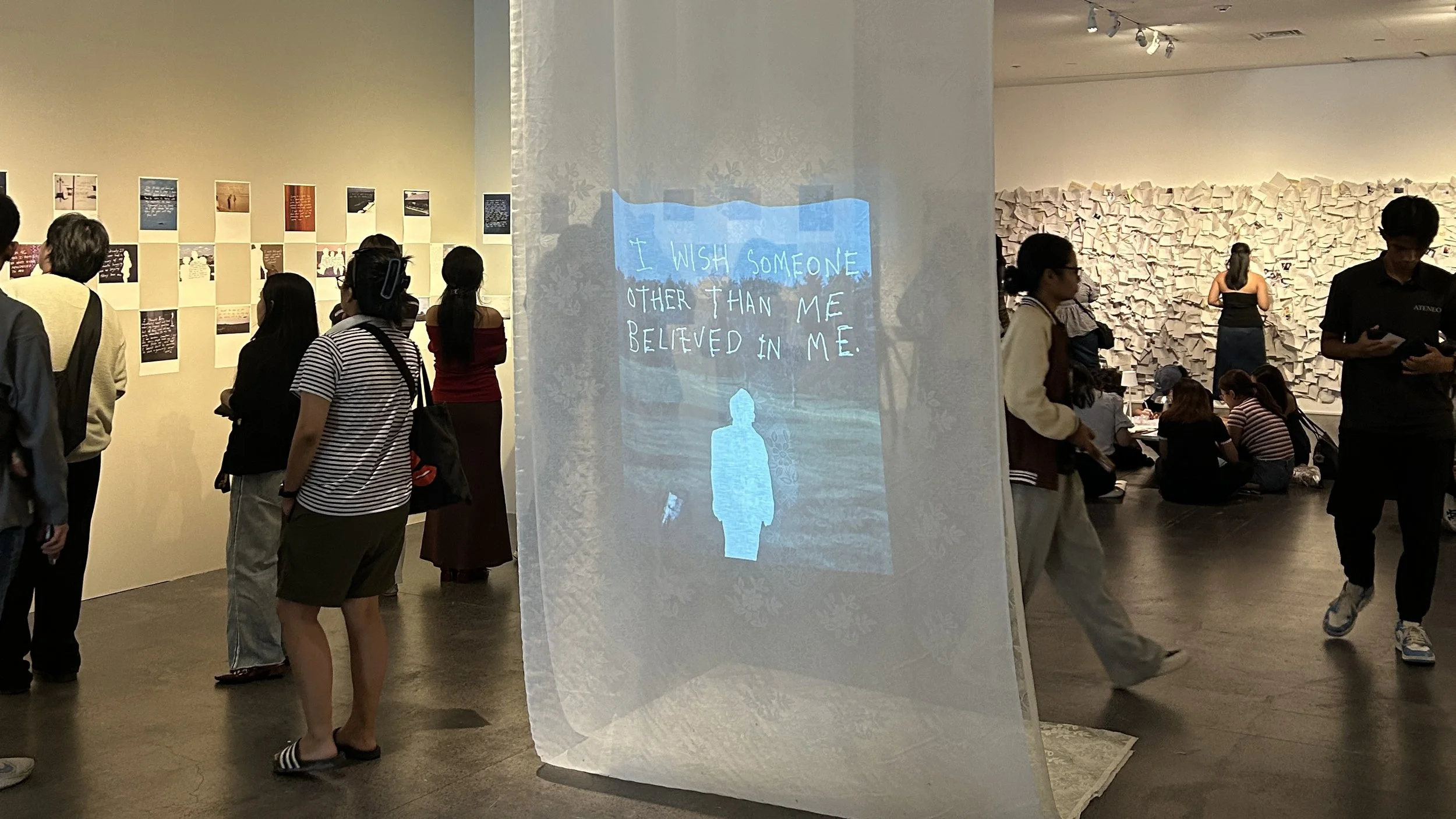
View of the exhibition. Image courtesy of Gian Daquiz.
Geloy Concepcion’s Things You Wanted to Say But Never Did enlivened the relational spirit of the exhibition space. It invites its guests to go beyond viewing art and into engaging with art as viscerally felt and lived. Concepcion’s style is defined by the anonymity of its sources. In part, anonymity risks generalising the nuances, depths, and complexities of grief. Yet, as the exhibition demonstrated, generalities may also authorise a viewer’s impulse to relate intensely.
This impulse is guided by the exhibition flow. The first section introduced the exhibition’s take on relationality through the meshwork of printed anonymous notes and photographs. Thereafter, the second section transformed the visitor into a collaborator. We were invited to write notes, revealing our own experiences. We reply directly, in support or intervention, to responses catalogued by Concepcion. In short, we become what we witness. We grieve and take part in grief. This possibility of collaborative witnessing was first founded by the digital.
Concepcion’s Instagram page, tagged @geloyconcepcion, promised a safe welcome to experiences of grief in all forms. Such a promise was actualised by anonymity, inspiring a digital public of 300,000 submissions, all with the initial desire to be heard. The exhibition transforms their desire into a deeper impulse to connect, to relate. The digital project became a physical space for guests to enter and move through grief with. In this movement from digital interface to exhibition, Concepcion’s works curiously retain the weight of their resonance.
Hence, Things You Wanted to Say But Never Did exists in states of process and open-endedness, neither fully revealing nor entirely concealing. It collapses the perimetres of the digital and probes the possibilities of the exhibitionary. It also speaks to the reality that, perhaps, there will always be things left unsaid, yet felt deeply.
This is a winning entry from the Fresh Take 2026 writing contest. For the full list of winners and prizes, click here.
Notes:
“Things You Wanted to Say But Never Did: Geloy Concepcion’s Six-Year Project Makes Its Exhibition Debut at the Ateneo Art Gallery,” Ateneo de Manila University, 30 March 2026.
Boots Herrera, “CONCEAL/REVEAL,” final session of FOUR CONVERSATIONS (on things we’ve always thought of and are just learning to say), talk, Ateneo Art Gallery, 9 July 2026.
Jelo Ritzhie Mantaring, “Alyssa Alano: Slain UP Student Leader’s Heart Was ‘with the People,’” Rappler, 24 April 2026.
Geloy Concepcion, “CONCEAL/REVEAL,” final session of FOUR CONVERSATIONS (on things we’ve always thought of and are just learning to say), talk, Ateneo Art Gallery, Quezon City, 9 July 2026.