
Editor’s Notes: Exhibitions in Seoul
Art Sonje Center, sangheeut, YPC Space, Yuryeong
This article is part of Art & Market’s coverage beyond Southeast Asia. If you would like to work with us to reach audiences from the region, please email us at info@from-the-margins.org.
In the first week of April, I attended a press trip organised by Art OnO 2026, and extended my stay to explore the Seoul art scene. Here are brief reviews of four exhibitions I saw.
Spectrosynthesis Seoul

Spectrosynthesis Seoul, 2026, installation view of works on second level, at Art Sonje Center. Photo by Seowon Nam. Image courtesy of Art Sonje Center.

Spectrosynthesis Seoul, 2026, installation view of works in the Art Hall at Art Sonje Center. Photo by Seowon Nam. Image courtesy of Art Sonje Center.
Among the four exhibitions highlighted in this review, Spectrosynthesis Seoul at Art Sonjie Center is the largest, with 74 artists and groups. It is co-organised by the Sunpride Foundation with the aim to create a space for diverse LGBTQ+ artistic practices, and builds upon previous iterations in Taipei (2017), Bangkok (2019-2020), and Hong Kong (2022-2023). The overall experience is unapologetically queer, with unexpected activations of transitional spaces in the building. While much credit is given to the curators for representing a significant number of Korean artists in the show, I would have appreciated more breathing room to allow the nuances among artworks and contexts to come through. A personal highlight is a selection of works by Wu Bak and Jeong-ui Yun that revisited their collaborative exhibition Platform 2 (2023-2024), which were made when the painter and sculptor shared a studio. It offered a calm and tender moment that returned to private creation processes and artistic relationships.
Each Every Angle
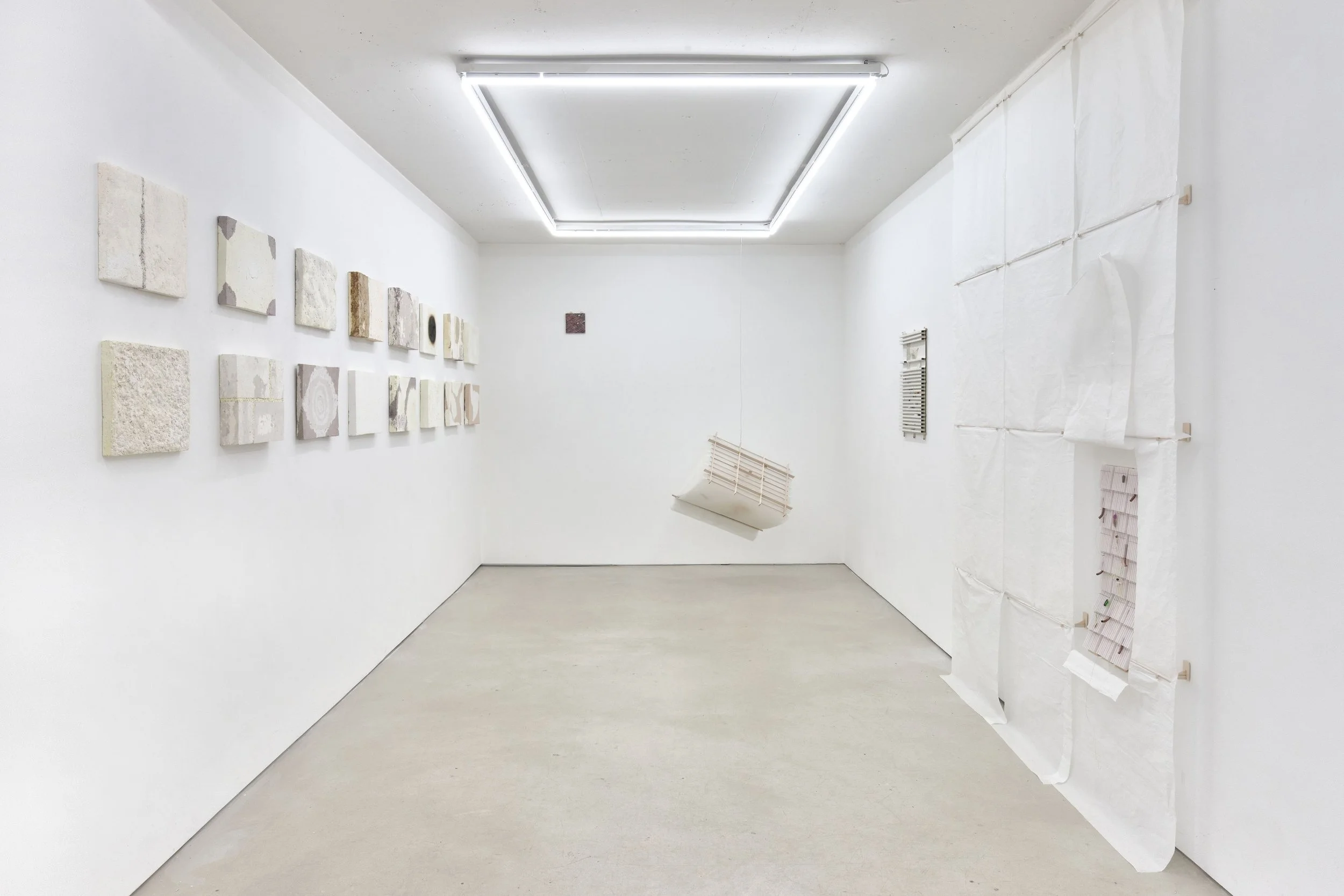
Each Every Angle, 2026, featuring works by Aurora Arazzi and Sean Jun Yeon, exhibition view at sangheeut, Seoul. Image courtesy of sangheeut. Photo by Jinhyeok Oh.

Each Every Angle, 2026, featuring works by Aurora Arazzi and Sean Jun Yeon, exhibition view at sangheeut, Seoul. Image courtesy of sangheeut. Photo by Jinhyeok Oh.
Each Every Angle is a beautifully composed encounter of textures. It brings together Bandung-born Aurora Arazzi and Sean Jun Yeon from Seoul, who share paper as a primary medium. Notably, these new works are created in response to sangheeut’s raw underground space. Both artists manipulate the paper in a way that reveals industrial characteristics, evoking the surfaces of construction sites and a logic of seriality. Beyond the formal synergies, this pairing also suggests interesting resonances between Bandung’s context as Indonesia’s printing capital and the heritage of traditional Korean paper.
The House in Between

The House in Between, 2026, featuring works by Yukyung Lee and Jisu Choi, exhibition view at YPC Space, Seoul. Image courtesy of the artists and YPC Space.
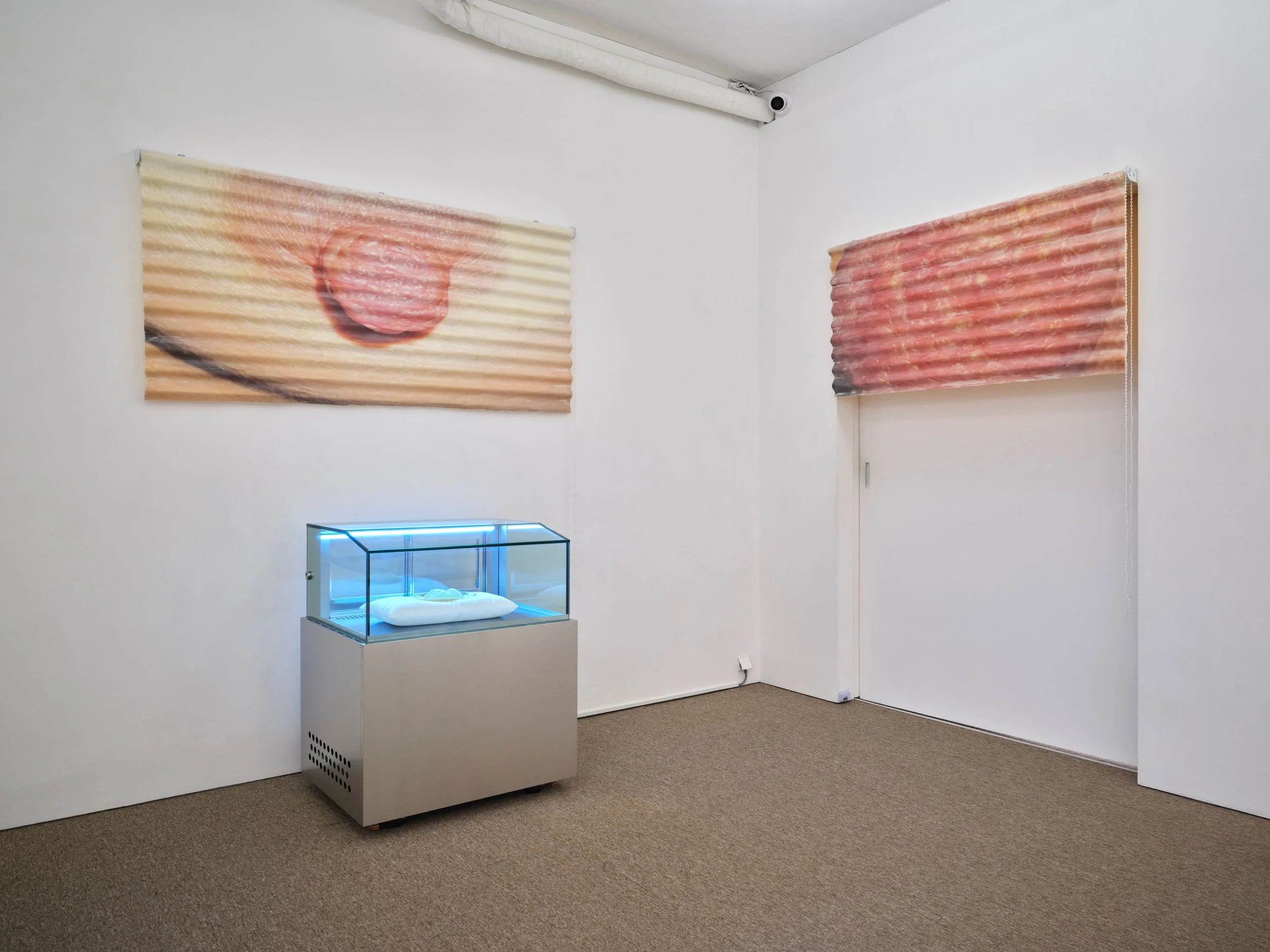
The House in Between, 2026, featuring works by Yukyung Lee and Jisu Choi, exhibition view at YPC Space, Seoul. Image courtesy of the artists and YPC Space.
I met the co-founders of YPC Space at the Share-Meeting 3 conference, and looked forward to visiting the independent space. Though modest in operation, YPC Space has the reputation of consistently punching above its weight with impactful exhibitions, and The House in Between is no exception. Curated by Junghyun Kwon, the show explores the notion of “a house as body”. The dialogue between Yukyung Lee’s sculptures made from edible materials and architectural interventions by Jisu Choi is intuitive without being didactic. The result is a strange and visceral experience that heightened my consciousness as I moved through the space. Like humour, it is the type of exhibition that escapes words and instead clings onto one’s emotional response.
The First Embodiment

The First Embodiment, 2026, exhibition view of works on the first floor at Yuryeong, Seoul. Image courtesy of the artists and Yuryeong.

The First Embodiment, 2026, exhibition view of works on the first floor at Yuryeong, Seoul. Image courtesy of the artists and Yuryeong.
On my last day in Seoul, I checked out Yuryeong, an itinerant gallery project founded by Sowa Yee. Its inaugural exhibition The First Embodiment gathers 16 emerging Korean and Korean American artists born between 1985 and 2004, none of whom have held solo exhibitions in commercial galleries. Among them, Hyobeom Bak’s works on paper from the Kim Swoo-geun’s Geometry series stood out. The artist compares two buildings designed by Korean architect Kim Swoo-geun: the former Namyeong-dong Anti-Communist Interrogation Centre which was a notorious torture chamber during the 1970s and 1980s, and Kim’s former office the SPACE Group Building, which is now Arario Museum. Rendered in intense layers of charcoal, it spoke powerfully to ideologies embedded in the language of modernist architecture and ghosts of history that linger within.