
Who Among Us Can Ever Return Home?
Jakkai Siributr at Canal Projects, New York
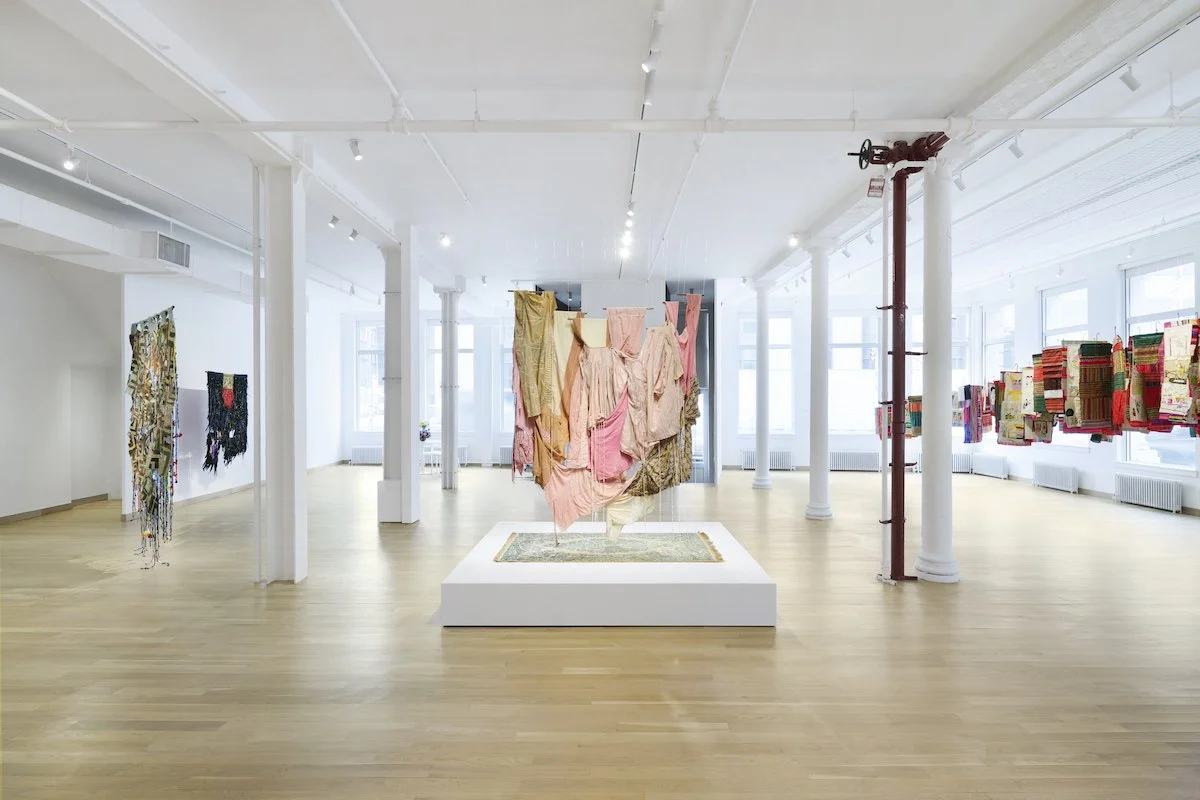
Jakkai Siributr, There’s no Place, 2026, installation view at Canal Projects. Image courtesy of Canal Projects. Photo by Izzy Leung.
On 30 January 2026, I met Jakkai Siributr for a private viewing of his exhibition There’s no Place (2026) at Canal Projects. Along with countless other galleries and cultural institutions across the country, Canal Projects had closed their doors that day in solidarity with nationwide protests against United States Immigration and Customs Enforcement (ICE). It was bitterly cold and there was rage in the air. But inside the gallery, Jakkai’s densely layered textile installations offered a certain warmth, as his work both literally and figuratively forms a patchwork of empathy for overlooked communities and troubled souls.
The exhibition title invokes the story of The Wizard of Oz, in which the protagonist Dorothy repeats the incantation “there’s no place like home” in order to return safely to Kansas. Jakkai’s exhibition turns this fantasy inside out. For the communities that appear throughout the show, refugees from Myanmar, underpaid labourers in Bangkok, and even members of the artist’s own family who have faced their own trials and tribulations, home is not a place to which one can simply return. Instead, it is fractured by war, political stigma, economic displacement, and bureaucratic limbo. If Dorothy’s journey ends with a reassuring restoration of belonging, these narratives suggest a harsher truth: for many people, the journey never resolves.
“Jakkai’s exhibition turns this fantasy inside out.”
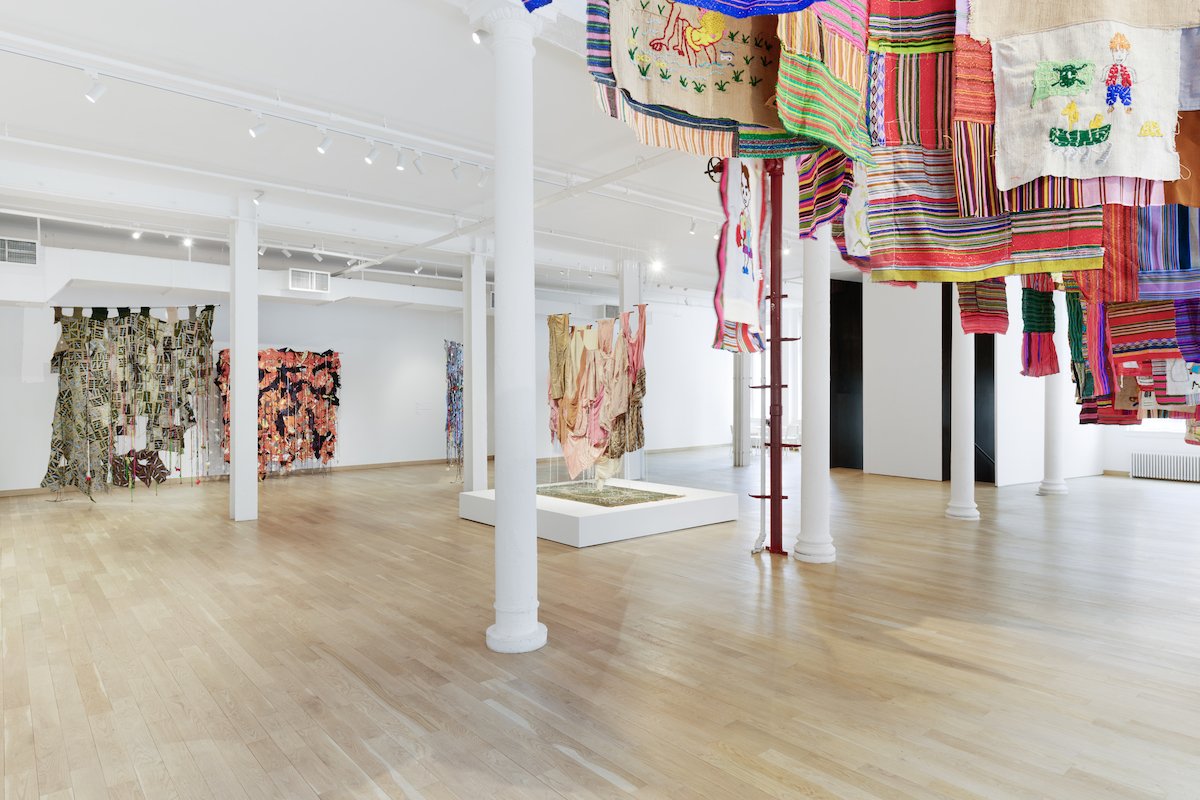
Jakkai Siributr, There’s no Place, 2026, installation view at Canal Projects. Image courtesy of Canal Projects. Photo by Izzy Leung.
This question of belonging runs through a collaborative body of work begun in 2019 near the Thai–Myanmar border. There, Jakkai encountered communities of refugees living in makeshift settlements around construction sites, many stateless and unable to obtain passports or official documentation. Using their own patterned textiles as a starting point, the artist invited women and children to embroider their dreams into quilt-like panels. The resulting images range from visions of peace in Myanmar to childhood aspirations: becoming a footballer, owning a home, or travelling to outer space. The project becomes more complex when Jakkai invites students from elite international schools in Bangkok, Singapore and other cities where he exhibits to embroider additional elements onto the quilts. The works collapse radically different social worlds into a single surface, as privileged students become palpably aware of the plight of stateless children living on society’s margins, or perhaps realise that they are not so different.

Jakkai Siributr, There’s no Place, 2026, installation view at Canal Projects. Image courtesy of Canal Projects. Photo by Izzy Leung.
Installed in dense rows just above eye level, more than a hundred of these embroidered works hang in a column spanning one side of the gallery. There were even more in the earlier presentation at Manchester’s Whitworth Museum in 2024. But despite being pared down to fit Canal Projects, this installation remains immersive. Visitors are permitted to touch the works and examine the narrative details stitched into each panel. This participatory spirit has long been part of Jakkai’s practice. For instance, in the work Changing Room (2017) which addressed the legacy of Muslim oppression in southern Thailand, viewers were encouraged to interact with the work by donning embroidered Thai military uniforms and Thai Muslim headgear. In each case the aim is similar: to foster empathy among the privileged individuals who frequent art exhibitions and who more often than not live their lives free from worries about homelessness, war and cultural erasure.

Jakkai Siributr, There’s no Place, 2026, installation view at Canal Projects. Image courtesy of Canal Projects. Photo by Izzy Leung.
Another body of work, from the series Outworn, shifts the focus from geopolitical displacement to economic precarity. During the COVID-19 lockdowns of 2020 and 2021, countless service workers in Bangkok were suddenly out of a job, with little to no government support. Jakkai bought up their discarded uniforms and wove them into abstract patchwork compositions recalling the assemblages of El Anatsui or Ibrahim Mahama, though grounded in distinctly Thai vernacular materials. Conglomerated uniforms from hotel staff, spa workers and motorbike taxi drivers are emblazoned with circular good-luck talismans evoking the fever-check stickers once slapped onto clothing. Small metal charms and plastic flowers dangle from ribbons, staples of Theravada Buddhism and local animist practices.
These prayers for protection reflect the daily struggles of working-class Thais. Yet in the context of deepening economic inequality in the United States, not to mention the ongoing persecution of immigrant labourers, the theme of desperation feels broadly relatable. Even the middle class is feeling the squeeze, as soaring stock prices disguise an increasingly precarious economic reality for workers. While AI-fuelled tech stocks increase in value, jobs are cut across the board, and immigrant workers serve as convenient scapegoats while public services are gutted.
“Yet in the context of deepening economic inequality in the United States, not to mention the ongoing persecution of immigrant labourers, the theme of desperation feels broadly relatable.”
The matter of scapegoating is central to the series Matrilineal, in which Jakkai looks inward at his own family history. His maternal great-uncle Chit Singhaseni was a royal page to King Rama VIII, who died under still-disputed circumstances. Chit was one of three palace officials executed in connection with the death, though the justice of the verdict remains contested. The family faced intense stigma afterwards, and that generational trauma plays out in these works alongside broader themes of race and gender. Most poignantly, a large work in the centre of the exhibition incorporates his mother’s and his aunts’ garments and jewellery, along with additional fake pearls. Before the Second World War, they were left behind in Thailand while their grandparents took the other two sisters to the United Kingdom. 12 years later the siblings were reunited in Britain. At a formal function there, Jakkai’s mother nervously fiddled with her necklace, causing the string to snap. Pearls scattered across the floor, a moment of humiliation that has echoed in family memory. For the artist, the spilled pearls become a metaphor for fragmentation: a family literally scattered across continents by history.
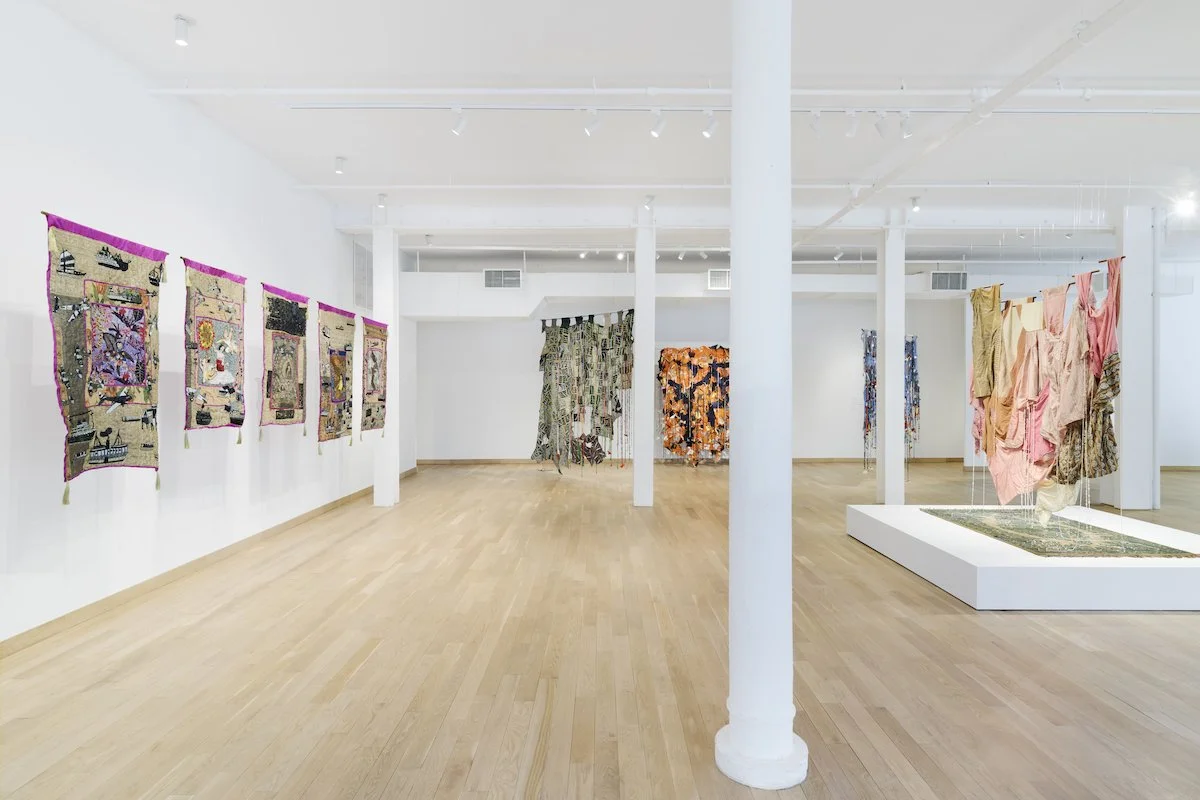
Jakkai Siributr, There’s no Place, 2026, installation view at Canal Projects. Image courtesy of Canal Projects. Photo by Izzy Leung.
Although Jakkai comes from a relatively upper-class Thai family, he and his relatives were not immune to the cruel dynamics of racial hierarchy, class exploitation and global warfare. Leaving the exhibition, I stepped back into the freezing cold and walked to City Hall, where thousands had gathered to protest ICE and its campaign against immigrants. In that context I reflected upon Jakkai’s timely show. If The Wizard of Oz promises that repeating the words “there’s no place like home” can magically restore belonging, Jakkai’s exhibition offers a more sobering proposition. By shortening the phrase to There’s no Place, he hints that for many of us, there may be no home to return to at all.
There is no Place is on view from 30 January to 23 May 2026 at Canal Projects, New York.
Read our Midpoint interview with Jakkai Siributr here.