
Review of ‘On the cusp’
NTU Museum writing competition 2026 winning entry

Installation view of 东邪西毒 I Want to Infect You with History, Boedi Widjaja, 2025. Image courtesy of NTU Museum.
Electric fans on a digital screen spanning the entire wall of a walkway. A quirky and somewhat otherworldly-looking structure in the middle of a lawn. At the edge of the lawn, a serene but modern-looking pavilion: part laboratory, part exhibition gallery.
At first glance, the title of NTU Museum’s exhibition On the cusp (2026) bewildered me. On the cusp of what? The answer would soon emerge.

Installation view of Turn On, Tromarama, 2025. Image courtesy of NTU Museum.
The artworks in the show blur the lines between medium and subject. To borrow a quote from American philosopher Alfred Korzybski, the map is not the territory. This notion is subverted at each installation. Turn On by Tromarama is a video installation depicting wind interacting with everyday objects. They quiver, with the image on screen transforming into a flapping cloth, and being blown off surfaces. I often perceived a gentle breeze that may have been imagined or real. Torlarp Larpjaroensook’s Cosmos of Nostalgia was a spaceship that transported me to a different planet even though it was on the lawn. At Boedi Widjaja’s 东邪西毒 I Want to Infect You with History, I inhaled an aerosolised poem encoded as DNA, simulating an infection. The actual presence of genetic material did not matter, as the idea of infection had already infected me.
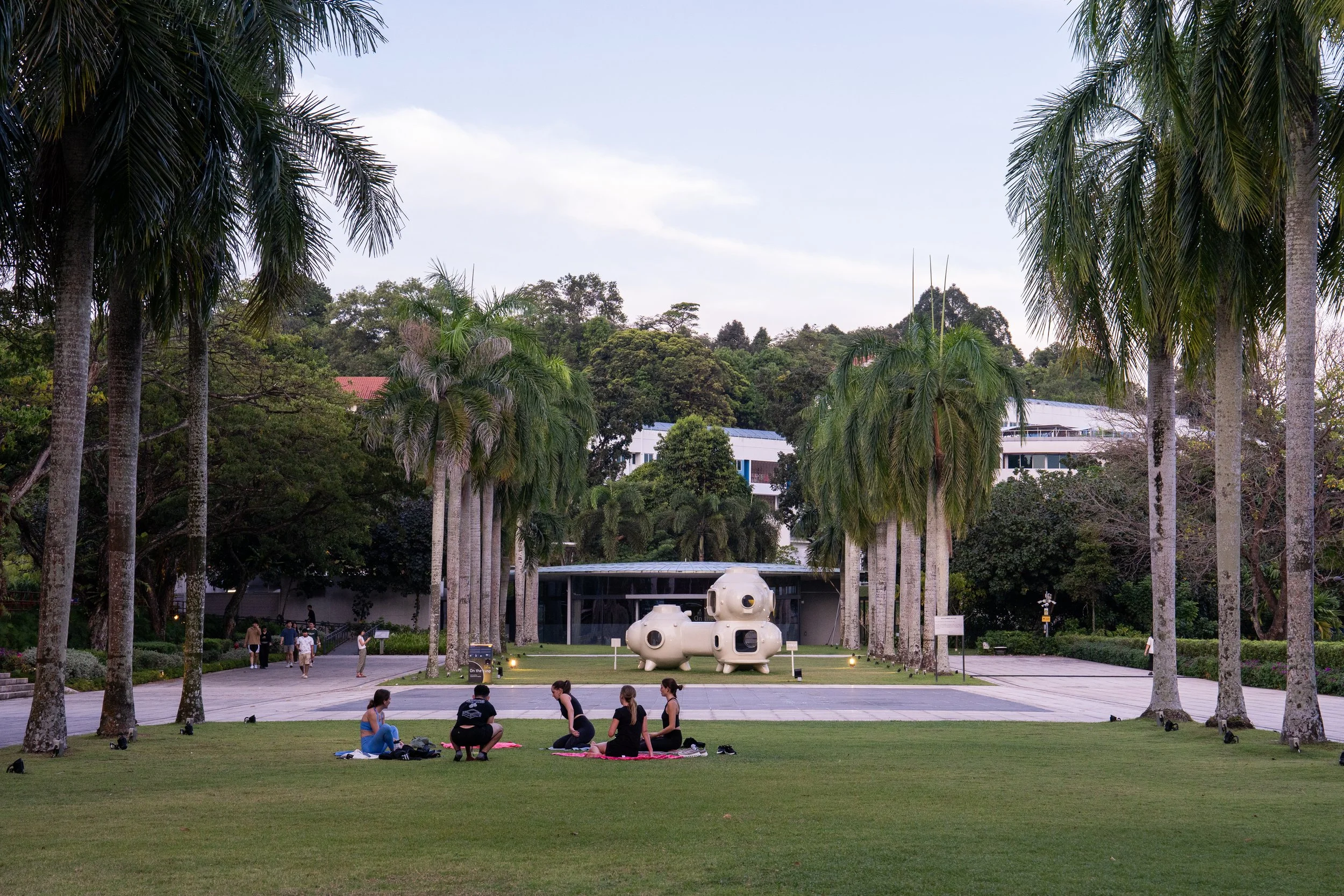
Installation view of Cosmos of Nostalgia, Torlarp Larpjaroensook, 2025. Image courtesy of NTU Museum.

Installation view of Cosmos of Nostalgia, Torlarp Larpjaroensook, 2025. Image courtesy of NTU Museum.
This segues into an overarching theme of the exhibition: quiet rebellion. In a video displayed at the pavilion, Widjaja recounts stories of a struggle to preserve his heritage. The poem is written in his cultural language, the Hanacaraka script. The twenty letters are assigned to corresponding amino acids, each with a three-nucleotide DNA encoding. By misting this DNA poem, there are no cries of protest nor violent uprisings. The entry into the body is subtle. Similarly, as I sat at the benches facing Turn On, it was intriguing to see how many people simply walked past it. It does not demand attention, but its message lingers at the walkway, almost imperceptibly. The structure at Cosmos of Nostalgia looks like one from a playground, benign and harmless. Yet, within it, paintings of traditional figures are juxtaposed with space-age machines. The contrast challenges the distinction between art and science, another quiet rebellion.

Installation view of 东邪西毒 I Want to Infect You with History, Boedi Widjaja, 2025. Image courtesy of NTU Museum.
Being a PhD student of biomedical informatics at the Lee Kong Chian School of Medicine, I was pleasantly surprised to find out that Associate Professor Eric Yap is the scientific collaborator for the DNA artwork. It is serendipitous that my thesis topic is on the transmission of bacterial antibiotic resistance, which found reflections in the themes of cultural transmission in Widjaja’s artwork. Connecting to the theme of quiet rebellion, it was as though the poem being encoded in DNA was resisting cultural erasure in its own way. Biological transmission may be benign or malignant. In this case, it did not appear to evoke an immune response or result in pathological effects. I also saw defiance in the blending of the boundaries of art and science, by leveraging the ability of DNA to form various shapes and structures in solution.
This exhibition is proof of how science and technology can complement art, rather than erase it. It is a striking experiment on how art can exist in spaces and carry their messages in new and intriguing ways. Here, I found the art right on the cusp of the transition between domains. History resisted fading into obscurity with the use of modern technology, the digital world reached into the physical, and tradition contrasted with visions of the future. Echoing DNA transmission, the messages of the exhibition lodge into minds and mutate, having a life of their own upon further contemplation. Like in Welsh writer Dylan Thomas’ poem, the art in their own little ways “Rage, rage against the dying of the light”. As long as culture persists, the number of ways that art can be created are seemingly endless.
Read curator Lu Xiaohui’s exhibition essay for ‘On the cusp’ here.