Midpoint: Tan Pin Pin
‘Singapore Index’ at the 10th Singapore International Photography Festival
Tan Pin Pin is a Singapore artist and filmmaker who works in film, photography and installation. She is well-known for her documentary features about Singapore, including Singapore Gaga (2005), about soundscapes in Singapore, Invisible City (2007), To Singapore, with Love (2013) and IN TIME TO COME (2017). Her films have been shown at festivals including the Berlinale, Busan International Film Festival, Hot Docs, South by Southwest, Viennale and Vision du Réel.
Aside from her work on film, she has presented installations including 80km/h (2004), 9th August (2006) and walk walk (2023), the latter commissioned by the Singapore Art Museum about the politics of walking is a public art installation. ( de installed already) Most recently, she made On a Clear Day You Can See Forever (2025) for the Singapore Biennale. Her works have also been exhibited at institutions such as M+ in Hong Kong, The Museum of Modern Art in New York and the Taipei Fine Arts Museum.
Tan was a board member of Singapore International Film Festival and National Archives of Singapore as well as a founding member of filmcommunitysg, which advocates for Singapore independent filmmakers. To support the next generation of documentary producers she has mentored development programmes including the Yamagata Documentary Dojo in Japan, and Docs by the Sea in Indonesia.
In October, her solo exhibition Singapore Index will be on show at Shop-House by DECK as part of the 10th Singapore International Photography Festival, from 16 October 2026 to 31 January 2027. It will feature a selection of photographs from her photo series that she took between 1991 and 1992 in Singapore. Rediscovered during a recent audit of her archives, it showcases Tan’s trained artistic eye as well as a slice of life in Singapore from more than 30 years ago.
In this Midpoint interview, Tan shares her beginnings as an artist and filmmaker, the questions that have guided her career so far, and the importance of making decisions to stay on an intentional creative path.

Tan Pin Pin at Aliwal Art Centre. Photo by Grace Baey.
Looking back, could you share a decision or event that marked a significant turn or moment in your path as an artist?
I qualified as a lawyer and was called to the Singapore Bar. I had completed six months of pupillage. But I decided that I was much more interested in art making than in contracts and cases and all of that. I remember telling my father that I was going to leave and join MediaCorp as a gopher. He was worried that I was not going to be able to make enough money to live, and I told him that I would figure things out. The life of learning about art was much more interesting for me. There was no school I could go to, and no apprenticeships I had access to. This was in the mid-1990s. So I thought I would join a TV station, and at least be around cameras and equipment that would bring me one step closer to learning about the craft. My father, interestingly, gave me his blessing, and said at the same time that I had to own my decision and make my own way.
I remember that I would wait for the latest issue of Sight and Sound or American Cinematographer every month, and we would go to USIS or British Council library to read these magazines. I remember being excited to visit Odell Video, which was a video shop in Tanglin Shopping Centre, or wait for the annual edition for Singapore International Film Festival. The world came alive at these small moments. I had caught a bad case of cinephilia.
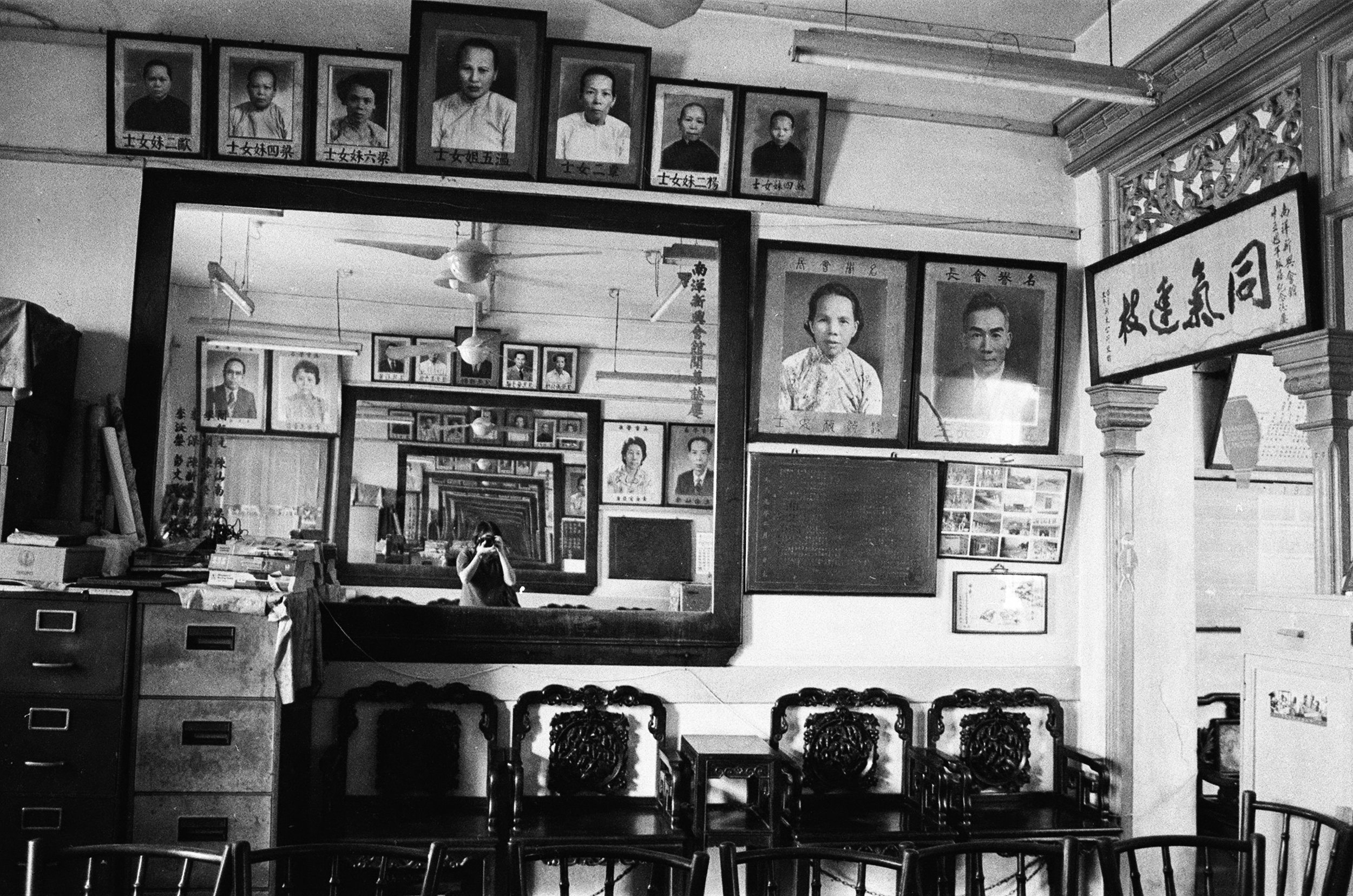
Tan Pin Pin, Self-Portrait, 1992.
When has been a milestone achievement for you as an artist, and why has it been particularly memorable?
I would say it was when To Singapore, With Love (2013), about Singapore’s political exiles, was banned by IMDA. I often joke that I must have been doing something right for it to be banned.
NUS Museum who was to premiere it had submitted the film to the censors but the film did not pass. I screened the film at the Freedom Film Festival in Johor instead. A few hundred Singaporeans took coaches to Johor Bahru to see it. I felt it was memorable because Singaporeans took the trouble to see the film for themselves, to decide whether the banning was justified.

A few hundred Singaporeans bused to Johor Bahru to watch To Singapore, with Love in a hotel, when the film was banned in Singapore.
What was the premise for these films?
I have made work in different mediums for over 35 years. I am known for documentaries about Singapore mainly because film is a populist medium, so more people know about it. Singapore GaGa was about the city’s soundscapes, Invisible City about people who documented the city, and IN TIME TO COME, about her time capsules. I don’t quite choose my topics. Rather, I find myself gravitating towards something I feel drawn to, a particular theme, a feeling or subject. It's one of those mysteries of the world: why I would be interested in A and not interested in B. I suppose it is a constellation of one's personality and curiosities. That is why the rediscovery of Singapore Index and Another China, a photography series from 1991 is meaningful. It reminded me of what my untrained eye was drawn to, right at the start. We all come from somewhere.
I feel that artists are reality creators, so that we try to reflect what we ourselves see. It is also a means to create community, because you have a medium to share that experience with others. The best-case scenario is when what I have created that grew out of my mind’s eye finds resonance for other people too.
Each of my works is an exploration of my own preoccupations. I work towards them, answer to them, and then I share them. I then hope that the universe will bring people towards each work, who are able to see something in it with me. And then I–or we–don’t feel so alone.
So for example, in Singapore GaGa, one of the things I wanted to do was to somehow record sights and sounds of Singapore that I myself thought was definitely worth recording. like school cheers, MRT announcements, or meeting up with my childhood ventriloquist, Victor Khoo. Things like that. But at that time, such recordings did not exist.
So that was a documentary about Singapore sights and sounds. The response was quite explosive. Because it turned out that a lot of people had noticed all these disparate buskers and sounds that I had recorded, with my camera too. And then there were sold-out performances and sold-out screenings.
“Each of my works is an exploration of my own preoccupations. I work towards them, answer to them, and then I share them. I then hope that the universe will bring people towards each work, who are able to see something in it with me. And then I–or we–don’t feel so alone.”
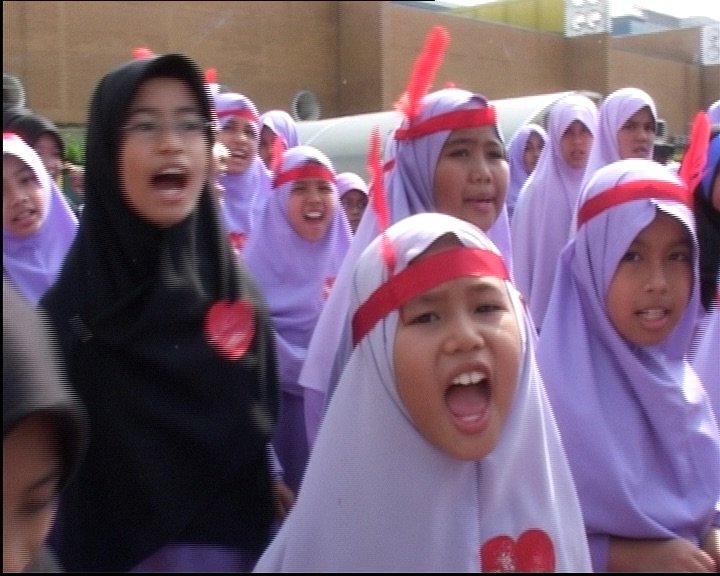
Still from Singapore GaGa (2005). Madrasah students chanting cheers during their sports day.
What about Invisible City?
For Invisible City (2007), the tone is very different. I wanted to acknowledge photographers, journalists, filmmakers and archaeologists, people who were in their own quiet ways documenting Singapore, for themselves, like what I was doing. We get to see some of their archives from way back. I felt that I was meeting the future me, the archivist, when I met with these older documentarians. They were working 50 years earlier than me, but doing essentially the same thing as I was.
It was my way of telling my interviewees that they were seen, these were people who were laboriously working on their own dime. They were working for a future generation, The film was a way of letting them know that, yes, the archives that you were protecting has been well received.

Tan Pin Pin interviews Dr Ivan Polunin about his archive of colour footage he shot of Singapore in the 1950s and 1960s. Photo by James Teo.
There was a recent screening of Singapore Gaga.
Yes it was to a brand new audience, and there was joy in the room when they met the personalities in the film for the first time that I was happy to witness. Because the film survives, right? For me, I am concerned that we are only making something that survives for a TikTok moment, and then after that, it expires and is taken over by another moment. I am glad that Singapore GaGa survived, at least for that screening.
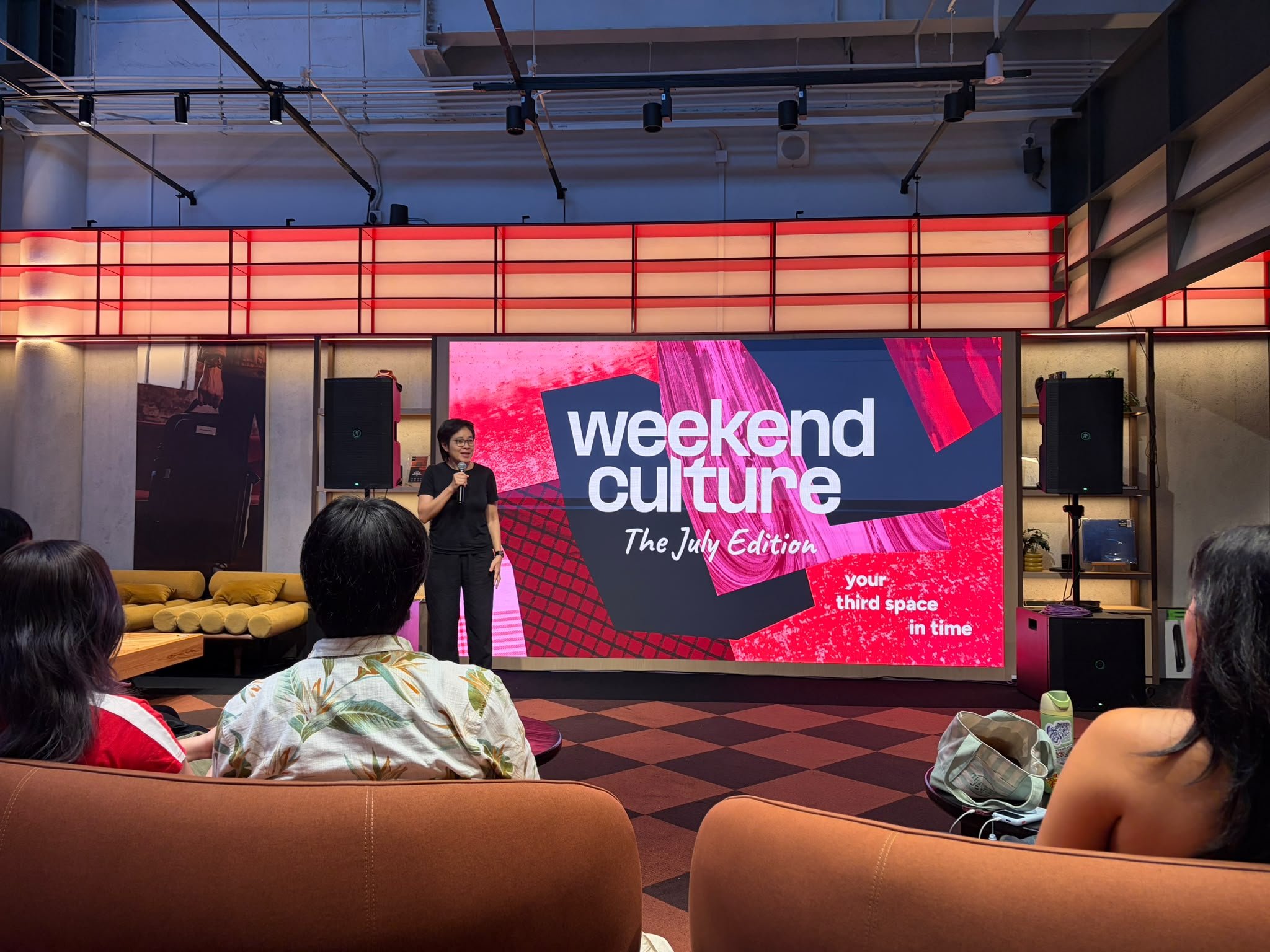
Pin Pin introduces Singapore GaGa at a recent screening organised by Weekend Culture.
What about To Singapore, With Love (2013)?
That was an accidental film, in the same way that Invisible City or Singapore GaGa were also accidental films. Accidental meaning that I started out wanting to do something, but along the way, it found something else more interesting, and then I made a detour, and then suddenly the detour became the work.
Have you heard of Ed Ruscha's work, Every Building on the Sunset Strip? It is an artist book where the 1960s pop artist put his camera on the back of a pickup truck. He mounted his camera on it, and he had a driver to drive slowly, so every time he passed a house, he just took a picture. And then what he did was to string every picture of every house together. in a book that stretched out like an accordion. The artist book was mind-blowing for me because it was another way of experiencing the movement and the journey, but in a book format.
I thought that I could circumnavigate Singapore in the same way, by taking a boat trip around Singapore's coast, taking a snapshot along the way, or a video, so that we could string out the whole video together into one long film. I wondered what the Singapore coastline looked like from the outside. Because we're always looking outwards, and we forget our island-ness.
As I explored the idea of Singapore inside, outside. I stumbled upon a book of first-person narrative accounts of Singapore political exiles titled Escape from the Lion’s Paw. And I was amazed that these people existed, and so I wrote to the editors of the book Teo Soh Lung and Low Yit Leng and asked if they could put me in touch with some of the people so that I could ask them questions as research for my round island boat trip. They said that one of the authors, Dr Ang Swee Chai, was in Kuala Lumpur and suggested that I go chit-chat with her. When I met and interviewed her, I just knew I had to change the direction of my project, because her account of her exile experience was something I felt that I needed to record there and then. That's what I mean by accidental! Going back to the original idea, I have a photography series of landscapes of Singapore photographed from the outside. It will be shown in December this year for the first time.

Film still from To Singapore, with Love: Chan Sun Wing, based in Hatyai, reads a poem he wrote about his exile experience to camera.
Could you walk us through a typical work day, or a typical week?
I have a shared office cubicle workspace at the Aliwal Arts Centre. It is important to me to have a space to call my own. I am in the middle of editing a new film. We start editing at 9am, the editor and I have a discussion, then while she's working, I do administrative work and watch edits. And I will probably stay until 7pm. That administrative work could entail gathering the images to go along with this article, or for recording a welcome note for the audience for a screening which I could not attend,
Are there routine(s) you follow to nourish yourself/your artistic practice?
I do Brazilian Jiu-Jitsu (BJJ) a couple of times a week. I have a blue belt, one up from white. I love it because BJJ is like solving a puzzle in real time with your body. I am always responding to someone else's action. For all of us who are knowledge workers where everything happens in the head, it can be uncomfortable to have to think about where your left foot is or how to escape a choke. So I highly recommend it for people who can deal with contact sports. I feel refreshed and reset after each session.
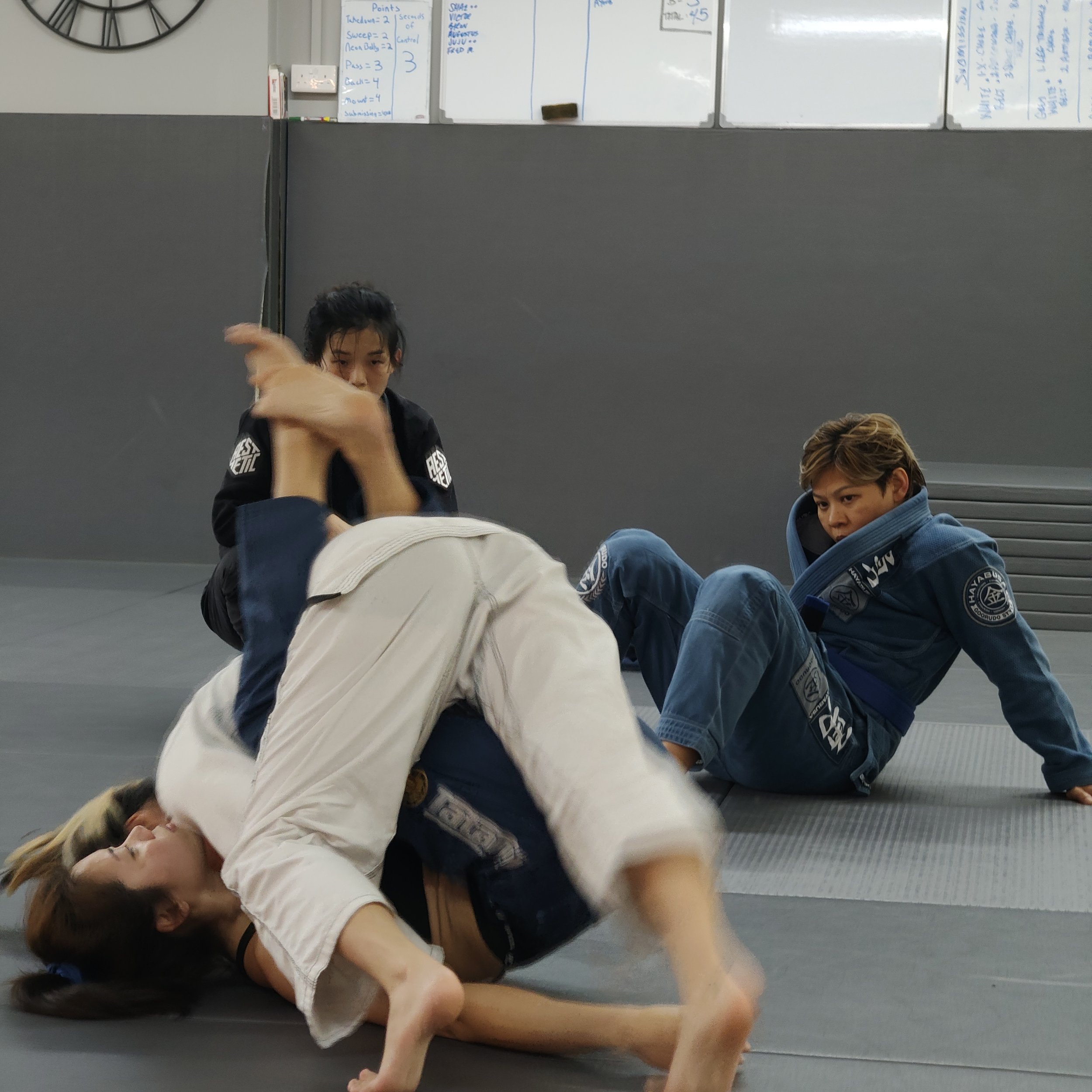
A day in the BJJ Dojo.
Could you describe your studio/ workspace? How has it evolved over the years? What do you enjoy about it, and what do you wish to improve?
I have worked in a co-working space in Aliwal Arts Centre on and off since 2019. My cubicle is very spartan. It is a place for me to put my mug and flask–to drink my non-caffeinated non-sugared tea–and a monitor.
I enjoy the company of my kakis who are in the neighboring cubicles, yeah. One of them is a choral master, another does Tamil theatre, and yet another is a producer of events and festivals. It is mind-expanding to be in touch with other kinds of art-making. It is an unusual and nurturing environment to be in. There is a lounge next to the office, so sometimes when I want to change my environment, I just bring my laptop next door. I do think the lighting here is a little too bright – the scourge of LED lighting – so I wear a visor.
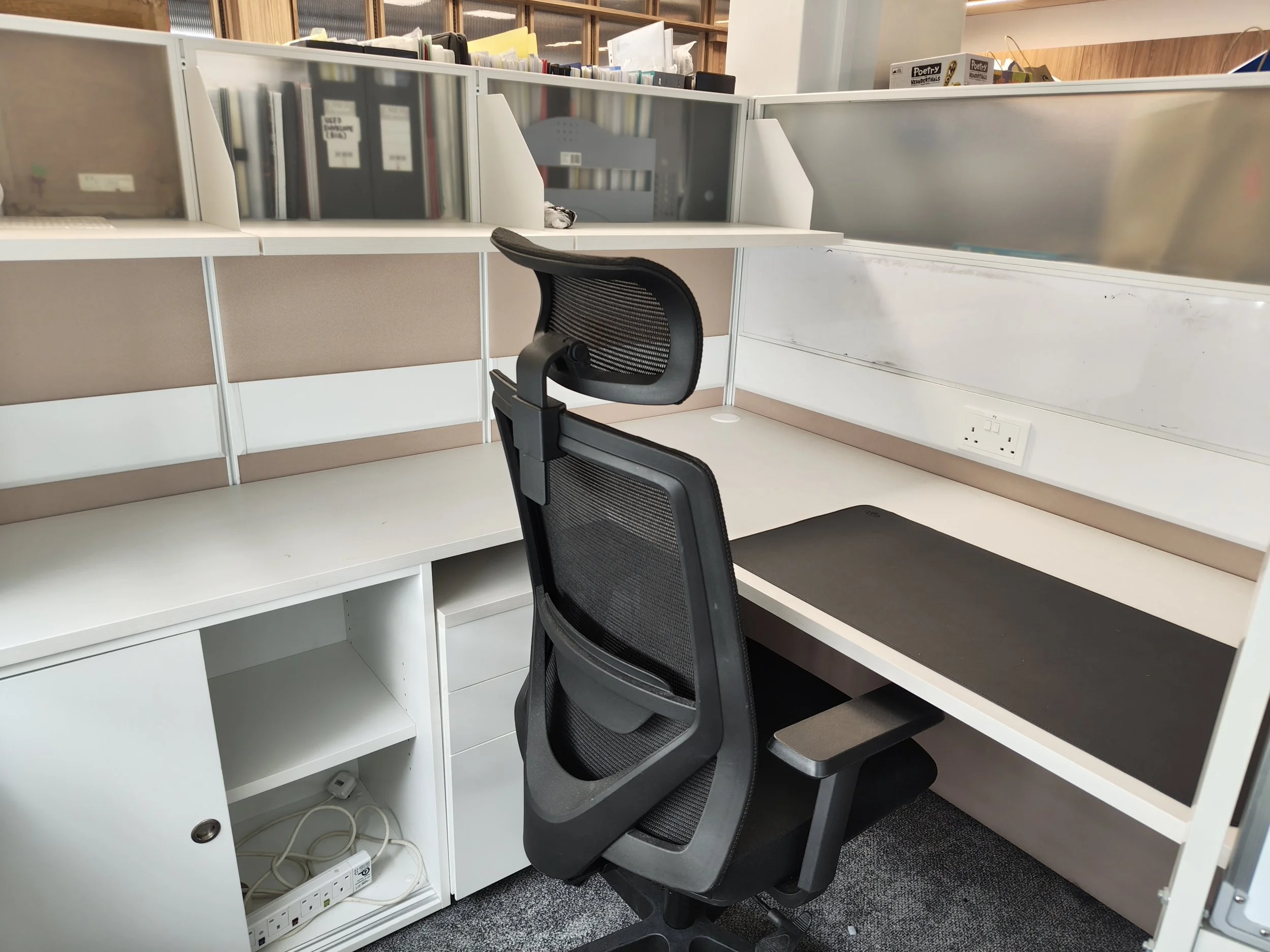
Cubicle at Aliwal Arts Centre.
What has become easier or more difficult to do as time has gone by?
It never gets easier. I thought it would, that I would have done this long enough for it to become easier, but it doesn’t get easier, which is a scary prospect. But it is easier to tell people my views, maybe because I have been around the block so often, and there is a higher chance of them listening to me.
As for what is more difficult, I am curious to see what is the minimum effective amount of effort to make a work. I think the holy grail is to find a way to make something elegantly simple, yet trenchant, in a self-sufficient manner.
I recently finished a work for the Singapore Biennale, which was acquired by the Singapore Art Museum, and that was helpful financially. It was a two-channel installation called On a Clear Day You Can See Forever. And it was wonderful to be able to work with a curator, who not only could provide a sounding board for the concept, but work on the administrative parts like co-ordinating with different sub-contractors or fundraising.
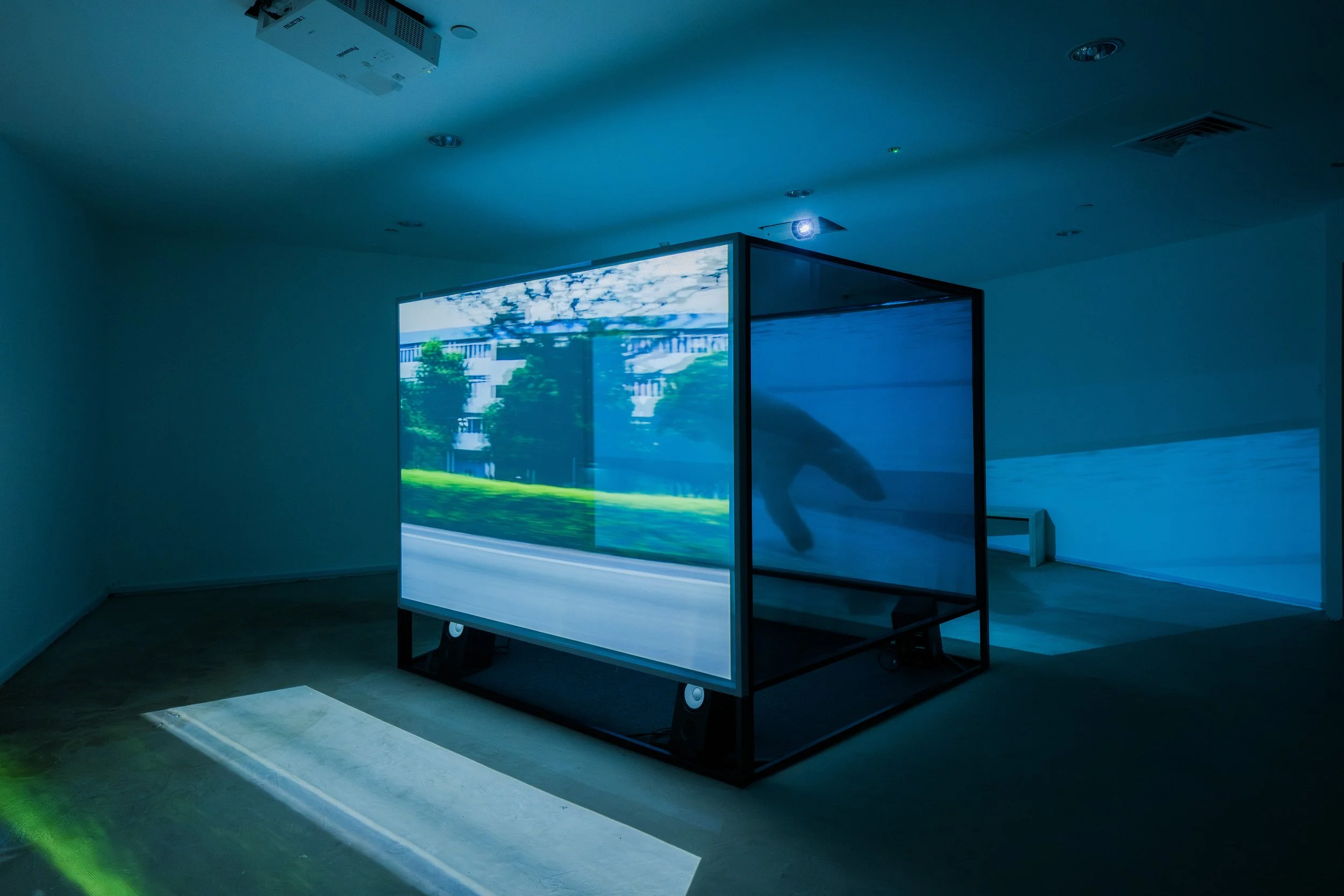
Installation view of Tan Pin Pin’s On a Clear Day You Can See Forever (2025), as part of Singapore Biennale 2025: pure intention. Image courtesy of Singapore Art Museum.
What do you think has been/is your purpose? Has your purpose remained steadfast or evolved over the years?
First of all, a work needs to reflect who I am at a particular time and place and the questions I'm interested in. And these change over time. So here’s a question that I might have been interested in ten years ago: “I wonder what it's like to be a political exile and not be able to come back to Singapore.” That is not the same question that I have now.
All my works are really manifestations of questions I have at a moment in time, and the act of articulating the questions, then trying to find an answer becomes the work. Put another way, the work is usually the outcome as I work through my thoughts on a particular issue.
It is important to finish a work and show it. It needs to be externalised even if it may not be imperfect. The works are the outcome of solving issues related to the form or content, and it is very organic. In the work, I present the questions and the solutions as it were. There is sometimes a messy inconclusiveness to this process because the work could throw up more questions, and more is fine too.
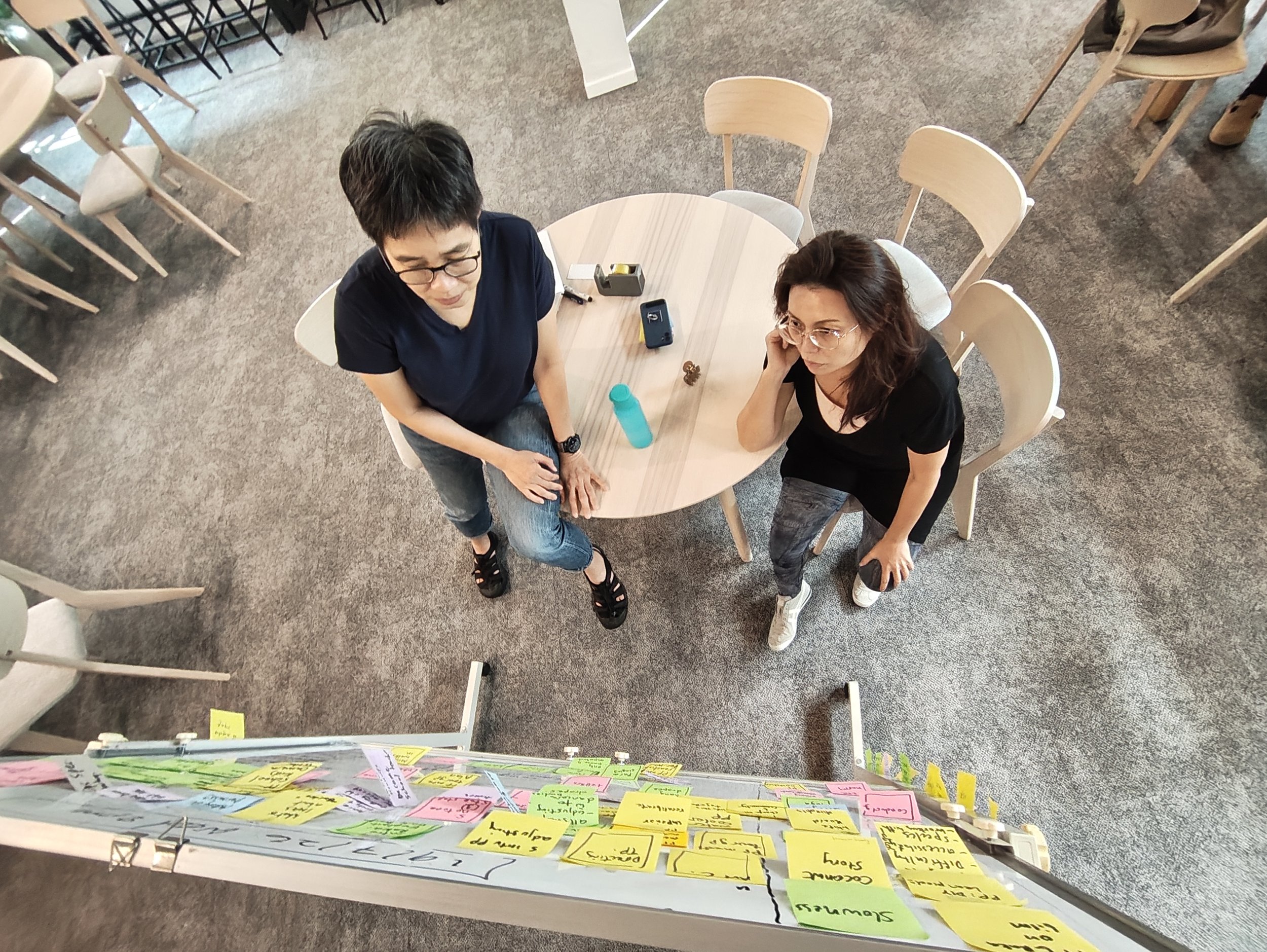
Pin Pin discussing with the film editor about sequencing scenes in an upcoming documentary, Arts Centre. Photo by Weinan.
You will be exhibiting Singapore Index soon at the Singapore International Photography Festival. Tell me more about these photographs which you took in 1991 and 1992 of Singapore, and why you are exhibiting them now.
I forgot I had all these photos I had made. I took a photo series in China in 1991, and towards the end of the year and going into 1992, I made one in Singapore. I wanted to know China because that's where my ancestors came from. So the first trip I made was to see the motherland and to photograph it from a Singaporean’s point of view. When I returned to Singapore, I wanted to get to know Singapore as well. These were projects for which I had proposals written to fundraise for them.
I had totally discounted these two bodies of photographs. I thought that I was a filmmaker, and everything else before was irrelevant. The only reason I took them out was because Singapore Art Museum wanted to acquire some works, and one of the curators asked me for an account of my catalogue. While I was digging through my archive, I stumbled upon these photos. There were nearly 2,800 photographs I had taken of Singapore and 2,000 of China. I had shown a selection of the China photographs in Shanghai in May in an exhibition titled Some Day 总有一天. There was a lot of interest amongst the visitors to be able to return to the place where the photos were taken 35 years later to show it to the denizens of the country. It is a high point in my career.
When I first saw the photographs, I was quite humbled, which is a strange thing to say. But I was humbled by my earnestness. I really wanted to be an artist, and I didn’t dare or know how to be one. Looking at the negatives, I saw that I was proving to myself that I had what it took to be an artist: to take on gruelling long form photography projects and see a project to completion. When I rediscovered these photographs, I gave a little air punch. They were a start to the journey that continues to this day.
We have selected about 65 works to show at the festival, and it is called Singapore Index because I was quite methodical in places I went to in order to reacquaint myself with Singapore. I had left as a schoolgirl and returned as a semi-adult, eager to put myself in places I would not otherwise go, in order to see Singapore as it was for myself. The titles are very important in the series of photographs to show the places I covered, from funerals to weddings to school excursions to beauty pageants. It is not quite a time capsule per se, but it is my time capsule. There are a good number of faces, so oftentimes the photographs seem contextless, though there are small details that place them if one is observant enough, and of course, the gestures of the subjects are also meaningful.
“When I first saw the photographs, I was quite humbled, which is a strange thing to say. But I was humbled by my earnestness. I really wanted to be an artist, and I didn’t dare or know how to be one.”
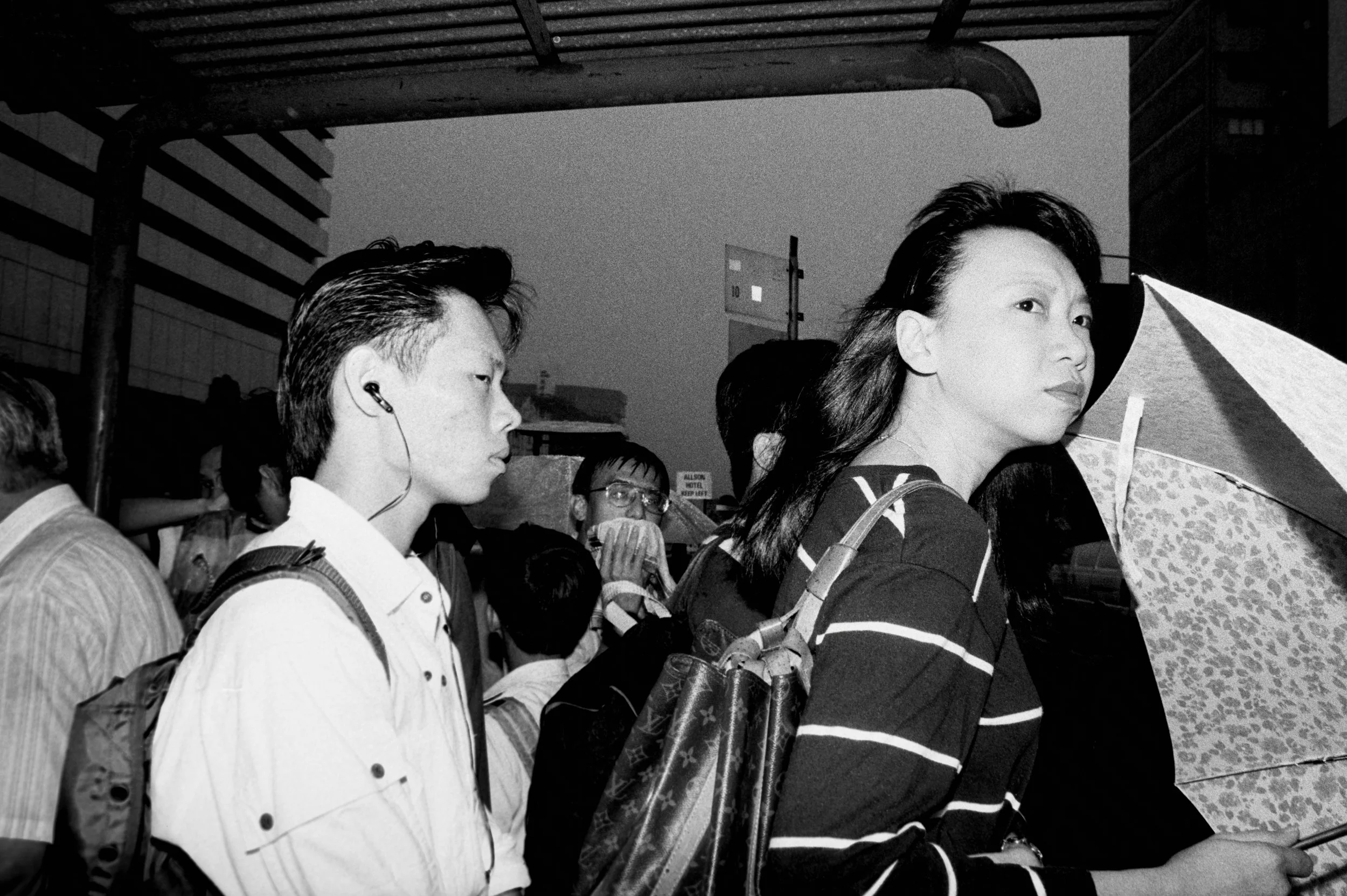
Photograph from Singapore Index series titled Bus stop, evening, 1992.
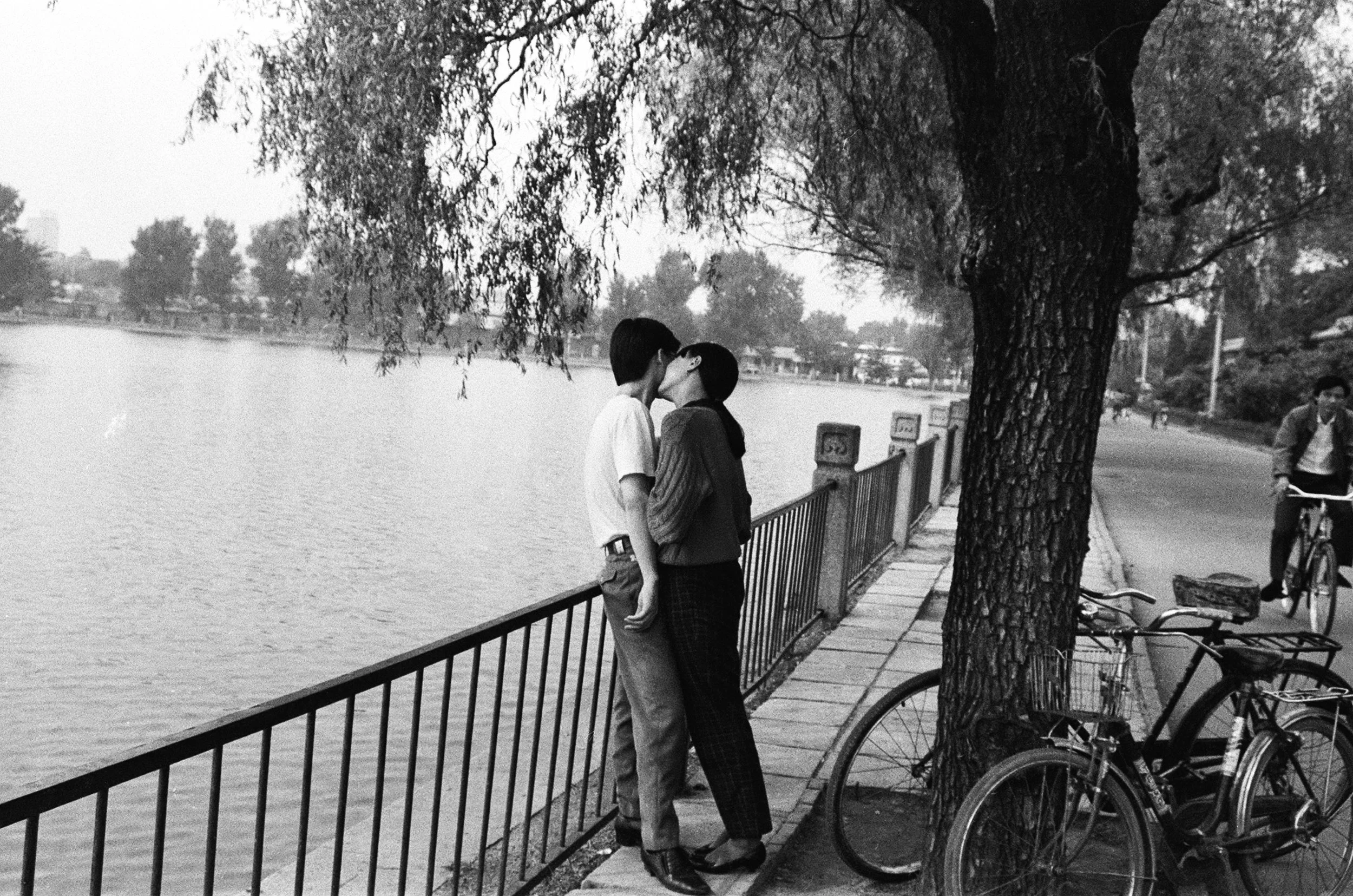
Photograph from Someday 总有一天, China, 1991.
Are there any upcoming projects you would like to share?
The film I am editing now is about the possibilities of art set in Aliwal Arts Centre. This is in line with how I stumble upon questions and then try to answer it.
And finally, what would be a key piece of advice to young art practitioners?
I don’t think what I went through is replicable so it is hard to extrapolate advice for my experiences. Anyone who gives advice is probably doing it under duress.
We have talked a lot about agency in this conversation, such as choosing to be an artist and then testing the label out and seeing if it fits and then deciding to go down the path. I think I place myself in a position where I have to make a decision, and then I make one. So I think my advice would be to try to create opportunities where you have to make a decision because you learn more about yourself in the decisions that you make. With each decision, you are moving towards yourself, and getting closer and closer each time to know who you really are. So my advice would be to create environments where you have to make decisions, because that is where you find out more about yourself. I feel inertia when I have to make a decision and I remind myself that it is a privilege to be in a position to have to make a decision.
Singapore Index will be on show at Shop-House by DECK as part of the 10th Singapore International Photography Festival, from 16 October 2026 to 31 January 2027.
Find out more about Tan Pin Pin here, and the 10th Singapore International Photography Festival here.