
Midpoint: Sim Chi Yin
One Day We’ll Understand, 归舟: Longings, Returns
Midpoint is a monthly series that invites established Southeast Asian contemporary artists to take stock of their career thus far, reflect upon generational shifts and consider the advantages and challenges of working in the present day.

Sim Chi Yin. Photo by Bryan van der Beek /CultureLink Sg.
Sim Chi Yin is an artist from Singapore whose research-based practice uses artistic and archival interventions to contest and complicate historiographies and colonial narratives. She was an artist fellow in the Whitney Museum’s Independent Study Program (2022–23) and holds a PhD in War Studies from King’s College London. Her work is in the collections of the Brooklyn Museum, The J. Paul Getty Museum, Harvard Art Museums, M+ Hong Kong, the Deutsche Börse Photography Foundation, Singapore Art Museum and the National Museum Singapore.
In this conversation, Chi Yin reflects on her pivot from journalism and documentary photography into contemporary art, as well as how the decision to pursue a PhD impacted her practice. She also offers insights into the evolution in her long-term project on the anti-colonial war in British Malaya and its resonances in today’s political climate.

Sim Chi Yin, The Suitcase Is A Little Bit Rotten, Van Riemsdijk (detail), 2026, UV print on glass, light box, replica vintage stand. Glass plate: 30.5 x 23cm; stand: 33.5 x 26.3 x 60cm. Image courtesy of the artist.

Sim Chi Yin, The Suitcase Is A Little Bit Rotten, Crowd, 2022, UV print on glass, light box, replica vintage stand. Glass plate: 30.5 x 23cm; stand: 33.5 x 26.3 x 60cm. Photo by South Ho.
Looking back, could you share a decision or event that marked a significant turn or moment in your path as an artist?
Perhaps the most significant moment was my decision to leave journalism and documentary photography to leap into the contemporary art world. This was cemented by my participation in the Istanbul Biennale curated by Elmgreen and Dragset in 2017. I had made and participated in artistic projects in my late teens and early 20s. But I was then set on a path to become a writing journalist and then a documentary photographer and filmmaker by the fact that I completed my first two degrees on scholarship from Singapore Press Holdings. In exchange, I spent all of my 20s working for the press on an eight-year “bond” contract. I left when I could and moved gradually through documentary work, and later a switch to art. I started a PhD in 2018.
I would say the other significant break in my work came around 2022/2023, when I started to make artworks that were clearly more speculative, fabulist, more in the realm of imagination and freed from the evidential. I was working with American theorist Saidiya Hartman’s now-famous notion of “critical fabulation” as a method of working with highly-subjective and omissions-filled official archives. I would say my series intervening with antique and colonial magic lantern slides, The Suitcase Is A Little Bit Rotten (2023-ongoing) is the first work I made that was clearly speculative in register. The subsequent projects gradually deepened that direction.

Disobedience Archive at the 60th Venice Biennale, 2024. Photo by Nuova Accademia di Belle Arti.
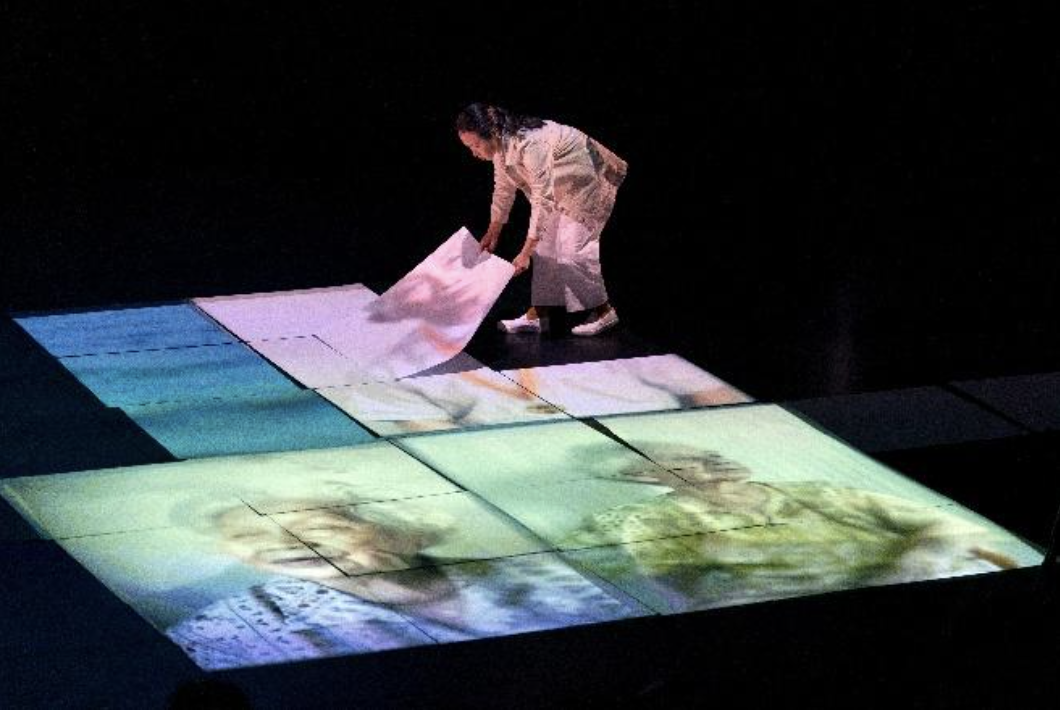
Theatre performance, One Day We’ll Understand, premiere, August 2024, Esplanade, Singtel Waterfront Theatre, Singapore. Photo by Joseph Nair /CultureLink Sg.
What has been a milestone achievement for you as an artist, and why has it been particularly memorable?
Being exhibited in the main show at the Venice Biennale in 2024, as part of the Disobedience Archive curated by Marco Scotini, was a milestone. It allowed me to be at the biennale’s opening week as a participating artist and take in that milieu, have rich conversations with curators from all over the world in the coffee queue and put some pieces of the art world puzzle together in my mind.
Making a full theatre production One Day We'll Understand in 2024 with a team from the performance world was also a milestone. I stepped out from behind the camera and out of the studio to do an hour-long monologue live before an audience of hundreds. It was panic-inducing but I learnt a lot in the process and stepped up to the role. We premiered in Singapore and then toured the performance to Melbourne in 2025, and I became progressively more attuned to being a performer.

Sim Chi Yin, 归舟: Longings, Returns, 2026, performance documentation on 13 August 2026, at Storefront for Art and Architecture, New York. Photo by Sarah Lam.
You have also mentioned how the new solo exhibition at Storefront for Art and Architecture in New York is a personal milestone.
Yes, it is my first institutional solo show in the United States (U.S.). But more than that, I created a show that allowed me to use my work on a relatively-unknown historical episode of mass deportation from colonial Malaya during the Cold War to speak to the moment we are living through, with all the forced migration we are witnessing in the world. I made a new three-channel video, four glass works and a giant collage mural. The installation stands on its own while the performances brought an additional layer to the work. I was not sure how the work would land in New York but it has been well-received.
We organised a discursive programme on 15 August 2026 that allowed me to speak, alongside others, to the links and lineages I have been seeing between colonial and contemporary political practices. The art opened up space for others to share their stories and experiences which have parallels across countries and times. I am grateful that the work and words seem to have landed in other people’s bodies too. For me, it felt like some sort of release as this material and subject has been sitting on my chest for years. The show focused on my primary research on this very under-documented topic of the mass repatriation of over 30,000 mostly ethnic Chinese from Malaya by the British during the anti-colonial war, including my paternal grandfather.
I chose to focus on this slice from my 15 years of research around the Malayan war specifically because the Storefront is located in Soho, at the cusp of Manhattan Chinatown with its deep migration histories. In our current moment, we read about the U.S. Immigration and Customs Enforcement (ICE) and deportation cases daily in the news, from the U.S. and other countries. I hoped for resonances between the work and the here and now, and others heard those echoes too.
For the performance which I presented twice, on 8 and 13 August, I wrote a new script, borrowing from the form of Lebanese artist Etel Adnan’s poem To Be In A Time Of War. It occurred to me it could fall flat as a bad copy of her but I made the text my own, using her form as a sort of multi-directional joystick to traverse time and geographies, to toggle between the mundane and the important, the personal and geopolitical, the past and present. It became a homage to her, while the script allowed me to speak my mind and heart.
Reflecting on my New York solo, I have come to more fully acknowledge that performance and writing are critical parts of my practice, on top of the visual art making. And these are aspects I would like to deepen, so that is a milestone too.
“The show focused on my primary research on this very under-documented topic of the mass deportation of over 30,000 mostly ethnic Chinese from Malaya by the British during the anti-colonial war, including my paternal grandfather.”

Sim Chi Yin, One Day We’ll Understand, 2015-on-going, exhibition installation view. Presented at Istanbul Biennial, 2022. Photo by David Levene.
Could you walk us through a typical work day, or a typical week? Are there routine(s) you follow to nourish yourself/your artistic practice?
When I am not traveling to make new work, do research or to open shows, I am based in Berlin. I often start my week with a pilates class on Monday mornings at the neighbourhood gym, and then work in the studio at home, till around 3:20pm when I collect my son from his school bus. I then am busy with family stuff and making dinner, and putting him to bed till around 8:30pm when I can get back to some work for another hour or two. Most days are like that when I am in Berlin. My husband, who is a writer, and I share the family load and our schedules are pretty much like that. Because we are parents as well as professionals, and we do not have childcare help, we are pretty flat out juggling work and family life.
Sometimes, I jog to think, and write my scripts in my head. I try to see as many art shows as I can that interest me, often taking my son too. I read novels, poetry and listen to audiobooks, as well as music; that nourishes my mind.
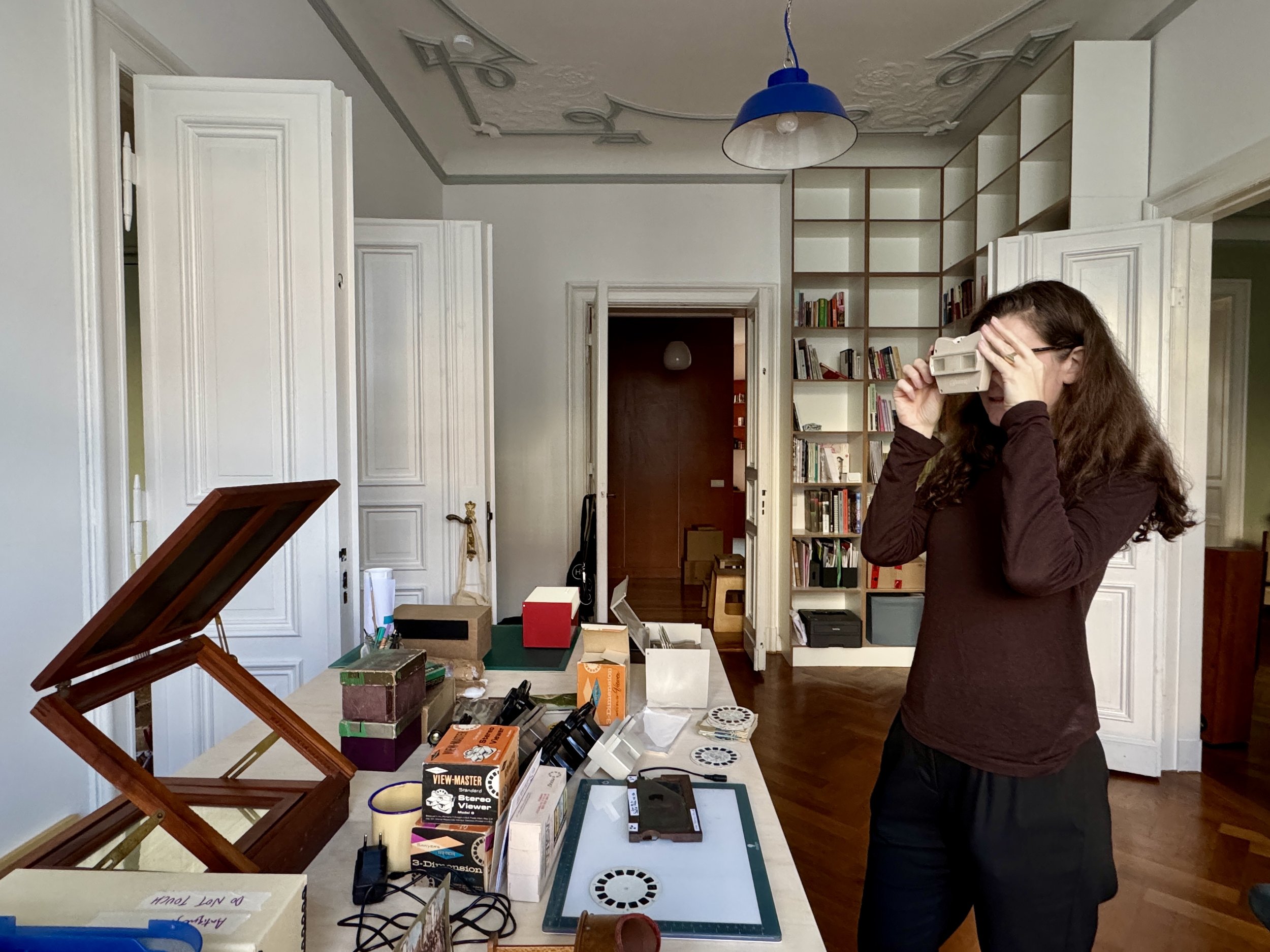
Studio visit by Lotte Laub, Zilberman Gallery Berlin director. Photo taken at Chi Yin’s studio in Berlin, in December 2025.
Could you describe your studio/ workspace? How has it evolved over the years? What do you enjoy about it, and what do you wish to improve?
The past year has been the first time I have a dedicated studio space of any size. We moved into an apartment in Berlin in the middle of last year, and I have two rooms in the front for my studio. I am still unpacking some of the things shipped from various countries and I am working to archive my materials. It is a typical old Berlin apartment with high ceilings and very interesting light in the summers or on sunny days. I appreciate it very much. I now have a large work table on wheels on which I can lay large prints or elements I am trying to collage. I also have wall space on which I can paste things, and try to make sense of the layout of a show etc.
It is a wonderful space but I have been thinking that eventually I would like to find a studio outside the house – much further away from the kitchen! A bit of separation between work and family life, as well as the discipline of going to work would be good, I think.
What has become easier or more difficult to do as time has gone by?
As the work became more ambitious in form, I found colleagues to collaborate with instead of doing everything myself, and that often meant needing to find larger budgets. The commissions do not always come with enough funding for the work I want to make, so fund-raising has taken a chunk of my time and energies, and that is always difficult especially as much of the world has seen cuts in arts funding and the gallery world is not doing well. But, onwards!
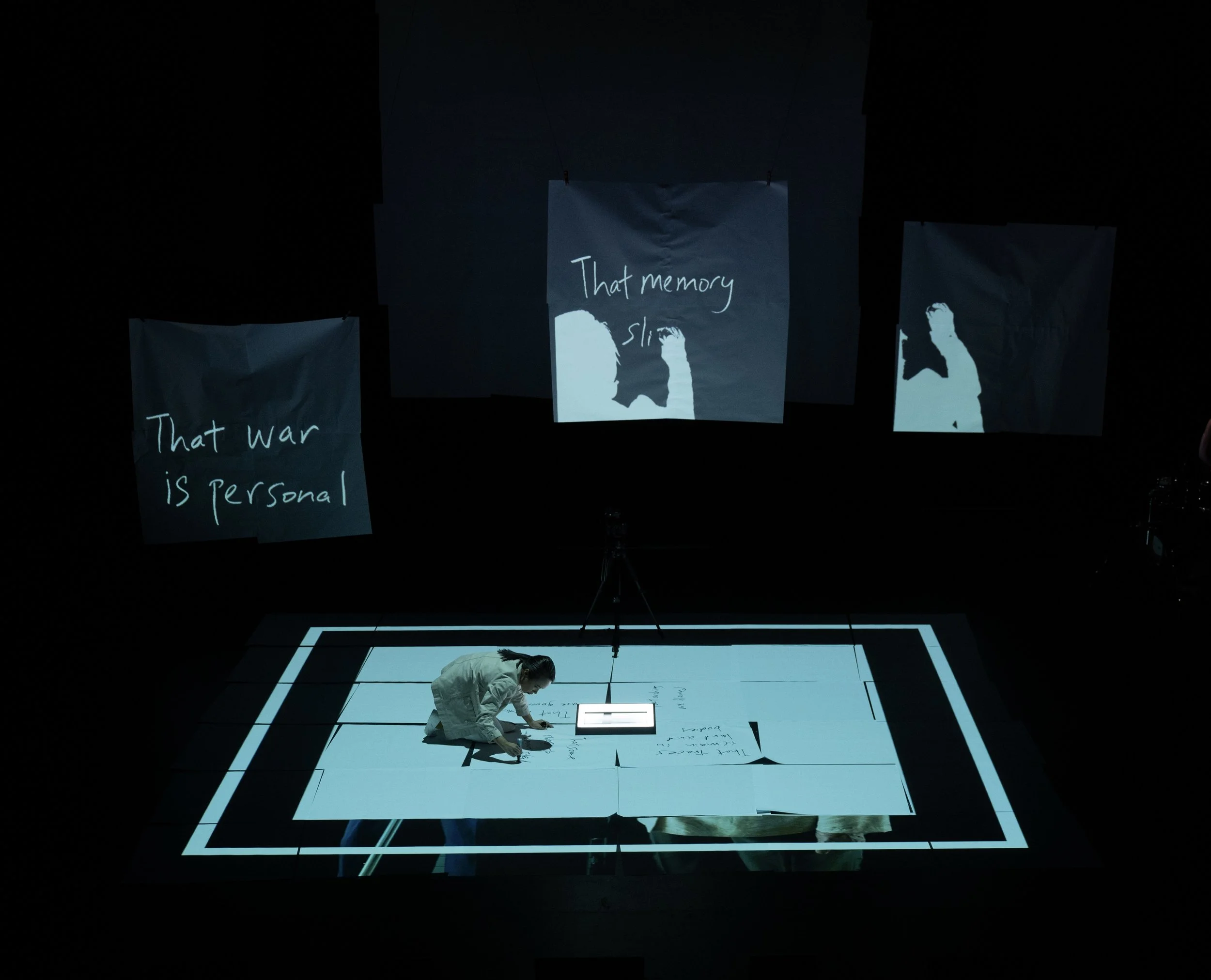
Theatre performance, One Day We’ll Understand, premiere, August 2024, Esplanade, Singtel Waterfront Theatre, Singapore. Photo by Joseph Nair /CultureLink Sg.

Sim Chi Yin, She Never Rode That Trishaw Again, 2021, book cover. Photo by Johannes Kremer.

Sim Chi Yin, She Never Rode That Trishaw Again, 2021, page spread. Photo by Johannes Kremer.
One Day We’ll Understand (2015-ongoing) is a long-term project that has manifested in different formats, including a theatre performance. Have your feelings or perspectives about this project changed over this period?
The multiple chapters of this project definitely chart an evolution: from working within the evidential/documentary register to then speculative ones. The forms have also evolved. I started with my base medium of photography, and gradually added moving image, book-making, glass works, lecture performance and then theatre performance.
The project is still based on primary research from oral histories and in archives, secondary research, as well as family history. That has not changed. My broad perspective on what the project is about, why I do it, have not changed much. But my methods have. I think the different elements and forms of story-telling are richer because of the different tools I now have and use in my work.

Sim Chi Yin, Time Travels With A Rotten Suitcase, 2025, two-channel video installation with sound, 08:27min; The Suitcase Is A Little Bit Rotten, 2022-23, UV print on glass, lightbox, replica vintage stands. Installation view in the group exhibition Visual Kinship (2025) at Hood Museum of Art, Dartmouth, United States. Photo by Ben Gancsos.
Could you talk about your decision to pursue a PhD in War Studies from King’s College London and if that influenced the way you relate to artistic practice?
I more or less accidentally walked into pursuing a PhD mainly because I was running out of ways to sustain myself working on the very research-heavy project around the anti-colonial war in Malaya. Initially, I was working as a documentary photographer to finance my research but I wanted more time to focus. By then, I had gathered a bank of primary research and some people suggested I look into working on a PhD. I applied and was offered a full scholarship; completing the PhD at King’s College London provided access to the British archives, so I said yes.
It was tough as I was juggling multiple things and a child by the later stages, but it allowed me to consolidate some of the primary research and also gave me some theoretical frameworks for the artistic work. My work does not begin from theory, but it sometimes helps push or nudge the work in certain directions or breakthroughs in form or register. It helps one contextualise one’s work and with theory there is a deeper well to draw on, a different well from art history.
My PhD was art practice-based, so I was able to theorise around my project on Malaya. I made an argument that art-making and artistic research can produce a different sort of knowledge that is not necessarily social scientific or positivist but something more visceral and difficult to translate into words, which are privileged in traditional forms of academic knowledge. So basically, that art can give us different, more complex and nuanced ways of understanding phenomena or in my case, the past, with one eye on its future.
“I made an argument that art-making and artistic research can produce a different sort of knowledge that is not necessarily social scientific or positivist but something more visceral and difficult to translate into words, which are privileged in traditional forms of academic knowledge.”
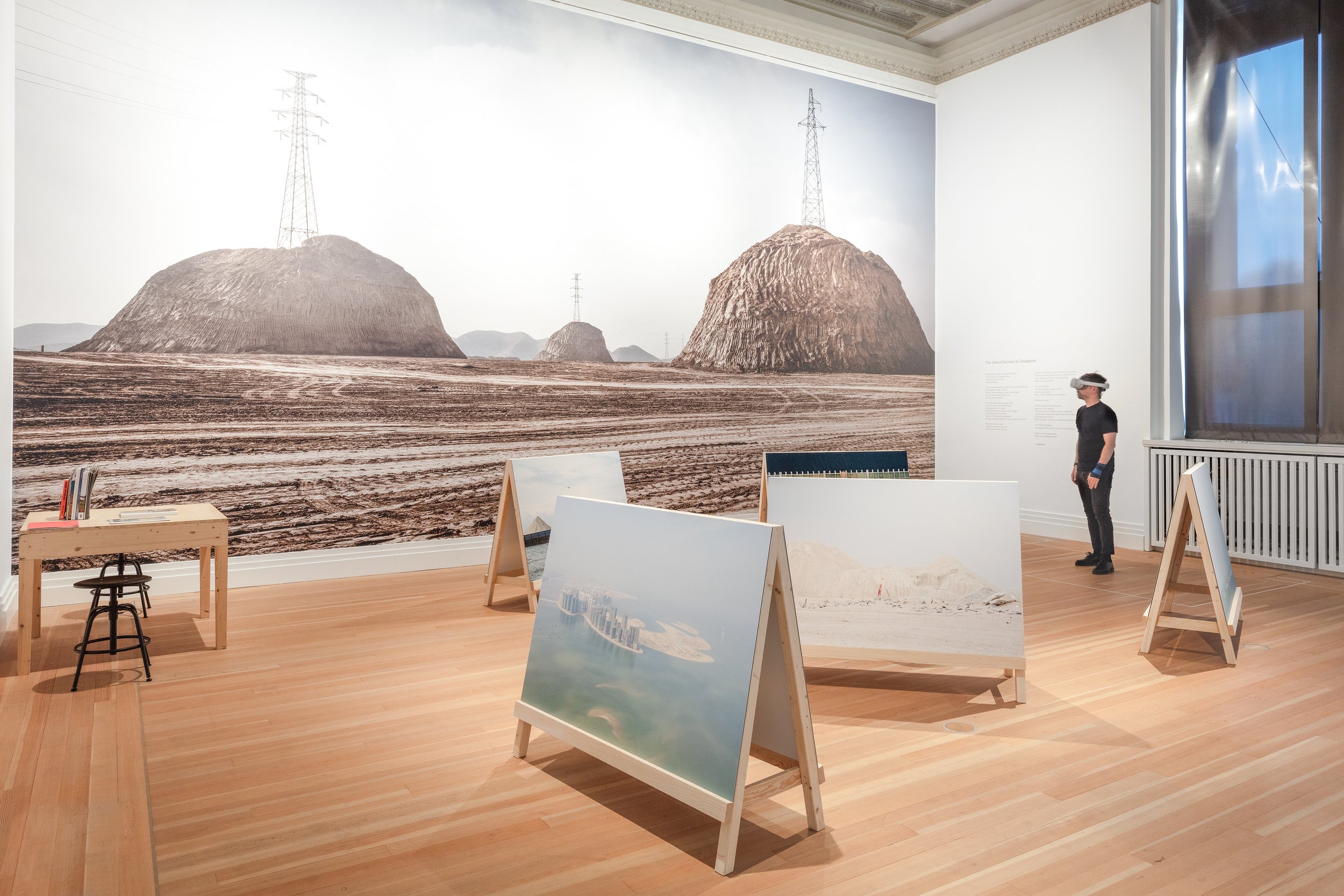
Sim Chi Yin, Shifting Sands, 2017, photographic installation, dimensions variable; The Garden of No Return, 2023 VR installation, 10:36min. Installation view in group exhibition Indigo Waves and Other Stories: Re-Navigating the Afrasian Sea and Notions of Diaspora (2023) at Gropius Bau, Berlin. Photo by Andre Carvalho.
What do you think has been/is your purpose? Has your purpose remained steadfast or evolved over the years?
My work has evolved away from the earlier attempts to “witness”, being evidential, and being more self-consciously didactic or prescriptive. But I think my broad sense of my work having some sort of social purpose has remained unchanged from the time I started out as a photographer in my teens. My methods have changed, my position and person have softened but my overall purpose feels similar: that the work should offer a more nuanced, complex way to understand the past, to think about the present and future, to leave some sort of trace for others who might find it interesting later.
Becoming a parent six years ago shifted my purpose to also include thinking about trans-generational inheritances, about how we might transform or transpose traumatic histories and archives for future generations. Or do unremembered chapters continue to haunt us, and cycles of violence and trauma loop? These are active lines of enquiry and on-going questions that I pursue in and through the work I have made since becoming a parent.
“Becoming a parent six years ago shifted my purpose to also include thinking about trans-generational inheritances, about how we might transform or transpose traumatic histories and archives for future generations.”

Sim Chi Yin, 归舟: Longings, Returns, 2026, exhibition installation view at Storefront for Art and Architecture, New York. Photo by Luis Corzo.
Are there any ongoing or upcoming exhibitions/ projects you wish to share? (Feel free to briefly discuss your new solo show and other projects, the interview is slated to be published in August)
My solo 归舟: Longings, Returns is showing at Storefront, New York, till 29 Aug. It uses the classical Chinese motif of the returning vessel to speak to the multiple returns in my telling of the story of the mass forced repatriations from Malaya between 1948 and the early 1960s. The invitation for the commission initially came from curator Jessica Kwok who has since left for Asymmetry Foundation in London. I am very grateful for the invitation and the very special collaboration I have developed with the Storefront’s incredible team and curator Guillermo Ruiz. On my end, I worked with multimedia artist Nick Roux who had also collaborated with me on my theatre performance in 2024 – and he won a Straits Times Life! Theatre Awards prize that year for “best multimedia design”. Nick was a thought partner and took charge of all technical aspects of my production for New York.
I am also part of the group exhibition Art Remembers at National Gallery Singapore. It will contain a room of my work on Malaya, the most substantive showing of this project in Singapore thus far. Some of the works displayed are drawn from the collection of the Singapore Art Museum, which acquired 33 works from the project earlier. M+ in Hong Kong and Brooklyn Museum in New York also have collected my work from the same project, as well as a few private collectors in Singapore. The newer works use technologies of viewing and photography to engage with difficult histories. It will be interesting to see how the work is read in Singapore.
And finally, what would be a key piece of advice to young art practitioners (artist, curator, manager etc.)? What has been a way of working, a certain kind of attitude etc. they can learn from to apply to their own careers?
I came to art late and as a third career, so I am still really only learning. I am not sure if I can be dispensing advice! I suppose staying the course is important, being clear about what it is you are about, and not taking it all too seriously – art is only one slice of life!
Sim Chi Yin’s 归舟: Longings, Returns (2026) is on view at Storefront, New York from 8 to 29 August 2026. For more information, click here.