Midpoint: Delia Prvački
‘The Unbuilt Museum of Two Curtains’ with Above the Vault
Midpoint is a monthly series that invites established Southeast Asian contemporary artists to take stock of their career thus far, reflect upon generational shifts and consider the advantages and challenges of working in the present day.
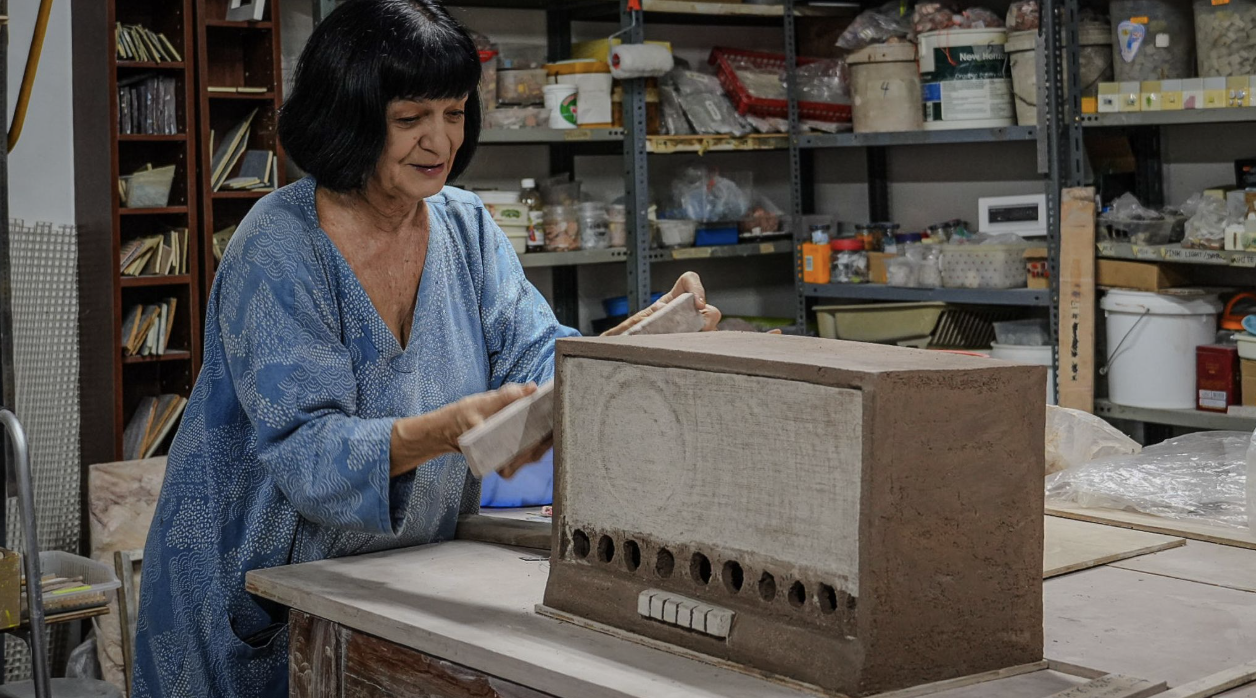
Delia Prvački working in her clay room. Photo by Georgina Lim. Image courtesy of the artist and Above the Vault.
Romanian-born Singapore artist Delia Prvački reflects on nearly six decades of artistic practice. Trained at the Institute of Fine Arts in Bucharest before establishing her practice in Yugoslavia, Delia relocated to Singapore in 1991—a significant transition that required her to rebuild her working studio practice from scratch, forging a pivotal path in Southeast Asian contemporary ceramics and public art.
Over the decades, her practice has been framed by milestone exhibitions, including her early retrospective De Rerum Natura at the Museum of Decorative Arts in Belgrade (1986), her career-cementing millennium exhibition Celebration at Sculpture Square (1999–2000), and her exploration of site and extraction in MINE (2010) and MINE/2 (2017). Most recently, she held her long-term survey Continuity, Persistence, Line: Thinking Through Clay at the NUS Museum (2024–2026).
Ahead of her upcoming solo exhibition in January 2027, The Unbuilt Museum of Two Curtains, produced by Above the Vault, Delia discusses her career milestones, daily studio routines, and the personal and political histories that continue to shape her work across ceramics and bronze.

Delia Prvački unloading a batch of freshly fired works from her studio kiln in the former Yugoslavia, 1991. Image courtesy of the artist.
Looking back, could you share a decision or event that marked a significant turn or moment in your path as an artist?
Leaving Europe and relocating to Singapore in a moment of emergency was an unexpected turn in my path as an artist. I did not come alone; Milenko Prvački, my husband, arrived in Singapore first, after accepting a job offer. At the same time, we were driven by a strong rejection of the ideology starting to take the form of a civil war in Yugoslavia. Now, 35 years later, reflecting on such an epic transformation of everything that constituted our personal and professional lives, I consider moving to Singapore the most radical and life-changing pivot.
When I relocated at 41 years old, I already had an established art practice, yet I found myself in a totally different world in Southeast Asia. I had to reinvent myself and rebuild all the components of a working studio space from scratch, having left behind my atelier with many works in progress. Logistically, I had to find practical solutions for sourcing materials and equipment, such as buying a kiln.
Yet, from an artistic perspective, this immense challenge was equally motivating and inspiring. Following my creative impulses, I immediately decided to use the kitchen area in our family space to continue working in the same spirit and on a similar body of work as before coming to Singapore.
Persistence and continuity have been my mantra.
“Now, 35 years later, reflecting on such an epic transformation of everything that constituted our personal and professional lives, I consider moving to Singapore the most radical and life-changing pivot.”

Brother Joseph McNally and Delia Prvački at the opening of Celebration in Sculpture Square, with A Piece of Sky, No. 7 (1999) in the background, December 1999. Image courtesy of the artist.
When has been a milestone achievement for you as an artist, and why has it been particularly memorable?
It was near the end of 1999 when I was invited by Sculpture Square to hold an exhibition in their gallery. With only seven weeks to pull it off, planning, realising, and implementing a sculptural installation in a large, distinctive space was both challenging and frightening. I was motivated by that extraordinary point in time, at the turn of the new millennium. Spontaneously, upon accepting the invitation, I titled the exhibition Celebration.
I conceptualised a site-specific setting dedicated to the arrival of a new era. Using a duo of keramo-sculptures, Suspended Garden (1999) and Amulet (1999), that were already nearing completion in my studio, I took advantage of the gallery’s ceremonial, quasi-religious setting and created two large-scale works that I still consider significant in my oeuvre.
I also created a very large blue sculpture titled A Piece of Sky, No. 7 (1999), featuring 2,000 golden and platinum porcelain stars manually made and set into a main body of glassfibre reinforced concrete (GRC) coloured with cobalt pigment. Symbolising the dreams, hopes, and achievements of humanity as we entered the year 2000, that work is now in the NUS Museum collection and exhibited in a public area. The other composition, 2000 Blades of Grass (1999), was charged with a meaningful message representing life and nature, perpetuating regardless of the passage of time. I am still very much in love with that composition.
For me, Celebration remains a milestone. The opening was truly special, with Brother Joseph McNally as the Guest of Honour, Gunalan Nadarajan writing the essay for the humble catalogue I put together with Milenko’s help, and curators from SAM, galleries, and many dear friends in attendance. It was a precious moment when I felt my sense of belonging to the Singapore art community was cemented by recognition from critics and fellow artists.

Delia Prvački, Folded Book, 2002, stoneware and glaze, 43 x 136.5 x 24cm. Photo by Rifdi Bin Rosly. Image courtesy of the artist and Above the Vault.
Could you walk us through a typical work day, or a typical week? Are there routine(s) you follow to nourish yourself/your artistic practice?
For the last couple of years, I have been blessed with a stable lifestyle. At the moment, my entire life is focused on my art practice, and I am very selective, even a bit selfish, with my time. I follow a structured daily programme, including routines like swimming, walking, healthy eating and weekly massage therapy.
When I wake up, I like to look out the window to catch a glimpse of the blue sky and step out onto the balcony to check on our beautiful plants and the occasional bird's nest. Coffee is a must.
I often take the bus from home to the studio. I have made sure to surround myself with plants there as well, as I love the space to be clean and orderly. I routinely work in my designated clay room for about six to seven hours daily, while listening to music. During intense periods of work, I rarely have visitors. I return home before 8pm for dinner with Milenko, keeping up with global news on TV before going to bed.
It may sound like a regimented daily routine. Yet I confess to feeling a certain nostalgia for earlier years. Up until a decade ago, my days were filled with a more complex and demanding rhythm that I thoroughly enjoyed. Back then, I had to balance my practice with family responsibilities as a young mother, and later as a grandmother, alongside the domestic duties of home life, gardening and knitting.
Could you describe your studio/ workspace? How has it evolved over the years? What do you enjoy about it, and what do you wish to improve?
Oh, this is my vulnerable point! Many times in the past, I complained about not having a proper space like other ceramicists have. My working studio space was always somehow improvised – perhaps because I never made traditional pottery; it was always more of a multipurpose area where any creative activity could happen. For a more professional environment, I preferred going to factories.
Over the years, my setup has evolved. For the last 12 years, I have had my own room in the same building as my studio, a separate space to protect the main area from dust. What I need is simple: a large table, a slab roller, and a kiln. Although I have collected many tools specifically for modelling and ceramic making, I enjoy using my hands and fingers as much as possible, alongside all sorts of domestic utensils and found objects to achieve what I envision.
Working with clay, plaster, glazes, mosaic, and cement is messy – when I am immersed in the creative process, cleanliness is the last thing on my mind. But as soon as a piece is completed and out of the kiln, I need a suitable location to store or display it. Right now, I am considering resetting and updating my workspace to add more storage space.

Guest of Honour Jean Wee delivering a speech at the opening of Delia Prvački’s exhibition Mine/2 at The Substation, 2017. Image courtesy of the artist.

Delia Prvački, Grand Classic Cornucopia, 2020, stoneware, glaze and wood, 150 x 150 x 80cm. Photo by Chan Soo Chee. Image courtesy of the artist.
What has become easier or more difficult to do as time has gone by?
It is interesting for me to think introspectively and analyse my art practice as layers of specific circumstances. When it comes to realising an artwork, it really depends on the material, medium, and technique – there are no strict rules. For me, the first stage, the gestation and conceptualisation of an idea, is actually the most important part of a project. Once the idea, design, and planning are clear, the execution follows smoothly.
At this stage in my career, simply working with clay – modelling and finalising the form and texture – has become the easiest part. I usually do it very fast and efficiently.
What has been more challenging and physically difficult is loading large, heavy pieces into the gas kiln for firing. Because of this, the recent projects I realised in bronze were very fulfilling. I enjoy the process of developing an idea in bronze – I find it suitable for me because it requires less physical effort, even though it demands very detailed preparation.

Site-specific installation at Esplanade. Delia Prvački, Tropical Day and Night, 2025, ceramic on metal structure, dimensions variable. Photo by Chan Soo Chee. Image courtesy of the artist.
What do you think has been/is your purpose? Has your purpose remained steadfast or evolved over the years?
I have not thought of my art practice in terms of purpose or goals – to me, art-making is a calling, a talent I have been gifted with, and my way of being and expressing myself. I have been a professional artist for nearly six decades now; I think of it as my fate and my mission.
When I was younger, I was more intuitive and emotional. I was keen on developing my art within the parameters of what I had learned at the art academy, drawing on information accumulated through reading and by following artistic developments in exhibitions, biennials, museums, and galleries.
At my age now, of foremost importance is to convey ideas and statements about life and the world through my work; therein lies the meaning in all I attempt to do.
“I have not thought of my art practice in terms of purpose or goals – to me, art-making is a calling, a talent I have been gifted with, and my way of being and expressing myself.”
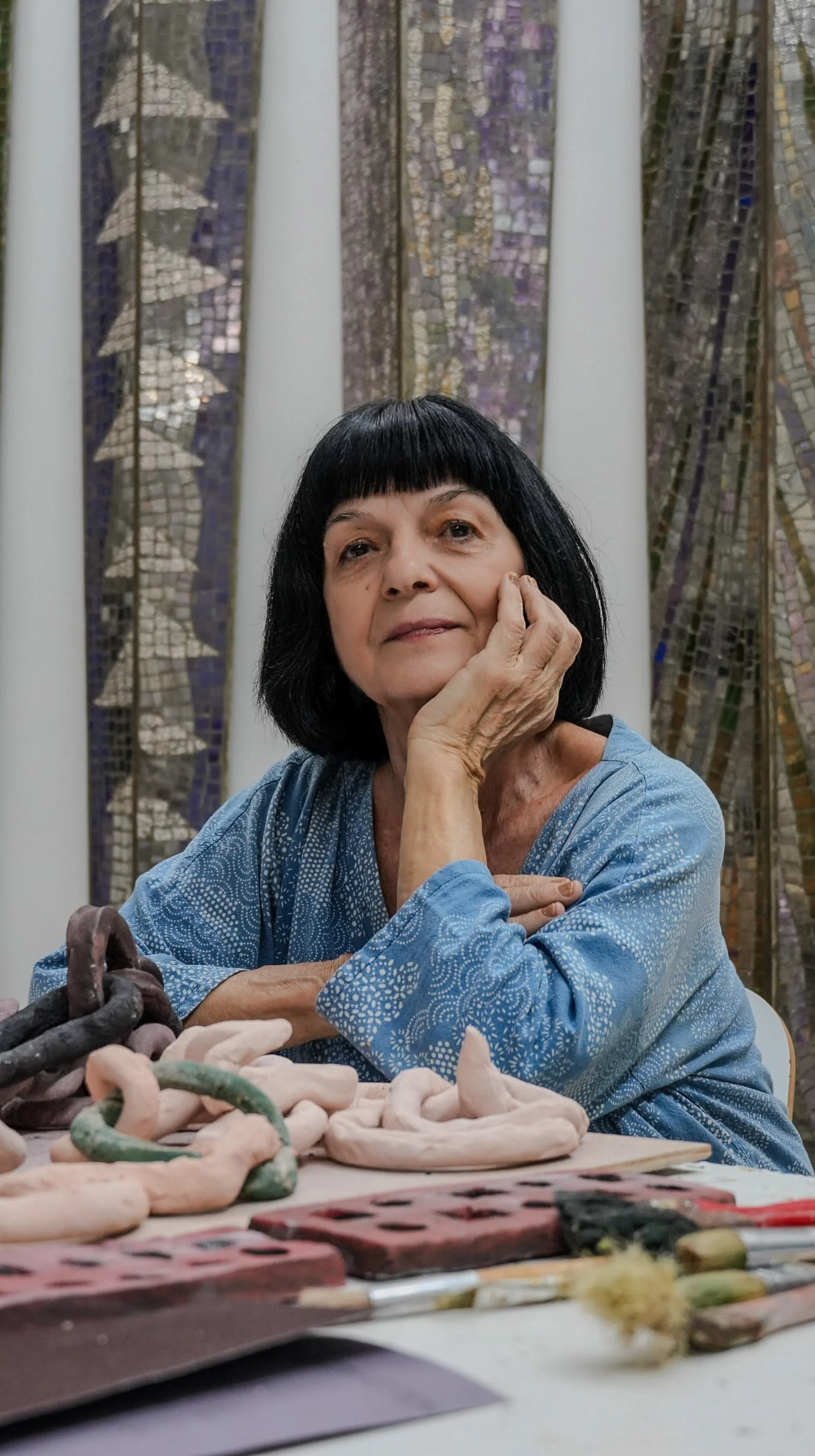
Delia Prvački. Photo by Georgina Lim. Image courtesy of the artist and Above the Vault.

Delia Prvački, Ring, 2026, stoneware, green and blue pigment, 40 x 53.5 x 53.5cm. Photo by Rifdi Bin Rosly. Image courtesy of the artist and Above the Vault.
Could you share more about the body of work you are presenting in January 2027?
The body of work I am presenting in January 2027 brings back memories of the Iron Curtain era – specifically, the time I lived in Romania from 1950, when I was born, until 1975 – and coincides with turbulent times in global politics today. It is an exciting project that is, in a way, autobiographical. As opposed to depicting detailed memories, I am using strong, tactile materials like bronze and ceramics to translate the encounters, visions and imaginings I experienced as a child and adolescent. While a few pieces were completed several years ago, the majority of this body of work has been created over the past year.
Through my installation and sculptural work, I try to bring to life the emotional, unseen side of those historical events and the impact that period had on people's psyches and inner lives. For me, the Iron Curtain embodies a duality: it was an ideological barrier that divided and obscured, but also a shield behind which cultural memory and human resilience endured.
I expect the exhibition to generate a range of reactions. While it is a deeply personal project, it comes from a desire to connect with the audience through history and shared human experience. I hope the public will immerse themselves in The Unbuilt Museum of Two Curtains and take the time to reflect on the past and what it means for us today.
In line with the theme, the Iron Curtain serves as an allegorical motif. All the works will be exhibited for the first time, introducing new forms, compositions, and colours. The most striking pieces are the bronze sculptures – it is my first time showing works in this medium in a solo exhibition, though some may remember my three large commissions at Ardmore Park in 2001. They are definitely a highlight.
The ceramic works – which I call Keramosculptures – are equally evocative. Showing this body of work in the unconventional space of a black-and-white colonial house naturally invites introspection. In planning the flow of the presentation with the exhibition producer, Wong Pei Lin from Above the Vault, we have taken into careful consideration the details that will create a theatrical atmosphere on site.

Delia Prvački, A Secret House, 2026, stoneware and glaze, 64.5 x 39 x 34cm. Photo by Rifdi Bin Rosly. Image courtesy of the artist and Above the Vault.

Delia Prvački, The Beginning of the Fall, 2025, bronze, 78 x 81 x 7cm. Photo by Rifdi Bin Rosly. Image courtesy of the artist and Above the Vault.
And finally, what would be a key piece of advice to young art practitioners (artist, curator, manager etc.)? What has been a way of working, a certain kind of attitude etc. they can learn from to apply to their own careers?
There is always a bit of a generation gap and a discrepancy in views between older and younger practitioners. Today, young artists face a very challenging environment, overwhelmed by an influx of information and images from social media. At the same time, the abundance of disclosed works in progress, technical demonstrations, and visual tricks can be deeply confusing. Throughout my career, I have avoided falling under external influences; instead, I have kept the lessons from my professors at the art academy sacred.
To be clear, I make no distinction or discrimination among various visual art forms. But when it comes to ceramics, there is a real danger in exposing young artists to the temptation of attractive or spectacular execution. So much of what is shown on social media is easy to copy and replicate.
What lies behind any accomplished artist is originality and depth. A sustainable practice and a lasting artistic voice require continuous, unconditional work and experimentation with materials, free from the demands of commercialism. My advice to young practitioners is simply to be honest, and to make a clear distinction between work created for commercial purposes and the work into which they pour their heart and imagination.
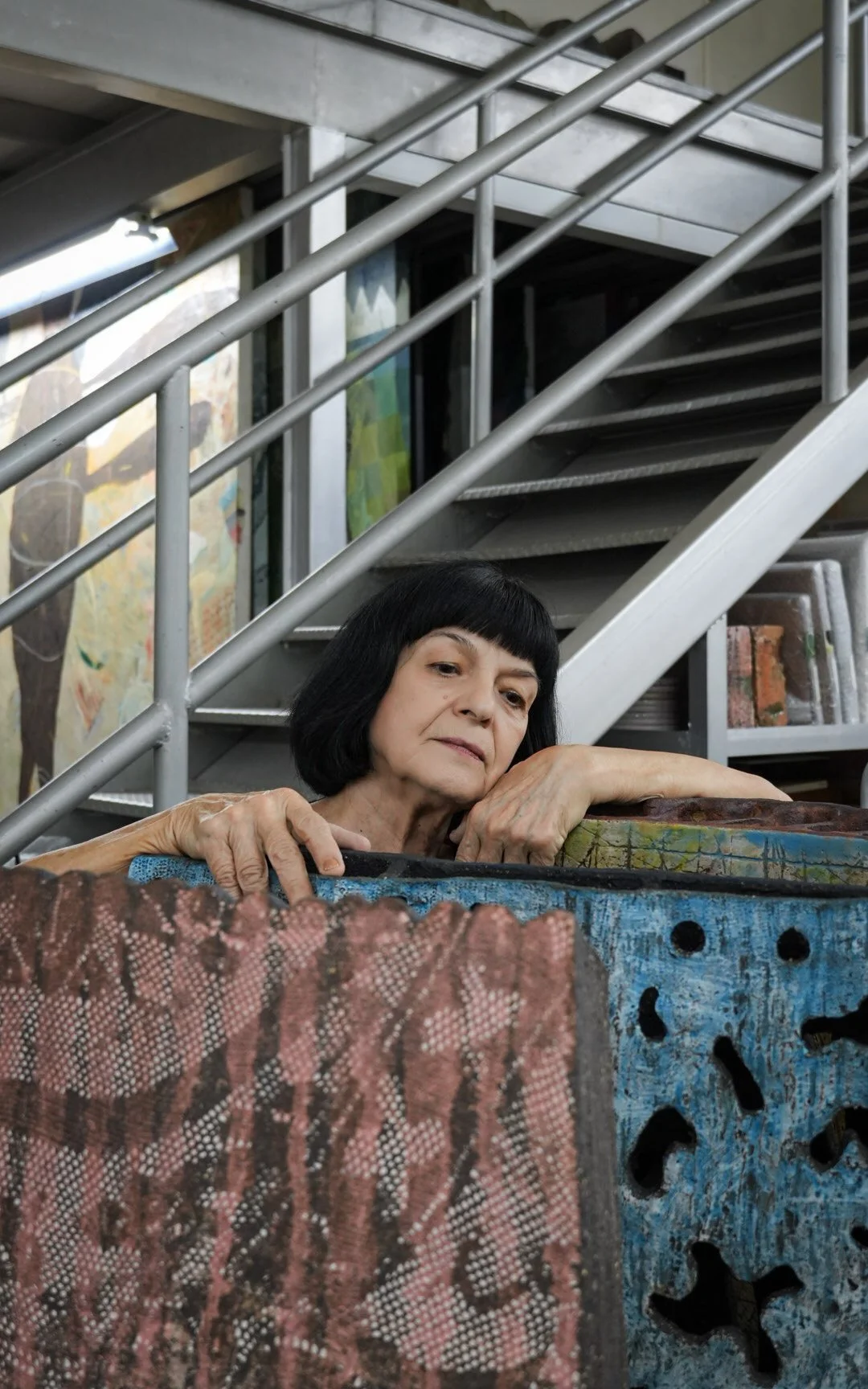
Delia Prvački. Photo by Georgina Lim. Image courtesy of the artist and Above the Vault.
The Unbuilt Museum of Two Curtains, a solo exhibition by Delia Prvački, and produced by Above the Vault, will be shown at Bayin Foundation in Singapore from 9 to 31 January 2027.
Front & Off-Centre, our affiliated cultural agency, is taking care of the communications for The Unbuilt Museum of Two Curtains. Please get in touch at info@from-the-margins.org if you would like to access the press kit.