
Midpoint: Nilo Ilarde
Philippines conceptualism after Chabet
Midpoint is a monthly series that invites established Southeast Asian contemporary artists to take stock of their career thus far, reflect upon generational shifts and consider the advantages and challenges of working in the present day.
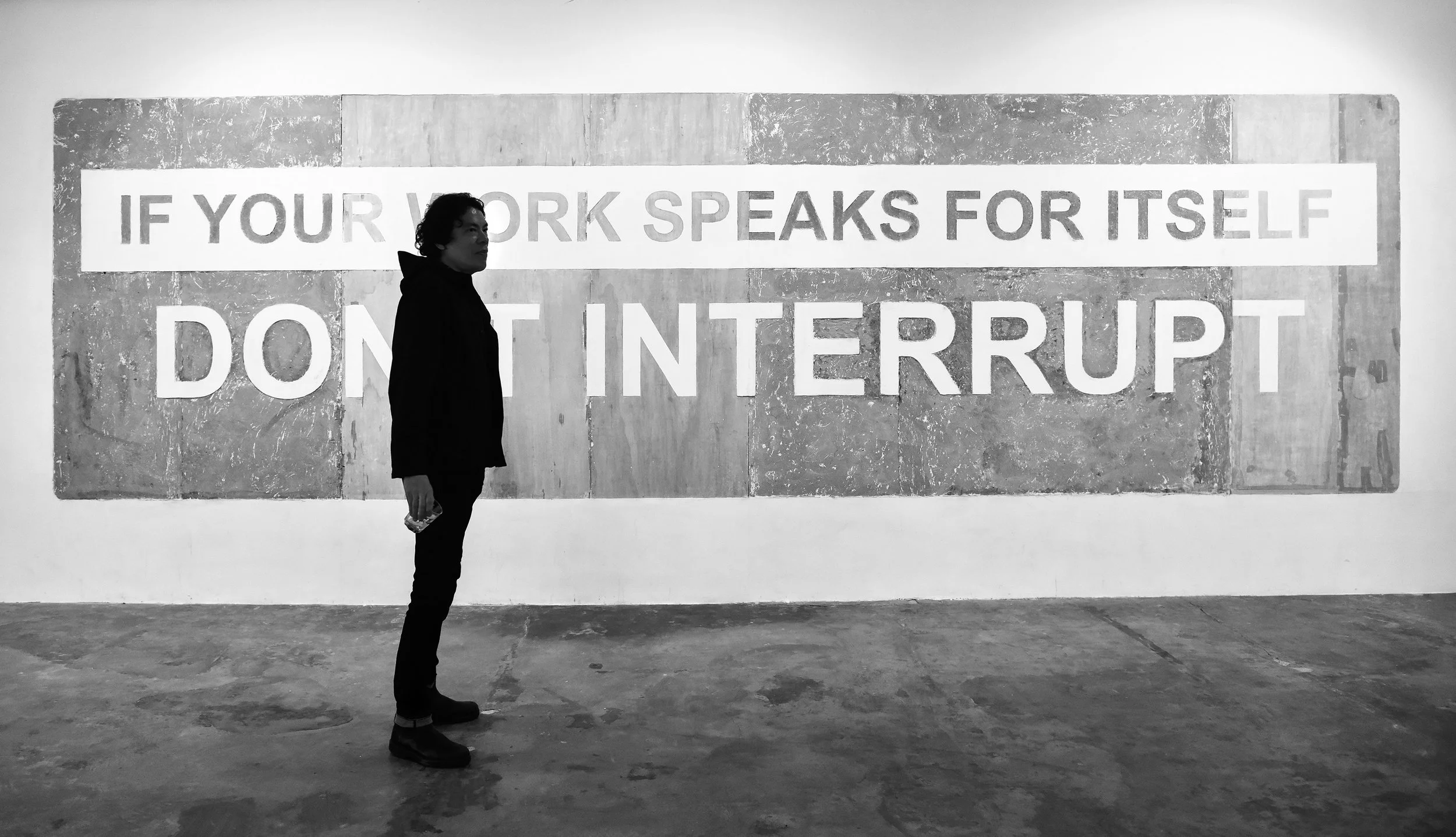
Nilo Ilarde. Photo by MM Yu.
Nilo Ilarde (b. 1960, Philippines) is a conceptual artist best known for works that examine and subvert assumptions about painting. His practice engages with the status of the art object and institutional structures of the art world, while maintaining a rich sense of form. This sensitivity to space and material dialogue is carried through to the exhibitions he has curated on Philippines art. Nilo has presented numerous solo exhibitions since 1987, and his works have been shown at venues such as Finale Art File, MO Space, Osage Hong Kong, Art Stage Singapore and Singapore Art Museum.
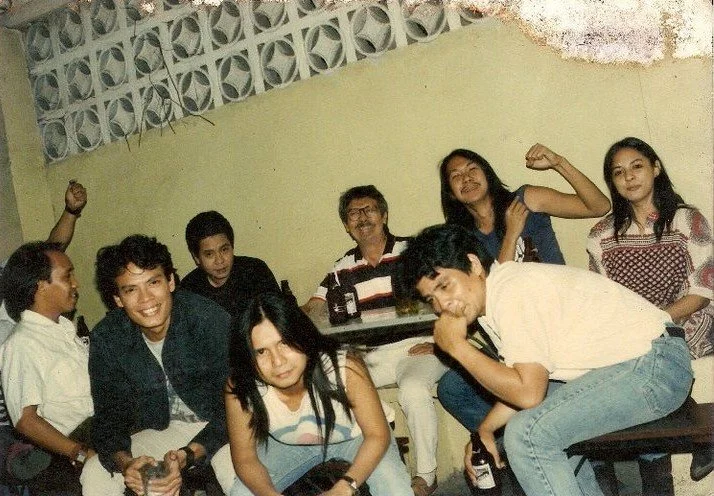
Artists gathering at Nanette’s in the late 1980s. Photo by Bert Antonio.
Looking back, could you share a decision or event that marked a significant turn/moment in your path as an artist?
The question brings me to the seminal conceptual art piece and social sculpture by Tom Marioni, called FREE BEER (The Act of Drinking Beer with Friends is the Highest Form of Art) (1970-1977). It reminds me of the discussions my peers and I had with Roberto Chabet, who was our professor in university. It happened in Nanette’s, our well of the night, where we spent hours talking and drinking beer. Listening to Chabet inspired me to say the least, and opened new doors. You could say these were my formative years.

Nilo Ilarde, Drawing a Line Between Painting and Sculpture, 1999 (reconstructed 2008), cast graphite and resin. Dimensions variable. Installation view in MO Space, Taguig City, Philippines. Photo by MM Yu.
When have been milestone achievements for you as an artist, and why have they been particularly memorable?
We all have to work on our originality. We create it; it does not create us. In the 1990s, I made a work I called Drawing a Line Between Painting and Sculpture. I collected hundreds of used Mongol pencils from my daughter's school, carved out the wood casing, collected the graphite, and crushed them to powder. The graphite powder was then cast in resin in the shape of one of the used pencils, which was presented with all its scars and bite marks. I installed it where the floor meets the wall, a no man’s land. It was an eureka moment. This is drawing, the same way Richard Long walking a continuous line into a field of grass is also drawing.
Could you walk us through a typical work day, or a typical week? Are there routine(s) you follow to nourish yourself/your artistic practice?
I start my day by making myself a cup of coffee. Then I get a book, and read. Books are toolboxes.
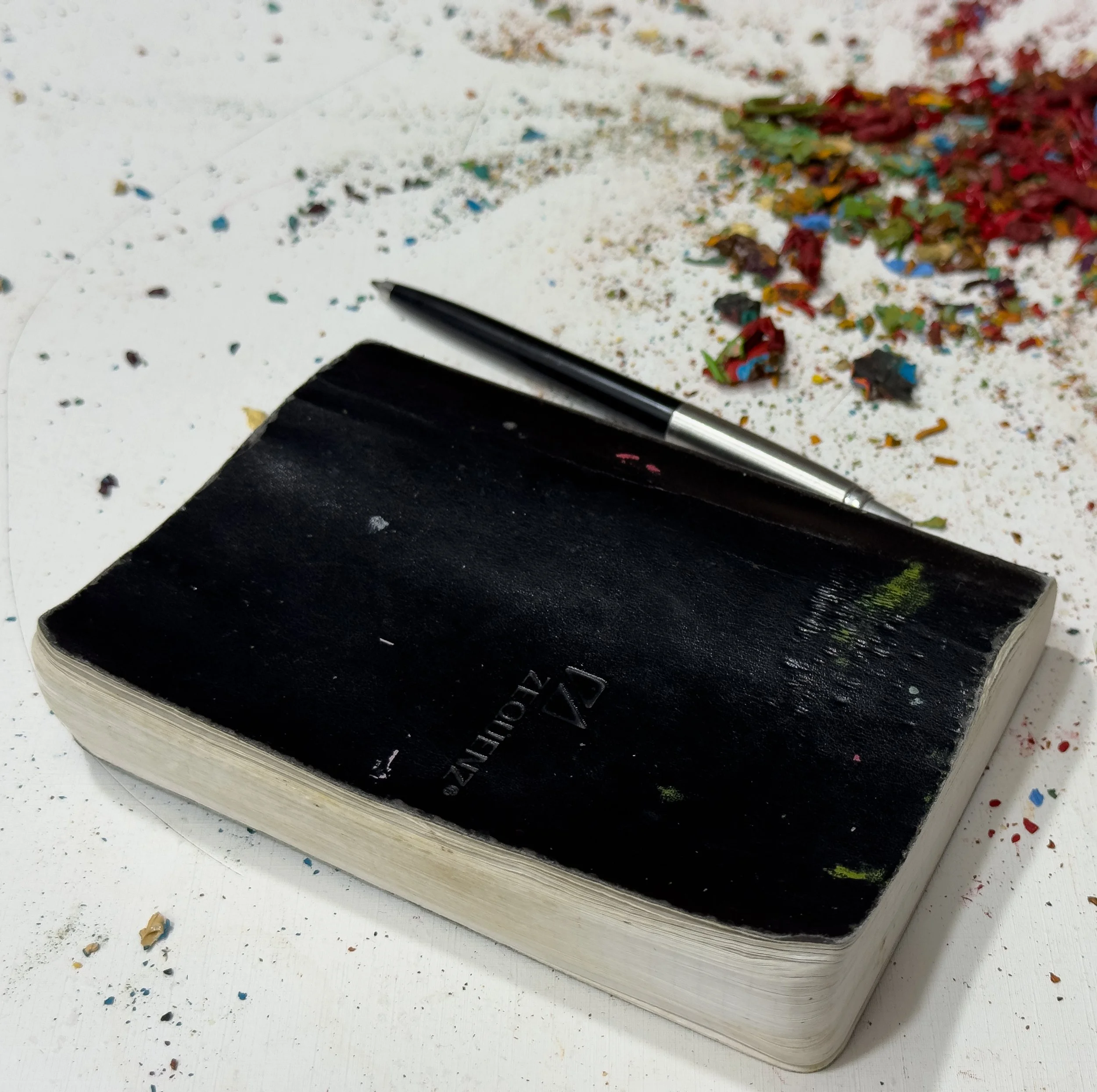
Nilo’s notebook and pen. Photo by Angelyn Marquez.
Could you describe your studio/ workspace? How has it evolved over the years? What do you enjoy about it, and what do you wish to improve?
My studio is a notebook and a pen. The work is executed in the exhibition space days before the show opens.
What has become easier or more difficult to do as time has gone by?
I am one of the few people who still does not have any social media accounts. I only started using Google during the pandemic. This has made accessing information a lot easier, and has been extremely helpful.
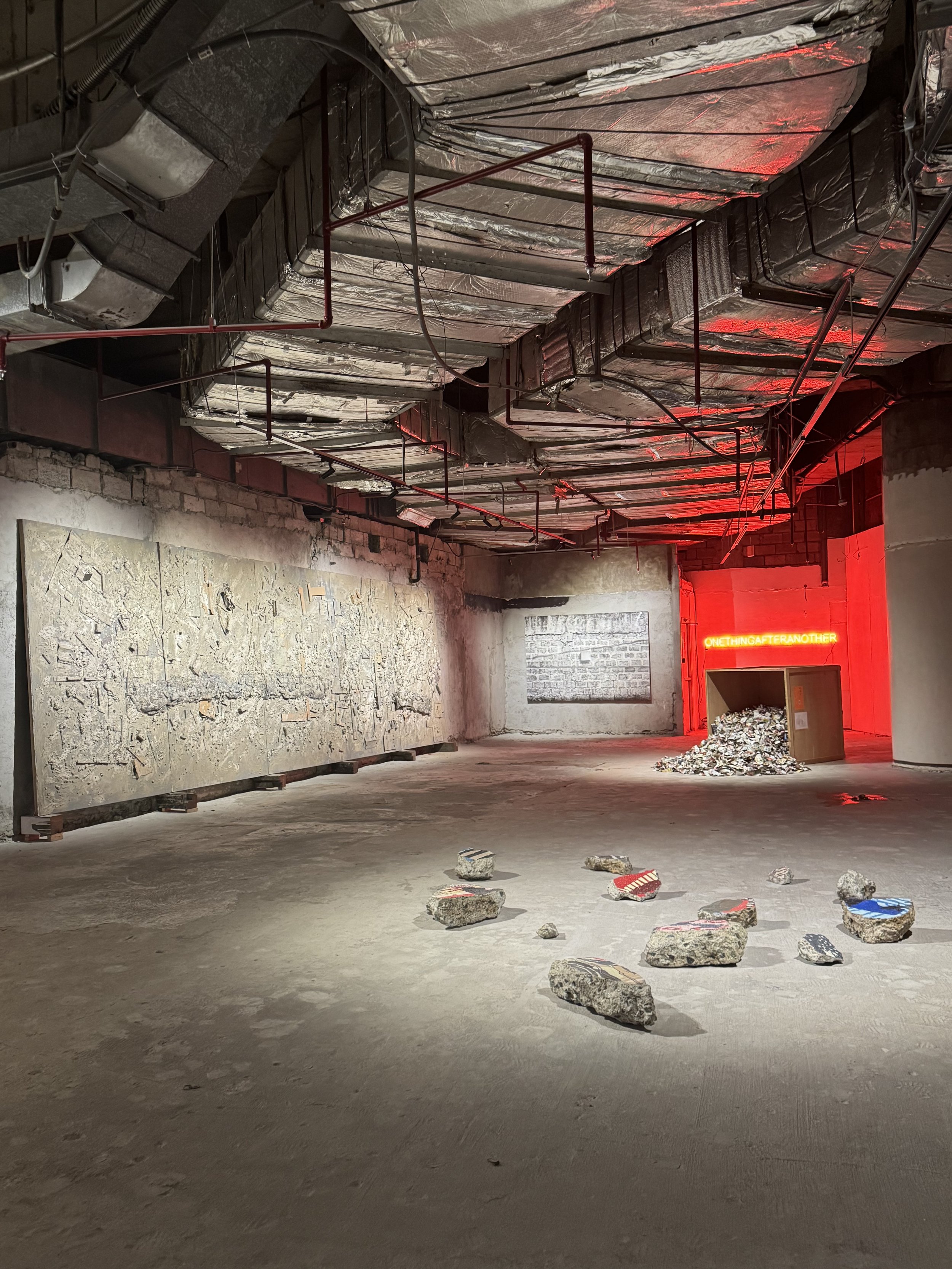
Here & Now & Now & Then, 2025, exhibition featuring works by Bernardo Pacquing, Poklong Anading, Jan Balquin, Nilo Ilarde and Roberto Chabet. RCBC Tower, Makati City, Philippines. Photo credit by Angelyn Marquez.
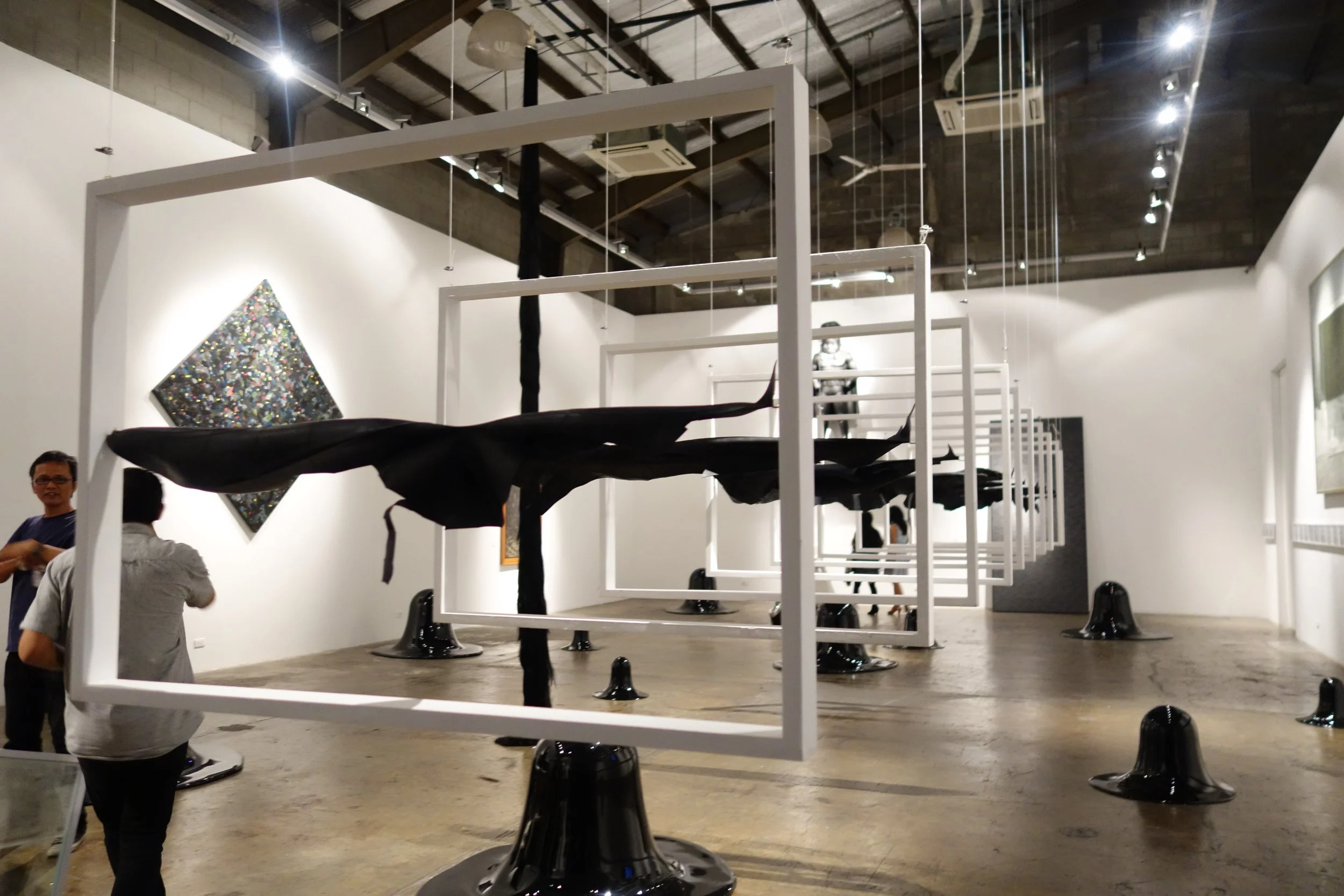
stick up don’t move smile (reinventing black, 1957 to today), 2014, exhibition installation view at Finale Art File, Makati City, Philippines. Photo by MM Yu.
How would you describe the relationship between your artistic practice and curatorial work?
I am a painter who curates, not a curator who paints. I do not think it would be fair to call myself a curator. I would rather call myself an exhibition maker. Installing exhibitions is like making a collage. The wall is a picture plane, and I am basically hanging squares, rectangles, and other shapes and objects. But it is not as simple as that. These shapes have colours, images, meanings, and narratives. Paintings thrive in each other’s company. Each one learns from the others.
“I am a painter who curates, not a curator who paints.”
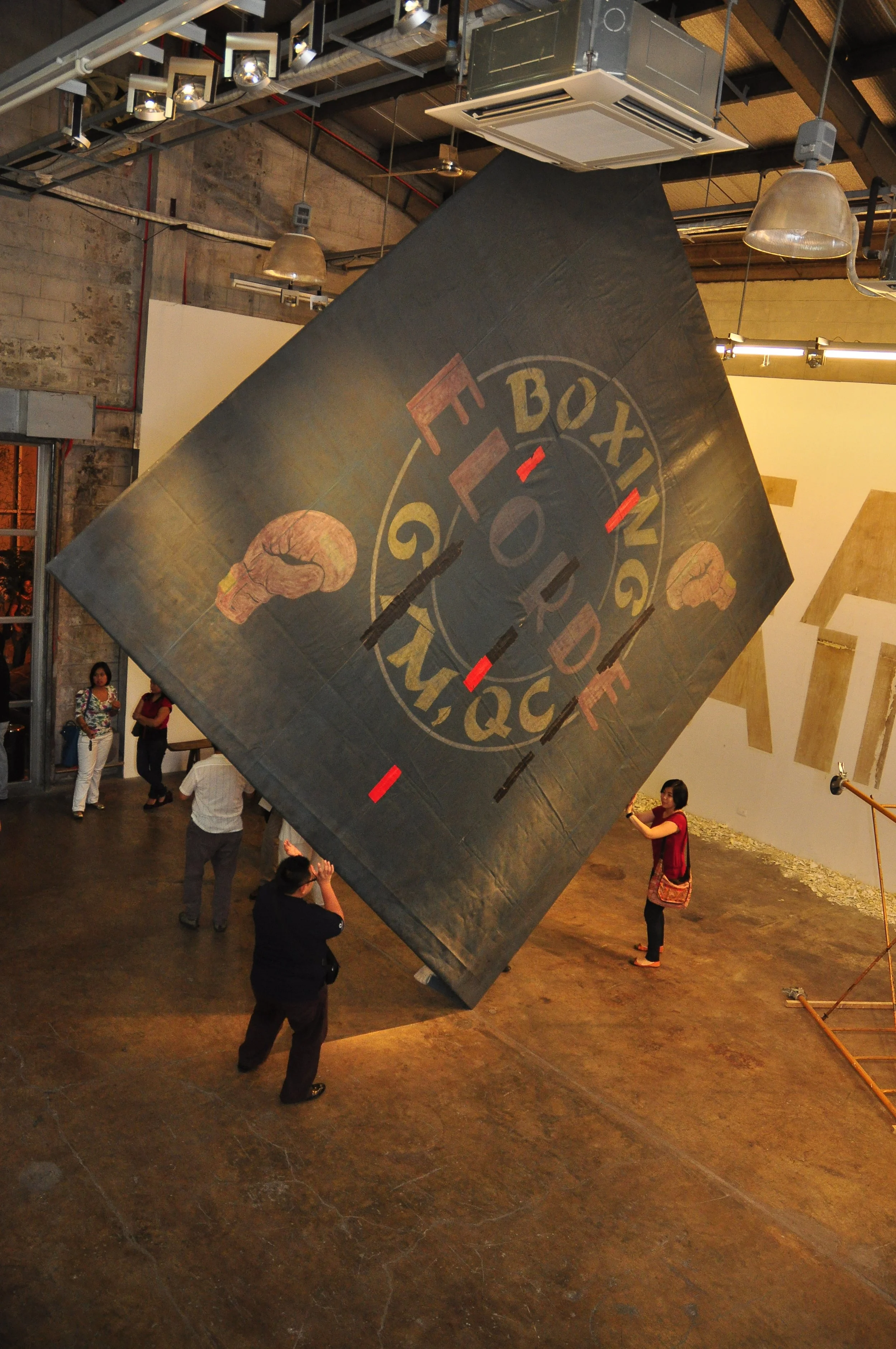
Nilo Ilarde, The Triumph of Painting, 2010, used boxing canvas from Elorde Boxing Gym, dimensions variable. Exhibition view in Finale Art File, Makati City, Philippines. Photo by MM Yu.

Nilo Ilarde, There's always a nail in a wall somewhere that can take a painting, 2013, nail, mirrors, easels, dimensions variable. Exhibition view in West Gallery, Quezon City, Philippines. Photo by MM Yu.
What do you think has been/is your purpose? Has your purpose remained steadfast or evolved over the years?
To practise a quiet, empty mind, put in the effort to make art look effortless, and to focus on substance and eliminate the unnecessary.
And finally, what would be a key piece of advice to young art practitioners? What has been a way of working, a certain kind of attitude etc. they can learn from to apply to their own careers?
Money is not a measure of success. It can make more art possible, but has it made art better?
Success does not mean anything if it is not open to failure. Young artists should take risks and not be afraid of failing, even if they risk falling flat on their face.