
Midpoint: Việt Lê
On being a shaman-artist, SEA sạ and healing
Midpoint is a monthly series that invites established Southeast Asian contemporary artists to take stock of their career thus far, reflect upon generational shifts and consider the advantages and challenges of working in the present day.

Việt Lê at Huntington Gardens & Library. Photo by Dr. Wendy Cheng.
Việt Lê is an artist, academic, and curator whose practice focuses on sexualities and spiritualities. Their hybrid projects encompass experimental film, ritual performance, pain-tings, installations and text. They are the author of Return Engagements (Duke University Press, 2021) and collaborated with Latipa on the art book White Gaze (Sming Sming Books | Candor Art, 2019). Lê has presented their work at the Shanghai Biennale, Rio Gay Film Festival, the Smithsonian and other venues.
The conversation is presented in an experimental format where the responses to each question serves as a chapter preview in a spiritual healer’s guidebook they are writing. In this interview, Lê reflects on their journey towards a spiritual calling and what a creative practice means.

Việt Lê, untitled self-portrait, 1999, gelatin silver print, 11" X 14" (27.9 x 35.6 cm). Edition of 7 + 1 AP. Image courtesy of the artist.
Looking back, could you share a decision or event that marked a significant turn or moment in your path as an artist?
Preface: The Wound is a Window
The significant turning of the wheel is now: As an artist-shaman and intuitive reader/ healer, I’ve encountered other healer/ visionaries in varying degrees of professional practice and experience who may just need simple best practice tips/ recipes on etheric boundaries during or after sessions, or dealing with living, ancestral, and non-living influences. Do not be afraid of ghosts, haunting is just a call for help; common portals are fear, anger, desire, despair…
Let me backtrack: In the last year of my MFA programme in 2000 at University of California, Irvine, where I later taught, I had surgeries for a debilitating nerve tumour which caused tremendous physical pain. This still affects me today, and I am disabled. Taking no time off, I went into a PhD programme at University of Southern California (USC) where I was a research assistant and translator for Professor Emeritus Janet Hoskins. At Đạo Mẫu (Mother Goddess) deity possession ritual ceremonies in Orange County, master mediums requested to speak with my mom, and asked me to come back to the temple repeatedly. They said I had a very strong calling and should “serve the spirits.” I never went back, telling them that I was busy with my dissertation, and academic and artistic careers.
After completing my PhD and a few years into my tenure, I became physically unfunctional again. I could not walk, talk, sit, sleep without incredible pain and had to take a two-year medical leave from my academic position. In addition to a range of traditional and “non-traditional” healing methodologies, what helped me recover was making “pain-tings” (bad pun) and an art film which is not released. I also asked other artists and healers–ranging from medical practitioners to shamans– how they approached healing.
15 years later, in 2023, after several careers and chronic illnesses, I became formally initiated as an indigenous Vietnamese shaman. Janet Hoskins, now a friend, told me that a Đạo Mẫu apprenticeship cycle takes exactly 15 years. All of my fears and failures, all of those years I was bereft and beatific was an apprenticeship. Fantastical.

Việt Lê, cycle, 2023, installation view at Headlands Center for the Arts. Image courtesy of Headlands Center for the Arts.

Việt Lê, đến đền den, 2024, exhibition installation view at Sàn Art, Ho Chi Minh City, Vietnam. Image courtesy of Sàn Art.
What has been a milestone achievement for you as an artist, and why has it been particularly memorable?
II. Becoming-orchid, becoming-wasp; becoming-shaman.
Presenting myself at different temples after the initiation ceremony, the deity statues’ eyes gleamed with spirit, everything throbbed and everything now made sense: the delays, the failures, the illnesses, even recently recalling my childhood rape in a refugee camp. At times excoriating, the body keeps the score. Though mentally and physically excruciating, I had to detoxify, metaphorically and literally, my spirit and body for the gods. Illness is an initiation. Heal thyself. For everyone has divinity within.
In many cultures, shamans who have a strong calling, or have căn in Vietnamese which translates as spirit “root”, often suffer from mysterious physical and/ or mental illnesses until they undergo initiation. For Korean shamans, this pain or psychosis is known as “shaman sickness”, shinbyeong (신병) or divine illness. Shamans in American Indian communities are also known as “wounded healers” for having gone through life-threatening and life-changing, life-affirming, obstacles. Is pathology a power? Is a shaman an artist?
Two months ago, on the 20th day of the 3rd lunar month (5 May 2026) was my three-year graduation of shaman apprenticeship. It is like getting an esoteric master’s on the way to a metaphysical PhD at Hogwarts Hà Nội.
Could you walk us through a typical work day, or a typical week? Are there routine(s) you follow to nourish yourself or your artistic practice?
III. Best/ beast practices | Best (After-)Lives
Morning meditation for 5 to 15 minutes. Breathing in, I feel what is truly “me”, breathing out, I release what isn’t
Swim/ Hike/ Commune with nature/ walking meditation, occasionally barefoot
Love the soft animal of my body
Boundaries: Etheric, Personal, Physical
Cord-Cutting
Meditation/ prayer/ gratitude: reconnecting with myself, others, spirit(s), the elements

Việt Lê, Charlie's Angels (of History), mirror | stage edit, from the lovebang! series, 2012-2025, mixed media, digital mural print. Image courtesy of the artist.
Could you describe your studio/ workspace? How has it evolved over the years? What do you enjoy about it, and what do you wish to improve?
I started off as a painter so I loved a large sunny studio. After my surgeries, I could not paint or use my right hand. Over the span of 25 years, my studios have shifted from my desktop, as a “post-studio” conceptual artist/ filmmaker, to bedrooms with naked men in various states of arousal as a young photographer doing work on queer desire and despair at Fine Arts Work Center, to dance studios as a performance artist, then to my garage, a temple, and back again. I like to think of the studio or studiolo in relation to French philosopher Roland Barthes’ concepts of studium and punctum: that which pricks, with all meanings of the word pricks.
What has become easier or more difficult to do as time has gone by?
V. Haunting
Ghosts and demons are not what one usually thinks of: ancestral, negative nancy entities. But they are like you and me. The Tibetan tangkas have images of wrathful deities, not beings to tame, but facets of one’s self and one’s divinity to comprehend and have compassion for: wrath, desire, despair. We are ghosts when we become stuck, mired, circling again and again in what ails us. Sometimes we just need help. And sometimes it is okay to tell the ghosts that you cannot help them. It gets harder and easier.

trầnsfiguration, 2023, group exhibition curated by Việt Lê at Slash Art, San Francisco, United States of America. Image courtesy of the artists and Slash Art.
How would you describe the relationship between your artistic practice and curatorial work?
VI. Same Same But (Hits) Different Strokes for Different Folx
A few years ago, I was going to stop curating as I mistakenly thought I had to focus on being an artist. Now I see that artistic practice, cultural organising, research, poetry, spiritual theory and praxis are the same, with some slight code-switching. For instance, in the syncretic Cao Đài faith, Việt Nam’s third-largest religion with 6 million followers globally, messages are received as poems. I think of the Tao Te Ching or Dào Dé Jīng (道德经) as a prose poem/ philosophical/ political/ spiritual text.
In the first half of my life, I was wondering “what is the relationship between trauma and popular culture?” This question manifested as an international traveling exhibition entitled transPOP: Việt Nam Korea Remix (2008) which was curated with the late artist Yong Soon Min, a music video trilogy, an academic book, some academic convenings in Europe, Asia and Africa, and so on. It also shape-shifted into a show I co-curated with Leta Ming and Yong Soon Min entitled humor us (2007) at Barnsdall Municipal Gallery, Los Angeles, which in hindsight led to my interest in humour as healing, hence the bad jokes in this interview.
In the second half of my midwife crisis, my question was, “What is the connection between spiritualities and sexualities?” It has morphed a bit, but it’s become some experimental films, several solo shows and performances, some panels, and an exhibition I curated entitled trầnsfiguration (2023) at (/) Slash Art, San Francisco. It was accompanied with five related programmes at 500 Capp Street Foundation, Headlands Center for the Arts, including a screening and discussion with Trinh T. Minh-ha.
“Now I see that artistic practice, cultural organising, research, poetry, spiritual theory and praxis are the same, with some slight code-switching.”

Việt Lê, trăng trắng | milk moon, 2026, tapestry video projections with sound, CGI (computer-generated image) animations, found objects, beads, hand-made flags, incense, window decals, mirrored video installation. Image courtesy of Artpace San Antonio.
What do you think has been/is your purpose? Has your purpose remained steadfast or evolved over the years?
VII. Purpose-Driven Life/ Porpoise-Driven Life
Increasingly I don’t think there is a “my” purpose or even a “me” nor “I” but rather evanescences, enchantments, or echoes. To evoke my teacher Fred Moten: “consent not to be a single being”. Or to echo poet Walt Whitman: I contain multitudes. My purpose is with a porpoise: I don’t want to get married to a dolphin, as some have, but am interested in cross-species, non-human regimes of being.
But at the end of the day, grrls (ghouls, GOATs) just wanna have fun.
After 24 years of teaching, I did retire early to focus on my spiritual calling. Focused on indigenous shamanisms and knowledge traditions, I started a non-profit arts foundation, SEA sạ, sạ means to seed in Vietnamese. It seeks to share resources and wisdom among artists, healers, and researchers. Rooted in Southeast Asian cosmologies, I am still continuing my training and practice as thầy đồng, a Vietnamese indigenous shaman-monk, through various mediums. Speaking of mediums, I am interested in connecting artistic medium to spiritual mediumship. For instance, I am expanding definitions of “trans”, “trance”, and “medium”, and am exploring various corporeal aspects like sight, sound, touch, smell, and taste, as modalities of embodied knowing.
Speaking of knowing, some of my work is focused on intuitive readings and healings. These sessions help beings achieve clarity and transcendence with energetic, physical and metaphysical purpose.
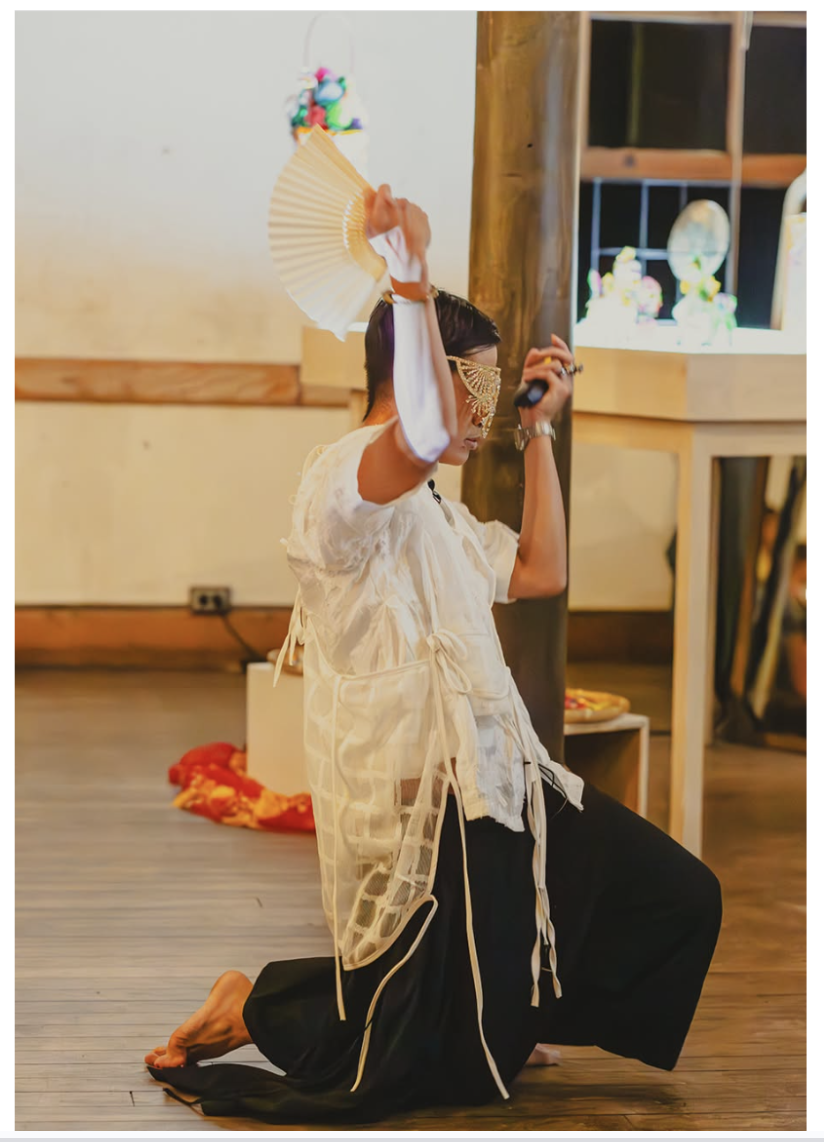
Việt Namaste performance at Headlands Center for the Arts, 2024. Photo by Aaron Wojack.
Are there any upcoming exhibitions/ projects you wish to share?
VIII/ Gr8
I am doing a solo Việt Namaste Shamanaste! QUẾeroke performance tour with local and transnational dance and music collaborators. It is happening in the United States, on 9 June 2026 at Mount Ida, upstate New York; 8 July 2026 at Institute of Contemporary Art Los Angeles (ICA LA); and 16 July as part of Artpace San Antonio evenings, co-presented by GPS*, BAD ASIANS, ICA LA and Artpace. There will be a related stop in Tokyo at Waseda University and a Kobe conference in August 2026. These performances are tied to two ongoing exhibitions. The first is a solo exhibition trăng trắng | milk moon (2026) at San Antonio curated by Dr. Aleesa Pitchamarn Alexander, which is the culmination of a two-month Spring 2026 Artist in Residence programme. The second is a group exhibition Speaking in Tongues (2026) at ICA LA, curated by Amanda Sroka.
And finally, what would be a key piece of advice to young art practitioners (artist, curator, manager etc.)? What has been a way of working, a certain kind of attitude etc. they can learn from to apply to their own careers?
IX. Advice (Sadvice/ Badvice/ Radvice) from Moi & Others
There are Buddhist stories about bodhisattvas disguised as beggars: wisdom, divinity is everywhere and within everyone. Have slow vision: it is divination. If you practise “slow looking”, meaningful, miraculous messages are in the mundane.
Example/ Embodied vision diary fragment/ inspo for current solo show trăng trắng | milk moon, Artpace:
A swarm of hundreds of dragonflies on my walk, and insects and bees point and land towards the earth. I had always wondered why depictions of Siddhartha attaining enlightenment underneath the bodhi tree often included the Bhumisparsha mudra, or "earth-touching" / "earth-witness" gesture). To know is to touch, and be in touch. I felt the tree, the earth, human and non-human, this and the other side of the world, at once, at one. This is why the Buddha had his fingers borne into the earth to achieve enlightenment. There is a whole world of special magic underneath. Touch grass.
……
Grass, clouds, humans, animals comprise each other, “inter-are”–nothing exists independently. Reincarnation can be thought of as literal and metaphorical: everyone you have met has been your mother, father, sister, brother through countless lives. In this life, in my cycles as refugee insect, lost child, page of swords, saged sage, strangers have shown me a thousand kindnesses: the love of a mother, sister, brother, father in fleeting moments and through thousands of lifetimes.
Last week in Huế, Vietnam, I was visiting my thầy (teacher) and late Zen Master Thích Nhất Hạnh’s temple and former school where he was as a baby monk before exile in the West. He later became a pioneering teacher in Plum Village in France and other locales, and eventually returned to the same temple where he passed away. He told me, “còn đi về đi” or “return home.” I wrote an academic book on return, entitled Return Engagements (2021), same same but hits different. It reminded me of thầy’s teachings about home is wherever you are, returning to yourself. “I have arrived, I am home.”
For more information about Việt Lê’s non-profit art foundation SEA sạ, click here.