Fresh Face: Kanokwan Sutthang
Road of Rocks in Rice and Weevils in Rice (มอด มอด)
A&M Fresh Face is where we profile an emerging artist from the region every month and speak to them about how they kick-started their career, how they continue to sustain their practice and what drives them as artists.
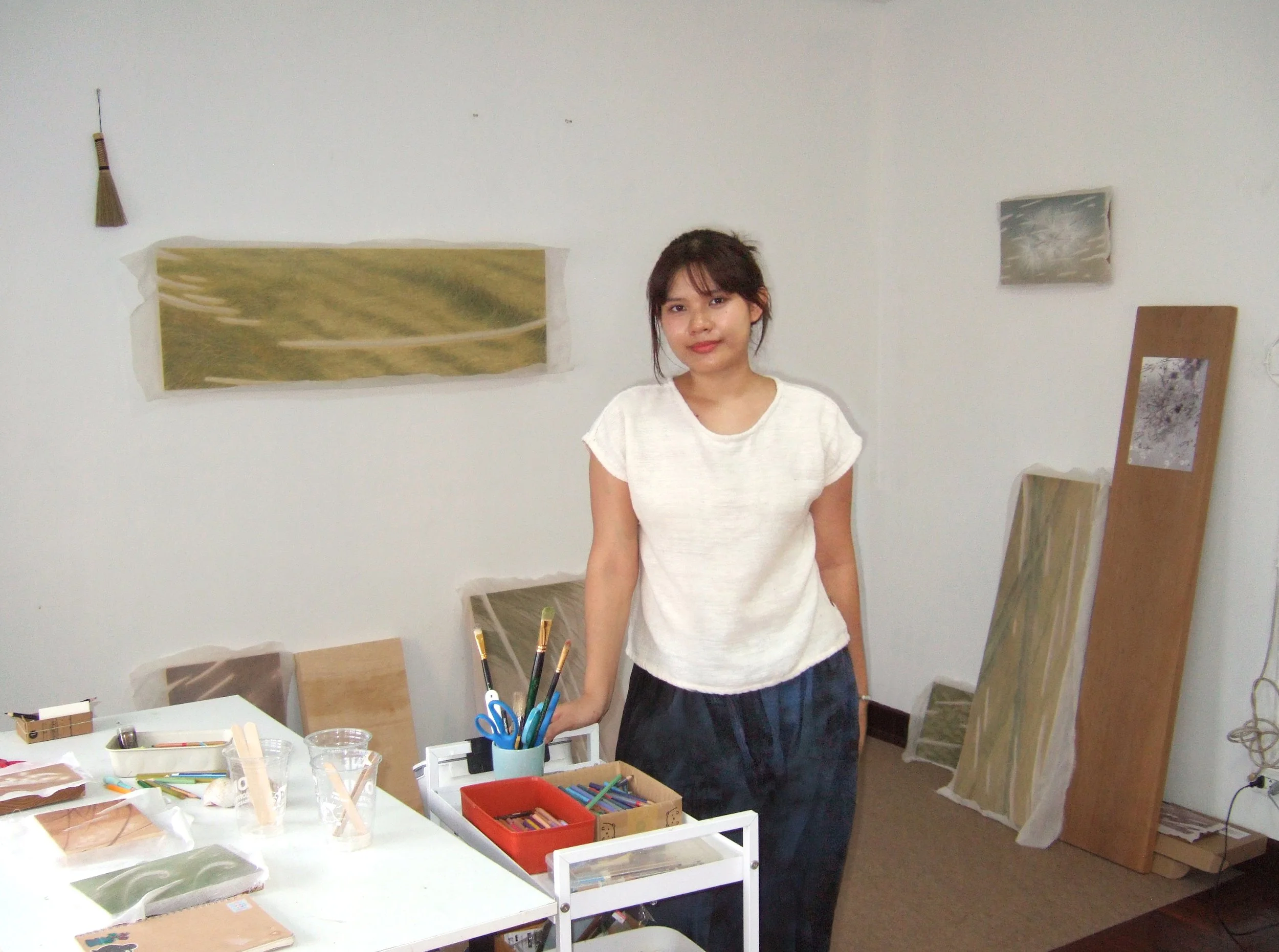
Kanokwan Sutthang, Image courtesy of the artist.
Kanokwan Sutthang (b. 1997, Bangkok) attends to a single small subject and documents its many stories through painting, sculpture, video and installation. In her work, a single grain comes to stand for an entire system. She approaches these subjects like a natural scientist, and treats myth and the intimacy of the domestic with the same rigour. She received her Bachelor of Fine Arts in Painting from Silpakorn University in 2020. In 2024, she was awarded a grant through the Bangkok Art and Culture Centre’s Early Years Project #7: A Change in the Paradigm. Her work has since appeared in group exhibitions across Bangkok, such as Merely Encountering the Evident (2025) at HOP Photo Gallery and Asaññakāya (2025) in Suphanburi. Weevils in Rice (มอด มอด) (2026), presented at Warin Lab Contemporary and curated by Pojai Akratanakul, is her first solo exhibition.

Kanokwan Sutthang, Road of Rocks in Rice, 2024, exhibition installation view in EARLY YEARS PROJECT #7: A Change in the Paradigm (2024). Image courtesy of the artist.
Kanokwan documents her research process in exhaustive mind maps. In Road of Rocks in Rice (2024), shown as part of Early Years Project #7 presented at Bangkok Art and Culture Centre, she assembled a makeshift canvas of woven rice sacks and drew a diagram that laid out the associations that branch out from a single grain, the labour and systems required in sifting rocks from the rice. A decision tree in Thai and English playfully tracks what happens when stones are found in the grain, with three options to keep eating, stop eating, or be forced to keep eating. Mounted specimens trace the industrial process, from the abrasives used to polish rice to rice samples graded by value. The elements taken together record the full apparatus by which a single grain is sorted, graded and declared clean and acceptable.

Kanokwan Sutthang, Mind Map Mod, 2026, drawing on washi paper, 30 x 45cm. Image courtesy of the artist.
Kanokwan applies the same method in her solo exhibition, Weevils in Rice (มอด มอด) (2026). The exhibition turns to the weevil, a small beetle that lives inside stored rice. One of the works entitled Mind Map Mod (2026) uses the mind map to draw both the life cycles of rice and the weevil on washi paper. At some point, an annotation brings the two cycles together. The diagram then details the process of elimination that occurs at an industrial and domestic level. Both systems, the mill and the kitchen, expend the same repetitive enormous effort in ridding rice of these creatures. The weevil, like the rock before it, is the small unit through which Kanokwan maps a larger process.
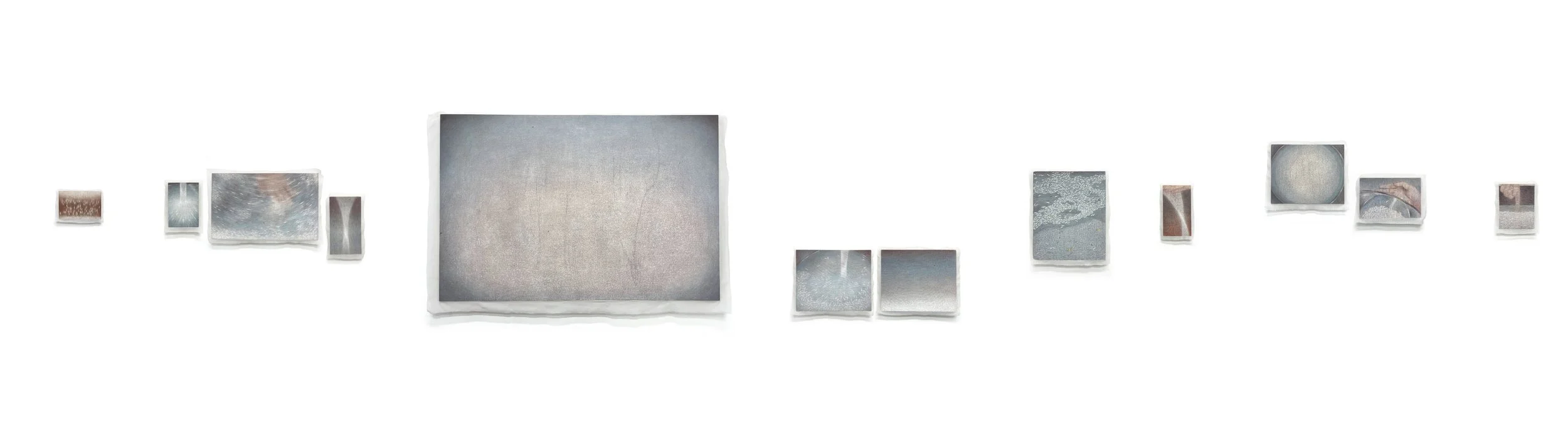
Kanokwan Sutthang, Rinsing Rice series, 2026, coloured pencil on muslin, mounted on wood panel, various dimensions. Image courtesy of the artist.
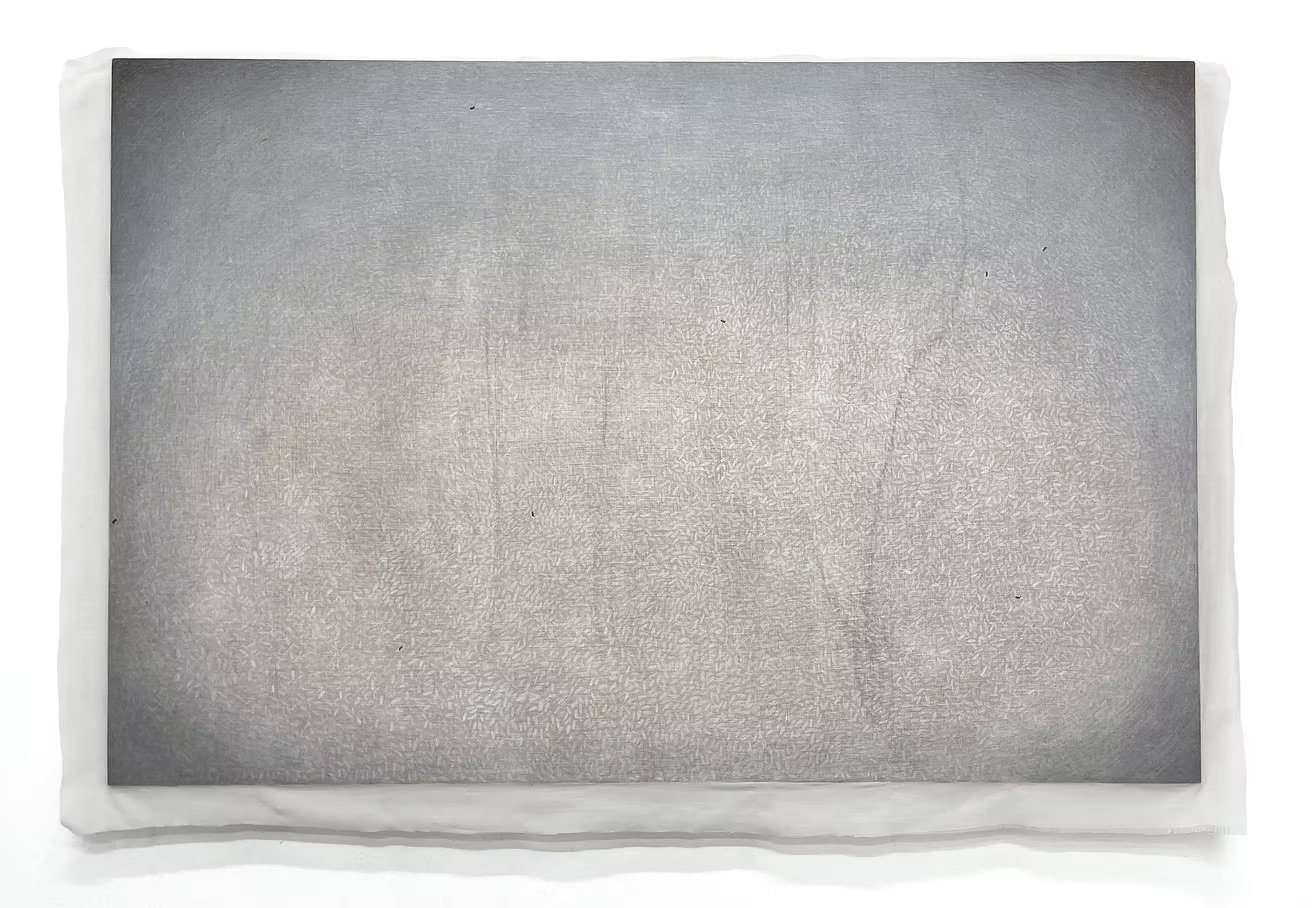
Kanokwan Sutthang, Clouded (ขุ่น), 2026, coloured pencil on muslin cloth, mounted on wood panel, 80 x 120cm. Image taken from the artist’s website.
While the mind maps feel scrutinising and forensic, her Rinsing Rice (2025-26) painting series is attentive to the process of “purification” in a different way. She treats it with a kind of looseness. The images are impressionistic, rendered in a palette of muted grey, silver, pale blue and warm brown. Each painting records a moment in the washing of rice: the pour, the swirl, the clouding of water and settling of grain. The contrast with the diagrams is striking. Where the diagrams are clearly defined with their labels and arrows, the paintings’ forms dissolve into soft fields and scattered flecks that are nearly abstract. Kanokwan is able to hold that tension between precision as a kind of violence and washing as care.
Across both bodies of work, repeated looking begins to mirror the act of rinsing rice — twice, thrice, four times — until what is overlooked is seen clearly. Through her deep engagement with this subject matter as a means of revealing a broader system, Kanokwan questions the processes by which we sort and segregate, separate and purify, and holds the contradictions up to view.
Interview

Kanokwan Sutthang during her studies at Silpakorn University. Image courtesy of the artist.
In 2020 you graduated from Silpakorn University with a Bachelor of Fine Arts majoring in Painting. Could you describe your experience there, both the education you received and the cohort you interacted with?
It was a good experience. The faculty gave us freedom to experiment and work independently. The most important thing I learned from studying art was to become more attentive to my practice such as the thinking process, making sketches, producing the work and choosing materials. This attention to detail has become part of my personality.
Who has been a mentor or an important artistic influence for you? And why?
To me one of the biggest influences on my artistic practice was visiting EARLY YEARS PROJECT #6 : In A Cogitation (2023) organised by Bangkok Art and Culture Centre. At the time, I was working a full-time job and had almost stopped making my own art. Seeing the work of emerging artists inspired me to return to my practice and create work based on my own ideas. It was different from my full-time job, where everything followed routines and client briefs. That experience reminded me why I wanted to make art in the first place.

Field research at a rice mill. Image courtesy of the artist.
What was one important piece of advice you were given?
One important question I received from the curator Pojai Akratanakul who curated my first solo exhibition was: “how do I see this as an abstraction?” It was both a question and a piece of advice. It made me stop and think more deeply about how I see my work and the subjects I am interested in. Because many of my works are research-based, I sometimes rely too much on the information and forget to filter it through my own perspective. That question reminds me to reflect on my thoughts and observations, rather than simply following the research.
Do you make a living completely off being an artist? If not, could you share what other types of work you take on to supplement your income? Do these activities also inform/ affect your practice?
After graduating, I started working a full-time job for almost two years before deciding to focus on my art practice. I initially chose a stable job because I was unsure about my financial situation and thought I could balance it with making art, but managing both became difficult and affected my creative process.
Now, I work as a full-time artist by applying for art grants, selling my work and creating smaller pieces such as ceramics and merchandise.

Kanokwan Sutthang, installation view of Weevils in Rice (มอด มอด), 2026. Image courtesy of the artist.
Weevils in Rice (มอด มอด) (2026) at Warin Lab Contemporary, curated by Pojai Akratanakul, is your first solo exhibition. How did the opportunity come about, and what are its central ideas?
Weevils in Rice (2026) is my first solo exhibition, developed from my previous work in 2024 about pebbles found in rice. The idea started when I returned to uninstall my work and collect the rice samples from the installation after it had been displayed for around five months. I noticed that rice weevils had appeared differently depending on the rice quality, which made me curious about where they came from and what accounts for the difference. This led me to examine the use of chemicals to prevent rice weevils and how they shape our relationship with rice. It made me question our perception of cleanliness and how we define what is considered “clean” rice. I began to observe and question our obsession with the whiteness and purity of rice.
I developed this curiosity into a proposal and submitted it to Warin Lab Contemporary, as I felt connected to the gallery’s interest in environmental issues. Sukontip Nakasem, the gallery’s founder, was also interested in issues surrounding rice, and gave me the opportunity to present my project at the gallery. They then invited Pojai Akratanakul to curate the exhibition. At the same time, I applied for support from the Contemporary Art Promotion Fund (OCAC) under Thailand’s Ministry of Culture and received funding.
“It made me question our perception of cleanliness and how we define what is considered ‘clean’ rice. I began to observe and question our obsession with the whiteness and purity of rice.”

Kanokwan Sutthang, As Rice Becomes, 2026 , ceramics and burlap sacks, variable. Image courtesy of the artist.
In both Road of Rocks in Rice (2024) and Weevils in Rice (2026), you worked with diagrams and mind maps. What draws you to that way of working?
I record my thoughts through mind maps before developing them into artworks. This process helps me see the overall picture as small pieces of information gradually come together to form a story.
For the Road of Rocks in Rice (2024), I wanted to tell the story of something tiny that contains a much bigger story within its smallness. It has its own background and can affect us more than we might expect. I chose to create diagrams on large rice sacks sewn together to form one large surface, allowing people to better understand and connect the different stories behind this small grain.
For the Weevils in Rice (2026), I continue to use mind maps as part of the work to connect with the thinking process from Road of Rocks in Rice. Besides serving as a way of recording information, the mind map also works like a footnote that shows the relationship between the two projects.

Kanokwan Sutthang, Khao Pan Khon, 2024, sticky rice ball, coconut stick, rice polishing stones, dimensions variable. Presented as part of Road of Rocks in Rice (2024), venue. Image courtesy of the artist.
Across your projects, you work with the small, overlooked things: a weed, a pebble, a weevil. What keeps pulling you back to them as subjects?
The elements in my work usually come from my experiences, things I encounter and the environment around me. Since my family grows rice, I often explore the area around my home and notice small things, such as weeds in the rice fields or small pebbles found in my rice during meals. When I started to notice these things, I became curious and wanted to understand them more.
This process of observing and exploring small overlooked things has become part of my artistic practice. Once I started learning about them, I enjoyed discovering their stories and backgrounds. I present these encounters and insights through my artworks.
Could you share a favourite art space or gallery in Thailand? What draws you to it, and what does it offer you and your practice?
I am interested in off-site exhibitions held in alternative spaces. Recently, this has become more common in Thailand. I especially liked Ghost 2565 (2022) presented at the World Travel Service building, where artworks were displayed throughout the old building while preserving its original atmosphere.
I enjoy exploring how artworks interact with different environments and how site-specific exhibitions create new meanings. It makes me think about how my own work might communicate beyond the context of the white cube.

Kanokwan Sutthang, installation view of A Ballad of Rice Weevil (ลํามอด), 2026, single-channel screening, duration 11:27, on muslin. Image courtesy of the artist.
What are your hopes for the Thailand art scene, and for Southeast Asia more broadly?
Continuous support is essential. I hope there will be more foundations and institutions that provide concrete support for artists.I believe that a strong support system will allow artists to create and experiment with new ideas more freely.
Are there any upcoming exhibitions or projects that you would like to share?
I will be part of Trinket Philosophy, a group exhibition curated by Pearamon Tulavardhana at ara contemporary, on view from 15 August to 13 September 2026.
In 2027, I will continue developing my project from Road of Rocks in Rice (2024) and Weevils in Rice (2026), which explore and search for foreign objects found in rice while expanding the perspectives and ideas from those previous works. The project will be presented as part of a group exhibition in Thailand next year.