
Fresh Face: Miranda Mazuki
‘Witness’ at ara contemporary
A&M Fresh Face is where we profile an emerging artist from the region every month and speak to them about how they kick-started their career, how they continue to sustain their practice and what drives them as artists.
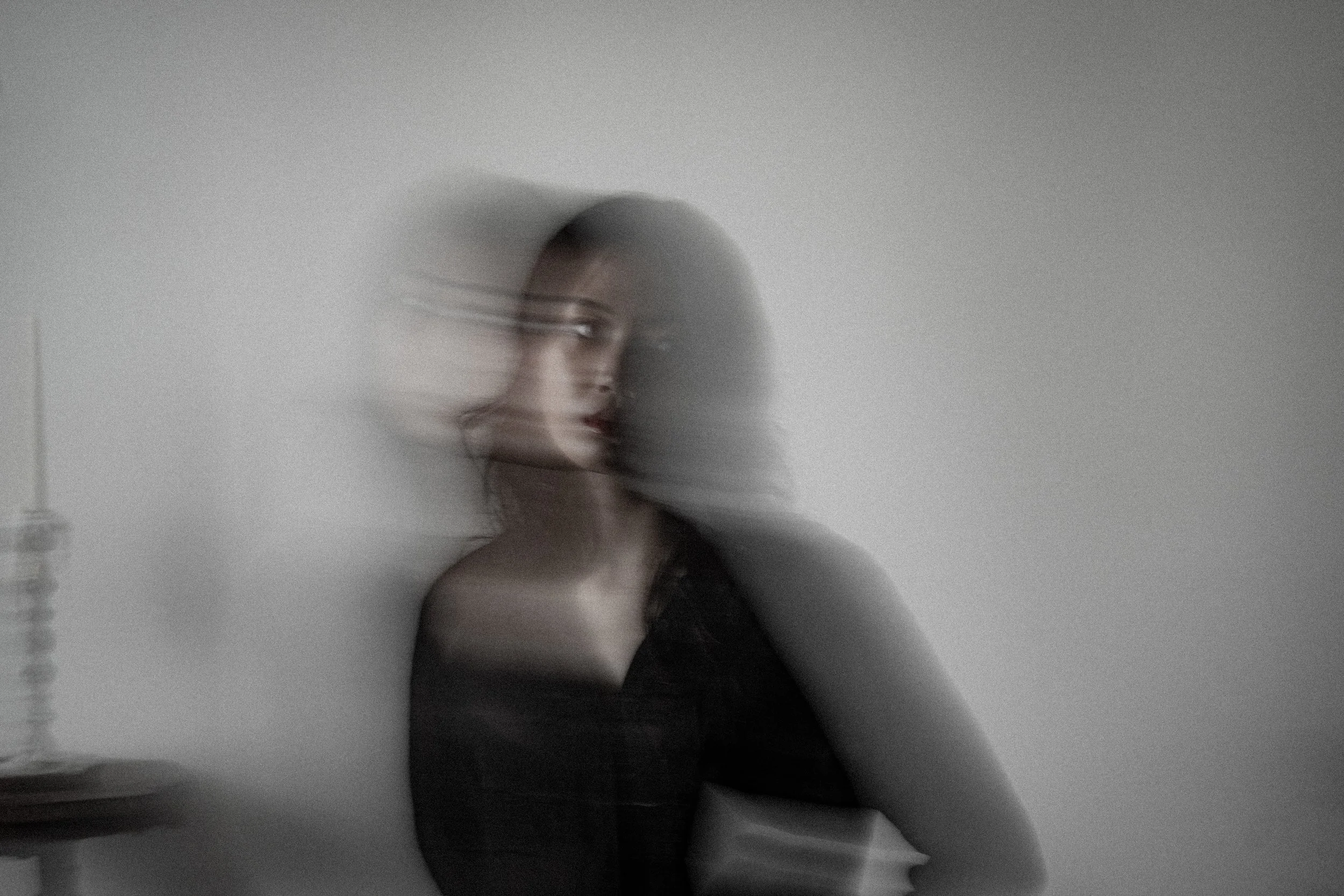
Miranda Mazuki.
Born in 1993 in Sumatra, Indonesia, Miranda Mazuki’s practice engages with notions of decline, unfamiliarity and the ephemeral. She graduated with a degree in Fine Arts from Paris College of Art in 2021 and studied Fashion Design at the Fashion Institute of Design & Merchandising in Los Angeles. These experiences inform her visual language and sensibility towards creating images and atmosphere. Her works have been presented at Art Jakarta Papers 2026 and ara contemporary.

Miranda Mazuki, Witness, 2026, exhibition installation view at ara contemporary. Image courtesy of the artist and ara contemporary.
For her debut solo exhibition Witness (2026) at ara contemporary, Miranda created a suite of paintings set within nocturnal environments. They have a spectral quality, capturing ghost-like figures that might disappear in the next moment. As the exhibition title suggests, these works position the viewer as witnesses to what seem like intimate or forbidden scenes. In works such as Final Recit (2026) and Luminesce (2026), this sense of anticipation is heightened through the paintings’ perspective of approaching the figures from behind. However, their ghostly form and period dressing also suggest that the image we are looking at might have been a scene that happened a long time ago.

Miranda Mazuki, Dancing Away the Apocalypse, 2025, oil on canvas, 40 x 40cm. Exhibition view in Witness (2026), at ara contemporary, Jakarta. Image courtesy of the artist and ara contemporary.
Indeed, historical paintings serve as important references for this body of work, especially biblical imagery. For Miranda, they offer a belief in mercy and the possibility of a second chance which connected deeply with her experience of a cancer diagnosis. In Dancing Away the Apocalypse (2026), the circle dance motif from western art history is processed through a personal lens. Miranda suspends tension between what seems like a joyous folk ritual and a sense of doom suggested by the painting’s title. The dancing figures also appear to be floating upwards rather than grounded. Viewers are left to dwell in this space of uncertainty.
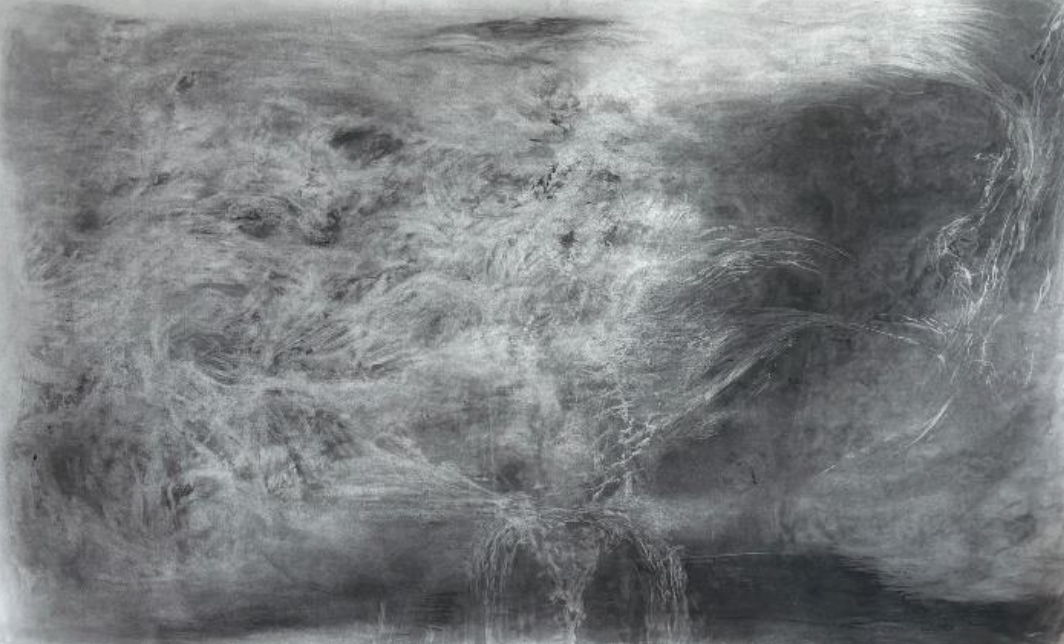
Miranda Mazuki, Nebula, 2025, graphite on paper, 85 x 140cm. Image courtesy of the artist and ara contemporary.
The process of erasure remains a throughline across Miranda’s paintings, drawings and sculpture. She uses this technique as a metaphor that gestures towards the nature of memory, which is altered by time and subjected to erosion. Figures and fictive landscapes emerge out of wiping or erasing layers of pigment. In turn, they also become the subject of absence and vulnerability.
Interview

Photo from Miranda’s time studying in Paris. Image courtesy of the artist.
You graduated with a degree in Fine Arts from Paris College of Art and studied Fashion Design at the Fashion Institute of Design & Merchandising in Los Angeles (LA). Could you describe your experiences, both the education you received and the cohort you interacted with?
Both pursuits were straightforward. I learnt what I needed to learn and picked up other valuable lessons from outside of school.
I appreciated how free it was to explore my identity and be expressive in LA. I was in an encouraging environment and it made me fearless to make mistakes and move on from them.
I moved to Paris a few months before the COVID-19 pandemic and confinement happened so interaction was pretty limited and I completed half of my studies online. It was challenging to integrate but I have grown so much out of this experience that I am nothing but grateful for it.
Who has been a mentor or an important artistic influence for you? And why?
I am drawn to apocalyptic, biblical imagery for its symbolic and emotional intensity, specifically for the way it holds human fragility. I often refer to old masters such as Francesco Goya and Edvard Munch for the way they confront fear, vulnerability and psychological unease.

Miranda Mazuki, Fissure #3, 2025, pastel on paper, 102 x 60cm.
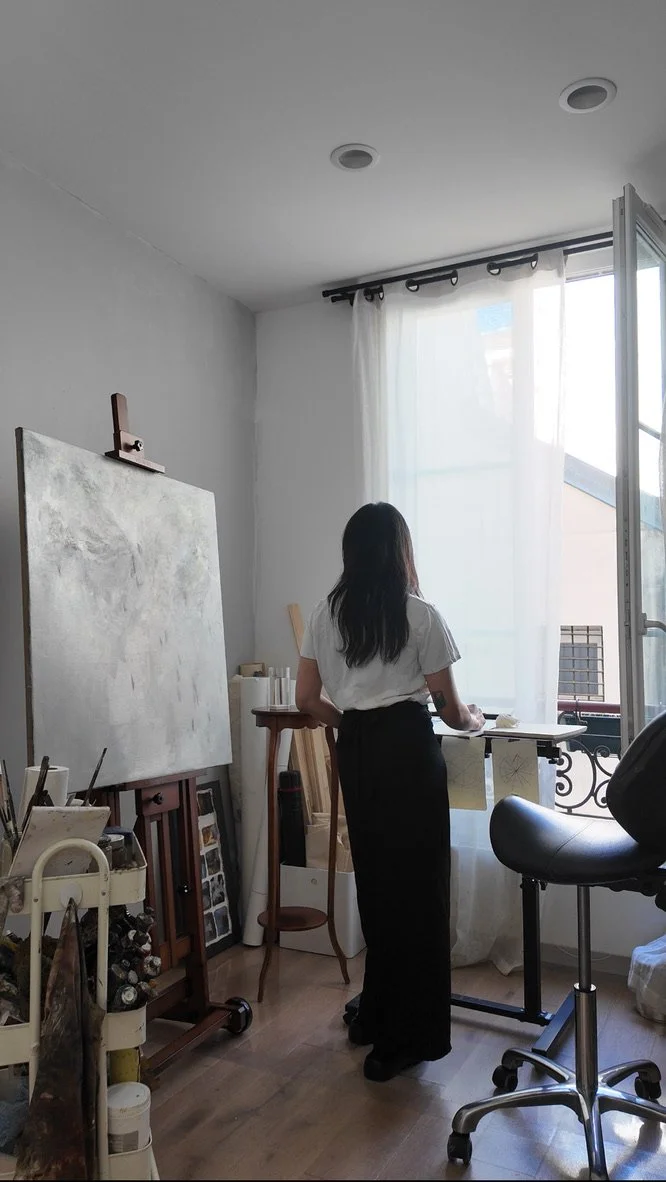
Miranda in the studio.
What was one important piece of advice you were given?
The best “advice” has come from living through cancer. I have never been more afraid of not having enough time to make things ever since.
Do you make a living completely off being an artist? If not, could you share what other types of work you take on to supplement your income? Do these activities also inform/ affect your practice?
I have worked in fashion, jewellery and graphic design. This year, I made the decision to fully focus on being an artist. It is risky and it also means that I have to live a simpler life, but it has been totally worth it for my soul.

Miranda Mazuki, Witness, 2026, exhibition installation view at ara contemporary. Image courtesy of the artist and ara contemporary.
Tell us more about your first solo exhibition Witness (2026) at ara contemporary. What is a central idea behind the show as well as one challenge you faced preparing for it?
The exhibition centres on positioning the viewer as a witness to scenes that feel intimate, uncertain and slightly intrusive. I was drawn to this idea because it allows me to explore the meaning of seeing something without fully understanding it. The nocturnal settings, layering and erasure keep the figures and landscapes in a state between absence and presence.
My challenge in the preparation, aside from working through the heatwave in Paris, was to find the right balance between revealing enough to hold the emotional tension while keeping the images unresolved.
“My challenge in the preparation was to find the right balance between revealing enough to hold the emotional tension while keeping the images unresolved.”

Installation view of Miranda’s works (middle) in a group presentation at ara contemporary’s booth in Art Jakarta Papers 2026, Pondok Indah Mall 3, Jakarta, Indonesia. Image courtesy of ara contemporary.
The process of erasure is an important aspect in creating your paintings and works on paper. How is this technique applied in your work? And what is its significance in relation to the themes in your practice?
Erasure is a process that is consistent throughout my practice. In my drawings and paintings, it manifests in the form of wiping off layers either with a rag or eraser. In sculptures, it is in the reduction of the material such as the lost wax process. I am interested in how an image can remain familiar while becoming uncertain and how the meaning can be altered through the process of removal and displacement.

Miranda Mazuki, Opilione, 2026, oil on canvas, bronze, chain dipped in rubber, 22 x 8 x 3cm. Image courtesy of ara contemporary.
You have also created intimately-sized pieces where small paintings are embedded into assemblages such as Thy Comb (2026) and Opilione (2026). How do you decide on the objects and why did you choose bronze as a material?
I tend to choose objects that already carry a certain symbolic resonance, then shift their meaning by placing them in a different context. With bronze, I was drawn to its sense of permanence and material weight, particularly in contrast with the image of a newborn. I like the duality between something new and fragile in juxtaposition with the oxidised bronze that suggests age and erosion.
Since 2019, you have been living in Paris. Could you share a favourite art space or gallery in France or Indonesia? Why are you drawn to that space and what does it offer to your practice?
In Paris, I love Musée d’Orsay, Musée Gustave Moreau and Musée de Cluny.
In Indonesia, I of course love ara contemporary in Jakarta.
What are your hopes for the Indonesian art scene, and for Southeast Asia more broadly?
I hope Indonesian artists can gain greater international visibility and be engaged more seriously beyond being framed primarily through geography or identity. More broadly, I would like to see a strong recognition of diversity and complexity of practices emerging from Southeast Asia in a global platform.
This article is presented in partnership with ara contemporary.
Miranda Mazuki’s Witness is on view at ara contemporary, Jakarta, from 26 September to 8 November 2026. For more information, click here.