Fresh Face: Daniel Chong
Longing as both personal and political condition
A&M Fresh Face is where we profile an emerging artist from the region every month and speak to them about how they kick-started their career, how they continue to sustain their practice and what drives them as artists.
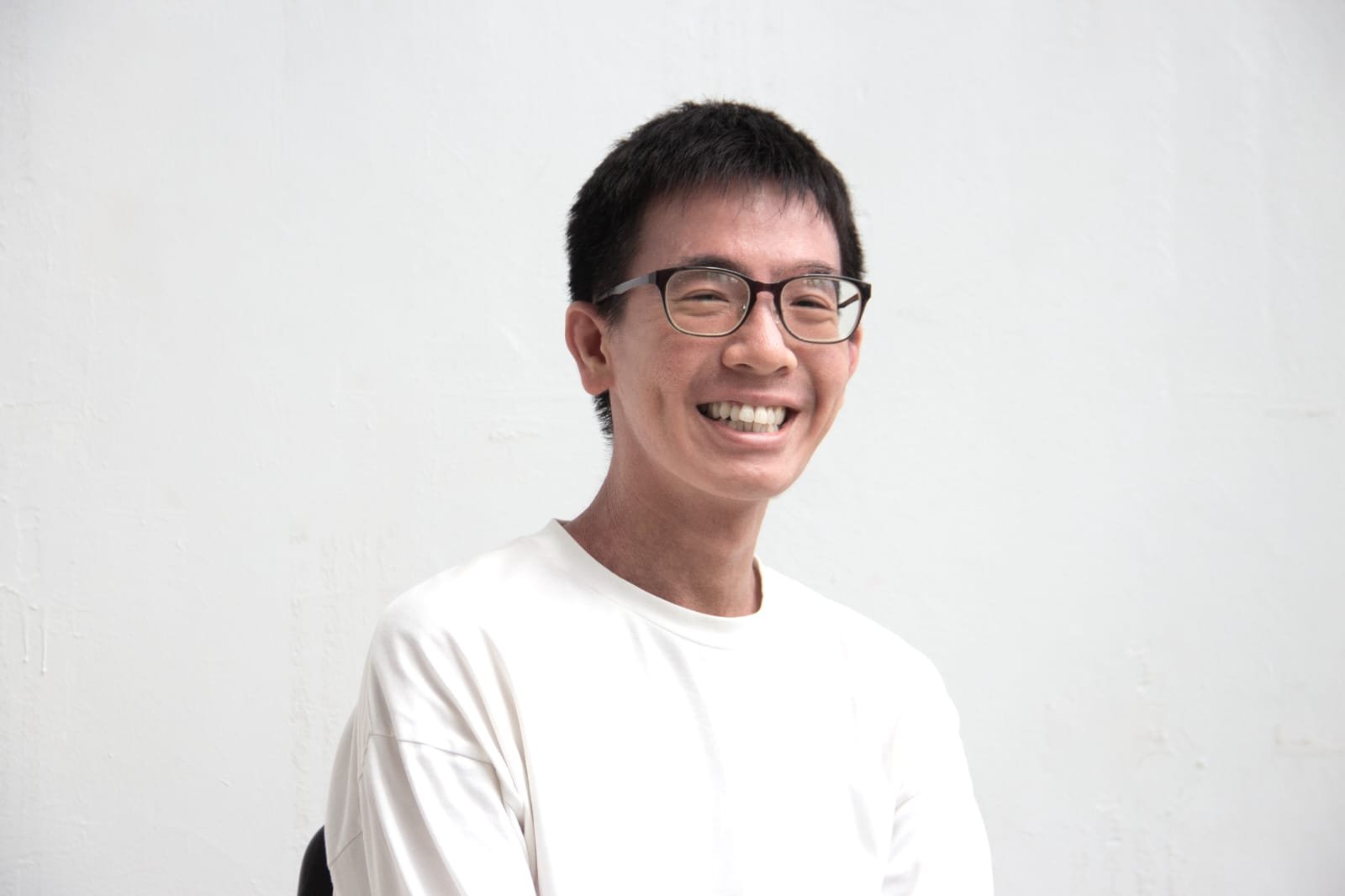
Daniel Chong. Image courtesy of artist.
Daniel Chong (b. 1995, Singapore) is an artist-curator who traces longing past the personal into the systems that govern life in Singapore. He works across sculpture, installation, video and found objects. He graduated with a Bachelor of Arts (Honours) in Fine Arts from LASALLE College of the Arts in 2019. Recent residencies include ARE in the Netherlands and the Goethe-Institut and Kim Association in Singapore. He has curated shows independently and at spaces including Objectifs and OH! Open House. As an artist, he has also presented solo exhibitions at Supernormal in Singapore, 1a space in Hong Kong, XPO Gallery in the Netherlands and RM Gallery in Aotearoa New Zealand.
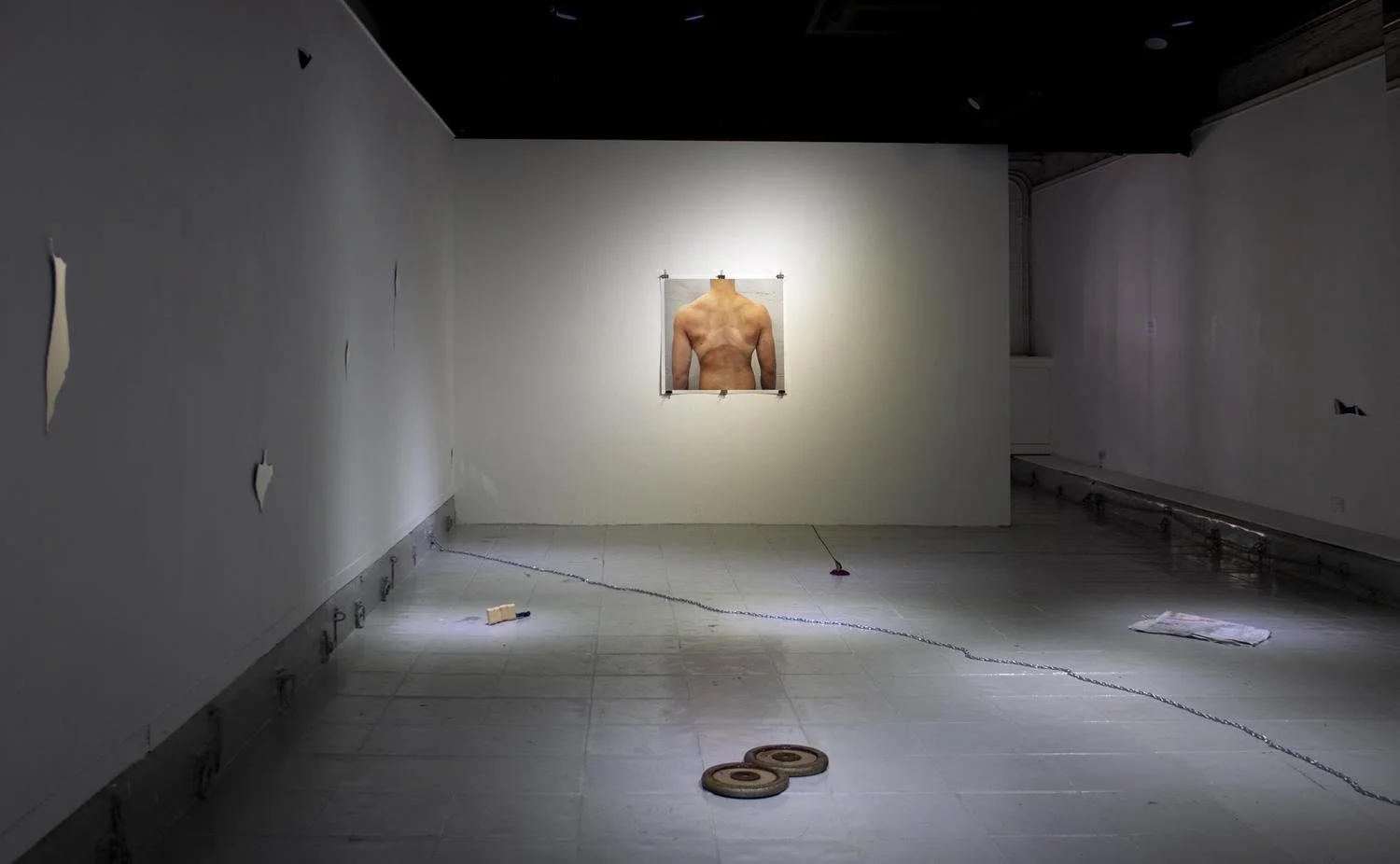
Daniel Chong, Shifting Subtleties, 2019, exhibition view at 1a space, Hong Kong. Image courtesy of artist.
Themes of longing and the body under tension can be traced to his early works shown in Shifting Subtleties (2019) at 1a space in Hong Kong. A mark of warmth (2018) is a photographic print showing a man’s bare back. The skin is reddened by the sun, apart from the lighter areas where someone had held him from behind, the pale outline of two arms across his back. The work seems to point to intimacy, instances when it goes too far, or lingers past the point it should.
Another work from that show, Even (2019), is made from two ten-kilogramme plate weights, water and adhesive. Daniel carved the edges of the two weights so they fit snugly side by side. He then sealed their centre holes and filled them with a shallow layer of water. The alteration renders them both unusable. Paired this way, they can no longer be loaded or balanced. A weight built for strain becomes something closer to a still, reflecting pool. Read together, a story begins to form between them. A mark of warmth (2018) holds tenderness in the image of a body, perhaps, the queer body marked by another’s touch, while Even (2019) takes an object manufactured for effort and lets it come to rest.
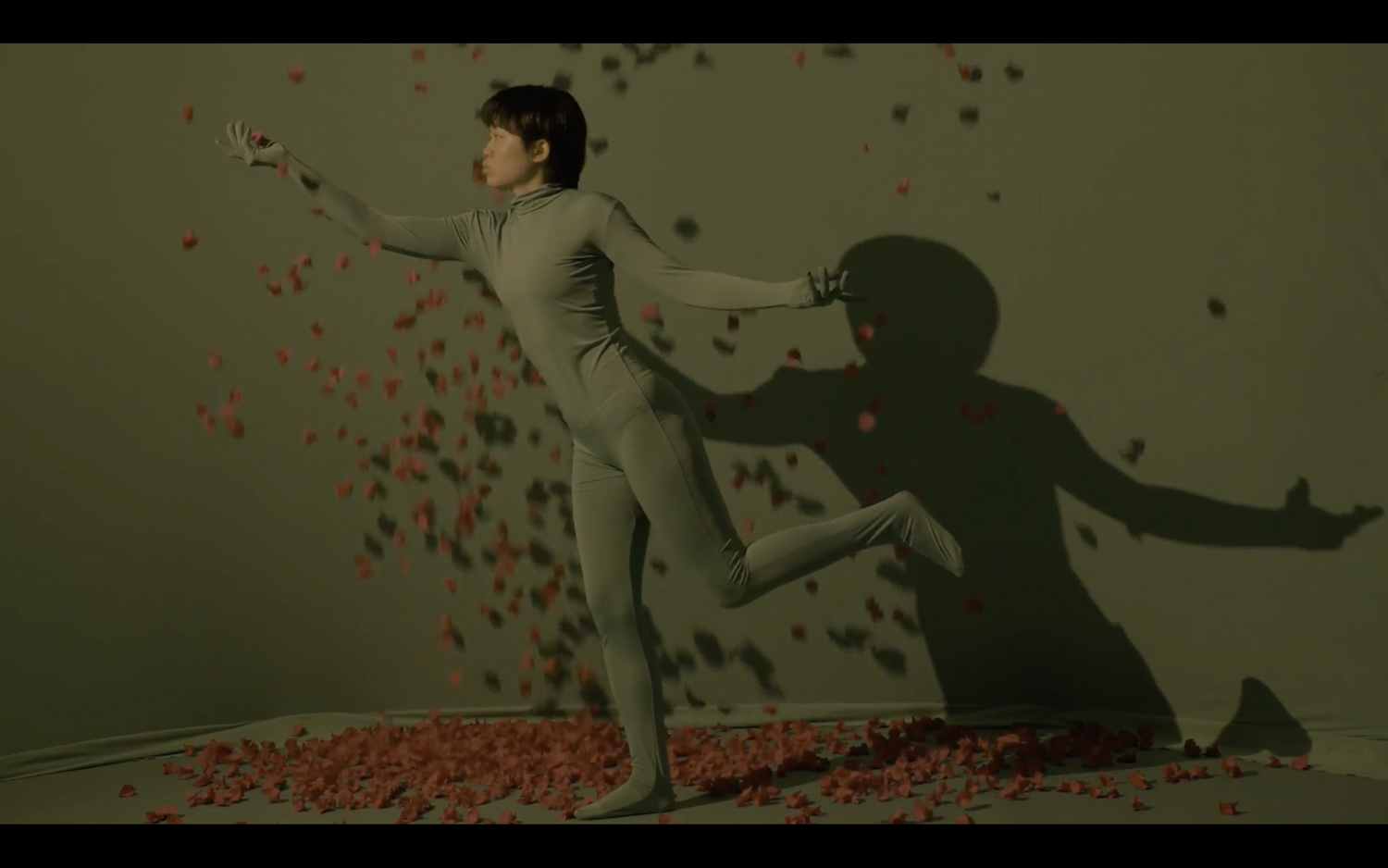
Daniel Chong, I want to be a plant - Chapter 1, 2023, video still. Image courtesy of artist.
In 2023, Daniel began an ongoing project, I want to be a plant, that redirects the same longing towards the state. Daniel sets out its premise in one of his own writings: “Perhaps it is easier to be loved by the state as a plant than as a person.” Chapter 1 focuses on the bougainvillea, a flower long planted along Singapore’s roads and highways. As Singapore has rebranded itself from a “Garden City” to a “City in Nature,” the bougainvillea looks too neat and too obviously planted.
In Chapter 1, a performer works through several stages. She attempts to emulate the forms of various native plants, before settling on the bougainvillea. She holds the pose for as long as possible, until she collapses. By the end she is overwhelmed, the falling flowers appearing to consume her. Throughout, the background is a flat chroma-key green screen used as a placeholder in film and visual effects. Between scenes, on-screen text moves between wanting to be the flower and resenting it: “I want to be a bougainvillea… The unofficial national flower. Cared, pruned, potted. A first class citizen dotting the Singaporean landscape. I will never root like the bougainvilleas. Unable to flower naturally. I hate bougainvilleas.”
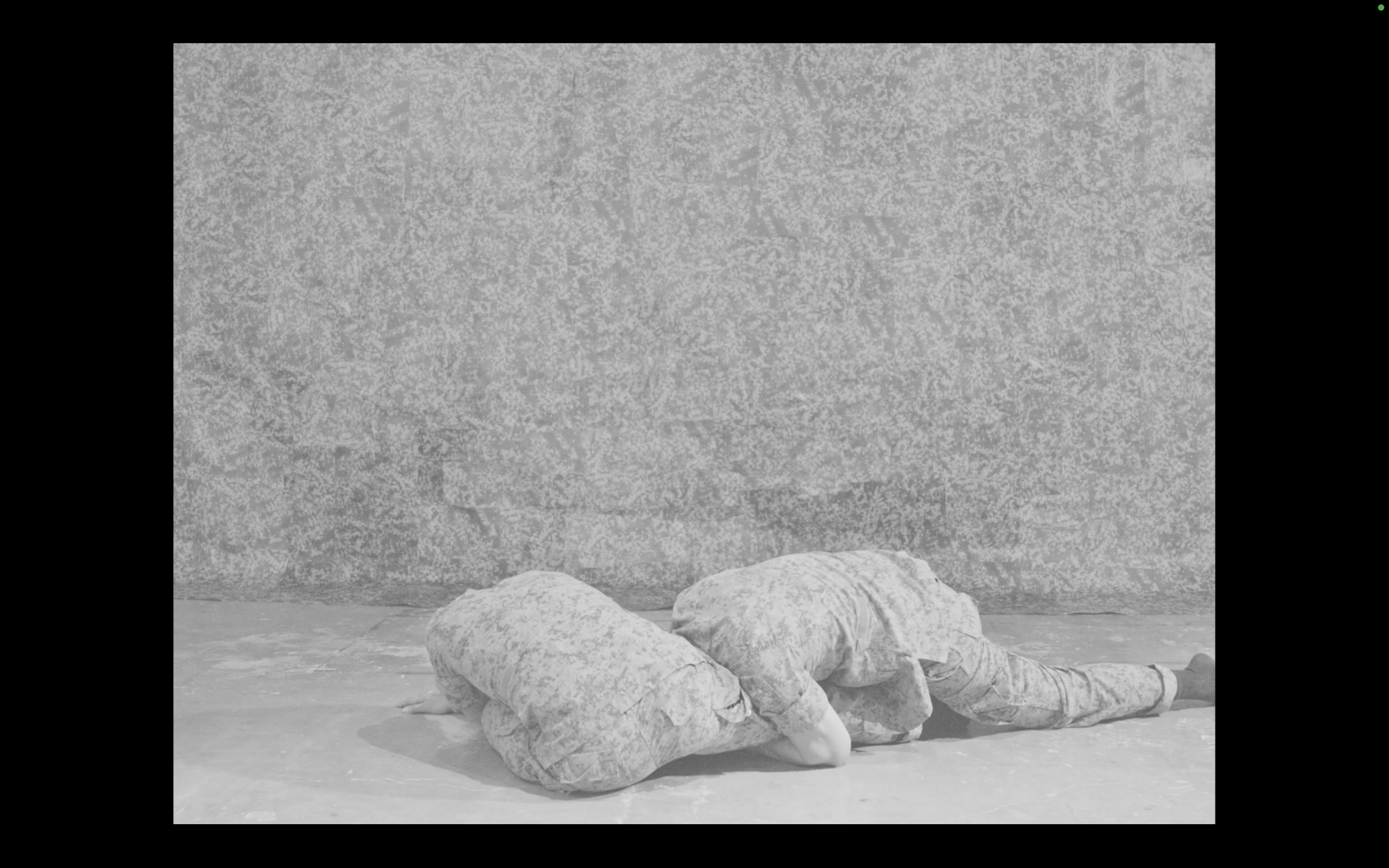
Daniel Chong, I want to be a plant - Chapter 2, 2025, video still. Image courtesy of artist.
In Chapter 2, Daniel turns to Singapore’s compulsory military conscription and the model of masculinity it produces. A black-and-white video sets two figures in singlets and shorts through the same crouched, defensive drill, while tense bodies in camouflage almost disappear against a matching backdrop. Daniel’s work finds pockets of urgent intimacy within this rite of manhood. The drilled motions are intercut with close shots of hands sliding over one another and cut flowers that lie against the dark. The two camouflaged figures crouch towards each other, almost embracing, until one lifts the other into his arms. The video shows these are bodies trained for national defence, reaching for each other.
Across both chapters, the same forms that once held private feeling are pointed at the state and the small ways it presses on a life. Daniel has built an intimate artistic vocabulary that is utilised with restraint. He keeps the reticence that has underwritten much of his work, trusting all that is unsaid and withheld.
Interview
In 2019, you graduated from LASALLE College of the Arts with a BA (Honours) in Fine Arts. Could you describe that experience, both the education you received and the cohort you interacted with?
I was allowed to fail a lot and through it I found my artistic language. LASALLE was formative because I felt protected as a student. No one is going to fault you for trying or blame you for making bad art. Those few years were probably the most prolific period of experimentation for me. I ran the gambit of experiments from sculpture to ways of exhibiting. Everyday was an act of breaking and making and what came out from it was an instinctive language that became quite foundational to my practice. That freedom to fail was probably more valuable than any technical skill I learnt.
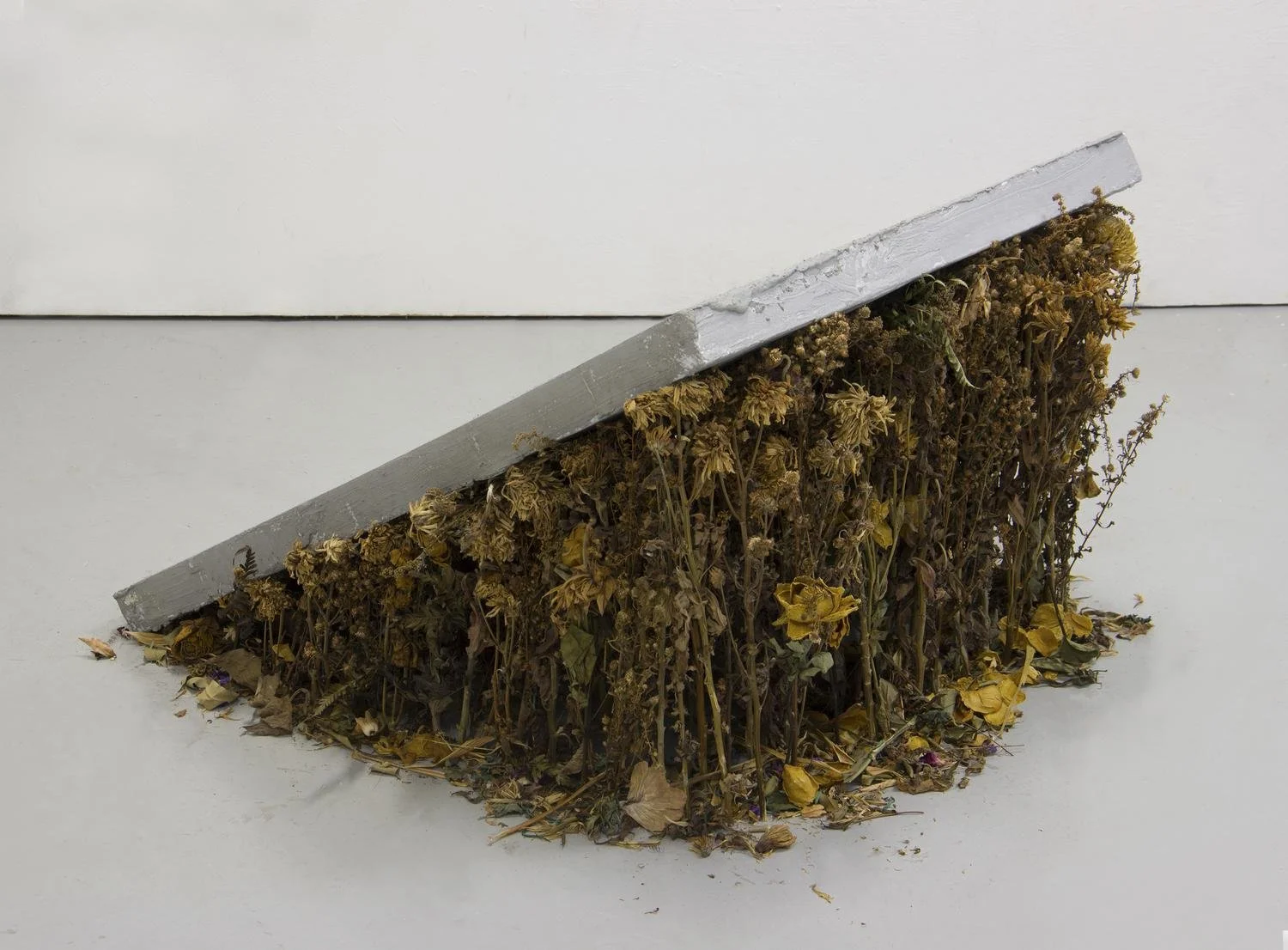
Daniel Chong, Unconditionally, 2017, funeral flowers and concrete slab. Image courtesy of artist.
Who has been a mentor or an important artistic influence in your development as an artist? And why?
An early influence was not so much a particular artist, but the terrifying discourse around American artist Eva Hesse. She has been constantly written about in relation to her cancer and untimely death. What ensues is a kind of veneer where curators, historians and now viewers understand her ground-breaking sculptures mainly through the lens of loss. This is not to disregard the importance of biographical details, but I find it a step too far when her diaries are published.
To this day, I am very conscious of the relationship between an artwork and the narrative surrounding it. I prefer my work to communicate on its own terms without heavily anchoring on my biography as an entry point.
What was one important piece of advice you were given?
Art is a marathon, not a sprint. It is advice I still struggle with. Early on, my graduating peers received opportunities much faster and bigger than I did. But over time, I realised that careers unfold differently. Two years in, many of them no longer practise.
The real challenge is learning how to balance ambition with longevity. There is a temptation to say yes to everything, but a sustainable practice also requires knowing how to protect oneself, be financially sustainable and stay curious. I would rather still be making work in 10 years than burn out trying to do everything in 10.
“The real challenge is learning how to balance ambition with longevity.”
You teach at a number of institutions and you also curate. Do these activities feed back into your own practice?
They do, although perhaps not in the most direct way. Teaching and curating force me to articulate what might otherwise remain intuitive. That process keeps a certain creative part of my mind sharp. However, it becomes a double-edged sword when one gets too comfortable with explanation. Ironically, once something becomes easy to explain, it can start to feel settled. Some of my most interesting ideas are the ones I cannot quite yet fully articulate. So while teaching and curating sharpen my thinking, they also remind me to leave room for uncertainty and discovery.
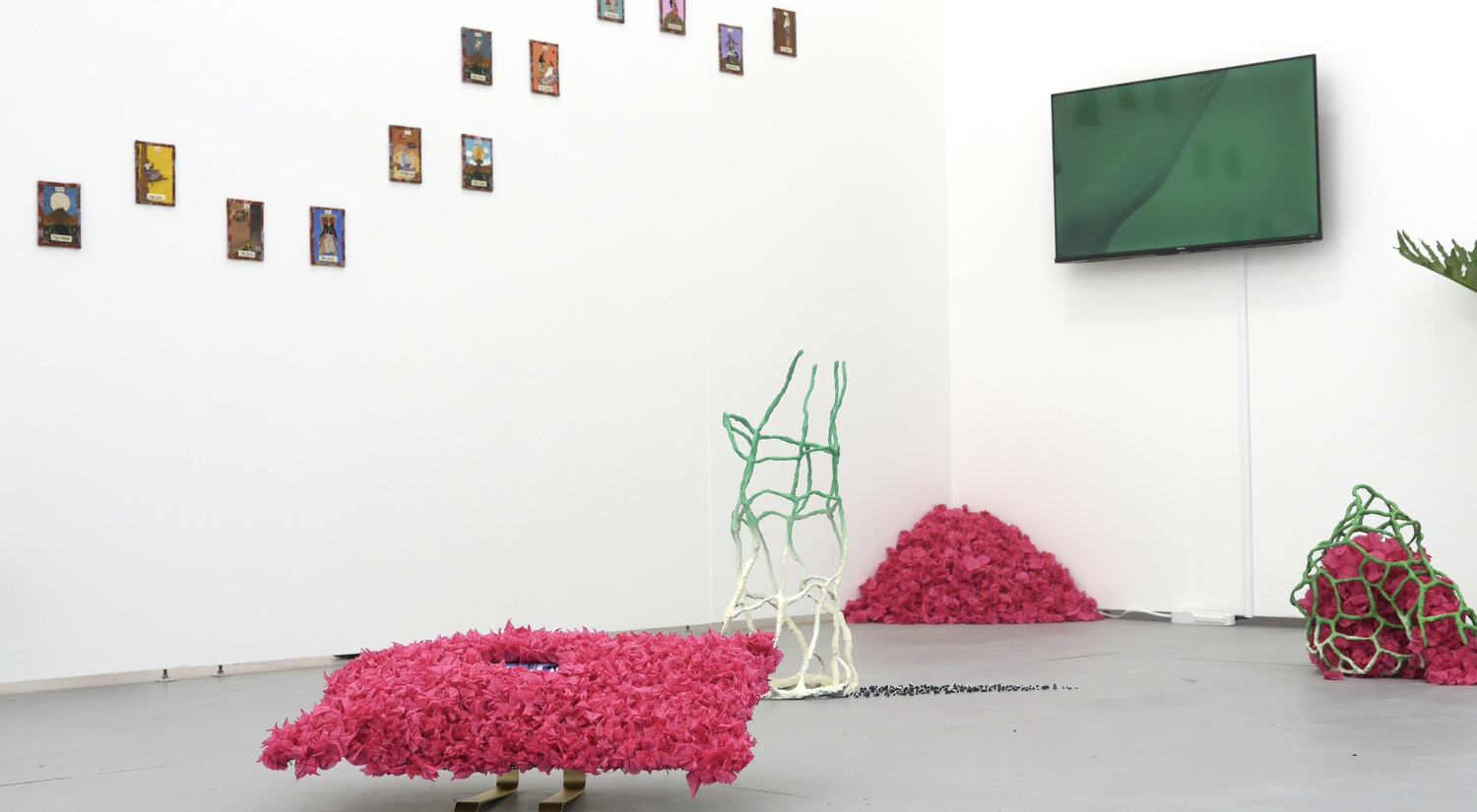
Daniel Chong, I want to be a plant - Chapter 1, 2024, exhibition view at UNTITLED Art Miami Beach presented by starch. Image courtesy of starch.
You think of your practice as a kind of language, something you are continually learning rather than a fixed theme. Where did that way of seeing your work come from?
I am suspicious of art explanations that feel too complete. Though I have been guilty of it. Once I can explain something perfectly, I often find myself less interested in it.
Thinking about my practice as a language became a way of understanding that feeling. A language is not just symbols with meaning, it can develop its own internal references and their own contradictions over time. Meaning begins to point to other meanings. And that is how I have been thinking about my practice. Individual works are fully formed on their own, but add meaning when seen with other works, be it across time, ideas or forms because they are inherently different expressions of the same language.
I have worked across sculpture, installation, found objects and various other approaches. Yet people who have followed my practice often tell me that an exhibition or a work I have made still feels “very Daniel”. At some point, I realised that the continuity is not based on materiality but the language underneath it.
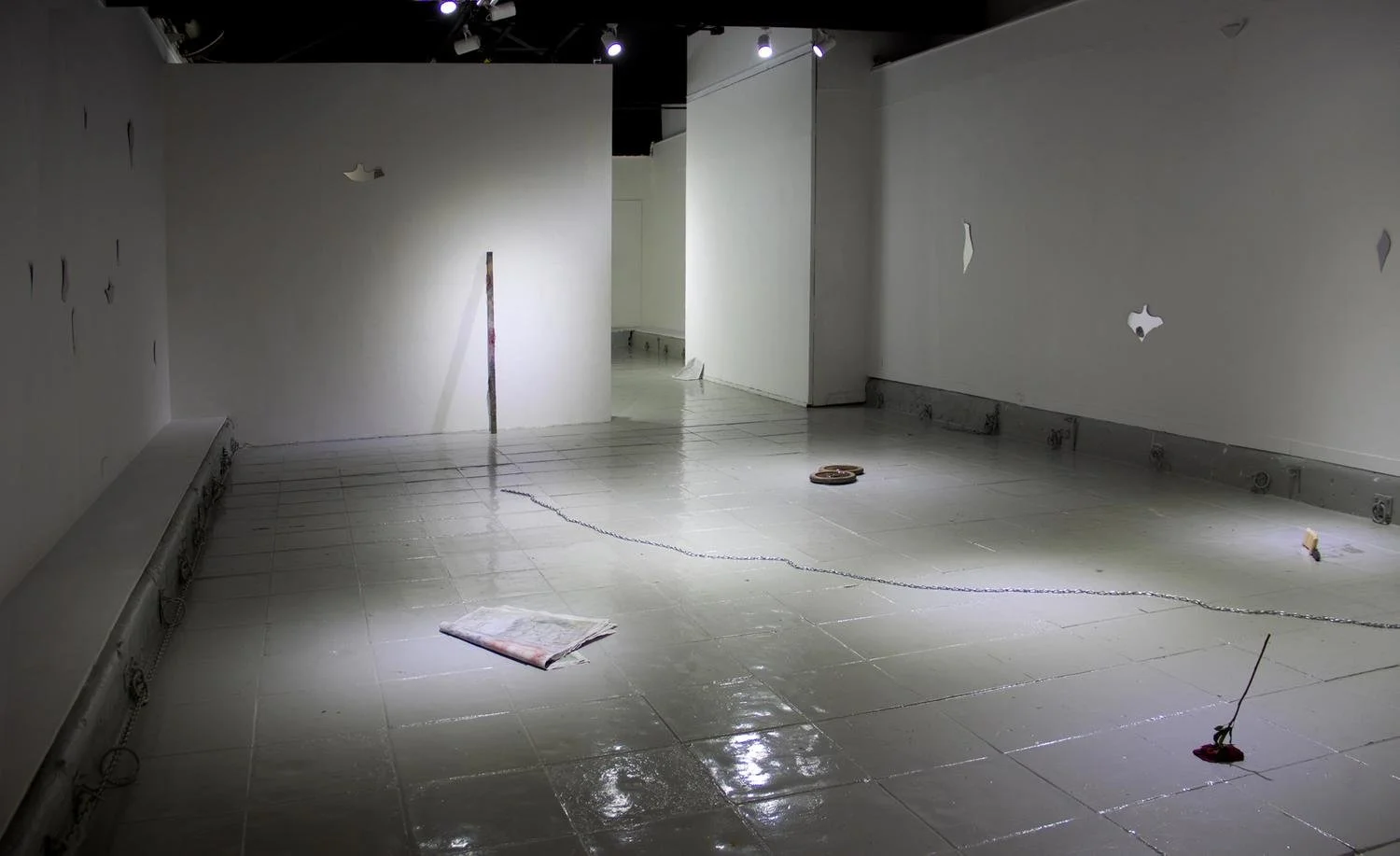
Daniel Chong, Shifting Subtleties, 2019, exhibition view at 1a, Hong Kong. Image courtesy of artist.
Shifting Subtleties (2019) at 1aspace in Hong Kong was your first solo exhibition. What do you remember most about making and presenting that show? And how do you feel looking back on it now?
I look back on it very fondly. There are things I would change now, but there was a certain innocence and playfulness in that exhibition that I do not think I can recreate. I am too deep into this void we call the art world. The show brought together several years of experimentation from my student days, and for the first time I was able to see those works occupying the same space and speaking to one another.
What surprised me was discovering recurring ideas that I had not consciously recognised while making them. Threads kept appearing across different works and materials, almost as though the practice already knew something before I did. Many of those ideas still feel foundational to me today, and I continue to revisit them in different forms.
“What surprised me was discovering recurring ideas that I had not consciously recognised while making them.”
I want to be a plant began around 2023 and has since unfolded across different chapters and venues. How did the project first take root, and what keeps you engaged in this long-term project?
Funnily enough, it was designed to be long-term. Around 2023, I became interested in applying my existing visual language and seeing how it could operate across a much larger framework. When I began mapping out the research, I realised it was far bigger than a single exhibition. It felt less like one body of work and more like an ecosystem of connected questions.
Because the core idea of the work is how desire moves from the personal to the political, it does not really have an end. It could go backwards or look forwards without losing that core. It was designed to fit my rather sprawling investigation of forms and help organise them in a way that might actually benefit from that framework.

Daniel Chong, Single bitten biscuits in Auckland (Gestures to mediate longing) (Artificial landscapes for intimacy), 2024, biscuits purchased in Auckland. Image courtesy of RM Gallery.
What is it about an object that tells you it belongs in your work?
You will be surprised that what draws me to an object is its performativity. I often think about objects in relation to the gestures they invite. Can it be bitten, carried, unravelled, stacked, worn, dragged or broken? And in those gestures, are there moments of sadness, pain, love or shame? I struggle with objects that do not allow for those possibilities. If you view my work from the perspective of an object being performed, or waiting to be performed, you can begin to trace the body and the ways it moves through the work. The materials I return to most often are usually the ones that offer that potential most readily.
In contrast, a series I struggled with is Unintended Vessels made using plastic storage boxes. They are too still of an object and they continue to resist my interventions. I still like them, but they do not offer much flexibility.
“If you view my work from the perspective of an object being performed, or waiting to be performed, you can begin to trace the body and the ways it moves through the work.”
Could you share your favourite art space or gallery in Singapore? Why are you drawn to it, and what does it offer you and your practice?
I am going to give a shout out to Objectifs - Centre for Photography & Film. I am drawn to it because it is sustainable. They are an independent non-profit visual arts space that works with image makers from around the region, and the consistency and quality of what they have put out over the years has been remarkable. I have benefited from them directly, through their Curator Open Call in 2022, and more recently through their hosting of the group exhibition Exposure_Exposure (2026). They built something substantial that is not chasing unrealistic goals or passing trends. I have a lot of respect for the way they operate. What I admire most is their long-term commitment to artists and communities. They have supported various aspects of the arts around their medium in a way that feels both sustainable and meaningful.
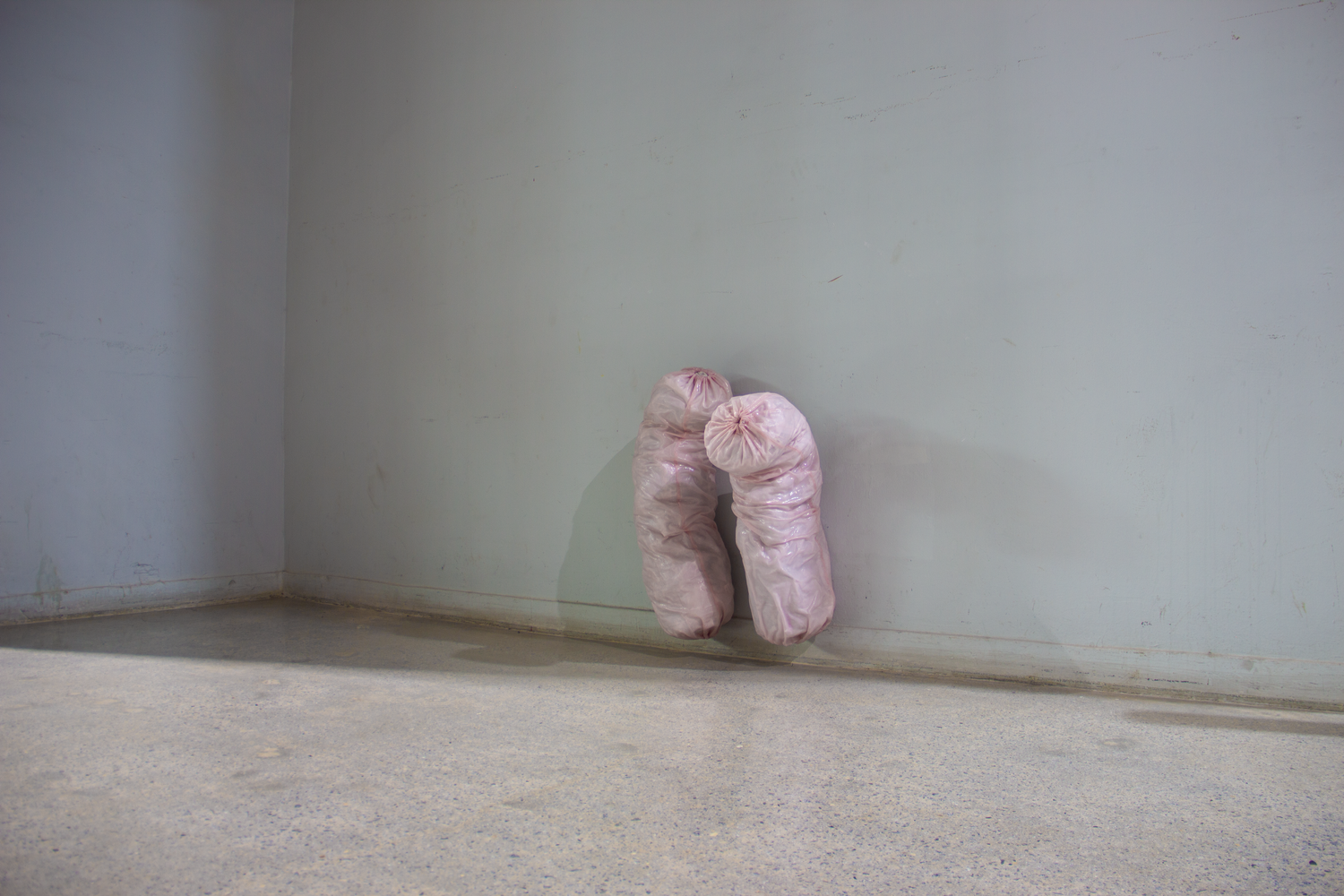
Daniel Chong, Insomniac States (an unhosted pair), 2025, fabric, cotton, resin, metal. Image courtesy of artist.
What are your hopes for the art scene in Singapore, and for the wider region?
I hope we can become more comfortable discussing the realities of artistic labour. Art is inherently difficult to sustain, and many artists support their practices through a range of other jobs from teaching, freelance work, institutional roles, or entirely different careers. These realities often remain invisible, which can create an unrealistic image of what artistic practice looks like.
I would like to see more openness around those conversations, not to diminish the work, but to demystify it. Understanding how artists actually sustain themselves can make the arts ecosystem healthier and ultimately, more accessible.
Are there any upcoming exhibitions or projects that you would like to share?
I am currently developing new work during a residency hosted by Kim Association from June to July. I also have an upcoming group exhibition curated by Gary Ross-Pastrana at Underground Gallery in Manila in July.