
Fresh Face: Chea Sereyroth
Memories of Cambodia painted with earth
A&M Fresh Face is where we profile an emerging artist from the region every month and speak to them about how they kick-started their career, how they continue to sustain their practice and what drives them as artists.

Chea Sereyroth. Photo by Roth Achara. Image courtesy of SNA Arts Management.
Chea Sereyroth (b. 1990, Battambang) presses literal earth into his canvases. Working in acrylic, he constructs his surfaces with sawdust, mud, mountain soil and pencil shavings. His paintings turn to memory, rural life in the countryside communities he comes from and the slow neglect of the natural environment.
That concern with memory took shape early at the Bophana Center in Phnom Penh, the audiovisual archive centre founded in Phnom Penh dedicated to preserving Cambodia’s history. In 2008, Sereyroth attended a workshop there with artists Sera Ing and Vann Nath under the theme “The Memory of Khmer Rouge Regime in Cambodia”. He returned for further memory workshops in 2009 and 2012, developing a deep relationship with Bophana. He has participated in group shows in Singapore, Japan, and Australia, and presented solo exhibitions at Romeet Gallery and Sa Sa Art Projects in Phnom Penh and at Sangker Gallery in his native Battambang.

Chea Sereyroth, Float, 2014, acrylic, sawdust and mud on canvas, 165 x 240cm. Photo by Long Kosal. Image courtesy of SNA Arts Management.
Sereyroth's first solo exhibition Disaster (2014) at Romeet Gallery in Phnom Penh took environmental catastrophe as its subject. The series came out of a run of disasters abroad: the 2011 earthquake, tsunami and nuclear accident in Japan, and the earthquake that had struck Haiti a year earlier. The palette in this series of paintings stays close to the ground: brown, grey and burnt orange, the colours of soil and silt. In Float (2014), everything is drifting, half-submerged under the current. The painting reads as an aerial view of catastrophe, a flooded town whose roads and rooftops dissolve underneath long bands of rust-red sawdust and mud. Small white forms surface from the wreckage: a temple spire, an overturned vehicle, electric poles, a road sign marked “Miyako”, the Japanese coastal city struck by the tsunami.
In another work, Waiting (2014) turns the turmoil into a vortex. A solitary woman is standing at the centre of the composition while everything around her collapses into churning grey and brown arcs. The lower half of the painting thickens into a dense, almost illegible mass of mud and pigment. It seems as if she is encircled rather than rescued. Sereyroth meant the series as a warning to not wait until it is too late to protect the environment.
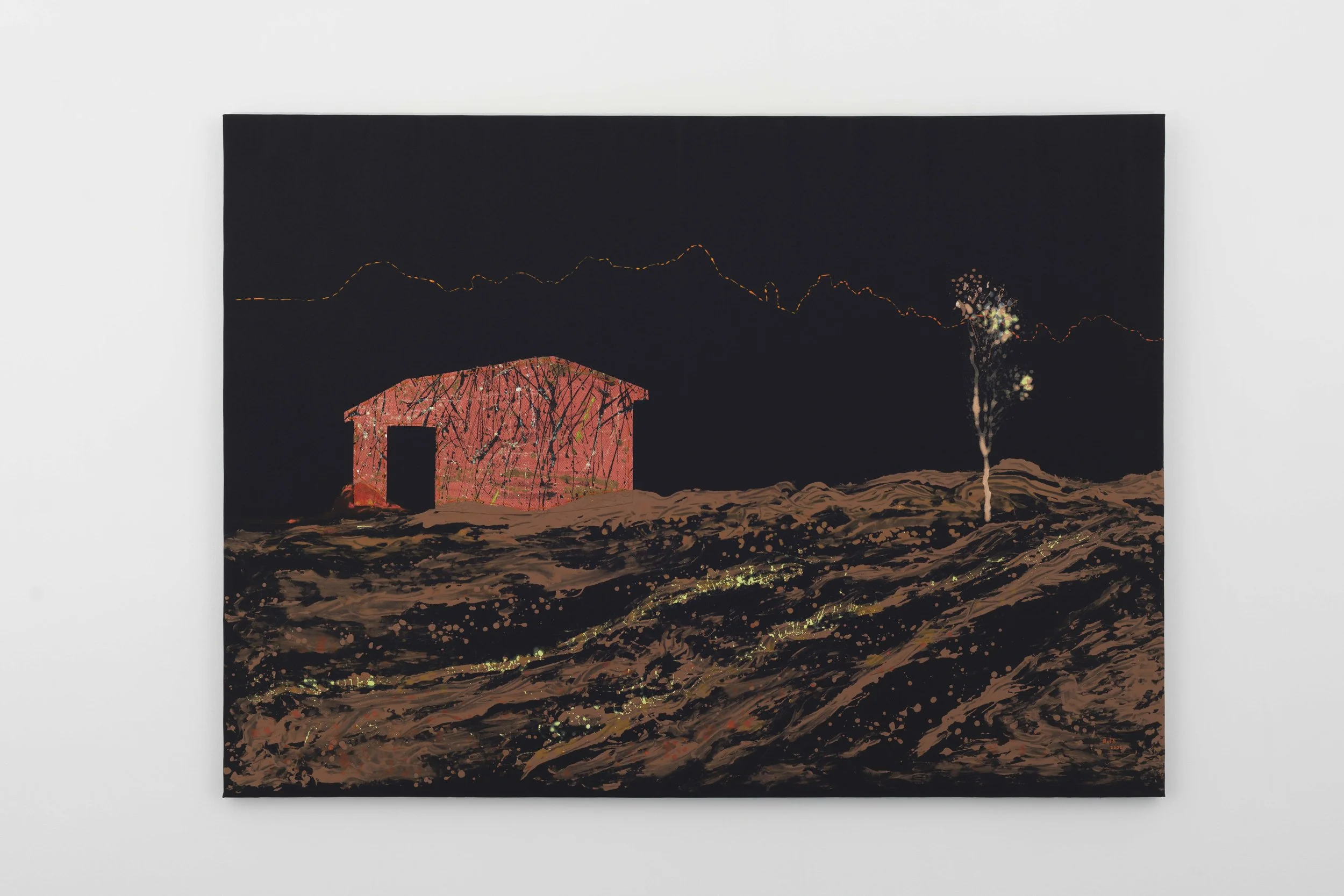
Chea Sereyroth, Early Morning, 2025, acrylic, sawdust, mountain soil on canvas, 119 x 164 cm. Image courtesy of SNA Arts Management.
Sereyroth returned to Bophana with his latest solo exhibition Am I Lost? (2026), in conjunction with the centre’s 20th anniversary. The new paintings carry the heft of that history but look markedly different from the Disaster canvases. The work featured on the exhibition poster, Early Morning (2025), depicts a latticed house in terracotta-orange, glowing against the black terrain and sky. There is a lone tree beside it and flecks tracing a distant ridge. Below, the earth is a dark, flowing mass stippled with acid green or yellow, like embers or fireflies floating in the night. The new palette is brighter, and the imagery turns from flood and ruin to regeneration of forest, grass, and cultivated ground.

Chea Sereyroth, Heteropogon Contortus Grass, 2025, acrylic, mountain soil on canvas, 80 x 165cm. Image courtesy of SNA Arts Management.

Chea Sereyroth, Emerged, 2025, acrylic, mountain soil on canvas, 164 x 119cm. Image courtesy of SNA Arts Management.
The other paintings depict different facets of Sereyroth’s nocturnal world. In the triptych Heteropogon Contortus Grass (2025), energetic strokes of acid green and yellow rise from a dark, blossom-flecked ground, the central panel smouldering into orange-red as though one patch of the field had caught light. In Emerged (2025), pale, chalky forms, marbled clouds, scattered stones, and raised mounds of mountain soil, are set against a warm, largely bare terracotta ground. Where Disaster (2014) crowded the frame with wreckage, here the same earth materials are set adrift in a wide, still expanse. What seems to carry the series is wonder. Throughout the series, Sereyroth plays figure against ground, the pale forms standing out from the dark or the terracotta like a photographic negative. There is a harshness about these night scenes, yet they carry no menace. The mood is quiet and contemplative.
What has stayed constant in Sereyroth’s practice for more than a decade is the earth itself. The change is one of temperament. It seems as if we are looking through the eyes of an artist who has stopped sounding the alarm, and has found a space to look longer and deeper. A sense of optimism shows in the surfaces of his paintings: the same mud, soil and sawdust now are inflected with acid green, chalk white and the warmest of terracottas.
Interview
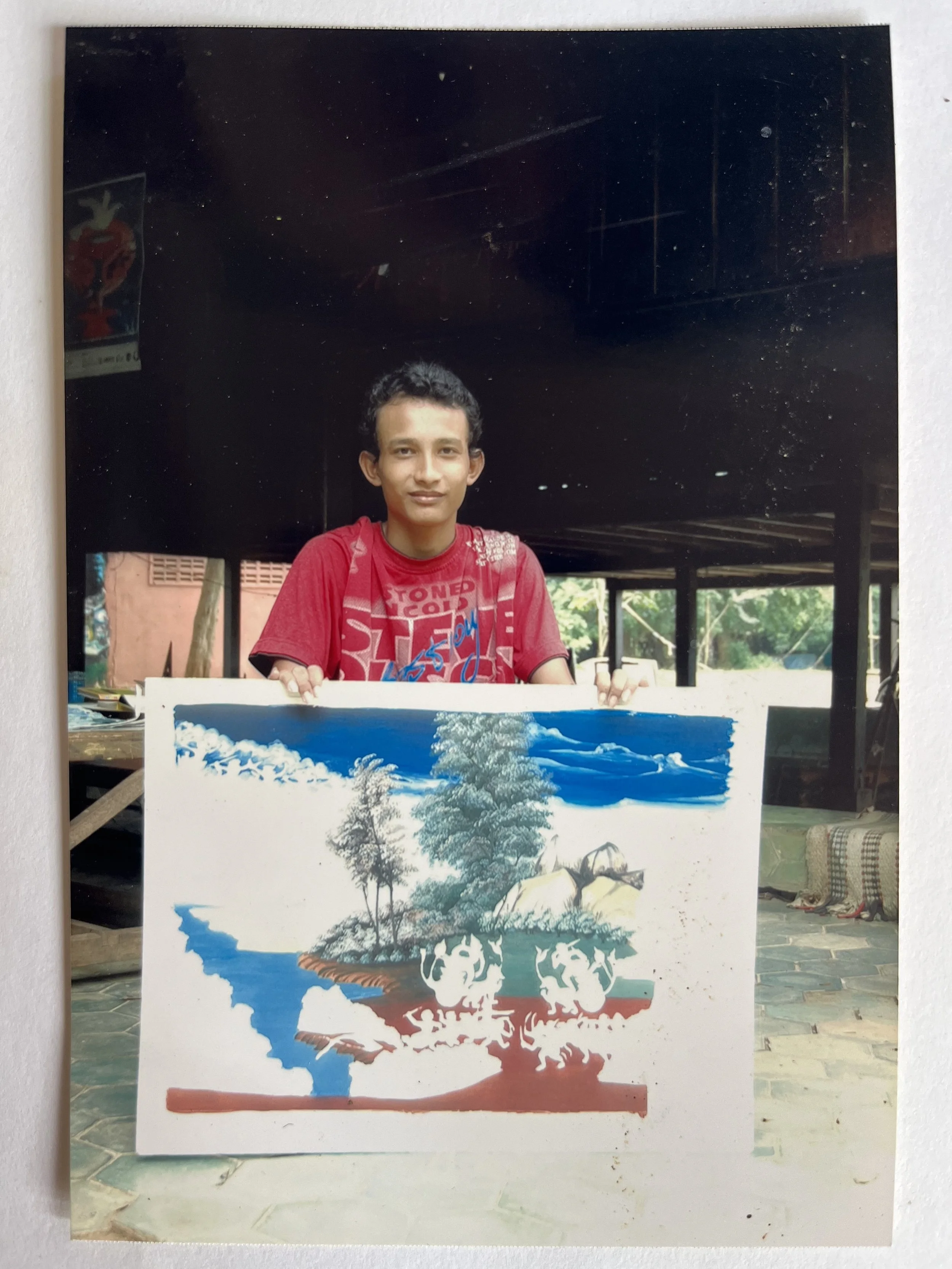
Chea Sereyroth during his student years. Image courtesy of SNA Arts Management.
In 2010, you graduated from Phare Ponleu Selpak’s School of Visual and Applied Arts in Battambang. Could you describe your experience during this period, the education you received and the cohort you interacted with?
I began my study at Phare Ponleu Selpak in 2005. I learned many skills during that period, such as working with pencil, ink, watercolour, oil paint, pastel, charcoal, and more. We practised drawing, painting, and tracing techniques.
My classmates and I went outdoors to draw in villages, along roads, and in rural landscapes. In 2008, I travelled to draw at various temples in Siem Reap and represented my group in opening a watercolour exhibition titled Morning Glory Flowers. The same year, several friends and I were selected to join a workshop with international artist Séra Ing and artist Vann Nath under the theme of remembering the Khmer Rouge regime in Cambodia. The workshop was led by Soko Phy Vakalis at Bophana Center in Phnom Penh.
Who has been a mentor or an important artistic influence in your development as an artist? And why?
From the beginning of my studies, the teachers guided me step by step, and this training deepened my interest. Art and painting contain so much that one could not fully learn all there is to know. The field is incredibly broad and expansive. In particular, my participation in three workshops with artist Séra Ing had a strong influence on me.

Chea Sereyroth during his student years. Image courtesy of SNA Arts Management.
What was one important piece of advice you were given?
It was about memory, and how one might integrate different elements into a work in order to create a meaningful and valuable experience for the audience.
Alongside your painting practice, you have worked as a graphic designer and taught at Phare Ponleu Selpak. Have these roles informed or affected your work as an artist?
I worked as a drawing and graphic design instructor at Phare Ponleu Selpak from 2011 to 2017. During that time, I was busy with my teaching and did not have enough time to develop my own artistic practice. A few years in, I decided to move to part-time teaching, and by the end of 2017, I stopped altogether in order to focus entirely on creating my own art, which I continue to do today.

Chea Sereyroth, Waiting, 2014, acrylic, sawdust and mud on canvas, 240x 165cm. Photo by Long Kosal. Image courtesy of SNA Arts Management.
Your first solo exhibition, Disaster, was held at Romeet Gallery in Phnom Penh in 2014. How did that opportunity come about, and what did it mean for you as an emerging artist at the time?
I have been participating in group exhibitions since the end of 2007. However, I was offered an exciting new opportunity to present my first solo exhibition in 2014. It came about after I was selected to participate in an international art programme in Singapore called SPOT ART in 2013, which was designed for artists under 30 years old in Southeast Asia.
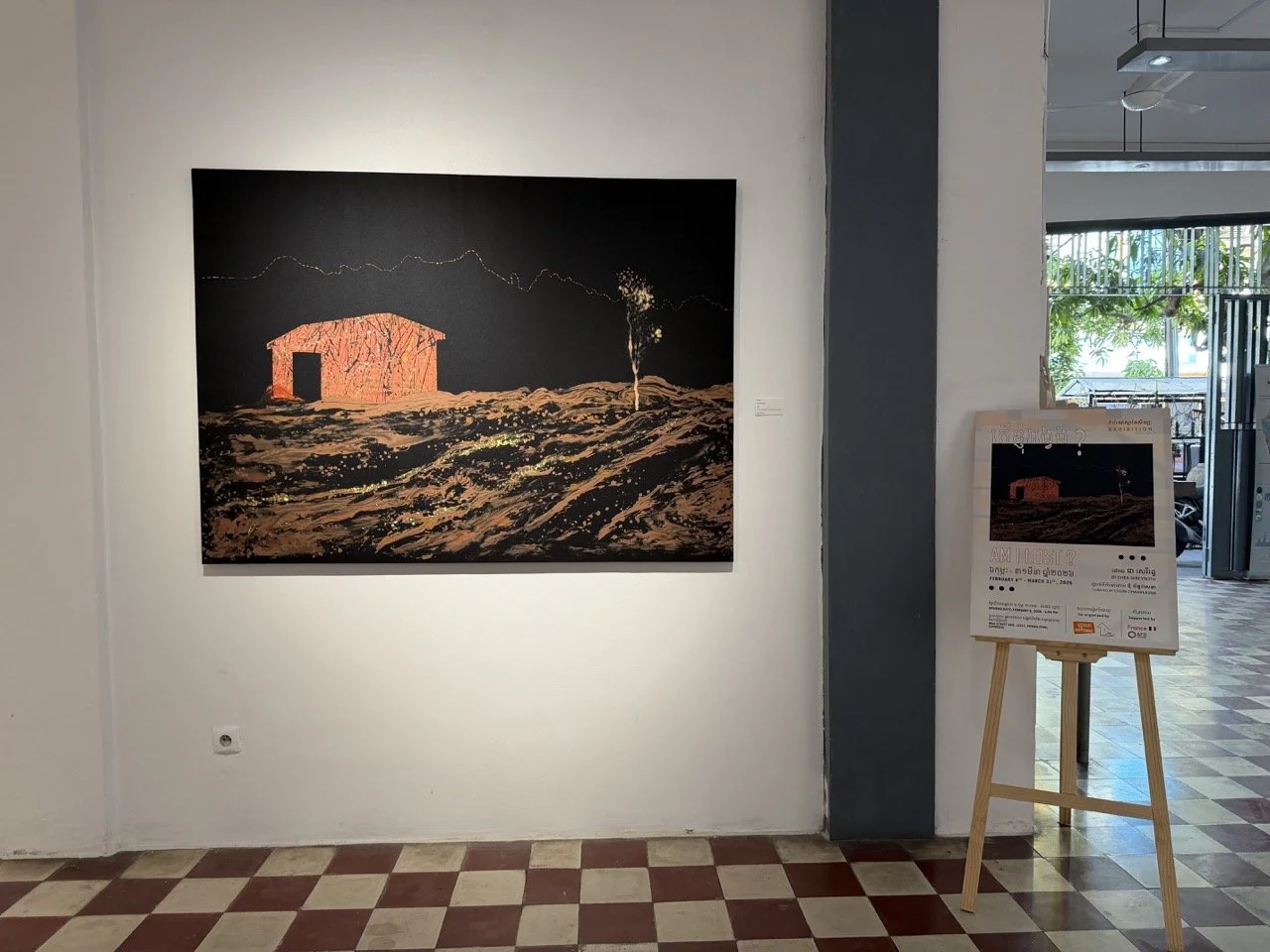
Installation view of Am I Lost? (2026) at the Bophana Center in Phnom Penh. Image courtesy of SNA Arts Management.
12 years on, your most recent solo exhibition, Am I Lost?, opened at the Bophana Center in Phnom Penh in February 2026. What are the key themes and ideas explored in the show?
As time passes, memories continue to grow and transformation quietly unfolds. Old images dissolve into new ones, each carrying a different resonance and meaning. Connection and disconnection, presence and absence, loss and fragmentation gradually become part of a process that seals old scars. This allows another image to emerge; one of healing and reconciliation. Through pain and sorrow, these spaces are filled with deeper meaning, becoming a source of courage, resilience, and the strength to continue moving forward.
How has your practice evolved between these two bodies of work?
The two bodies of work are painted on canvas, but they are very different. In this later work, I used multiple techniques. For instance, I applied paint onto the woven mats and repeatedly pressed them onto the canvas to create multiple layers of prints. Then, I continued painting over them. In some works, I also added sawdust to create additional surface texture. For this series, the canvas backgrounds are in two colours, orange and black, unlike the aged yellow tone in my earlier works.
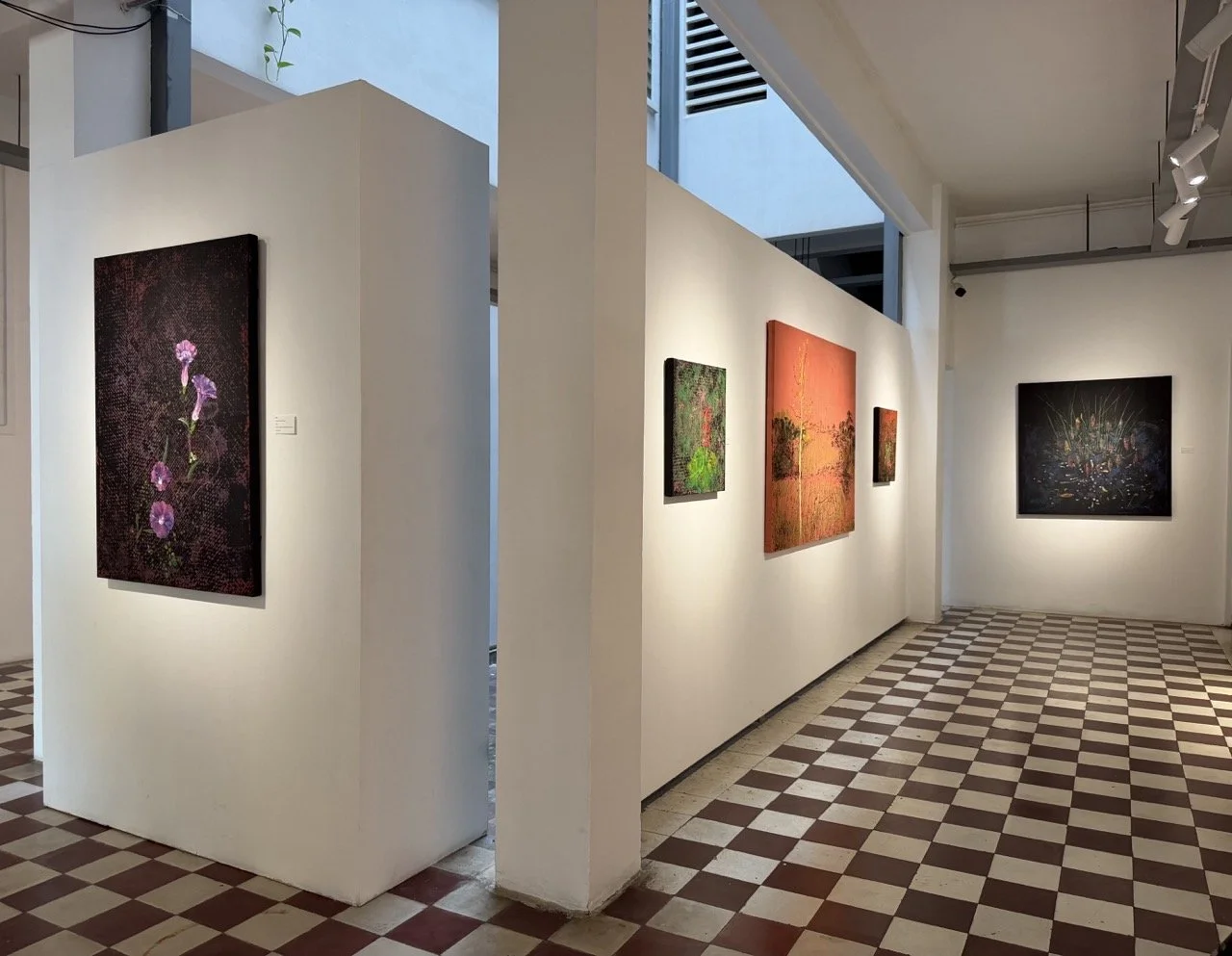
Installation view of Am I Lost? (2026) at the Bophana Center in Phnom Penh. Image courtesy of SNA Arts Management.
Your works incorporate sawdust, mud, earth, even pencil shavings. How did you arrive at this particular material language?
The materials and techniques I use have gradually developed in response to the themes, meanings, and imagery I want to express. I collect soil in different colours from mountainous areas, then crush, dry and sift it into a fine texture before mixing it with water and straining out any unwanted particles. I combine the mixture with glue and acrylic paint to create my works.
Could you share your favourite art space or gallery in Cambodia? Why are you drawn to that space and what does it offer to your practice?
Although there are only a few art galleries and a limited number of art institutions in Cambodia, the places I have been able to visit include museums, temple sites, historical places, some galleries, as well as remote areas such as forests, mountains and border regions. All of these places have provided me with stories, histories and different forms of transformation and development, which have become a great source of inspiration and motivation for my practice.
What are your hopes for Cambodia’s art scene, and for the broader Southeast Asian region as well?
The period following the COVID-19 outbreak, compounded by the ongoing conflicts, has been the most difficult time. I hope that the art scene in Cambodia and across the wider region will continue to grow and develop. It is through hard work and curiosity that we continue to connect and share art from across regions. To me, that is the most meaningful progress we can hope for in the future.