Fresh Face: Juventino Madeira
Timor-Leste Pavilion ‘Across Worlds’ at Venice Biennale 2026
A&M Fresh Face is where we profile an emerging artist from the region every month and speak to them about how they kick-started their career, how they continue to sustain their practice and what drives them as artists.
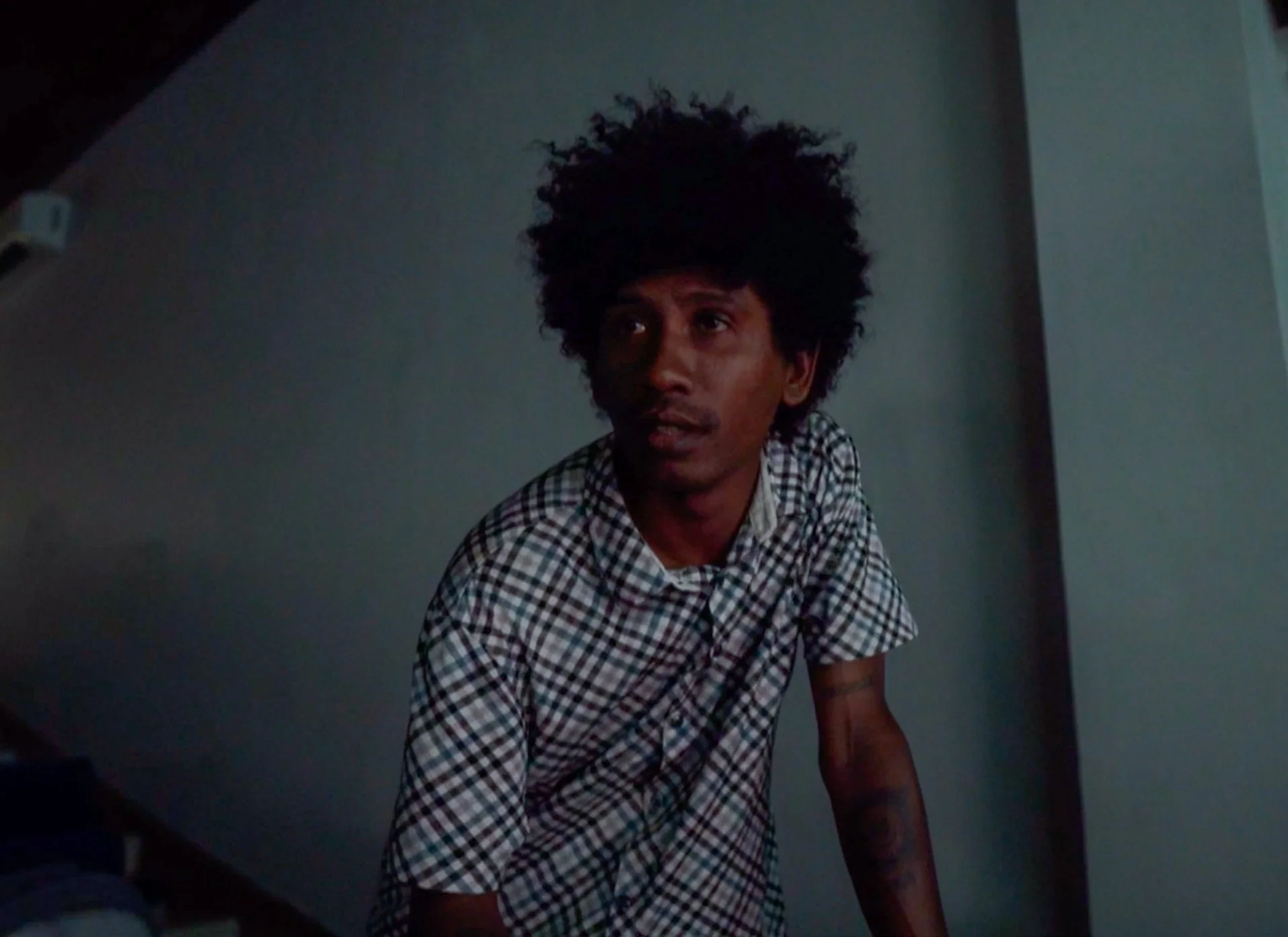
Juventino Madeira. Image courtesy of the Timor-Leste Pavilion.
Juventino Madeira (b. 1993, Timor-Leste) is a multidisciplinary artist whose works both draw from and transform his environments. He is the youngest participating artist in the Timor-Leste pavilion, Across Words, at the Venice Biennale 2026. Prior to this engagement, his works have been presented across the country in festivals, live performances, and major exhibitions. His short narrative video Rama Husi We-Ua (2022) was an official selection of the Timor-Leste Tourism Short Film Festival (2023) and screened at the Darwin International Film Festival (2024). Madeira also participated in BIENALSUR Timor-Leste (2025).
Largely self-taught, he has developed an experimental approach to creating evocative, site-specific video installations that organically respond to their surroundings. A forerunner of projection mapping as an emerging art form in Timor-Leste, Madeira’s cinematic installations transform urban settings into dynamic visual displays. In particular, the contours and materiality of surfaces serve as experimental mediums to present his projections. For instance, his work Arte Moris Archive Video Installation (2026), for the Arte Moris Free Art School 23rd Anniversary celebrations, saw his projection mapping not on the usual cement walls, but on individual pieces of paper. The result was akin to moving postcards, where fragments of memories were held in simultaneous conversation with each other, allowing viewers to understand the school’s history as a cohesive whole.

Video still from Juventino Madeira, Fraze ne’ebé seidauk hotu (An Unfinished Sentence), 2025–26, produced by Thomas Henning. Image courtesy of the artist and Timor-Leste Pavilion at the 61st La Biennale di Venezia.
In this vein, Madeira’s work tends towards the archival. He cites the peculiarities and indescribable moments from everyday life in Timor-Leste as his sources of inspiration. At the same time, his practice is deliberately conscious of the historical and political contentions that undergirds much of contemporary Timor-Leste. Capturing the present for the future, and modes of heritage for posterity’s sake are key motivators for him. His work for the Venice Biennale, Fraze ne’ebe Seidauk Hotu (2025 to 2026), embodies this exigency through its explorations of Timor’s evolving cultural polyphonies. Alongside artists Veronica Pereira Maia and Etson Caminha, Madeira’s presentation provides a fresh exposition on Timor-Leste’s unique cultural contexts on a global platform.
Interview
You are a self-taught multi-disciplinary artist. What kickstarted your interest in art, and how did you develop your practice?
I spent two years in Indonesia, studying architecture at a university in Surabaya, East Java. But I returned to Timor-Leste before my course was complete because my interest waned. At the time, my friend Danny, who plays guitar in the band Klamar, told me he was looking for someone to hold the boom on a film shoot. The film had already begun preproduction. Titled Ema Nudar Umanu, it was written and produced by Thomas Henning and another friend, Jonas Rusumalay Dias. The experience of working on a film production inspired me to start exploring multimedia art. I began to study photography, video production and graphic design. In the end, Thomas trusted my work enough that I designed the promotional posters for the film. I also went on to produce their music videos, and their faith in me encouraged me to continue learning about multimedia arts on my own.
With this experience, Etson Caminha, who is also exhibiting at the Venice Biennale, invited me to design the promotional materials for NOISE. NOISE is the first experimental sound art event in Timor-Leste which he put on with Yohan York. I soon moved into Arte Moris Free Art School to live together with the artists there and continue my practice.
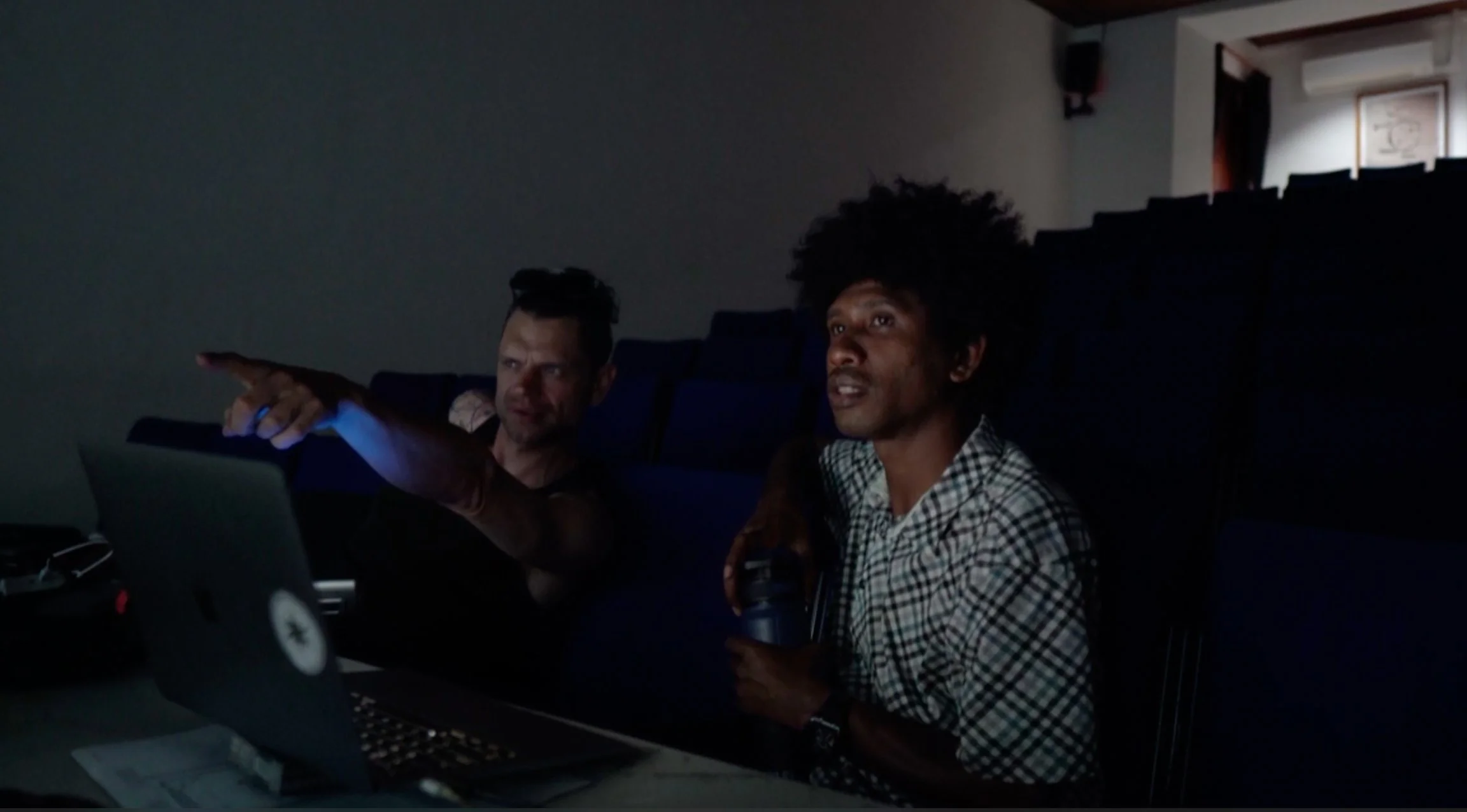
Juventino Madeira (right) with Thomas Henning (left).
Who has been a mentor or an important artistic influence in your development as an artist? And why?
Timor-Leste is a young country rich in oral culture. It is also a post-conflict nation with a history of resistance. Art played an important role in the history of our struggle. When I was still young, we gained independence and the nation’s walls were covered in words of struggle, rage, love, hope and happiness alongside drawings of resistance heroes. Much of the music written under occupation hides passionate expressions of resistance within songs of romance. At that time, the band I listened to the most was Galaxy, where Etson played bass. Their music told the stories of our fight and inspired the artists of my generation. He also supported me personally while I formed my creative approach.
Another key mentor would of course be Thomas. When the film Ema Nudar Umanu was completed, we became good friends and he would include me in his work for the NOISE events. I presented my first ever projection mapping work at this event thanks to Thomas. He has consistently encouraged me to explore and learn independently.
“Timor-Leste is a young country rich in oral culture. It is also a post-conflict nation with a history of resistance. Art played an important role in the history of our struggle.”
Your immersive, sensorial works are typically enacted on a large scale through site-specific installations. Who are the other artists you work with for your projects?
My friends work together with me. They include Adi Caminha, Etson’s younger brother who plays with the band Klamar, my good friend Atoy who is now the pianist in Galaxy, alongside Latu Ricky and Zemalay. They join in to work on the installations not so much as jobs but more as friends who want to support me as they appreciate the art I make.
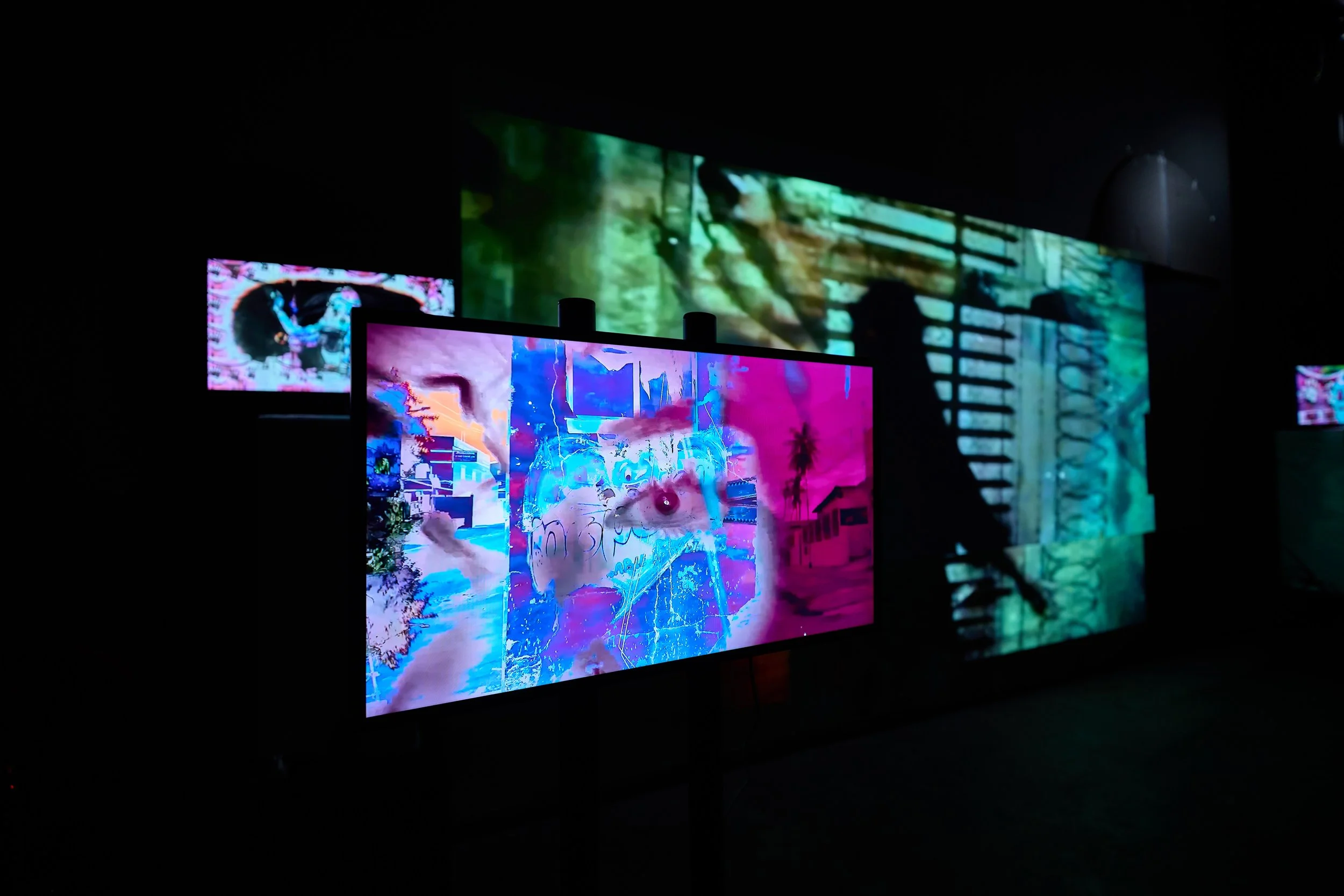
Juventino Madeira, Fraze ne’ebé seidauk hotu (An Unfinished Sentence), 2025–26. Video installation. Produced by Thomas Henning. Installation view, Timor-Leste Pavilion at the Venice Biennale. Image courtesy of the artists and Timor-Leste Pavilion at the 61st Venice Biennale.
Could you tell me more about your use of projection mapping? How did your interest in this technology start and what about this format of presenting your art intrigues you?
The first time I saw projection mapping was at the 2023 NOISE event. Thomas made an installation where video textures served as lighting with an audio overlay, and I was in love with the technique. Because I had basic video editing skills, I picked up projection mapping quite quickly.
When Thomas came back from Indonesia in 2023, he had the idea of making a projection mapping show at Fundacao Oriente in Dili, and a group of us chose different walls to do projection mapping on. I was pretty taken aback by the result when I looked at the buildings around us covered in moving images as it made the whole place become very strange. That experience cemented my belief that projection mapping can be an unique art form of its own.
Since then, I have worked primarily on video installations, developing work for the Hasoru Malu art exhibitions that were presented in Dili at Fundacao Oriente. In 2025, when Timor-Leste was represented at the BIENALSUR for the first time, I took part alongside four other fellow artists. It was the first time I had presented a purely video-based artwork.
Do you make a living completely from being an artist? If not, could you share what other types of work you take on to supplement your income?
This is an interesting question because in Timor-Leste, it is immensely difficult for an artist to live just from their artistic practice. It is important to have alternative sources of income. This is especially so for artists who have a family to look after. As such, I do freelance work such as designing flyers and banners. I also make commissioned documentaries, and do photography and videography for events. The alternative work that I do is not very different from my artistic process. In fact, I started doing this kind of work before I became an artist.
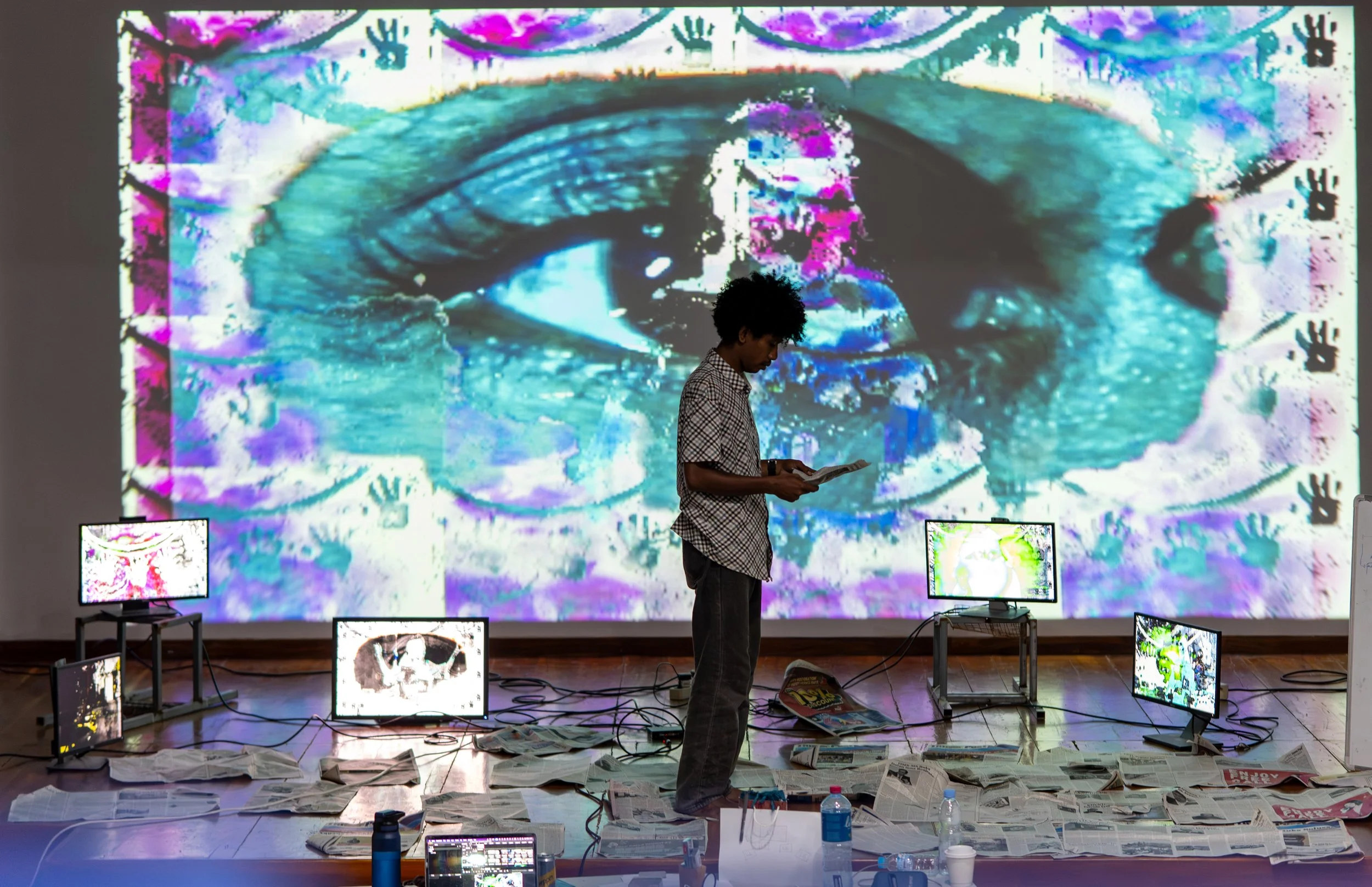
Juventino Madeira at work on Fraze Ne’ebe Seidauk Hotu (An Unfinished Sentence) (2025-26). Image courtesy of the Timor-Leste Pavilion.
In the last five years of your practice, what are some core interests that have formed the foundation of your work?
I am interested in capturing daily life in Timor-Leste with all its contrasts and peculiarities. It is difficult to develop a complex and rich art practice here in Timor-Leste due to the lack of infrastructure. As such, I take inspiration from real life, which I then turn into an art experience. My freelance work also forms the basis of my practice and inspiration, as does going through videos on YouTube. As an artist born in the 1990s, digital information is for me very relevant. I mix archival videos and images of Timor-Leste, as a way of looking at my country and society through contemporary eyes but also through the eyes of the past.

Video still of Juventino Madeira, Rama Husi We-Ua, 2022, displayed at the Timor-Leste Tourism Short Film Festival (2023).
Your short narrative video, Rama Husi We-Ua (2022) explores the stories and heritage of the We-Ua people. What is your approach when you have to work closely with communities?
Rama Husi We-Ua is a short documentary I made together with collaborators Potenzo, Cesco and Fidel. We made it for the Timor-Leste Tourism short-film festival that was organised by Fundacao Oriente together with the Asia Foundation which partially-funded the film. The documentary speaks about the community of We-Ua that lives in the area called Kuri. They sustain themselves through hunting and fishing.
In truth, it was not easy to get close to them as a community because they generally avoid outsiders and are quite shy with strangers. But because Potenzo had already connected with them and lived near them, we were able to develop a relationship. They are also a community that has a deeply respectful relationship with the natural world.
The reason we chose to make Rama Husi We-Ua was that there are documentaries already made about Timor-Leste and its landscape, our ceremonial houses, tais, or traditional weaving, and many other things. The We-Ua is a unique community that is not widely known, and we felt it was important to create the film as a visual archive for future generations. We wanted to capture in memory the images and stories of a culture that maintains traditional hunting and fishing through archery.

Ha Dao, Strange Tales from a Studio of Leisure, 2025, exhibition view at Matca, Hanoi, Vietnam. Image courtesy of the artist.
You will be representing Timor-Leste at the 2026 Venice Biennale alongside two other artists, Etson Caminha and Veronica Pereira Maia. How did this opportunity come about?
This is the second year Timor-Leste has a national pavilion at the Venice Biennale. The first time was in 2024, when Maria Madeira represented our country. For this year’s pavilion, the National Secretariat of Art and Culture made an open call for all artists in Timor and across the diaspora to submit their proposals. I joined the application process, but did not have big expectations that I would get through, as I am still quite fresh in my artistic practice without much experience in international events.
I was surprised when they notified me that I would be interviewed alongside nine other artists, and in the end, Etson and I were chosen to join Veronica Perera Maia. My guess as to why I was selected is that my proposal responded to curator Loredana Pazzini-Paracciani’s concept exploring the oral traditions of Timorese culture.

Juventino Madeira at work on Fraze Ne’ebe Seidauk Hotu (An Unfinished Sentence) (2025 to 2026). Image courtesy of the Timor-Leste Pavilion.
At the Biennale, you will be presenting your work Fraze ne’ebé seidauk hotu (An Unfinished Sentence) (2026), which delves into the linguistic and cultural polyphonies that undergird East Timorese society. What are some key messages you hope for audiences at the Biennale to take away from your work?
Fraze ne’ebe Seidauk Hotu is a video which mixes archival film with new textures and gestures. It is an installation that will be presented together with Etson’s audio creations and the tais by Veronica Pereira Maia as a singular artwork under the title Across Words.
Fraze Ne’ebe Sedauk Hotu is made of footage shot since Timor-Leste’s independence. The abstract narrative begins with a young woman walking at dawn from the forest all the way into the city’s night lights before it loops back around to dawn again in the forest. It explores how Timor-Leste came through the darkness of a long war until finding itself in light. At the same time, it needed to adapt to modern culture and modern systems, but did so with a spirit for life that cannot be brought down. Although the woman who dances in the film is much younger than me, she is technically my mother as in Timorese culture, the sisters of our mothers are our mothers too. Our connection is across ages, which I feel connects with the pavilion’s concept of “Across Words”. In the film she represents mother earth as well as future generations.
Could you share your favourite art space in Timor-Leste? Why are you drawn to that space and what does it offer to you and your practice?
Fundacao Oriente is the most supportive space in Timor-Leste for experimenting with art. They also do interesting art projects. BIENALSUR, which I participated in, was hosted at Fundacao Oriente. I feel most artists hang around Fundacao Oriente and Arte Moris Art School. There are also a few art galleries in Dili that are becoming very interesting.
As a multimedia artist, the best place to see and be inspired is street life. We have many street artists that do graffiti works. I get a lot of pleasure from filming people going about their everyday lives, in the local market, at the university, and in the kinds of spaces where words cannot quite explain what we are seeing.
“I get a lot of pleasure from filming people going about their everyday lives, in the local market, at the university, and in the kinds of spaces where words cannot quite explain what we are seeing.”
What are your hopes for your own local art scene in Timor-Leste, and regionally across Southeast Asia as well?
I hope that one day Timor-Leste will have a strong art curriculum and a great art museum. At the moment in Timor-Leste, there are many talented artists who have made great works, but we do not yet have a venue like a national gallery in which those works can be collected.
To think about Southeast Asia, I hope that there will be opportunities for regional artists to have their residencies here. It is important to have spaces where we can share ideas, tell stories of our lives and cultures, because I believe that Southeast Asia is a region that is culturally rich.
More information about the 2026 Timor-Leste Pavilion here.