
Fresh Face: Hà Đào
On Dung Hà, Matca, and the ethics of the camera
A&M's Fresh Face is where we profile an emerging artist from the region every month and speak to them about how they kick-started their career, how they continue to sustain their practice and what drives them as artists.
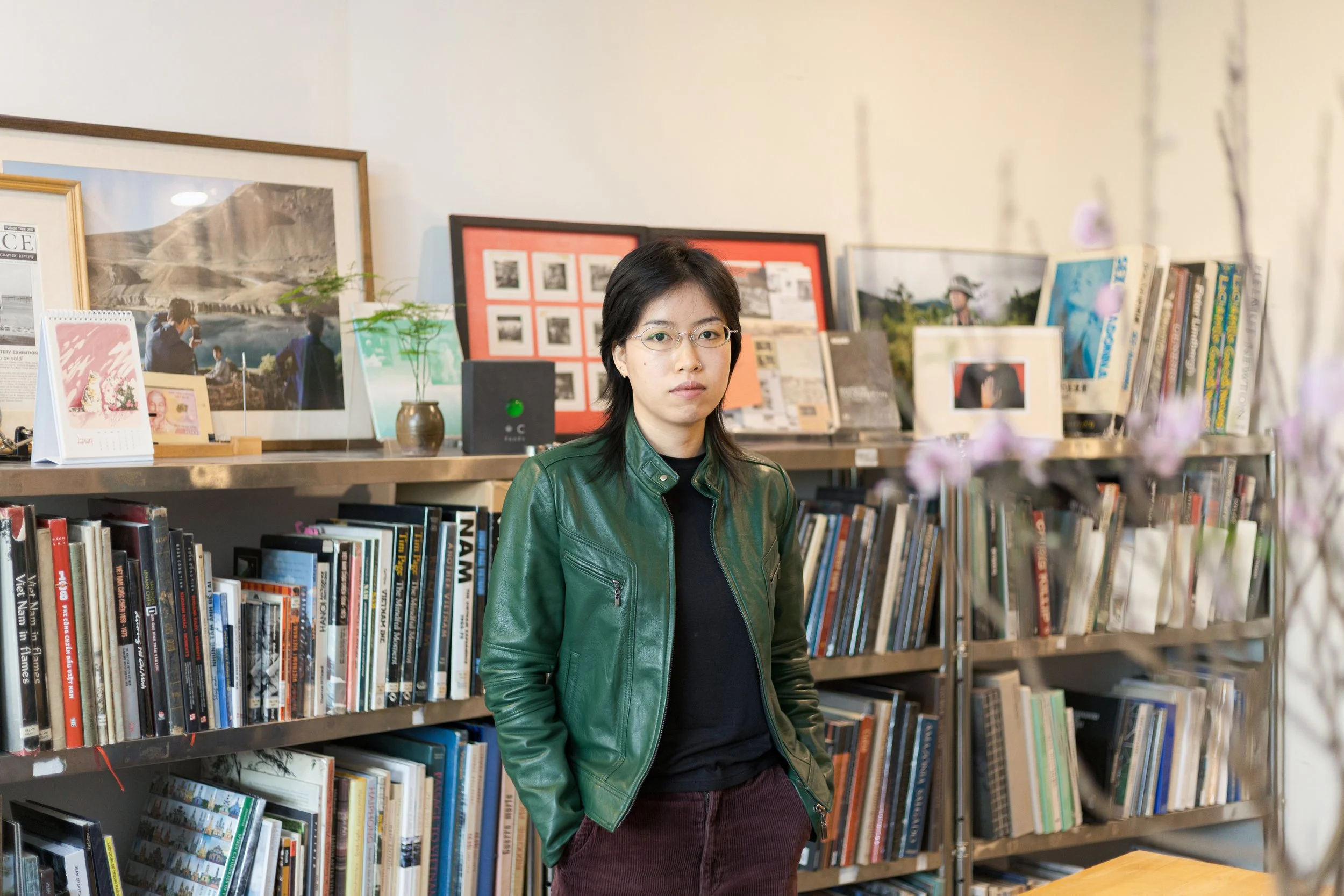
Hà Đào. Portrait by Vu Khoi Nguyen.
Hà Đào (b. 1995, Hanoi) is drawn to the space where documentary instinct meets the seductions of fiction. Working across photography and moving image, she has reconstructed a 2017 murder case from court testimony, resurrected a notorious female gangster through the aesthetics of 2000s pop, and documented alternative spiritual practices in a haunted Swiss villa, among other endeavours.
Alongside her personal practice, she co-runs Matca Space for Photography in Hanoi, an independent initiative she helped build from an online journal into a physical space. It has been dedicated to expanding the conversation around photography in Vietnam since 2017. Her work has been recognised with the Seed Award by the Prince Claus Fund and the 38th Higashikawa Award in the Overseas Photographer category. More recently, she received the 2025 Dogma Prize, presented by the Dogma Collection in Ho Chi Minh City.

Hà Đào, All Things Considered, 2019, digital photographs with court audio, dimensions variable. Image courtesy of the artist.
Incidents of everyday life are her material. All Things Considered (2019) takes as its subject a notorious 2017 murder case from Bình Dương province, in which a factory worker named Hàng Thị Hồng Diễm killed her husband in an act of jealousy and self-defence. She then recounted the entire sequence of events during a four-hour public trial. The work pairs 41 photographs of Bình Dương province alongside subtitled excerpts from the 2018 trial. The images are seemingly affectless, such as a patterned folding chair holding a brown backpack studded with black flowers and a leather belt. The truth is several hands removed, and All Things Considered treats that distance as its real subject, tracing the trajectory of a private tragedy sieved through courts, newspapers, and public opinion.
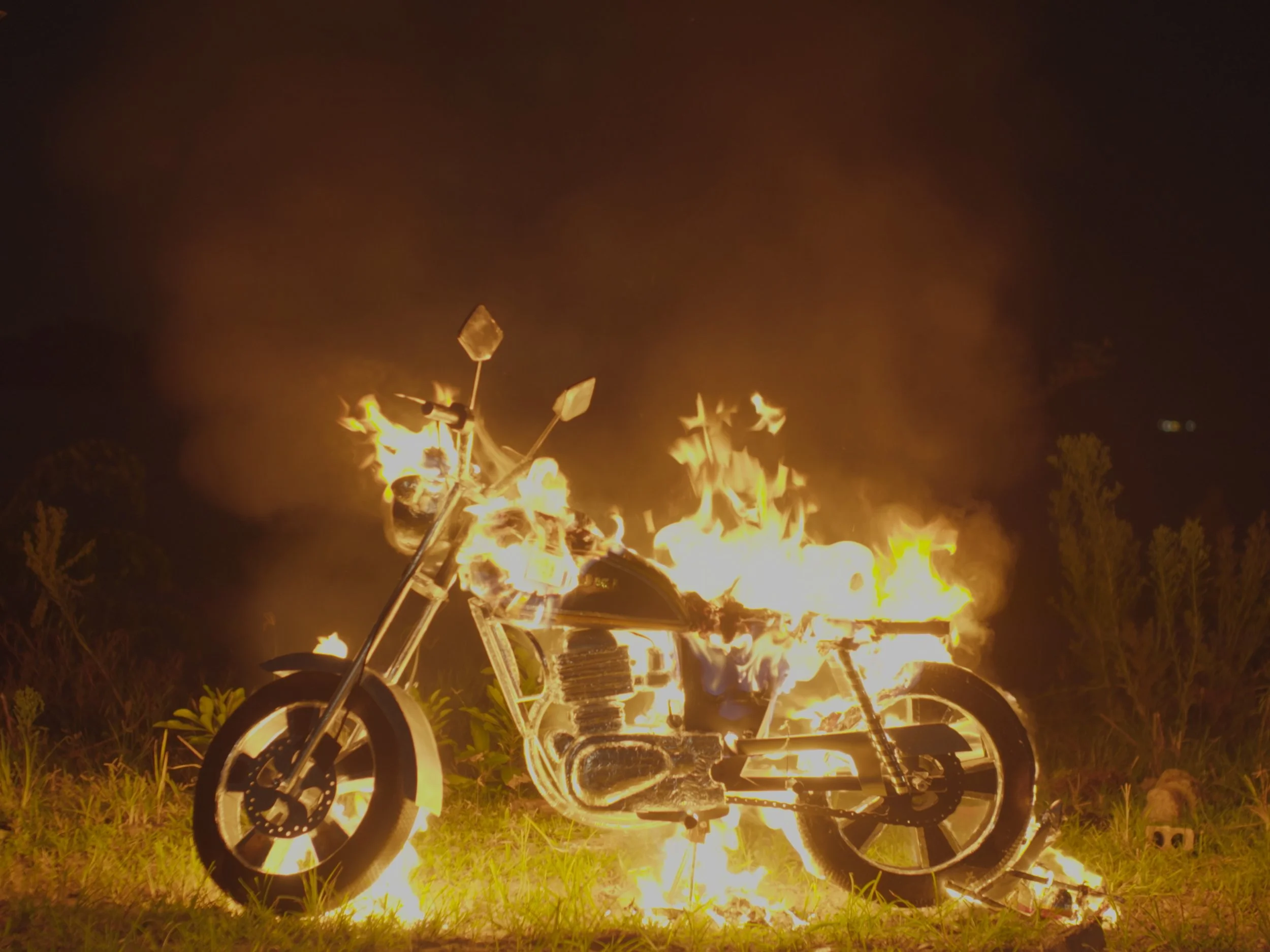
Hà Đào, If Heaven Awaits, 2024, music video, dimensions variable. Image courtesy of the artist.
For her first solo exhibition </3 (2024), Hà frames her ongoing inquiry into the ethics of a borrowed story. One of the works, If Heaven Awaits (2024), takes as its subject Dung Hà, a Hải Phòng gangster, openly queer, shot dead by a rival in 2000. The work remakes a popular 2000s ballad, Đêm Nay Anh Mơ Về Em, into a single-channel music video, accompanied by two laser-engraved crystal cubes depicting Dung Hà's tomb and the Đồ Sơn Casino, and a life-size paper motorcycle burned in her honour at the end of production. Both works are animated by something closer to empathy than investigation. They become a kind of posthumous restitution, reinstating the full weight of the lives that have been reduced to headlines.
Her most recent solo exhibition Strange Tales from a Studio of Leisure (2025) features a body of work produced during a three-month residency at Villa Sträuli in Switzerland. It combines photographs of alternative spiritual practices, such as witchcraft, divination, tarot, sound baths, with a written account that examines the residency itself. Hà is again drawn to what has been pushed to the edges. In this instance, she looks at spiritual traditions which practitioners were once prosecuted for, but is now commodified. But she adds a further layer of scrutiny, asking who gets to have a studio of one’s own and the luxury of uninterrupted time.
These three exhibitions map Hà's inquiry into the particular entanglements of the medium of photography itself: its ethics, its empathies, and the material conditions it is produced under. Throughout her work, she is driven by a refusal to accept the narrative presented by images at face value.
Interview
In 2016, you completed your studies in Professional Communication at RMIT University in Hanoi and Melbourne. Could you describe your experience during this period?
I was accepted into the Academy of Theatre & Cinema, the only institution in Hanoi at the time offering formal education in so-called art photography, though its definition diverged from contemporary discourse. I ended up attending RMIT University with a scholarship. The programme lasted only three years, which meant I could enter the workforce early. The curriculum focused on advertising and public relations, preparing students with the skills to break into the booming creative industry. These were practical considerations for someone without a family background in the arts. In reality, however, I had little interest in the aspirational upward mobility promised by that career path. Photography was something I learned elsewhere: through workshops, self-directed experimentation, and, most importantly, by continuously making work.

After hours with Antoine d’Agata and Sohrab Hura at Angkor Photo Workshop, Siem Reap, Cambodia, 2017. Image courtesy of the artist.
Who has been a mentor or an important artistic influence in your development as an artist? And why?
A formative experience was the three-month photography mentorship in 2016 with cinematographer and photographer Jamie Maxtone-Graham at the now defunct Hanoi Doclab. Aside from brief sessions about the history of photography, it offered a sustained space to develop a body of work. It privileged personal urgency over market demands or institutional agendas, these conditions are still largely absent where I am based. The following year, I participated in the Angkor Photo Workshop, studying under Sohrab Hura, Antoine d’Agata, and Tania Bohórquez. It was brief but intense: a charged environment where work was quickly produced and boundaries actively tested. The time constraints may not suit everyone, but for me, they instilled a sense of physical and emotional intensity to carry into my practice. It also reinforced the belief that learning happens through making, through staying accountable and open to chance happenings.
I am deeply grateful for the opportunities to join these affordable yet rigorous educational platforms and have contributed in small ways to help sustain them. In places like Vietnam and Cambodia, their existence depends on the collective goodwill of just a few dedicated individuals.
What was one important piece of advice you were given?
Many photographers I look up to have been reluctant to give advice despite their professional success. This might come from an awareness that artistic journeys are shaped by vastly different circumstances, and that their own practices remain in flux. In a recent conversation with Christina Schwenkel, an American anthropologist with ties to Vietnam, I shared my concerns about working in contexts with unequal power relations. That also comes with the debt I owe to those who let me into their worlds, which could never be fully repaid. She acknowledged my concerns and said debt can also be productive; it makes us remember. Perhaps the desire to make things fair and square is a kind of illusion.

Roots & Worlds, editing session at Matca, Hanoi, Vietnam, 2025. Image taken by Vu Khoi Nguyen. Image courtesy of the artist.
Do you make a living completely from being an artist? If not, could you share what other types of work you take on to supplement your income? How do your roles, particularly as Managing Editor of Matca, inform or affect your personal artistic practice?
I do not live off of my art. It would be insincere to pretend otherwise or to frame that as an unideal condition. I have been fortunate enough to receive a few grants, but I also take, and even enjoy, various non-art gigs in media production. I also would not describe my work at Matca as a day job. We are a tiny team of photographers with our own practices, consisting of Linh Phạm, Vũ Khôi Nguyên, and me, dedicating ourselves to this without state backing or private wealth. Securing funding is very much part of a shifting workload, alongside taking the trash out, packaging books for delivery, adjusting spotlights before exhibition openings, or occasionally dealing with the cultural authorities.
As there was hardly any blueprint to follow, growing into editorial and curatorial duties has taken time. The double uncertainty of running a multi-platform initiative while pursuing my own art has created palpable tension. A more senior photographer once urged me to choose one thing to focus on, because “only failed artists write/curate”. That tension, however, is not something I necessarily seek to eliminate. Nearly a decade in, the everyday labour of sustaining Matca has made me acutely aware of the material conditions behind artistic production and how these shape what kind of work is even possible. This is where it becomes crucial to have team members who also believe in this burn-the-candle-at-both-ends way of life. Needless to say, without Matca, I would not have crossed paths with the many photographers, researchers, and collaborators who help shape both our activities and my own thinking.
“The everyday labour of sustaining Matca has made me acutely aware of the material conditions behind artistic production and how these shape what kind of work is even possible.”

Hà Đào, All Things Considered, 2019, digital photographs with court audio, dimensions variable. Image courtesy of the artist.
Your work, All Things Considered (2019), reconstructs the 2017 Bình Dương murder case through staged photographs and court audio. Could you walk us through your thinking process when approaching such sensitive, real-life material?
The work deals with a notorious case involving a woman who, out of jealousy and in self-defence, killed her husband and dismembered his body. They were both factory workers living in an industrial town in Vietnam where many branded shoes and backpacks are manufactured.
One must take sensible caution when dealing with a real tragedy. That said, when the piece was screened in a cinema, there were a few moments when the audience laughed out loud. This likely had less to do with detached cruelty than with the tone of the court audio, which slips into moral lecturing rather than legal judgement. Online reactions show a similar dynamic, treating the case as a darkly humorous cautionary tale about infidelity.
While the gory details caught attention, my interest lies in how cases like this circulate. How mediation creates distance, how private affairs become public narratives, and how tragedy turns into something we consume and debate.
Visually, I emulated the actual crime-scene documentation, focusing on banal details in non-descriptive spaces. Ordinary objects take on different meanings once context is imposed. Some images, such as those set in love hotels, are speculative. But remaining physically grounded was important. I visited the neighbourhood where the case occurred and spent time in similar factory dormitories and surrounding areas. Being there and photographing, however imperfectly or incompletely, felt necessary.
“Being there and photographing, however imperfectly or incompletely, felt necessary.”

Hà Đào, If Heaven Awaits, 2024, music video, dimensions variable. Image courtesy of the artist.
Your first solo exhibition, </3, was shown at Manzi Art Space in 2024. The exhibition featured If Heaven Awaits, which reimagines the life of gangster Dung Hà through the aesthetics of 2000s music videos. How did this opportunity come about, and what were the key themes or ideas you sought to explore?
I pitched the idea to Trâm Vũ together with the Manzi team on a whim, because without a physical manifestation, a piece that exists only in digital form feels unfinished. Manzi is one of Hanoi’s longest-standing independent art spaces that welcomes experimental works that most likely will not sell. Since my work is tied to local micro-histories and cultural references, it would not make sense to show elsewhere. The title </3 references both heartbreak and the digital realm, continuing a thread from the earlier work.
If Heaven Awaits sits within my broader interest in the creative and ethical limits of the camera, and in stories from Vietnam’s recent past marked by violence and moral ambiguity. I was drawn to Dung Hà not only as a female gambling boss, or as a butch/trans-masculine figure openly dating women at a time when homosexuality was illegal, but also as a wuxia-like character who invented one’s own rules and dared to live and die by them.
The work takes the form of an alternative music video for a popular 2000s love song, allowing a marginalised figure to occupy centre stage and giving lesbian longing its hypothetical moment in pop culture. While paying tribute to the kitsch aesthetics of the time, I also wanted the installation to carry a sense of reverence by presenting the work within a temple-like structure, framed by blue velvet curtains and two crystal cubes elevated on podiums. The crystals are engraved with two remnants of bygone empires: Vietnam’s first casino and her final resting place.
Dung Hà died at age 36 by gunshot. Before production, I sought permission, first at her tomb, then from a family member. A life-size paper motorcycle, an object of status and power that she once proudly owned, was burned for her at the end. I hope she received it.

Ha Dao, Strange Tales from a Studio of Leisure, 2025, exhibition view at Matca, Hanoi, Vietnam. Image courtesy of the artist.

Ha Dao, Strange Tales from a Studio of Leisure, 2025, exhibition view at Matca, Hanoi, Vietnam. Image courtesy of the artist.
Your second solo exhibition, Strange Tales from a Studio of Leisure (2025), emerged from a residency in Switzerland where all expenses were covered. In the past, you have written candidly about the practical realities facing Vietnamese photographers. What did the residency experience teach you about your practice or about making work?
During the residency, I sought to photograph alternative spiritualities, including tarot, sound baths, witchcraft, and the like. It stemmed from an intuition that the old villa I was staying in was haunted, which the director later confirmed. It also stemmed from something more practical: in a new and potentially isolating environment like Switzerland, spiritual circles were a rare place where I felt like my presence was welcomed. This experience reminds me of the 17th century book Strange Tales from a Chinese Studio or Liaozhai zhiyi, particularly the author’s process of travelling to collect mythical folklore, then returning to his room for reflection and writing.
Supported by the Swiss Arts Council, I had the luxury of my own studio and a production fee, which covered a tarot reading, visits to spots with spiritual legacy, and various ceremonies at Zurich wellness centres. After mindfully consuming cacao from Peru, I joined group exercises in authentic relating, where instead of profession or nationality, we were asked to identify with an element and to state our deepest wishes aloud in the present tense. During sound baths, participants were lulled to sleep by the vibrating hum of crystal singing bowls. Paying for rest must be the epitome of our vita activa. The residency sharpened my interest in the politics of rest under capitalism, which informs an upcoming video work.
Could you share your favourite art space or gallery in Hanoi or Vietnam? Why are you drawn to that space and what does it offer to you and your practice?
The film festival Như Trăng Trong Đêm (Like the Moon in the Night Sky) in Hanoi, the Dogma Collection and their public activities in Ho Chi Minh City, and AirHue as a dedicated art residency in Hue are a few examples of initiatives of different scales that I have had the pleasure of engaging with, whether as an artist, collaborator, or simply as an audience.
Recently, I have visited artist Le Tuan Ry’s new studio in Hanoi and was struck by how he transformed a former garment workshop into a working space of his own, not to mention his impressive home cooked bak kut teh. What draws me to these spaces is the roles they play over time rather than a singular exhibition or event. An art space in Vietnam can function differently from what is visible on the surface. It may be a site of civic duty, of play and slow accumulation of meaning, or of critical re-reading of the past. These idiosyncratic, less immediately legible dimensions are more fascinating.
What are your hopes for your own local art scene in Vietnam, and regionally across Southeast Asia as well?
When people from outside the country visit, the conversation often touches on censorship. I do not want to downplay the impact, but I am far more interested in what gets made out of necessity, despite and not because of constraints. I also do not think we need more rising stars or grand monuments to prove to the world the greatness of Vietnamese art.
I hope to see clearer pathways for emerging artists to grow into mid-career. I hope for real opportunities for those from outside big cities or wealthy families to enter and stay in the field. I hope for a culture of editorial critique that maintains journalistic distance. I hope for communities to grow out of tight-knit friendship and into shared values. I hope for exhibition and programme makers who are willing to take risks. I hope that we can keep creating and listening from the heart.
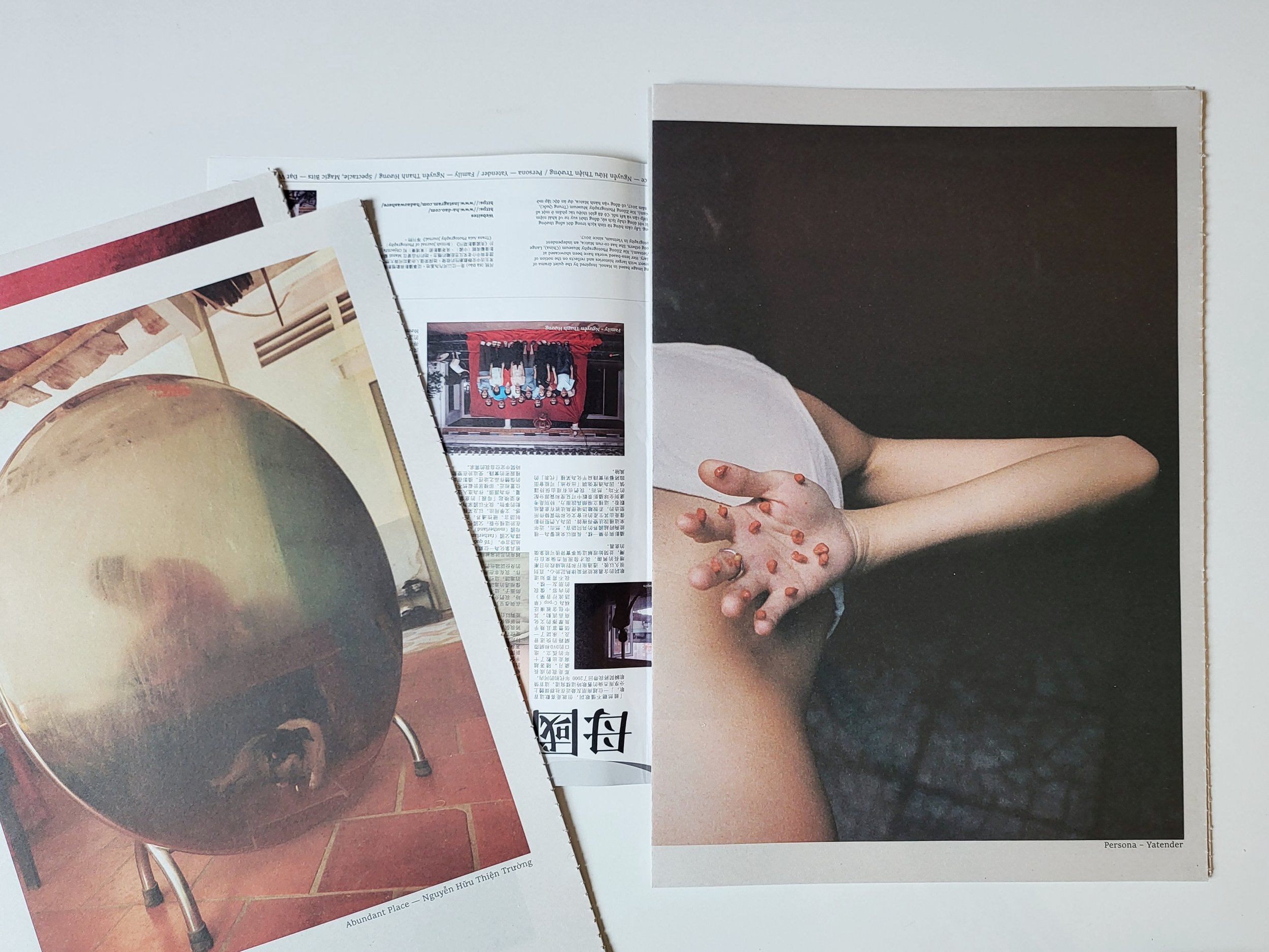
Issue 8 of Springbao, an independent publisher based in Taichung, featuring five Vietnamese photographers Vũ Khôi Nguyên, Yatender, Nguyễn Hữu Thiện Trường, Nguyễn Thanh Hương, Đạt Vũ. Image taken by Yan-Cheng Chen. Image courtesy of the artist.
Are there any upcoming exhibitions or projects that you would like to share?
Apart from working on an upcoming video work, I am guest-editing the issue of Springbao which will feature five Vietnamese photographers. It is published by an independent publisher in Taichung. Beyond that, I am still trying to find coherence in the relentless contradictions of living and working as an artist in a time like now.
This interview has been edited.