Maria Taniguchi’s ‘Afterimage’ and Sigma’s ‘Temporal Bodies’ at Singapore Art Museum
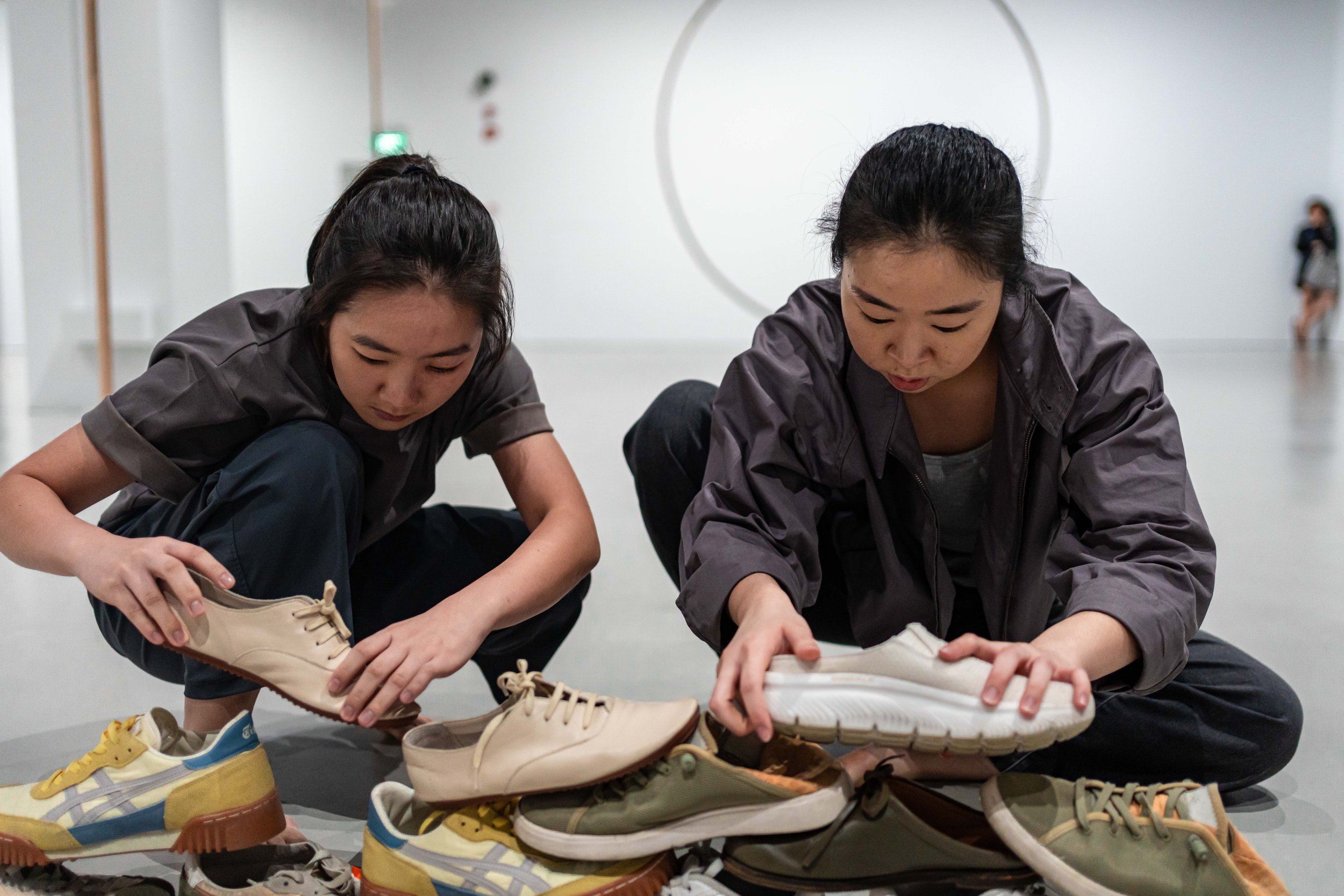
Sigma Collective, Temporal Bodies, 2026. Performance documentation from the exhibition Maria Taniguchi: Afterimage at SAM at Tanjong Pagar Distripark, 2026. The performance is situated in relation to Maria Taniguchi’s Runaways (2026), in the background. Image courtesy of Alex Chua.
The low hum of conversation in the exhibition hall gradually wound down, leaving only the metronomes from the video work slicing through the air. The audience gradually moved towards the edges of the exhibition hall, gathering along the walls as the dancers’ movements began to emerge. A group of dancers from Singapore contemporary dance collective Sigma wordlessly stacked their shoes into a mini pyramid at the foot of a giant circle made of plum wood. One dancer looked up from their squatting position as if grasping for something that could not be seen.
The site-specific movement piece Temporal Bodies was performed by Sigma at Singapore Art Museum, in response to Afterimage, Filipino artist Maria Taniguchi’s first solo exhibition in Singapore. Afterimage offers a survey of Taniguchi’s practice, presenting her iconic Untitled (2017-2026) brick painting series, three sets of video works Mies 42 (2010), Figure Study (2012, 2018), and A painter, if black were a place (2026), together with a sculptural installation titled Runaways (2026).
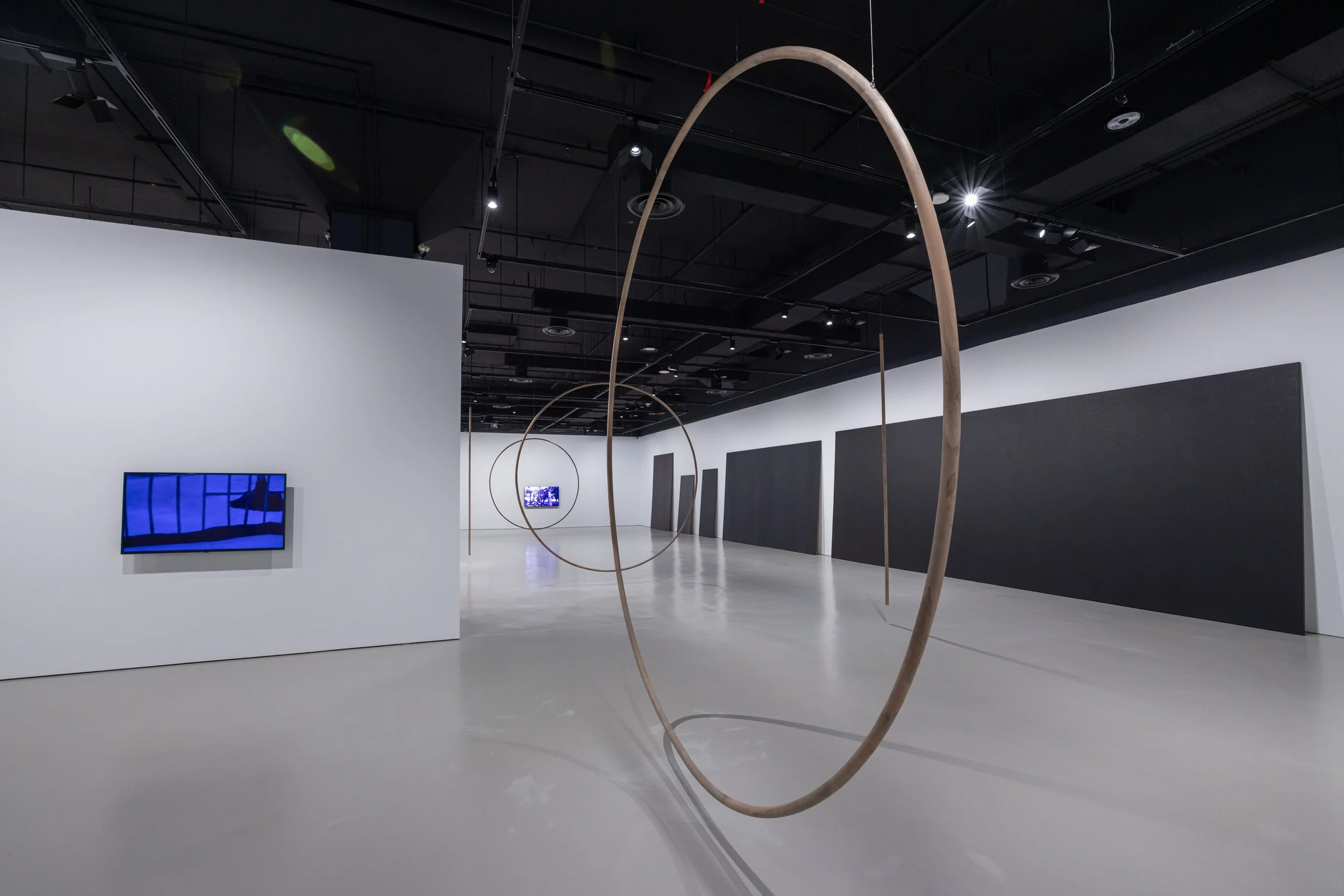
Exhibition view of Maria Taniguchi: Afterimage at SAM at Tanjong Pagar Distripark. Image courtesy of Singapore Art Museum.
The Untitled (2017-2026) brick paintings series occupy a central position in Taniguchi’s oeuvre. The artist compares her brick painting series to a “nervous system” that grows and branches into new nerve endings, with other works in her oeuvre described as its “reflections” or “refractions”.1 The sensibility of repetition and the labour-intensive nature of the brick paintings form the core thread of her practice. Conceived in 2008, the ongoing acclaimed brick painting series, rendered primarily in black, grey and pink tones, is a body of work produced by Taniguchi with the help of one assistant. Across the many paintings, she systematically prepares the canvas, draws grid patterns by hand using a pencil, and fills in each grid using acrylic paint mixed with varying amounts of water. Each brick painting is an amalgamation of subtle variations and contingencies produced through repetitive gestures, and forms a calendar of labour with a muted index of time.
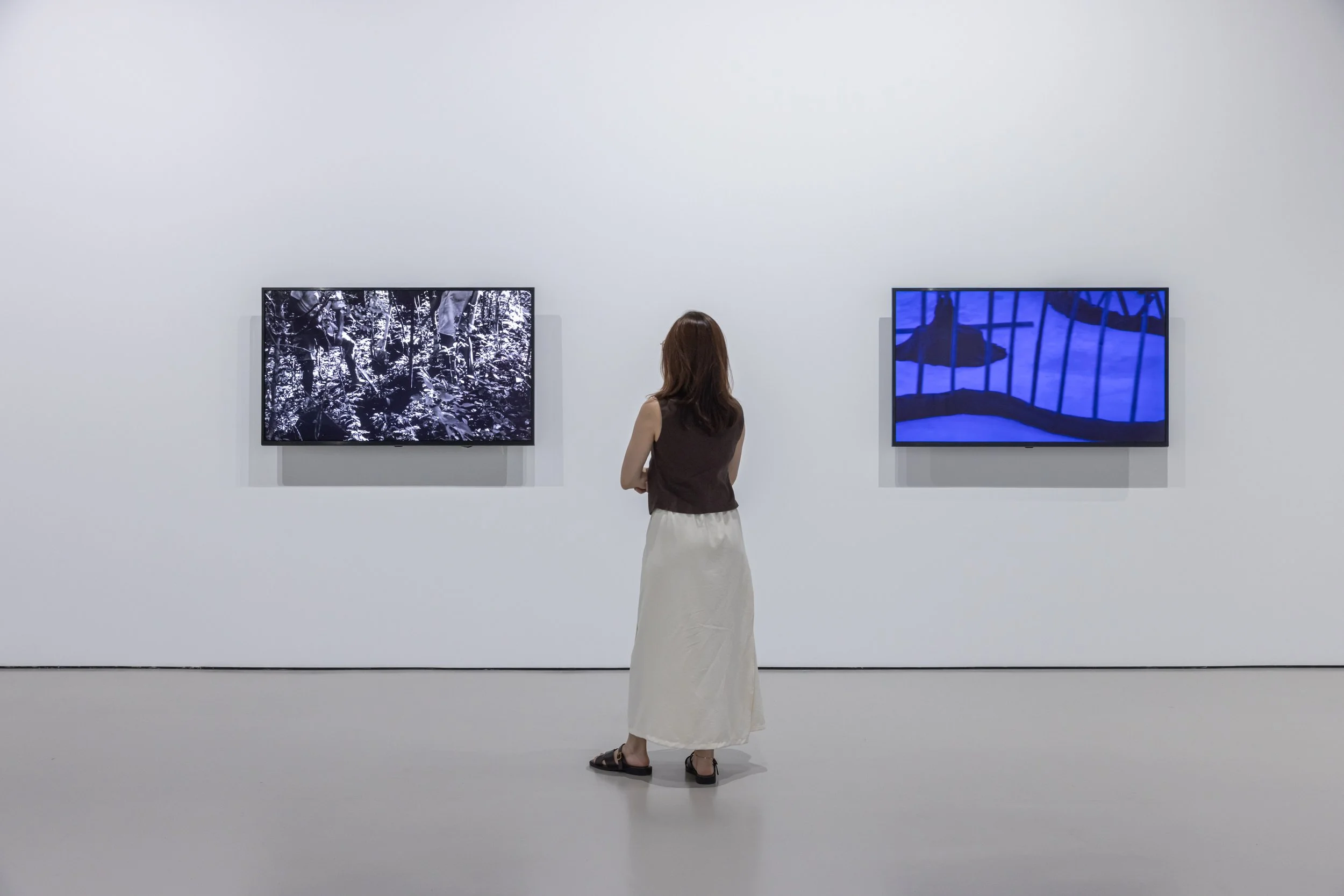
Installation view of Maria Taniguchi’s Figure Study (2012) and Figure Study (2018) as part of Maria Taniguchi: Afterimage at SAM at Tanjong Pagar Distripark. Image courtesy of Singapore Art Museum.
An afterimage is an imprint or an impression that remains after the original image has disappeared. Taniguchi’s work goes beyond painting the afterimage of labour; it also sculpts the negative space within it. Taniguchi traces the gap between two forms of labour presented in Figure Study (2012 and 2018). The earlier piece is a 37-minute black-and-white video of two workers digging clay from the ground in Zamboanguita, about 28 kilometres south of Dumaguete City, where Taniguchi was born, accompanied by the sounds of the jungle and digging. The latter version presents tightly framed shots of her hands shaping the clay. The close framing pushes the image towards abstraction, and depicts an impression that is yet to fully emerge but might never fully materialise.
Comparing the two iterations of Figure Study reveals how Taniguchi’s conception of the afterimage has evolved. Presented in a group exhibition at Museum of Contemporary Art and Design (MCAD), Manila in 2013, the video from 2012 was paired with fired clay slabs made by Taniguchi’s mother, Kitty Taniguchi, which match the dimensions of the video monitor. The slabs are the afterimage of the video. In the current iteration, it is no longer represented by a separate sculptural object but explored through the video made in 2018. This shifts the focus from the material distinction between two forms to the perceptual limits of the image. The abstract imagery in Figure Study (2018) now complicates and intrigues our perception, making the images of clay objects difficult to recognise compared to the monitor-shaped clay slab. Across the two iterations, the nature of the afterimage becomes increasingly elusive, foregrounding the limits of perception and the impossibility of fully apprehending an image.
The Temporal Bodies performance further translated the formal language of Taniguchi’s works into choreography, moving between collective formations and fragmented visual experiences. The dancers moved through repeated cycles of gathering, using their bodies to form sculptural formations at different points of the performance. At other times, they dispersed in smaller groups across the room, making it difficult for the audience to take in the performance as a whole. As the dancers stacked themselves into a pyramid, their formation took on an architectural quality, trembling under the weight of human bodies and echoing the cumulative labour in the brick paintings. When they dispersed and moved into different corners of the room, my attention was similarly pulled in multiple directions, recalling the camera cuts and movements in Taniguchi’s videos. The sudden shifts in their positions produced a series of disjoined visual encounters. I caught fragments of a dancer’s elbow or calf, framed against the clay and sculptural works depicted in the videos. These fleeting glimpses echoed the compositions of Taniguchi’s footage, extending its visual language into the live performance.
Temporal Bodies also established a physical connection between Taniguchi’s artworks and the dancing bodies through its intimate choreography. This intimacy emerged partly from the choreography which reenacted and dramatised ordinary movements and scenes. The dancers dashed across the room, chasing one another, and giving each other piggyback rides in scenes of carefree play. At other times, they walked in the manner of pedestrians but at a much slower speed, or simply paused. These familiar gestures, transformed through the careful framing of performance, moved beyond the visual and stirred the audience’s muscle memory. They prompted us to notice and reflect on the texture of our own everyday movements. In this way, the performance became a living echo of our daily routines, which often go unnoticed, much like the ungraspable visual impressions depicted in the artist’s work.
Sigma’s dancers also incorporate their shoes into the formations, turning them into the afterimage of movement and collective effort. The slight deformations of the shoes are traces of the dancers’ shifting weight and balance, making them imprints of physical exertion. The performance began with a pyramid of shoes. Later, they were arranged into a trail, a path that broke off midway, with one shoe flopped onto its side alongside another stray pair. A few metres away from this trail, the dancers gathered to stack themselves atop one another’s shoulders against the central pillar of the exhibition space, forming a towering human sculpture. The diagonal sightline connecting the trail of shoes, the human sculpture and Taniguchi's hanging sculptures formed a spatial triptych of afterimage, extending and connecting the concept of the afterimage to the dancers’ and audience’s bodies.
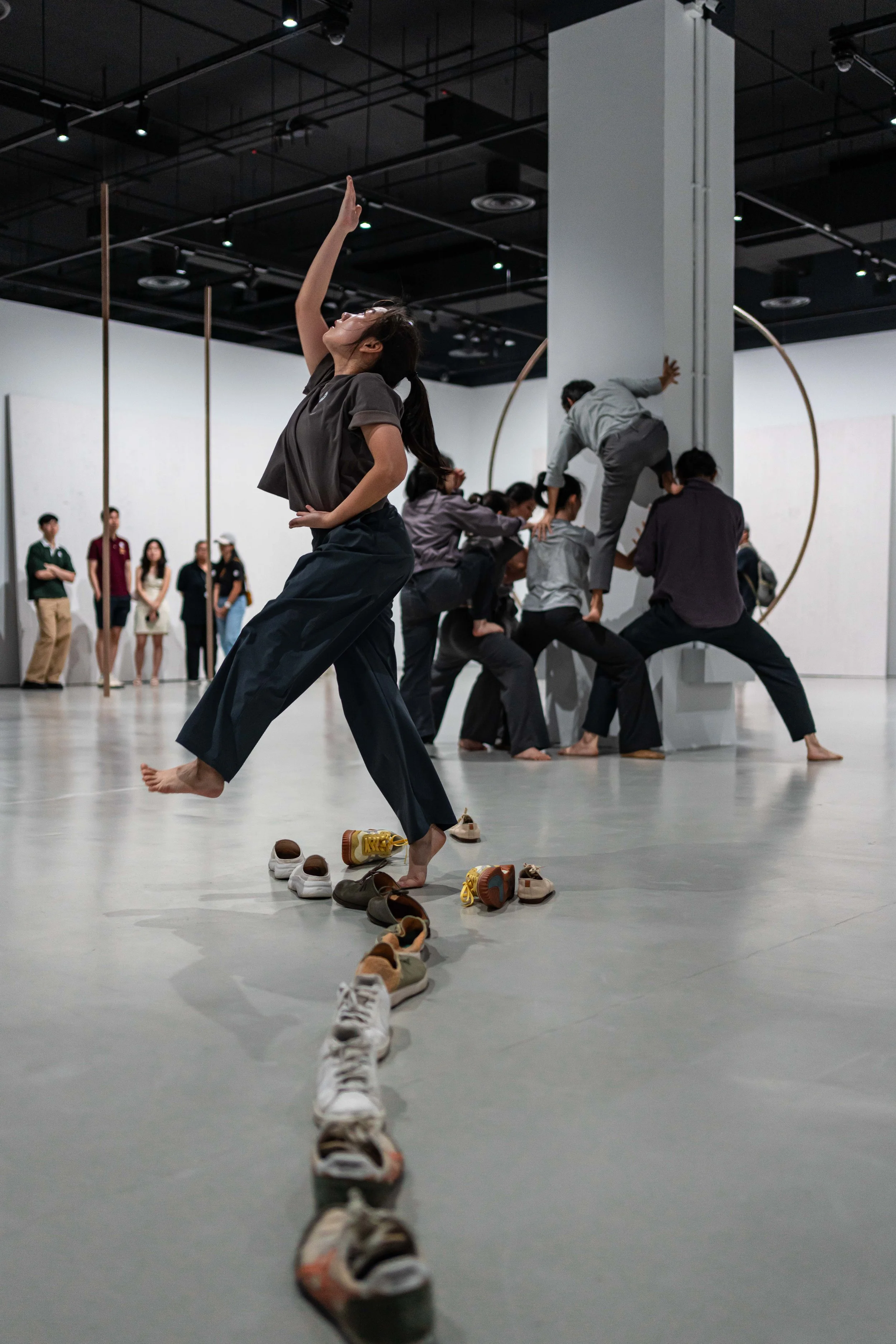
Sigma Collective, Temporal Bodies, 2026. Performance documentation from the exhibition Maria Taniguchi: Afterimage at SAM at Tanjong Pagar Distripark, 2026. The performance is situated in relation to Maria Taniguchi’s Runaways (2026), in the background. Image Courtesy of Alex Chua.
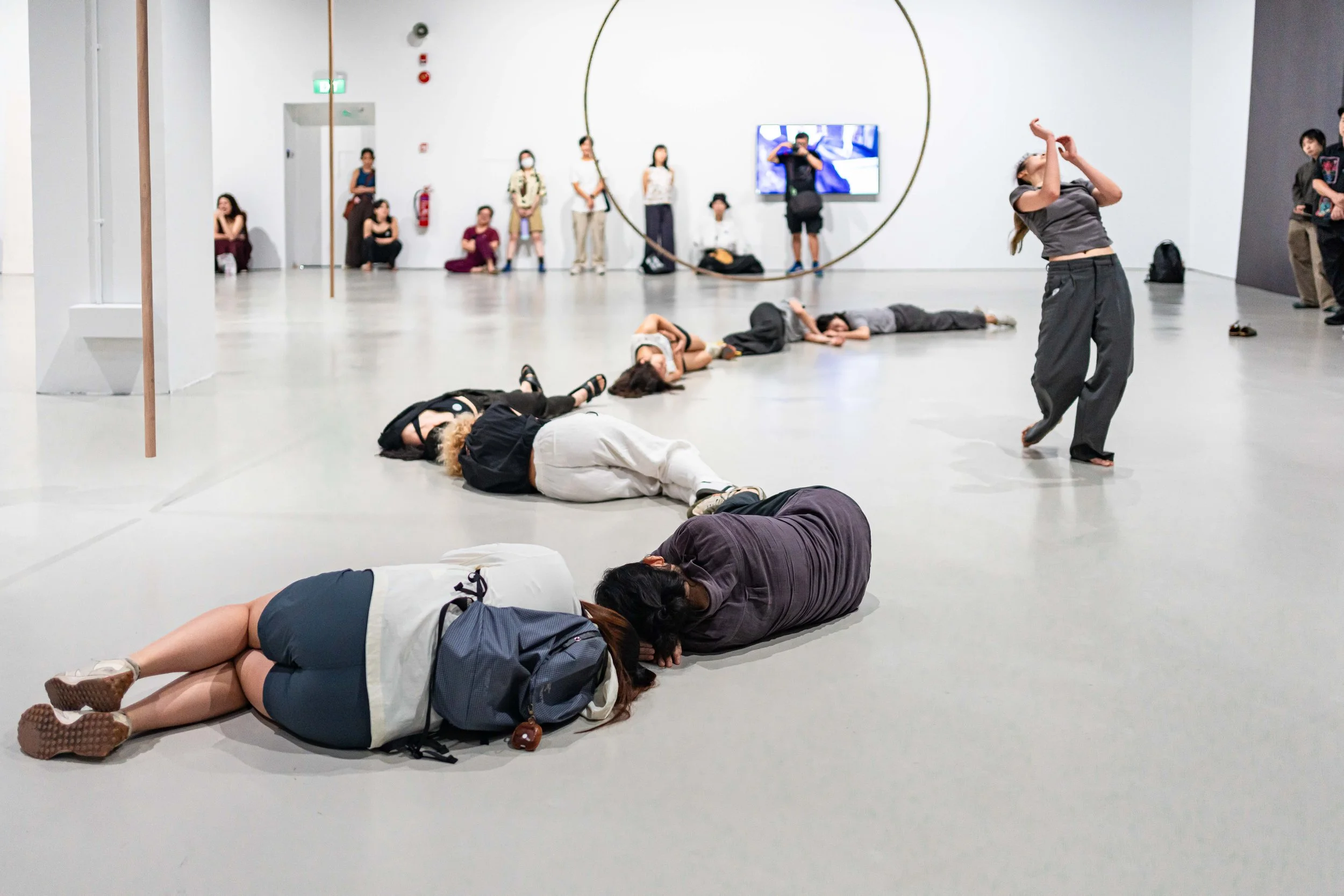
Sigma Collective, Temporal Bodies, 2026. Performance documentation from the exhibition Maria Taniguchi: Afterimage at SAM at Tanjong Pagar Distripark, 2026. The performance is situated in relation to Maria Taniguchi’s Runaways (2026), in the middle ground; A painter, if black were a place (2026), in the background; and Untitled (2017-2026), on the right. Image courtesy of Alex Chua.
The abstraction in Taniguchi’s forms creates a tension between presence and absence, but it also obscures the personal histories and material conditions that give physical labour its specificity—dimensions that Temporal Bodies brings back through live performance. The exhibition draws the audience into a state of suspension as we encounter Taniguchi’s forms. We are reminded of something out of sight but cannot quite pinpoint what exactly it is. Yet this abstraction also flattens the differing stakes and conditions of labour, detaching the afterimage from its inherent physicality. It masks the personal and familial contexts behind Taniguchi’s work, which are often highly specific: the brick paintings are inspired by the quality of the dark night in Dumaguete, where she grew up; the Java plum wood used in Runaways carries the distant memory of her mother’s pregnancy. Temporal Bodies intervenes by summoning the physical presence to which Taniguchi’s forms allude. It invites us to perceive the human form as an afterimage of movement and experience, bringing these lived dimensions back into the encounter with her artworks.
Towards the end of the performance, some dancers lay on the floor, forming a zigzag trail with the full lengths of their bodies, echoing the arrangement of shoes from an earlier part of the performance. Others ran around to invite the audience members to join the formation. Some of them lightly held audience members by the wrist, while some tugged at a corner of their shirts. The audience’s initial hesitation gradually loosened through these gestures of contact. As more people joined the formation, their interconnected bodies became a live re-enactment of the brick paintings. The act of lying down and connecting one person to the next mirrored the process of laying one brick alongside another, an action that gradually built towards a larger composition through the accumulation of effort.
Notes
Maria Taniguchi, "CONVERSATION Maria Taniguchi," interview by Diana d’Arenberg, Ocula Magazine, November 22, 2016, https://ocula.com/magazine/conversations/maria-taniguchi/.