Ayka Go and Catalina Africa at Silverlens Manila
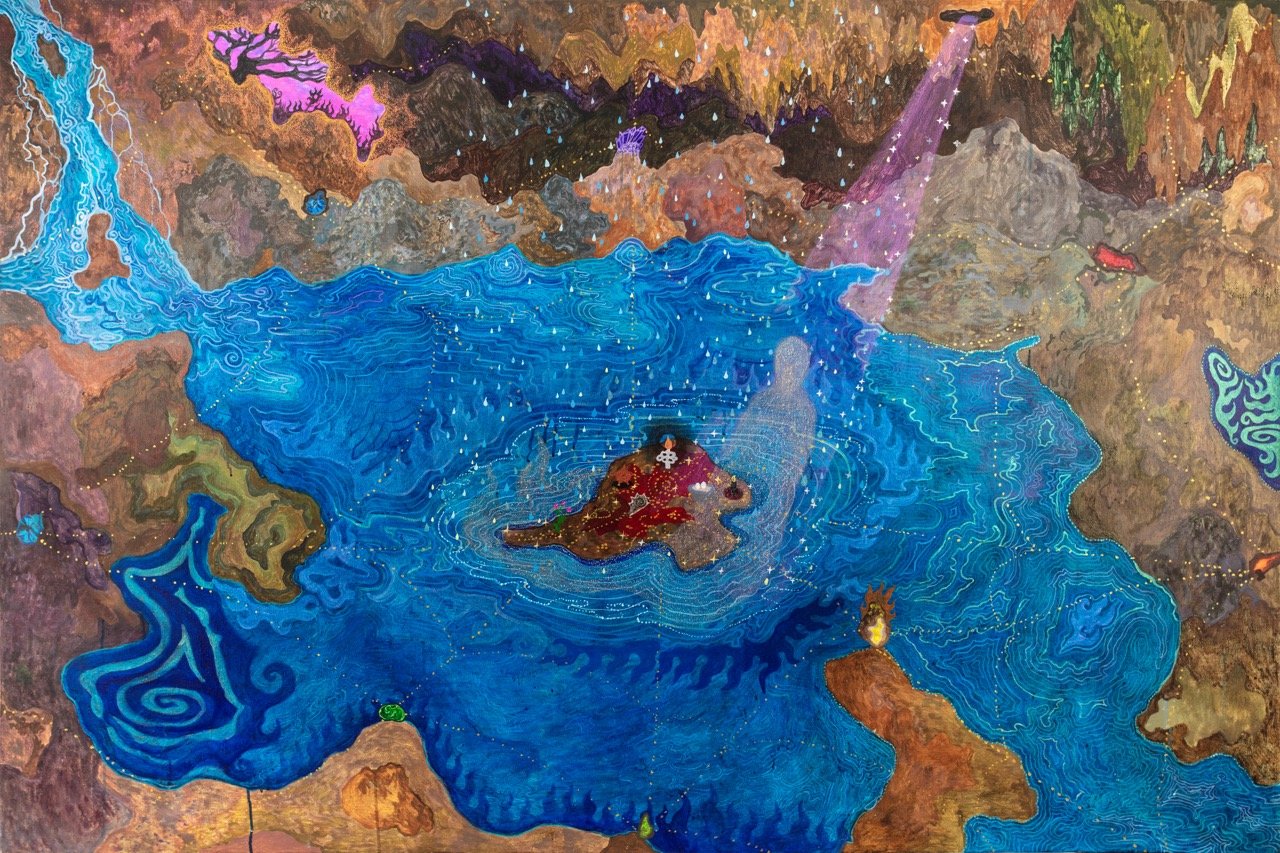
Catalina Africa, Living Altars, 2026, acrylic, interference paint, oil pastel on canvas, 122 x 182 cm. Image courtesy of Silverlens.
On a rainy Saturday afternoon in August 2026, I visited two solo shows that ran simultaneously at Silverlens Manila: small vast things by Ayka Go and mirrors, merging by Catalina Africa. It was the final hours of the last exhibition day – my last chance to see the shows. So, moments before, I gathered all my energy to get off the couch and leave the house. Not only was the weather making it that much cozier to stay in, I was also nine weeks pregnant with my first child.
Saturday meant that the gallery was more crowded than usual, teeming with young visitors and their cameras. Yet, the artworks of Go, hung in the gallery’s largest exhibition room, cut through the noise. Save for two eight-foot-tall paintings bookending the space, most of the works were rather small, sparsely hung across wide walls. Their subject matter, even smaller: butterfly wings. On one wall, paper cocoon sculptures surround a vertical line of tile-like canvases, which contain painted details of the wings that are visible to the naked eye: wisps of blue, eyespots. On the opposite wall, circular canvases reveal the wings on a microscopic level.
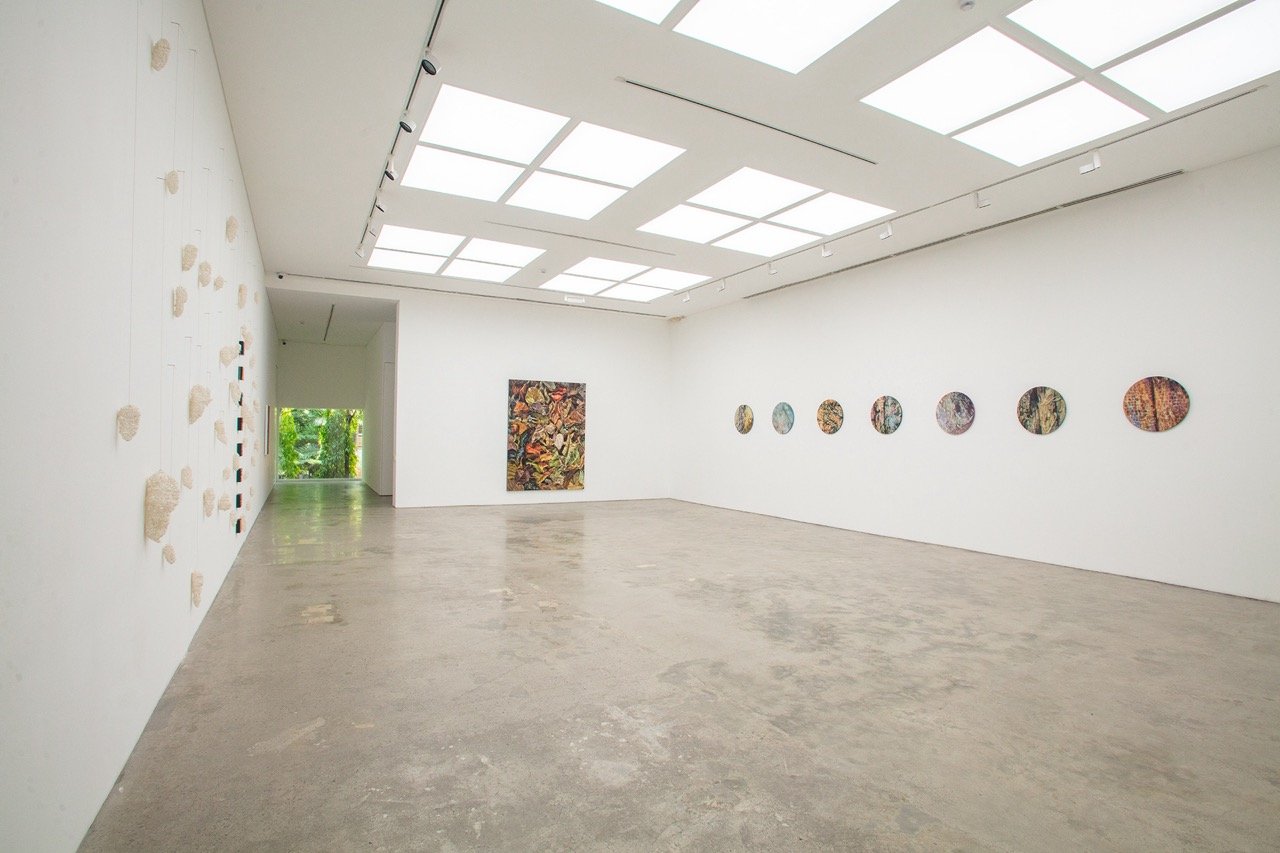
Installation view of small vast things by Ayka Go at Silverlens. Image courtesy of Silverlens.
In 2025, Go planted a garden in her studio. As it grew, butterflies would visit, travelling from plant to plant. “Every day I started looking forward to their visits, until eventually it felt like I was the one visiting them,” she says in the exhibition video.¹ She began to examine their wings through a microscope, and was struck by the beauty of their intricate details. Blue wings, for instance, appeared in shades of grey – the blue she saw with the naked eye, she learned, was an effect of reflected light. She also found meaning in the metamorphosis of a butterfly as she considered her own personal transformations, which included navigating a range of health issues in her thirties. The cocoon as a symbol for the state of becoming and its uncertainties. The butterfly’s brief yet far from insignificant life.
While Go painstakingly executes them in realistic detail, the microscopic fragments of butterfly wings almost have the effect of abstract paintings. Texture and color take centre stage, and viewers must face the unfamiliar: the way the wings’ scales form strange, complex patterns; the infinite shades of brown and grey on a single scale.
Confronting the delicacy and preciousness of something so small can be overwhelming. At least that is how these works made me feel at the time. Two weeks before I visited the show, my husband and I saw our baby and their heartbeat for the first time through an ultrasound. A white, flickering blob, then the size of a blueberry. I never thought of how something so small, so illegible, could make my husband cry.
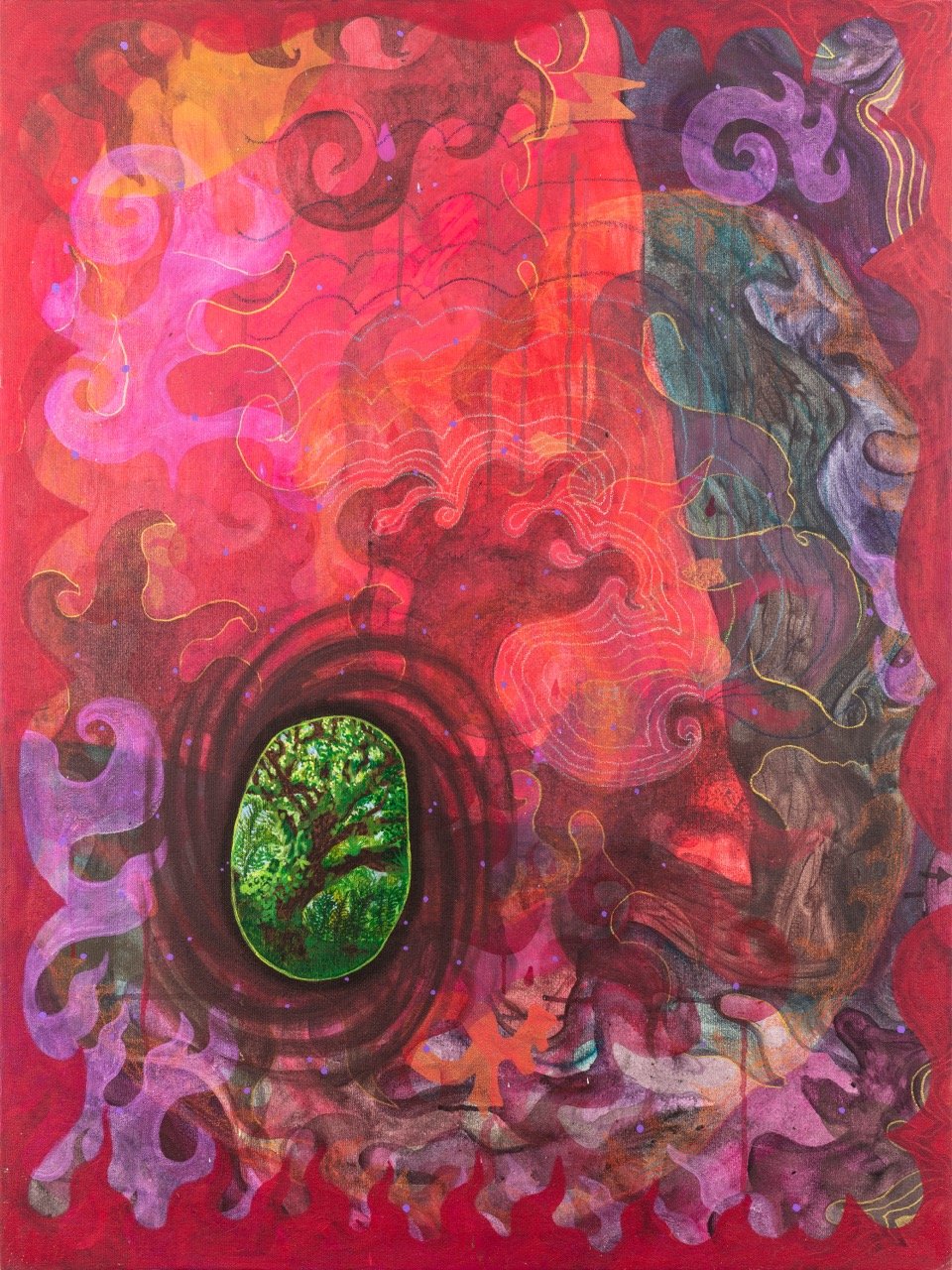
Catalina Africa, Collapsing Time, 2026, acrylic, interference paint, oil pastel on canvas, 102 x 76cm. Image courtesy of Silverlens.
As visitors turn from Go’s show to Africa’s, the first work they would see from the latter is a painting entitled Collapsing Time (2026), hanging on a wall outside the smaller room housing the rest of the show. Blood red, lavender, and pink smoke-like forms fill the background, like a magical fire. Amidst this, a lush tree peacefully floats; it is contained inside what, to me, resembles a womb – protecting it from the chaos of the outside.
Africa painted the works in mirrors, merging while she was pregnant with her second child and after giving birth. During this period of profound change, the process gave her a space to release her muddled thoughts and emotions.² The paintings thus capture the kind of mystical, untamable energy that such an experience would summon. They meld organisms, characters and landscapes from both the natural world and the otherworldly, shattering the boundary between the two. Whereas Go’s works made me feel as if I were standing outside nature, peering into tiny glimpses of it, here, with depictions of its vastness fit into an intimate room, I became immersed in its terrains.
Yet, there is something about how Africa portrays the wild and its mysteries that feels strangely comforting rather than disorienting. In every painting, a kind of gentleness emerges — whether it’s in the soft, amorphous lines outlining the shape of water, or in the presence of entities that seem to guard and care for, rather than domineer, their surroundings. Dwelling in that room, I began to feel like the tree in Collapsing Time — engulfed in wildness, yet grounded and safe.
In early 2025, when my husband and I decided to start trying for a baby, new fears emerged in me, despite the fact that I desired a child in theory. What would happen to my body? Would I be able to let go of the sense of control over it that I fiercely protected? Will I survive the trauma of childbirth? In those days, I could barely imagine the joy of raising a child, my mind consumed by worst-case scenarios before a child could even be born.
I expected this wave of anxiety to come the day I finally saw those two lines on a pregnancy test. Instead, the moment was marked by preternatural calm. It surprised me. I felt held by something beyond me, shielding me from fearing the strangeness of my body. Was this what Africa felt too?
In the eponymous work Mirrors, Merging (2026), a body’s outline lies at the centre of a dark field, while a winged figure hovers over it. A crowd of green spirit-like creatures surround the scene, some of whom are connected by the tips of their limbs. The painting depicts a mental place that Africa would constantly return to after giving birth, whenever she needed to console herself. There, her “ancestors, angels, guardians and guides” surround her.³
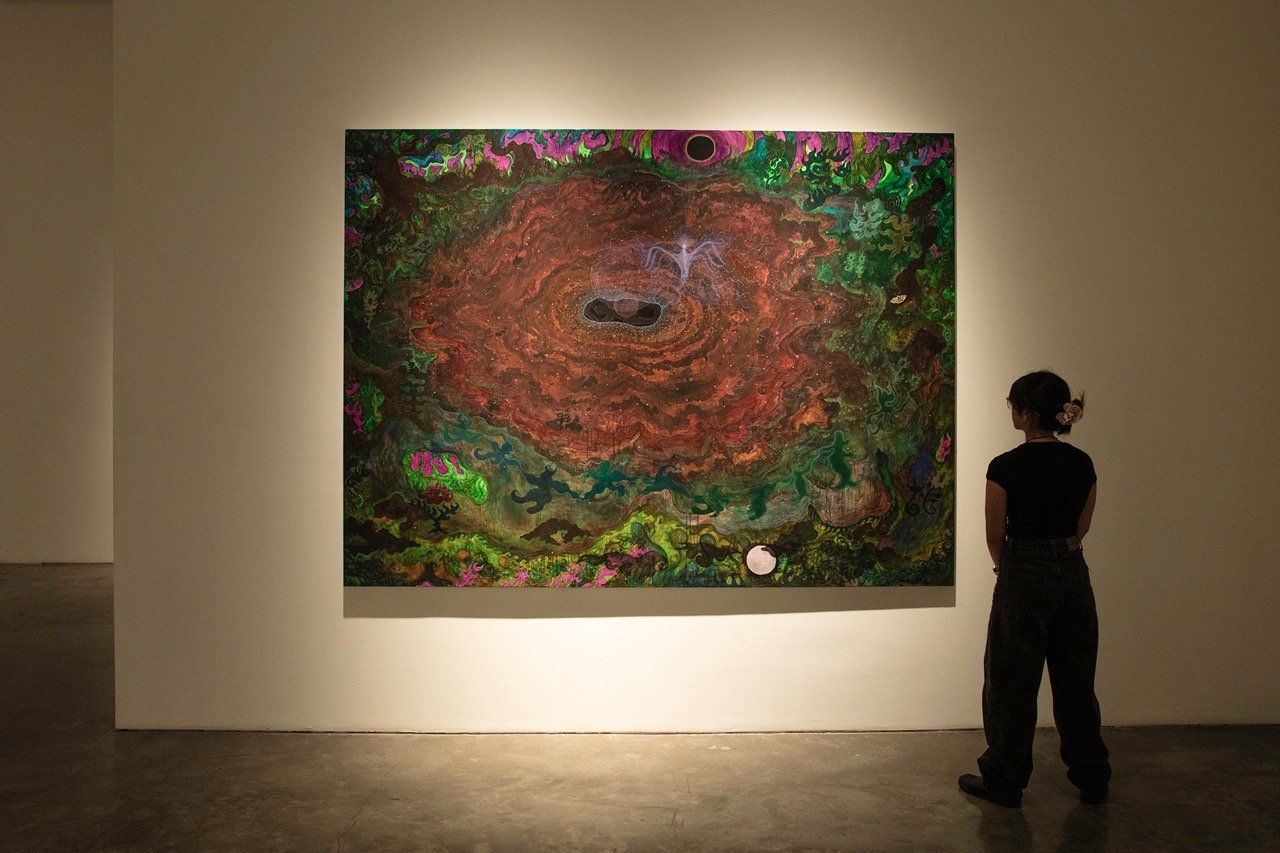
Catalina Africa, Mirrors, Merging, 2026, acrylic, interference paint, and oil pastel on canvas, 182.9 x 243.8cm. Image courtesy of Silverlens.
Like Africa, I have discovered how the strongest balm to the feelings of isolation and confusion during this time is leaning on the guardians and guides of my own life. Every pregnancy story is unique, but there is relief in remembering that I share slivers of mine with others. How my friend, newly a mother, sensed that I was pregnant the moment I told her my brain was foggy. How another friend bonded with me over having crazy dreams during pregnancy. How my mother told me that she still felt like a baby herself, caring for my sister and me when we were babies. That always comforts me, because even if she may have felt that way then, she still did so well.
As I made my way to exit the shows, I saw Go taking pictures with her works. I approached her, telling her about how I was particularly drawn to one of them. It was the blurriest one among the series of butterfly wings, most of it is pearl-like orbs and clouds of blue grey. She explained that it was the wings’ out-of-focus view, as she adjusted her microscope to find the more defined image.
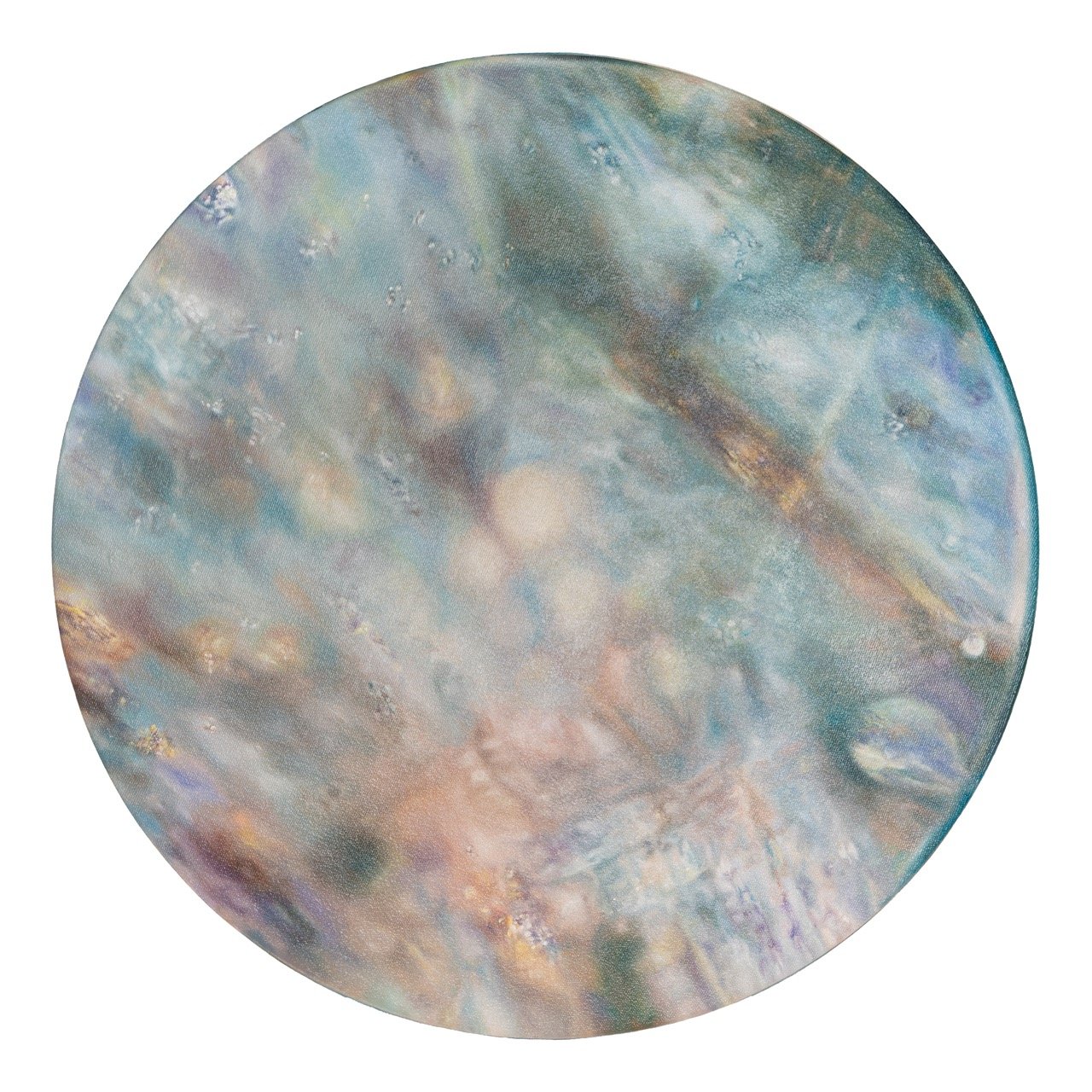
Ayka Go, Lepidoptera – Butterfly 2, 2026, oil on canvas, 61cm (diameter). Image courtesy of Silverlens.
I was struck by how she found that nebulous state worth painting. The early stages of pregnancy are similarly the haziest, the time when the baby is most vulnerable. It is hard to picture the contours of a child when everything feels uncertain. I hold my breath at every scan, simply hoping my little blueberry has graduated to a strawberry.
I walked out of the gallery holding on to that blurry image. It has since appeared in my mind again and again, reminding me of the singular, fleeting beauty of where I am.
Notes
Akya Go, “Ayka Go : small vast things, Silverlens Manila (2026) Exhibition Video” Silverlens, August 24, 2026, https://www.youtube.com/watch?v=23rl12bwsaw
Sean Carballo, “Catalina Africa’s ‘pregnancy paintings’ put your wonder to work,” Cartellino, September 20, 2026, https://cartellino.com/features/2026/09/20/Catalina-Africas-pregnancy-paintings-put-your-wonder-to-work.
Catalina Africa, “Catalina Africa: mirrors, merging, Silverlens Manila (2026) From the Studio,” Silverlens, August 10, 2026, https://www.youtube.com/watch?v=W4LO7TPcz7o.