
Yau Bee Ling, Painting and the Feminine, Reconsidered
The Weaving of Life: Art through Trials and Triumphs
Over the years, we have republished parts of long-form writing, from catalogue essays to book chapters. This practice is now formalised as part of our Excerpt series. If you would like to work with us to republish a text, please email us at info@from-the-margins.org.
Here is an excerpt from Louis Ho’s essay in The Weaving of Life: Art through Trials and Triumphs (2026), a monograph that surveys Yau Bee Ling’s practice from 1990 to 2025. The publication is produced by Wei-Ling Gallery and supported by Balai Seni Visual Negara.

Cover of The Weaving of Life: Art through Trials and Triumphs (2026), a monograph that surveys Yau Bee Ling’s practice from 1990 to 2025. It is produced by Wei-Ling Gallery and supported by Balai Seni Visual Negara.
The present moment is an interesting one within which to rethink how we receive the work of female artists, particularly those who reside in regions of the world where feminism is still regarded as something of a suspect ideology – as Yau Bee Ling does. Born and raised in a Sino-Malaysian family in small-town Selangor¹, she has, for the past quarter of a century and more, oriented her practice around the twin poles of autobiography and the medium of paint, her subject matter ranging from domestic interiors, to portraits of women, to natural landscapes. Some of her earliest exhibited works include the Family (1995–99) and Home series (2000–01), comprised paintings set in the four walls of everyday, residential spaces, brimming with a plethora of extended family members and quotidian objects. Moving Out and Moving In (2005) marked a moment of transition in the artist’s life, as she undertook a year-long residency and left the home of her in-laws, while the feminine portraits that constitute The Women (2013) were intended to distil “fleeting emotions, desires, and perceptions against a real circle of friends, sisters, housewives, and neighbours”.² More recently, Interwoven Terrains (2019) marks a shift away from the human figure to abstract, figure-less topographies of greenery, reflecting a renewed sense of empathy that emerged from the process of caretaking for her (now late) father.

Yau Bee Ling, Where expansion begins, 2026, oil on jute canvas, 150.5 x 213.5cm. Image courtesy of the artist and Wei-Ling Gallery.

Yau Bee Ling, Intimate Study I, 2016, oil, charcoal, pastel, acrylic medium on jute canvas, 75 x 100cm. Image courtesy of the artist and Wei-Ling Gallery.
That the aforementioned sort of iconography, drawing upon emotional and domestic landscapes, is often explicated in terms of feminine complexes is summed up by Yau’s fellow artist, Nadiah Bamadhaj, when she wrote of the former’s preferred imagery: “Confronted by the food, cups, plates, and other domestic objects of Bee Ling’s On Moving Out and Moving In series, I immediately read the work with the same chauvinistic discourses that reduces ‘serious art-practice’ to ‘stereotypically female’, thereby revealing the ridiculous irony of my own brand of feminism.”³ The notion of “stereotypically female” work, relegated to the peripheries of art history, has coloured even the attitudes of women artists towards their own practice, as Bamadhaj rightly points out – particularly in this part of the world, where cultural and religious tradition tend to regard Western varieties of feminism with no little suspicion. The editors of a recent survey of the otherwise overlooked intersections of gender and art history in Southeast Asia remarked of “perceptions that “feminism” (when imagined as a Euro-American-centric ideology) has little relevancy, or even worse, repressive potentialities when applied to the region.”⁴ They note “that very few artists have been willing to label themselves ‘feminists’, with either a view that the term does not apply to them as ‘Southeast Asian artists’, or that it functions to flatten interpretation and diminish the complexity of their works, which may engage with issues beyond that of gender.”⁵ The scepticism that dogs feminism in many parts of Asia, including the large swathes of Southeast Asia that profess Islamic piety, have become internalised in the repudiation of feminist prerogatives, with female artists themselves shying away from identification with feminism’s ideological umbrella, preferring to locate themselves – paradoxically enough – in an a-gendered discursive space.⁶

Yau Bee Ling in her studio. Image courtesy of the artist and Wei-Ling Gallery.

Yau Bee Ling, Mother and child series IV, 2012, oil on canvas, 140 x 102cm. Image courtesy of the artist and Wei-Ling Gallery.
Yet, in the #MeToo age, it seems entirely germane to return to, in James’ turn of phrase, the situation of women, and the inescapable fact of gender and all that it implies. Viewed through the lens of an androcentric art establishment, long the champion of male artistic preoccupation with the grand narratives of history, state and the socio-political, the images of an artist such as Yau, with their cornucopia of household objects, family members, ordinary anxieties and un-erotic female bodies, looks indeed stereotypically feminine and all too personal. Her work derives its originary impulses and exegetical premises from biographical fact, the vicissitudes and everyday concerns of the artist’s life. After all, as she states: “I do not see art as separate from my life. I am a wife and mother, and how I create art is not so different from how I nurture my children, for instance. It is holistic, since creation equals flexibility of expression for me. I do not separate the two.”⁷ The rooting of Yau’s visual universe in the realm of the home, and the quotidian, seems inimical to the notion of artistic innovation. The sphere of the domestic, with its associated values of family, comfort and seclusion, has been positioned as the other to the avant-garde ambitions of high Modernism; to an artistic vanguard making aesthetic inroads in the manner of a military advance, “being undomestic came to serve as a guarantee of being art.”⁸ The domestic world she conjures, inescapably marked as feminine, would tend to be perceived as the antithesis to more experimental, boundary-pushing practices (of her all too often male counterparts).
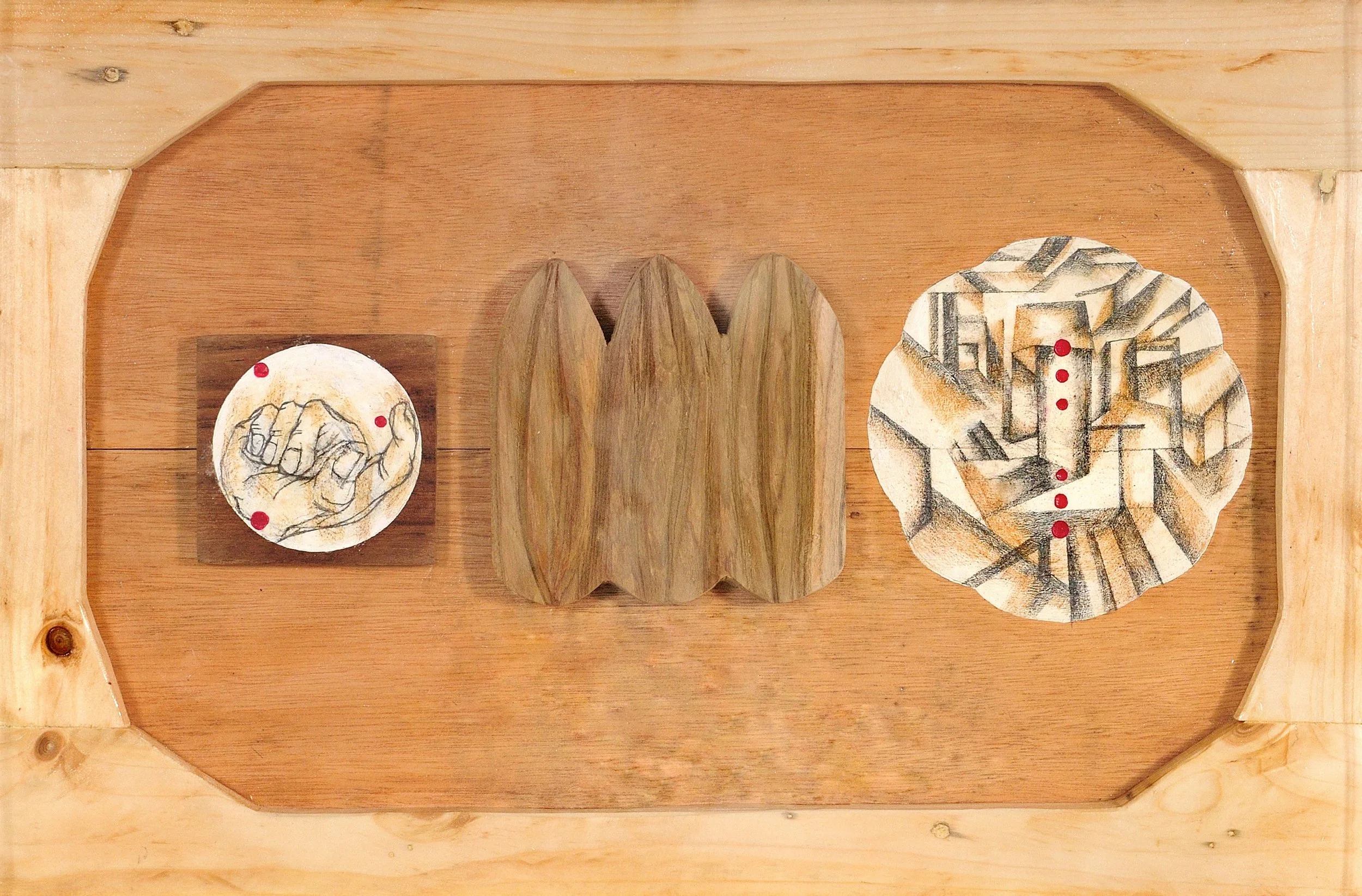
Yau Bee Ling, Devotion I, 2016, acrylic gesso paint and varnish on wood, 39 x 58.5cm. Image courtesy of the artist and Wei-Ling Gallery.
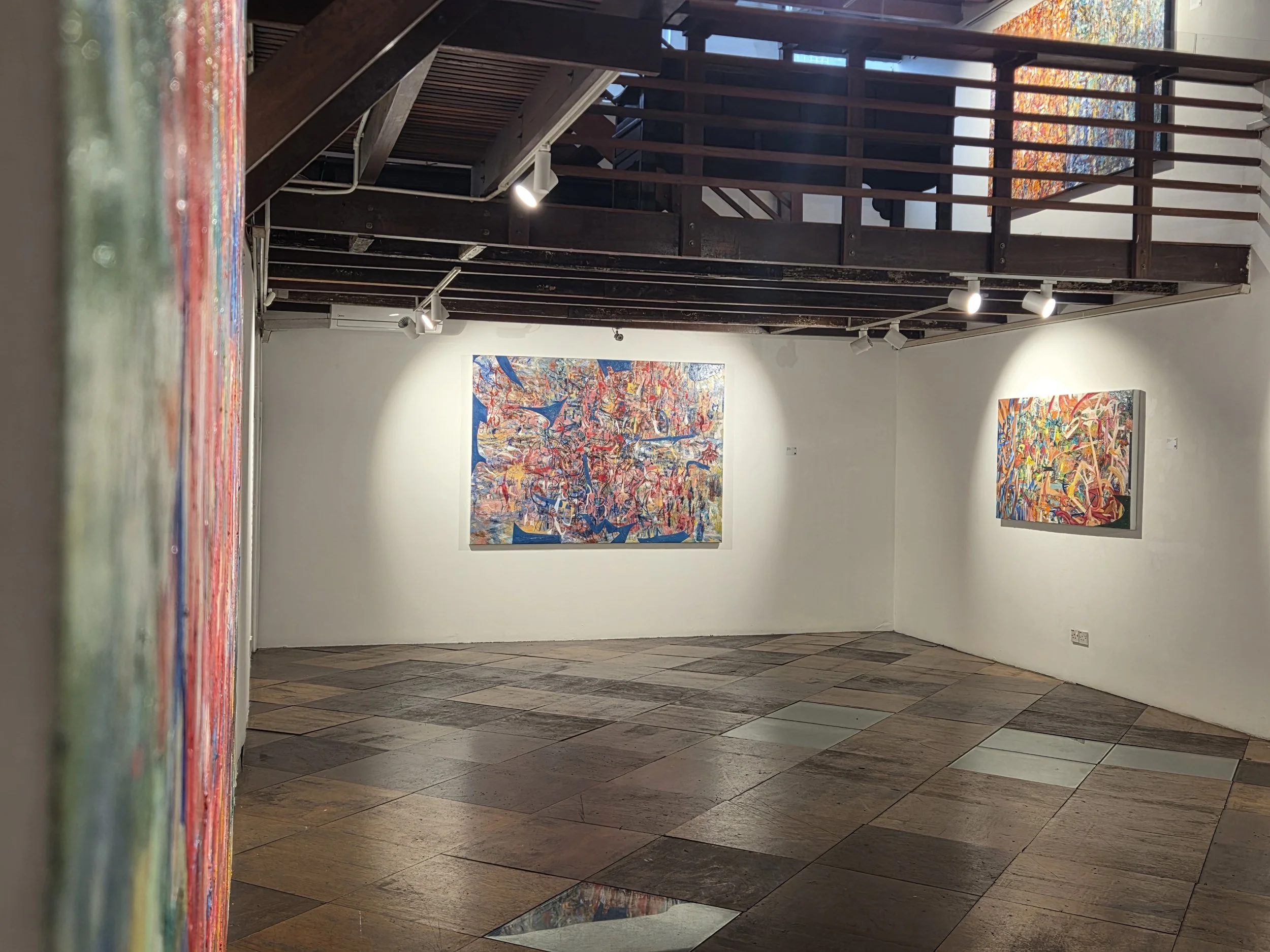
Yau Bee Ling, Structural Voids, 2026, exhibition view at Wei-Ling Gallery, Kuala Lumpur. Image courtesy of the artist and Wei-Ling Gallery.
If this is women’s art, or so the establishment would have us believe, that perception itself might constitute the problem. That we now understand the family and the home as sites of the enforcement of patriarchal ideologies determining the possibilities of female labour, confining women to the domestic sphere and limiting their participation in the public workforce, obliging them to bear the burdens of child-rearing and housekeeping, could well serve to foreground Yau’s paintings as reflections of the asymmetries of privilege that have shaped, and continue to shape, the role of women in the body politic. What her images represent are not mere representations of objects and figures and spaces, but the facts of female subjectivity enmeshed within androcentric entitlement. The everyday worlds that Yau brings to visual life – her worlds – are reflective of the male-oriented social terrain that she, as a Sino-Malaysian woman, daughter, wife, mother and artist, has had to negotiate. “The spaces of femininity”, according to Griselda Pollock, “operated not only at the level of what is represented, the drawing-room or sewing-room. The spaces of femininity are those from which femininity is lived as a positionality in discourse and social practice. They are the product of a lived sense of social locatedness, mobility and visibility, in the social relations of seeing and being seen… Femininity is both the condition and the effect.”⁹ Yau’s paintings, in other words, may be read not simply as images of female lives, but the result of the socially-circumscribed operations that produced those lives.
*The footnotes in this excerpt follow the format used in the publication.
This article is presented in partnership with Wei-Ling Gallery.
Structural Voids is on view from 9 May to 6 June 2026, at Wei-Ling Gallery. To find out more about the exhibition and the monograph The Weaving of Life: Art through Trials and Triumphs, click here.
Notes:
Yau was raised in the town of Pandamaran, located in the district of Klang in Selangor, Malaysia. Scholars have categorised the feminist movement in Malaysia into four phases of historical development: a nationalist-oriented feminism in the colonial era; a second phase of post-independence social feminism; political feminism in the 1970s and ‘80s as the effects of the New Economic Policy (NEP) and its affirmative action agenda were felt; a market-driven feminism, which emerged in the post-Reformasi era. See the chapter, “Accommodating feminisms: The women’s movement in contemporary Malaysia”, in Cecilia Ng, Maznah Mohamad and tan beng hui, Feminism and the Women’s Movement in Malaysia: An Unsung (R)evolution (Abingdon and New York: Routledge, 2006), pp. 16–40.
According to the artist, in “Kaleidoscopic metaphors: The Women Series in conversation with Yau Bee Ling”, The Women (Kuala Lumpur: Wei-Ling Gallery, 2013), pp. 4–7. See p. 4.
Nadiah Bamadhaj, “About Face” (2008), archived on Wei-Ling Gallery’s website. Retrieved from <https://weiling-gallery.com/gallery/portfolio-item/about-face-by-nadiah-bamadhaj/>.
Yvonne Low, Roger Nelson and Clare Veal, “Editorial Introduction: Gender in Southeast Asian Art Histories”, Southeast of Now: Directions in Contemporary and Modern Art in Asia 3:1 (2019), pp. 1–11. See p. 4.
Ibid., p. 5.
As a contributor to the aforementioned issue of Southeast of Now remarks: “… gender apparently registers as still too fiercely charged or unequivocally ghetto-pushing for some living artists, particularly of later generations. For instance, in my case, one ‘subject’ was palpably put off in my having ‘roped’ her into research that privileged gender when it was a trope she did not feel was central to her practice.” Eileen Legaspi-Ramirez, “Art on the Back Burner: Gender as the Elephant in the Room of Southeast Asian Art Histories”, Southeast of Now: Directions in Contemporary and Modern Art in Asia 3:1 (2019), pp. 25–48. See p. 26.
As expressed to the author, who conducted several interviews and informal conversations with the artist over the course of June and October 2023. Unless otherwise noted, all quotations from Yau, as well as relevant biographical details, are derived from these exchanges.
Christopher Reed, “Introduction” in Not at Home: The Suppression of Domesticity in Modern Art and Architecture, ed. Reed (London: Thames and Hudson, 1996), pp. 7–17. See p. 7.
Griselda Pollock, Vision and Difference: Feminism, femininity and the histories of art (Abingdon and New York: Routledge, 2003), p. 93.