Excerpt: Domestic Emotions
Ella Wijt’s solo exhibition at Sullivan+Strumpf
Over the years, we have republished parts of long-form writing, from catalogue essays to book chapters. This practice is now formalised as part of our Excerpt series. If you would like to work with us to republish a text, please email us at info@from-the-margins.org.
Here is an excerpt from Nadya Wang’s essay on Ella Wijt’s solo exhibition, Domestic Emotions, at Sullivan+Strumpf Singapore. First published in Sullivan+Strumpf Issue 32, the essay expands on how Wijt’s attentive approach to art making imbues her work with pronounced care, while ruminating on her domestic life in Rumah Tangga.
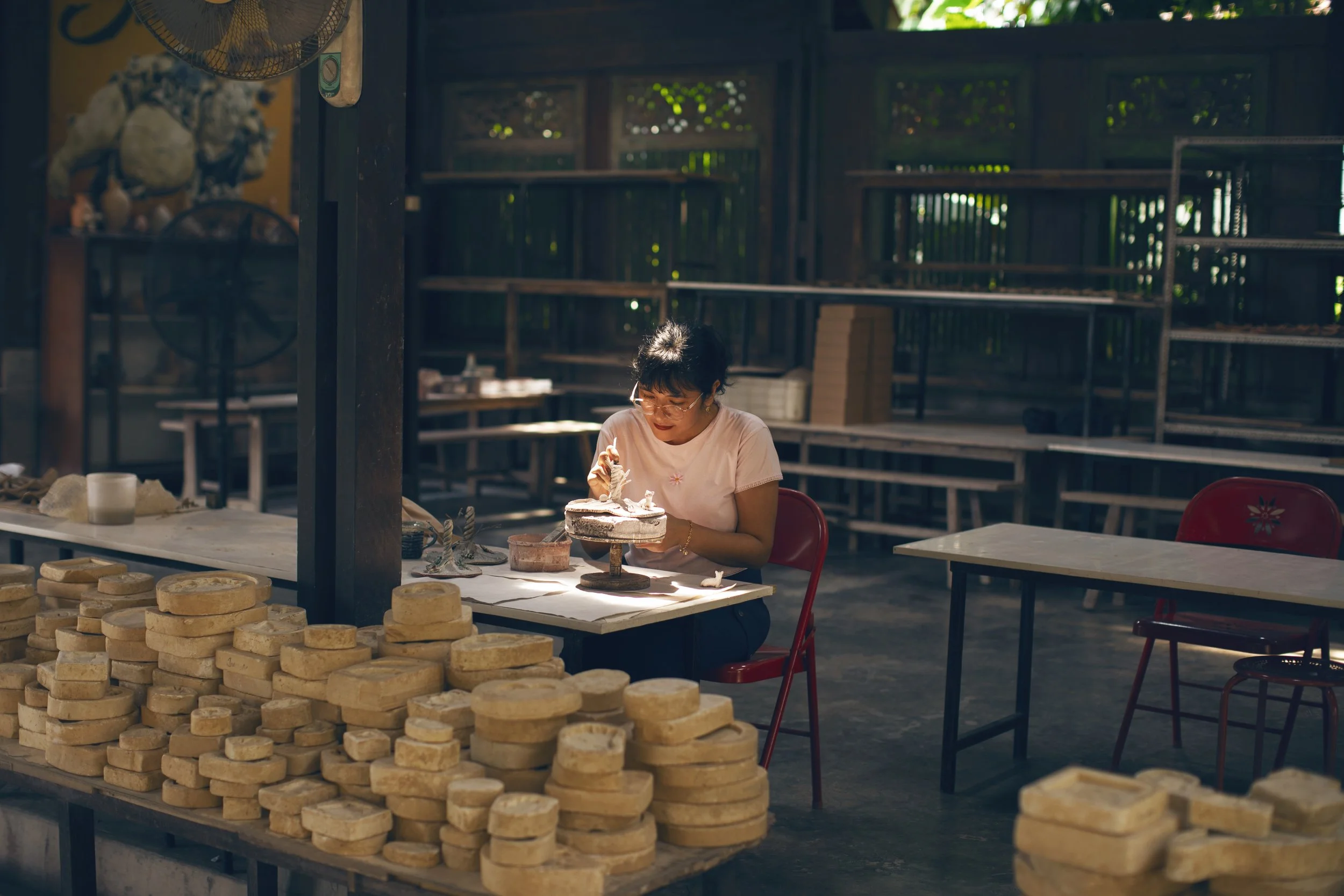
Ella Wijt. Photo by Hilarius Jason. Image courtesy of the artist and Sullivan+Strumpf.
Rumah Tangga in Depok, south of Jakarta, is home to Ella, and where she takes her call with me about Domestic Emotions (2026), her upcoming exhibition at Sullivan+Strumpf Singapore. Rumah Tangga translates to household or domestic. To Ella, the domestic means more than her home. “What is domestic to me is not only when I cook or when I tend to my garden,” she explains. “It is also about how I feel familiar inside me about life.” She elaborates, “When I put something in the home or when I dress, I want to be who I am, but I also want to experiment with who I am not.” This playfulness is a through thread in Ella’s way of life, and a quality I admire as I get to know her through her work and in our interactions.
I first met Ella in late 2023, in a panel discussion that was not coincidentally about the relationship between space and art. At the time, Ella’s home was in Bandung, and she was working out of her bedroom, measuring 3 metres by 2.5 metres. She talked about the advantages of working out of the small space, such as having everything within reach, and the challenges that she made the best of, such as creating artworks on a more intimate scale. She also spoke about how the people she shared the space with had a significant impact on her artistic practice.
Ella had just shown Domestic Emotions in its first iteration at the art fair ARTJOG in Yogyakarta as a site-specific work, subtitled A Home Within Me (2023). The closing lines of the poem that Ella wrote to accompany the work are striking: “For I have lost many homes, I search for one within me”. Since then, Ella has built Rumah Tangga on 5,500 square metres of family land, together with her husband and fellow artist Kurt D. Peterson. As Ella shares in our conversation, “My home is my mould. How I create my home is what is inside me, but the home also makes me who I am.”
“As Ella shares in our conversation, ‘My home is my mould. How I create my home is what is inside me, but the home also makes me who I am.’”
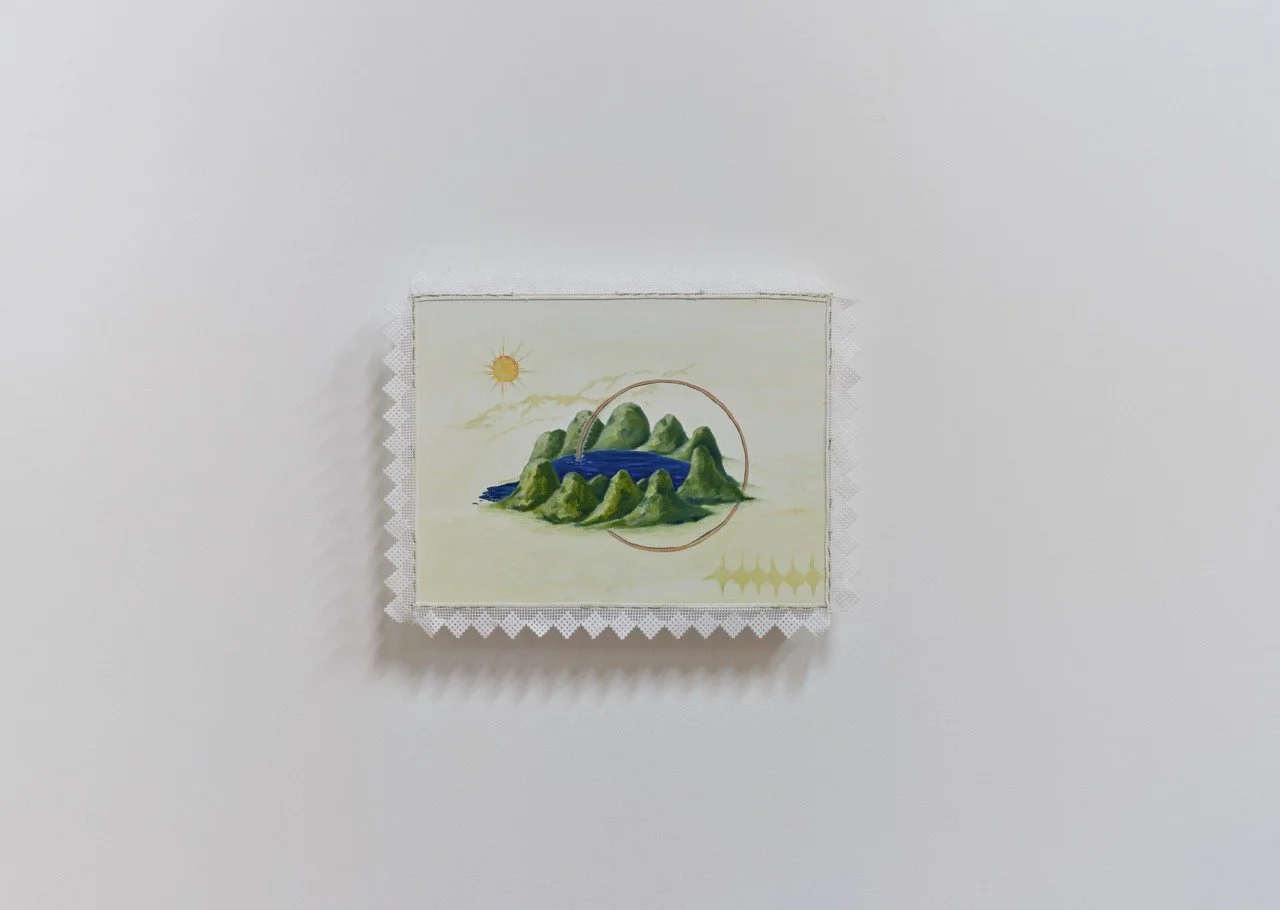
Ella Wijt, Life is a Vow of Land and Water, 2026, oil on canvas with cotton lace frame, 45 x 35cm. Photo by Philip Huynh. Image courtesy of the artist and Sullivan+Strumpf.
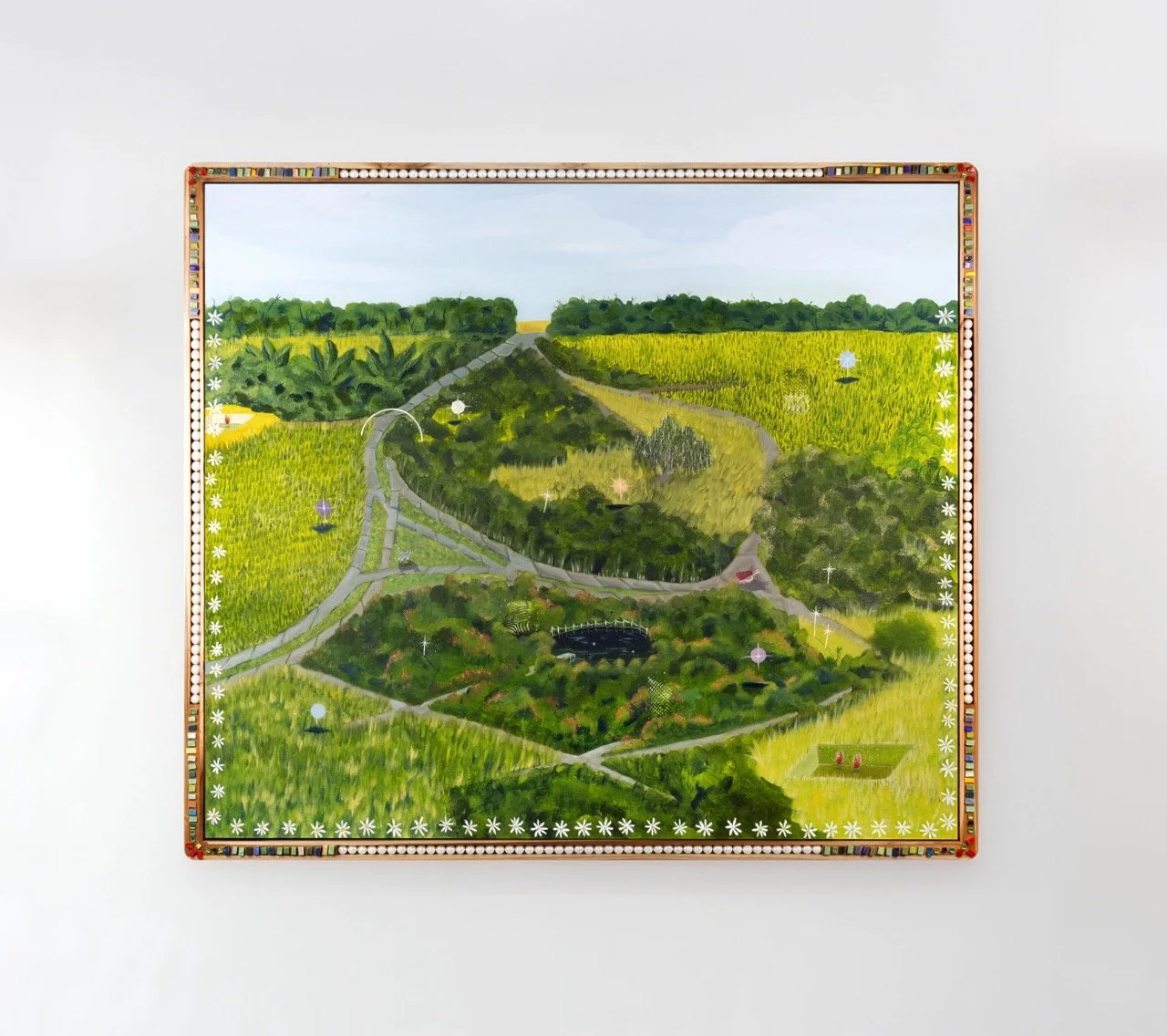
Ella Wijt, Abundance of Blessings, 2026, oil on canvas, 158 x 148cm. Photo by Philip Huynh. Image courtesy of the artist and Sullivan+Strumpf.
Built on her family’s land, Rumah Tangga cements Ella’s strong connection to her family. Her grandparents believed in kejawen, where humans are not masters of nature, but a part of an interdependent ecosystem. The Pentecostal church, where she grew up, also places importance on the holy spirit, often described in the Bible to be present in nature. These teachings guide the artworks she makes. Ella adds cosmological elements such as stars, moons and suns as symbols of the souls she perceives to exist in nature. In Abundance of Blessings (2026), a portrayal of her land, she has painted delicate star-shaped dandelions, almost imperceptible at first glance, waiting to be discovered. It is a reward for those who take the time to look closely.
Aside from tapping into the wellspring of nature to make art, Ella is curious about how other creatives live and work. Abundance of Blessings, for example, is painted in the naive style of dairy farmer turned folk artist Nick Engelbert, whose works Ella saw at the John Michael Kohler Arts Center in Wisconsin a few years ago. She enjoys his honest depictions of rural living, and has a cherished poster of one of his works displayed in her home. The poem Go to the Limits of Your Longing by Rainer Maria Rilke is another favourite: “Let everything happen to you: beauty and terror.” Come what may, Ella delights in the beauty of life, and weathers its storms.

Ella Wijt in her studio. Photo by Philip Huynh. Image courtesy of the artist and Sullivan+Strumpf.
Ella’s curiosity is catching. She tells me that she is learning more about the life of Agnes Pelton, a painter she admires. She is also reading A General Theory of Love. Several days after our chat, Ella texts me about the poems of Lauren E. Bowman that have been instrumental to the development of her recent works. Through her collections The Evolution of a Girl, What I Learned from the Trees, and Shapeshifter, Bowman writes about the interactions between humans and nature and the shifting roles that women take on as they age. Within poetry, home, in addition to being a physical structure, often represents a complex, emotional space. This dual meaning reiterates the premise of Domestic Emotions as an expression of Ella’s two homes: her self and Rumah Tangga.
“Within poetry, home, in addition to being a physical structure, often represents a complex, emotional space. This dual meaning reiterates the premise of Domestic Emotions as an expression of Ella’s two homes: her self and Rumah Tangga.”

Ella Wijt, Pilgrims of Faith, 2026, oil on reclaimed teak wood with plaster of paris, candles and pearl beads, 43 x 41 x 20cm. Photo by Philip Huynh. Image courtesy of the artist and Sullivan+Strumpf.
Making others feel at ease, and encouraging an exchange of ideas are what Ella longs to do, and she does it well. It is no surprise that Kurt says “the warmth that she brings is what keeps this place a home while also being an art space, and the fine line between those two is definitive of Rumah Tangga”.1 Stirred by her generous sharing, I start to compile a list of texts to share with Ella: Atlas of the Heart by Brené Brown, What Kind of Woman by Kate Baer and to these, perhaps she might also enjoy the podcast Happy Place by Fearne Cotton.
As the call progresses, we talk about our thoughts on girlhood/womanhood and the habits that carry over from one phase to another. We connect on the fact that we both enjoy being homebodies. For Ella, it is about hanging out with her cats and listening to music—an eclectic mix of heavy metal, hip-hop and pop music—while making art, cooking… and daydreaming. It is in the in-between times of pottering around at home that she comes up with ideas or makes a sketch. I identify with this way of working from home too, and tell her about outlining a story idea or answering emails while I am making a meal. It is comforting to share stories with someone who understands.

Ella Wijt, Still Life from the Prayer Room II with Dancing Daisies, 2026, coloured pencil on doily paper, mirror, dried daisies, sandblasted glass, handmade teak frame, 13.5 x 21 cm. Photo by V Ravalen. Image courtesy of the artist and Sullivan+Strumpf.

Ella Wijt, Grace Upon Days, 2026, charcoal on paper with torched teak wood frame and sandblasted glass, 18.5 x 18.5cm each. Photo by Philip Huynh. Image courtesy of the artist and Sullivan+Strumpf.
Musing on the conceptual and the real, Ella reveals that the lumber used in the building of Rumah Tangga was bought by her father at the time of her birth. He had a vision that she would build a house with trees that were as old as she would be. The gesture, at once romantic and pragmatic, came as a surprise to Ella because her father is otherwise a strict, logical person. In this case, the wood is both a material and a symbol of love that houses and protects Ella.
Reclaimed teak that her father has saved for her is also used to frame a suite of 60 small charcoal drawings. Each one is accomplished in under ten minutes, and is an exercise in making decisions without hesitation. I am already looking forward to studying them one by one, and seeing what I can find within them. I will also be looking for the daisies and pearls that are recurring motifs in her work, and stand for resilience: daisies for their ability to thrive in her garden, no matter the conditions, and pearls from the sea to embody sweat and tears. Even as Ella seems to live an idyllic life at Rumah Tangga, it is underscored by a resilient spirit that makes her work as an artist as compelling as it is.
There is a deliberate amateurism to the look of Ella’s creations, which lays bare her playful approach to art-making, in the small details that translate into big ideas. Vulnerable is how I would choose to describe her practice, but not as a weakness, as Brown explains. She defines vulnerability to be uncertainty, risk and emotional exposure. It is, to her, the most accurate measure of courage. Through Ella’s vulnerability in Domestic Emotions, she invites all of us to be in touch with our inner selves, to play and discover what is within us, and to feel at home with ourselves.
Domestic Emotions is on view from 25 June to 1 August 2026, at Sullivan+Strumpf Singapore. An artist talk will be held on 27 June 2026 at the gallery. To find out more about the exhibition and talk, click here.
Notes:
1. Nadya Wang, “Conversation with Ella Wijt and Kurt Peterson”, Art & Market, 15 October 2025, https://www.artandmarket.net/conversation/2025/10/15/conversation-with-ella-wijt-and-kurt-peterson.