
‘The Memories of Individual Memories’
Prach Pimarnman’s solo exhibition at De’ Lapae Art Space
Over the years, we have republished parts of long-form writing, from catalogue essays to book chapters. This practice is now formalised as part of our Excerpt series. If you would like to work with us to republish a text, please email us at info@from-the-margins.org.
Here is an excerpt from the exhibition text written by Prach Pimarnman for his solo exhibition The Memories of Individual Memories (2026) at De’ Lapae Art Space Narathiwat.

Prach Pimarnman, Rozee Haree and Adinan Kantintra, (Pelanduk) Placing the Place, 2025, 3D hologram animation video, 48m 15s (loop), 200 x 150 x 90 cm. Image courtesy of Prach Pimarnman.
The Memories of Individual Memories examines history as a means of understanding the interconnected relationships created by the movement, migration, and distribution of individuals in the past. The exhibition encourages the viewer to think about and explore the complex details that create the foundation of a community from the past to the present. Through the history of Patani, the piece utilises legends, histories, sailors’ stories, trade routes, and interviews from scholars, all presented as documentary video, moving images, holographic images, object exhibitions, as well as two-dimensional paintings, object fragments, and digital art, created between 2021 and the present.
Traces of Complexity in Personal Space attempts to hold traces of memory from being lost. The exhibition engages with shared aspects of history as it is perceived within society, some of it visible, some of it lost, and some of it contested, allowing the viewer to consider what aspects of history are made to “appear” and who has the power to dictate what history is presented. This brings about the concept of personal history through space, family, and re-constructing fragmented memories of history.

Prach Pimarnman, Saen Saep Bunga Mas, 2024, ceramic, gold, cement, 45 x 35 x 35 cm. Image courtesy of Prach Pimarnman.
In the section, Saen Saep, presented at the SAC Gallery as part of the FROZEN ธาราพันลึก exhibition (2024), I uncover history from the fall of Patani up to the Melayu Patani becoming captives during the early Rattanakosin period. The traces of migration and movement of people expose the wounds of history embedded within the collective memory of the formation of the Thai state, where some are constructed as “the oppressed.” These memories linger and continue to influence the present. I also explore what it means to exist under the weight of historical suppression, which still lingers in the present, as both insider and outsider in these “overlapping spaces”, among Melayu Patani and Melayu Siam who have had to contend with the effects of state-imposed division of identity. My inquiry into the intersections of written history, as represented by documents and objects, and oral history, as represented by storytelling, has also led me to explore the objects handed down by one’s family through the course of history.
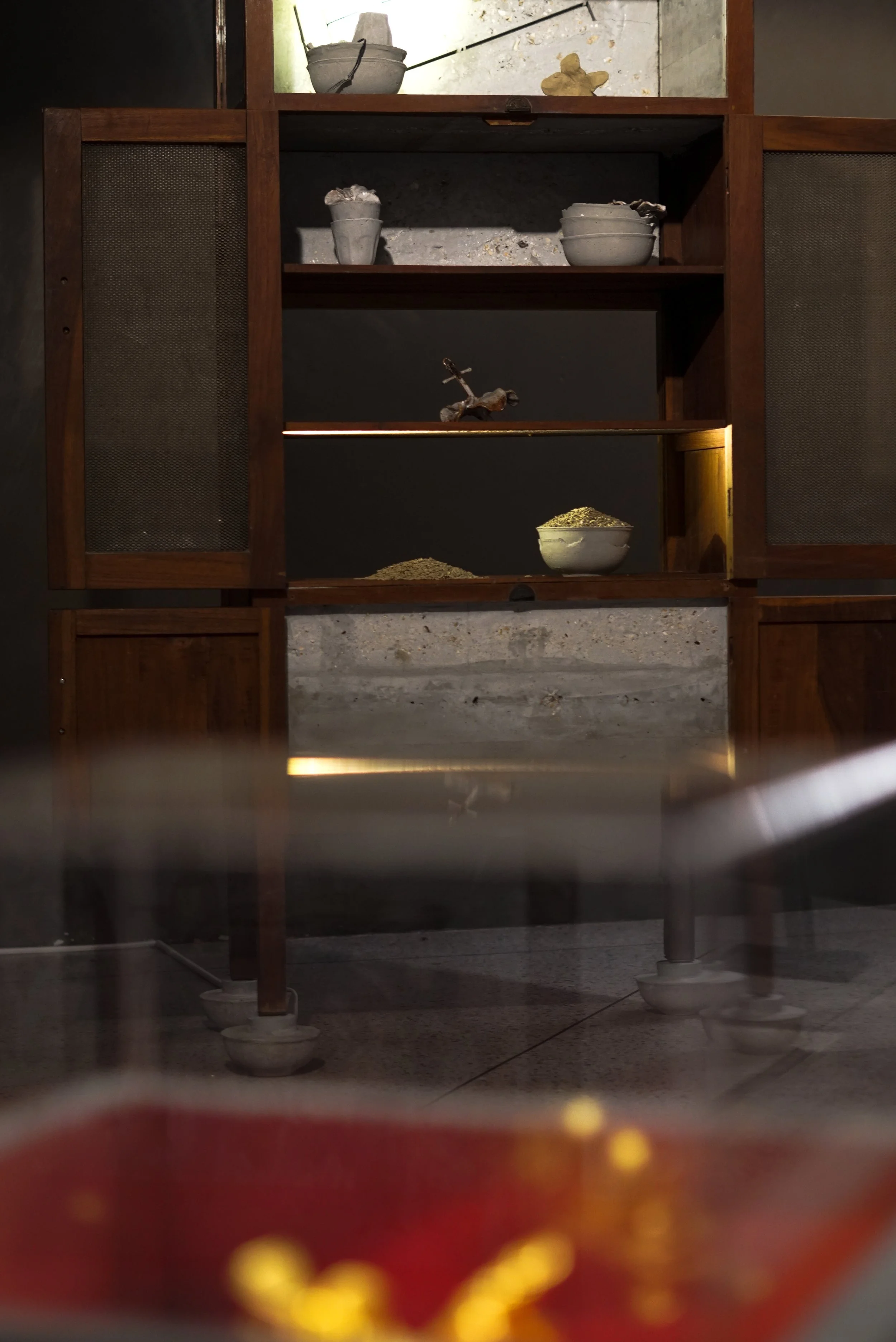
Prach Pimarnman, Pantry from Homeland 2, 2024, cement, steel rattan anklet, rice grains, glass cup, and gold ceramic flowers, 170 x 76 x 60 cm. Image courtesy of Prach Pimarnman.
This installation work is therefore a combination of disparate elements that represent wounds inflicted by emotions, the settlement of the Melayu people in Siam, and the history of Khlong Saen Saep. The works that are part of this section include Saen Saep Bunga Mas (2024), which presents gold and silver flowers as a symbol of the former prominent position of Patani as a port city, and Pantry from Homeland 2 (2024), which represents the experience of forced captivity through the wearing of ankle bracelets, migration, resettlement, and the legacy of language, including place names that evoke questions about the legacy of the past, as well as the legacy of land deeds and farming traditions.
The work Memory Creates Traces Within Memory, was created in a context characterised by images of violence and conflict over more than 21 years, starting from the events of 2004. These conditions have influenced my perception of home as a space characterised by memories. The connection between individuals and a location, as well as through the different stages of their lives, leaves unique imprints of memories, which differ from one another. The work Flowers, Fields, and Rice (Rice Field) (2024) is a vivid representation of memories, as it combines elements resulting from wounds into a composition characterised by objects associated with memories. The growth of rice plants is a metaphor for the growth of life, as represented by a newborn baby growing up under conditions of violence and conflict. The scene, at first glance, is a representation of the beauty of a hypothetical rice field. However, under this appearance, all elements are made from memories of wounds, parts of barbed wire, and rigid metal, which are harsh elements embedded under the appearance of a peaceful environment… …
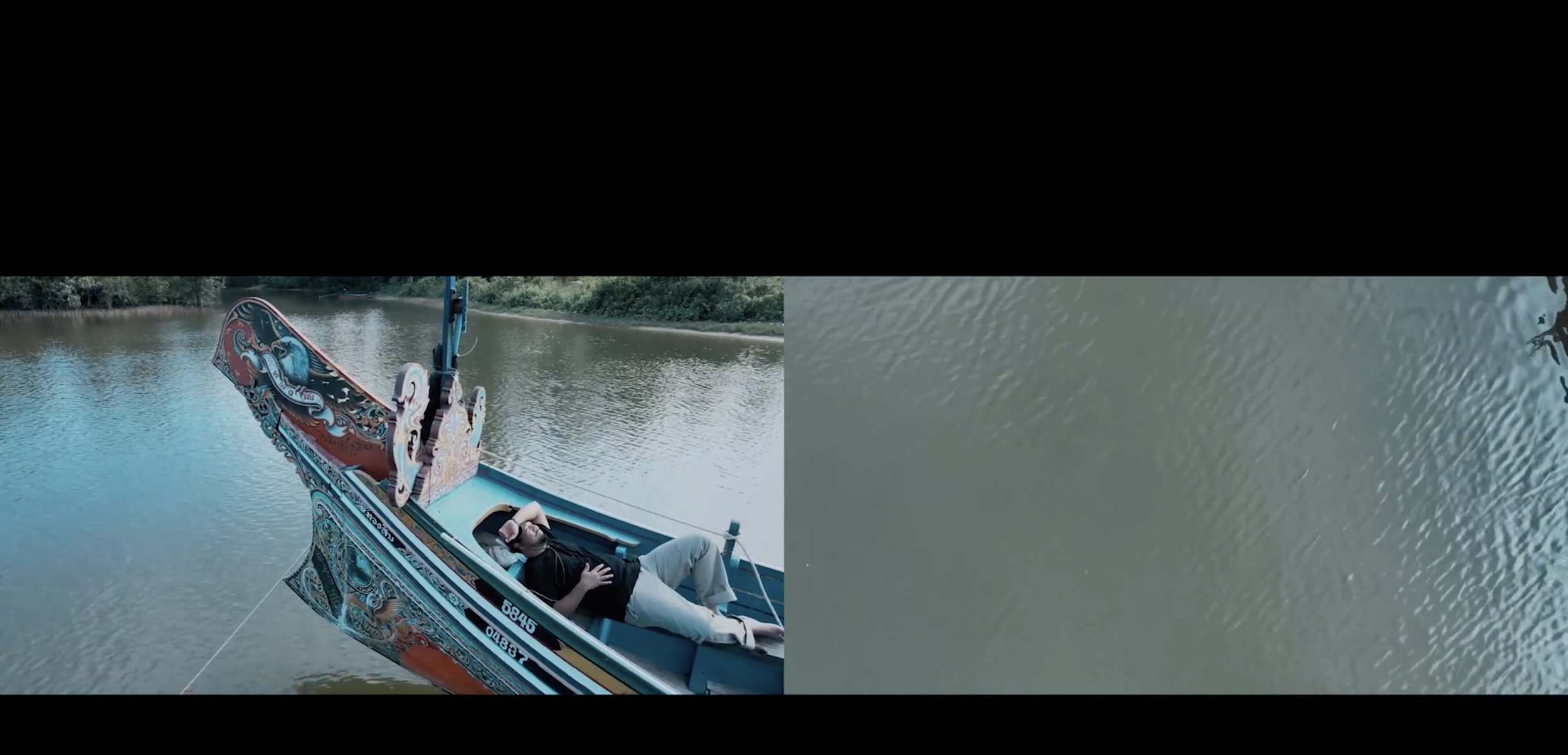
Prach Pimarnman, Makae Tea’ Experimental Film, 2021, single channel video,12m 41s. Image courtesy of Prach Pimarnman.
… … The exhibition also includes three experimental and documentary video works selected from more than ten video works I have made. The first video, Makae Tea’, Experimental Film (2021), part of the exhibition Orang Siyae/Oghae Nayu (2021–2022), examines the question of identity in relation to the concepts of language, otherness, and hybridity in the context of being Melayu. This work represents a crucial juncture that motivated me to continue exploring the history, migration, and the dynamic physical appearance of diversity in the notion of the term “Melayu”. The second video, No Land No Salt No People (2022), part of the exhibition Deep Salt Pattani Decoded (2022), centres on the salt fields of Pattani, which was once an important location for the historical development of the Patani city-states. The salt trade was a major factor in making Patani a significant port, with many individuals from different time periods coming to inhabit the land. And the third video, No Sand No Sea (2024), part of the exhibition From Nomad to Nowhere (2024), focuses on the lives of fishermen in Narathiwat, who face the challenges of environmental changes and the effects of capitalism. The video demonstrates the indomitable spirit of the maritime people, as expressed through their connection with the sky, sea, and wind, as well as their ancestral stories and histories of migration, which give them a sense of identity and belonging.
This exhibition marks the first time the works will be exhibited and communicated in the Narathiwat region. The works challenge silence and create space for dialogue, bringing together complex memories and fragments of memory into a cohesive whole within the space provided by the De’ Lapae Art Space Narathiwat. It is also an excavation of historical layers in search of fragments of memory that have been obscured by the state and capital. The works create a bridge between personal pain, shaped by the long period of unrest in the region, and the history of Patani, once a thriving land based on multiculturalism and maritime trade, and the history of the beginnings of urban development and the existence of diverse communities.
Read the full essay on Prach Pimarnman’s website here.
The Memories of Individual Memories by Prach Pimarnman is on view at De’ Lapae Art Space Narathiwat from 1 February to 30 September 2026.