
Octopus 26: Melange
Artists from Bali, Indonesia, and Australia at Gertrude Contemporary
Over the years, we have republished parts of long-form writing, from catalogue essays to book chapters. This practice is now formalised as part of our Excerpt series. If you would like to work with us to republish a text, please email us at info@from-the-margins.org.
Here is an excerpt from the curatorial essay written by Krisna Sudharma, for Octopus 26: Melange at Gertrude Contemporary, Melbourne, Australia.

Octopus 26: Melange, 2026, exhibition installation view at Gertrude Contemporary, Naarm Melbourne. Photo by Christian Capurro. Image courtesy of the artists.
Mela(ha)ng nae mang. Before you are old enough to ask the right questions, you learn the cadence of care. My mother would say this whenever things needed to be handled—verbally or physically. It was an instruction to tread carefully, a reminder that the world is fragile and must be navigated with deep intention.
“A mind is a thing that endures.” When French philosopher Henri Bergson asserted this, he suggested that to endure is not simply to survive; it means that it is our duration, our passage through time, that truly thinks, feels, and sees. The first creation of consciousness is its own speed in time-distance: a causal idea, an idea before the idea.
Odd though it may be, the premise of this exhibition begins right here, in the space between a mother’s warning to be careful and a philosopher’s realisation that we are shaped by how we endure time. It begins in a phonetic accident, a slip of the tongue between two languages that reveals the quiet tension of our shared geography.
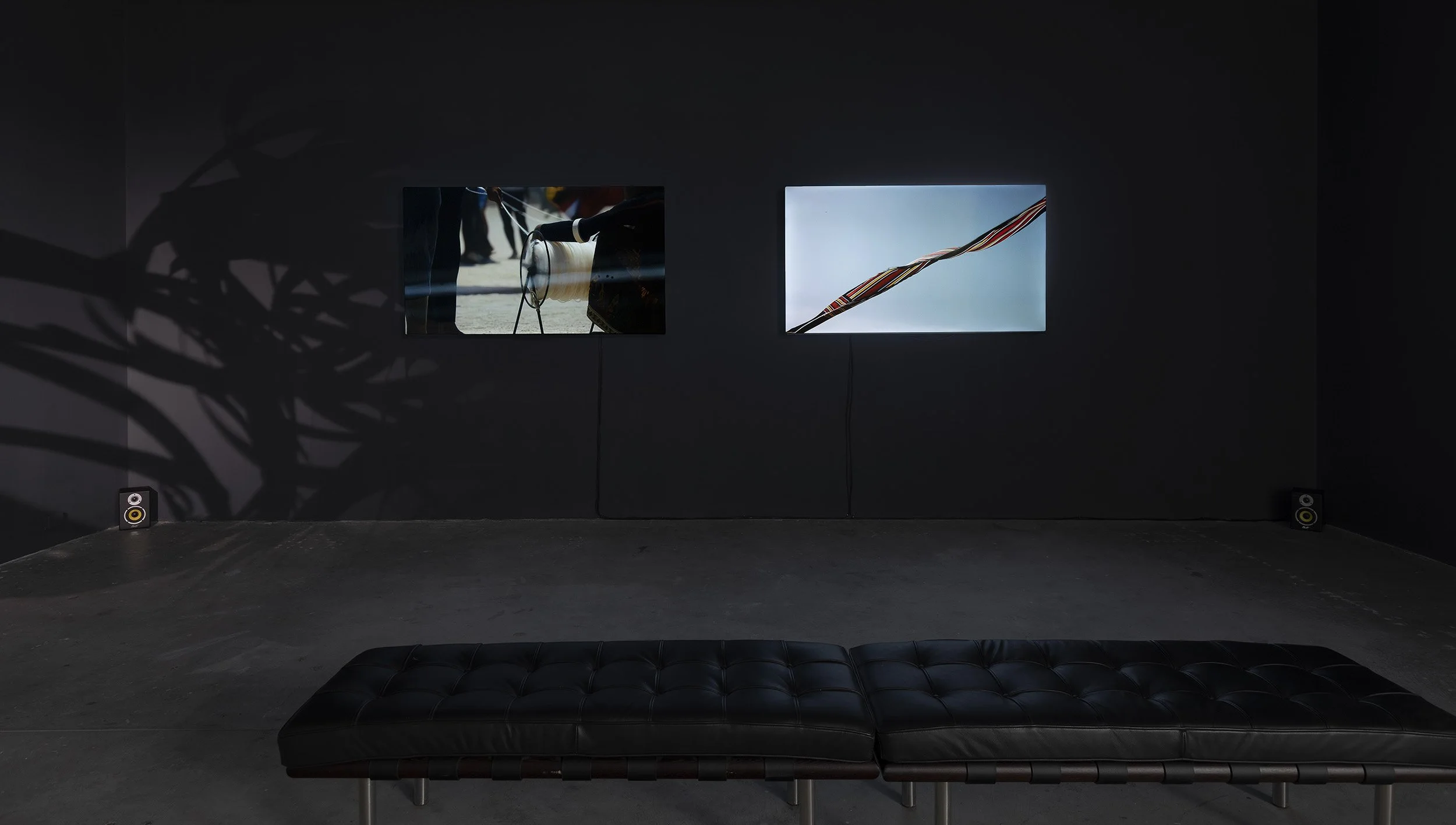
Octopus 26: Melange, 2026, exhibition installation view at Gertrude Contemporary, Naarm Melbourne. Photo by Christian Capurro. Image courtesy of the artists.

Octopus 26: Melange, 2026, exhibition installation view at Gertrude Contemporary, Naarm Melbourne. Photo by Christian Capurro. Image courtesy of the artists.
On one hand, there is the mélange: a mixture, a medley, a distinctively anti-essentialist state where Indonesian and Australian identities blur and entangle. On the other, echoing the local vernacular of my childhood like an odd heckle of linguistics, is the Balinese imperative melahang: a command to handle with extreme care, to fix what is broken, or to split a material carefully along its natural grain.
It is within this friction, between the desire to mix uncontrollably and the deep-seated necessity to be careful, that this exhibition operates.
I have always loved words. Yet, the persistent worry in curating and writing is not just losing the words themselves, but losing the feelings or the meanings behind them. When we try to bridge the linguistic gap, different people will inevitably grasp at varying threads. To explain the abstract solely through language risks turning nuance into a rigid statement, a forced conclusion I do not wish to make or condone. If a feeling still hangs in the air, enduring beyond the text, it is working. If not, we must turn to the visual and the audible. This exhibition is an attempt to render those lingering feelings, letting the visual do the heavy lifting where words fall short, so you can feel the translation rather than just read it.
“If a feeling still hangs in the air, enduring beyond the text, it is working.”
Because the act of looking is hard work. If you don’t truly come by, if you only offer a passing minute or a fleeting second, it is easy to see a lot of art by simply looking and continuing to walk by. But every now and then, something truly pulls you in. Engaging with art is a motion, a physical and emotional investment. Sometimes I stand in these spaces acting as a home and a hope for certain feelings, and for the certain people I encounter. It is about uplifting someone, bringing them to the art, not just pointing at it.

Octopus 26: Melange, 2026, exhibition installation view at Gertrude Contemporary, Naarm Melbourne. Photo by Christian Capurro. Image courtesy of the artists.
Drawing from English born cultural theorist Nicholas Mirzoeff, we are here to grapple with the autonomy of the image, to attempt “to see how it is itself seen.” These artworks are not passive objects awaiting our approval or a polite nod of comprehension. They possess their own logic. To understand them is not to grasp them by gesture or strict definition. It is to acknowledge that by the time we feel we have grasped a moment, the circumstances have already shifted, angling toward a place where we have lost sight.
Melange is an act of endurance. It asks us to suspend our desire for easy translation and instead engage with the distance between us. To navigate this landscape requires a complex form of entanglement. The artists here are not simply blending cultures; they are engaging in a dual motion of fostering and remembering. There is a commitment to nurture a collaborative space that pushes boundaries, yet this forward momentum is inextricably tied to the tutur; the oral transmission of folkloric narratives.
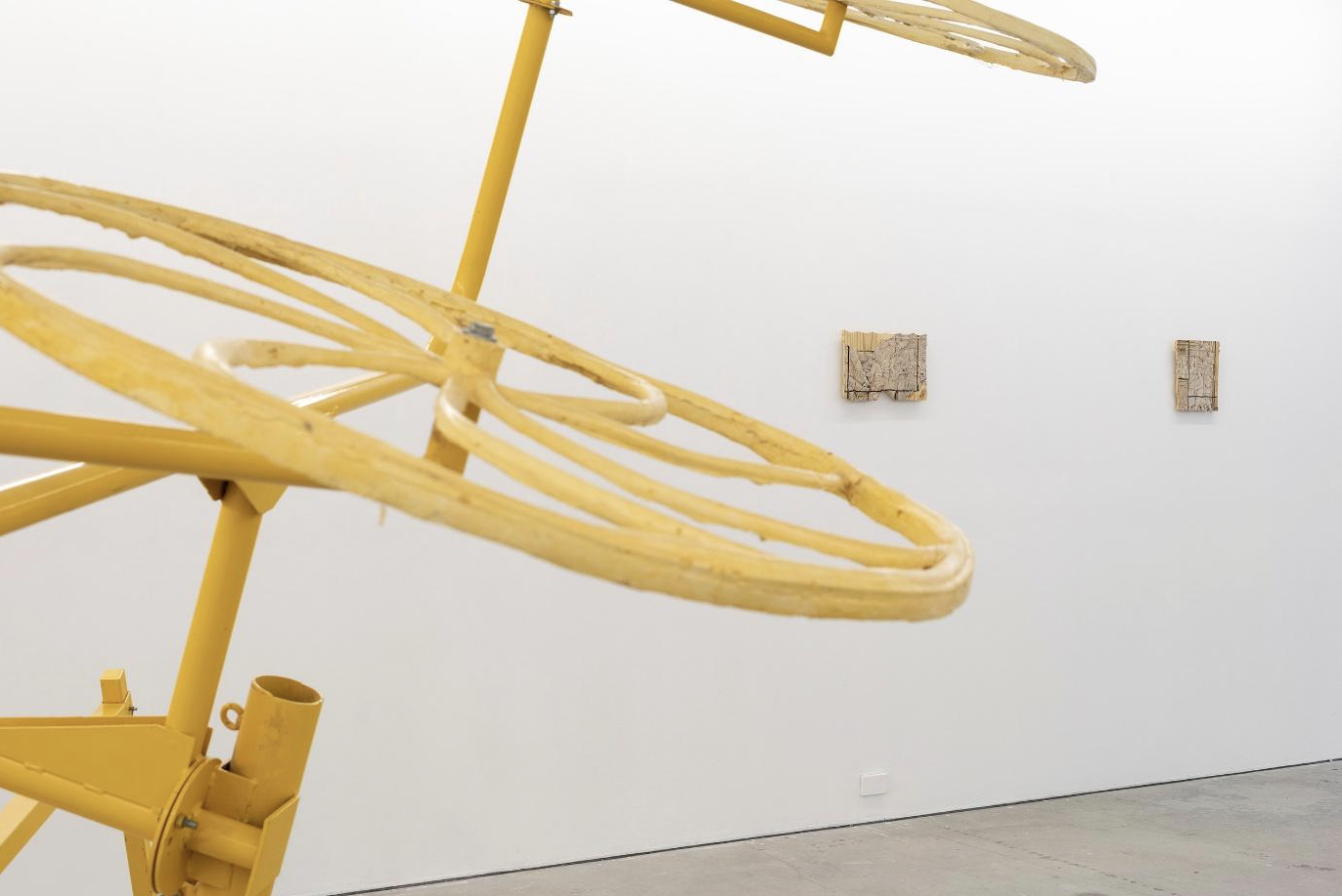
Octopus 26: Melange, 2026, exhibition installation view at Gertrude Contemporary, Naarm Melbourne. Photo by Christian Capurro. Image courtesy of the artists.
We see this explicitly in the work of Noviadi Angkasapura. In his work Untitled (2025), the Indonesian words jujur sabar (honesty and patience) stand as legible moral pillars. Yet, surrounding them are inscriptions that defy linguistic translation altogether—energetic vibrations manifesting on linen paper that act as non-verbal, spiritual forces. It is a visual translation of a feeling that transcends the spoken word. Similarly grappling with the frustration of language and imagery is Gian Manik in Marouflage (2020-2021). By stitching together various painter’s drop sheets—some used, some pristine—Manik presents a literal melange. His tumbling figures, animals, and objects represent the sheer difficulty of pulling disparate visual vocabularies together into a cohesive narrative without forcing a rigid conclusion.
This autonomy is deeply embedded in how the artists handle history and tradition—the act of melahang. Nyoman Darmawan, in Benih Kehidupan (2026), manoeuvres at the intersection of preserving the communal artistic traditions of Pengosekan and cultivating his own self-awareness. He does not merely replicate tradition; he refines it, offering a dialogue devoid of the hegemony and divisions that fragment global civilisation. Maharani Mancanagara also interrogates inherited narratives in Allegory of Cornupia #5 (2026). By replicating select objects from the National Museum of Indonesia using recycled wood, she constructs a cabinet of curiosities that challenges ‘official history’. By juxtaposing everyday objects with Nusantara valuables, she critiques the feudal, nationalist narratives that often marginalise grassroots memory, reminding us that repatriation is not merely about ownership, but the migration of meaning.
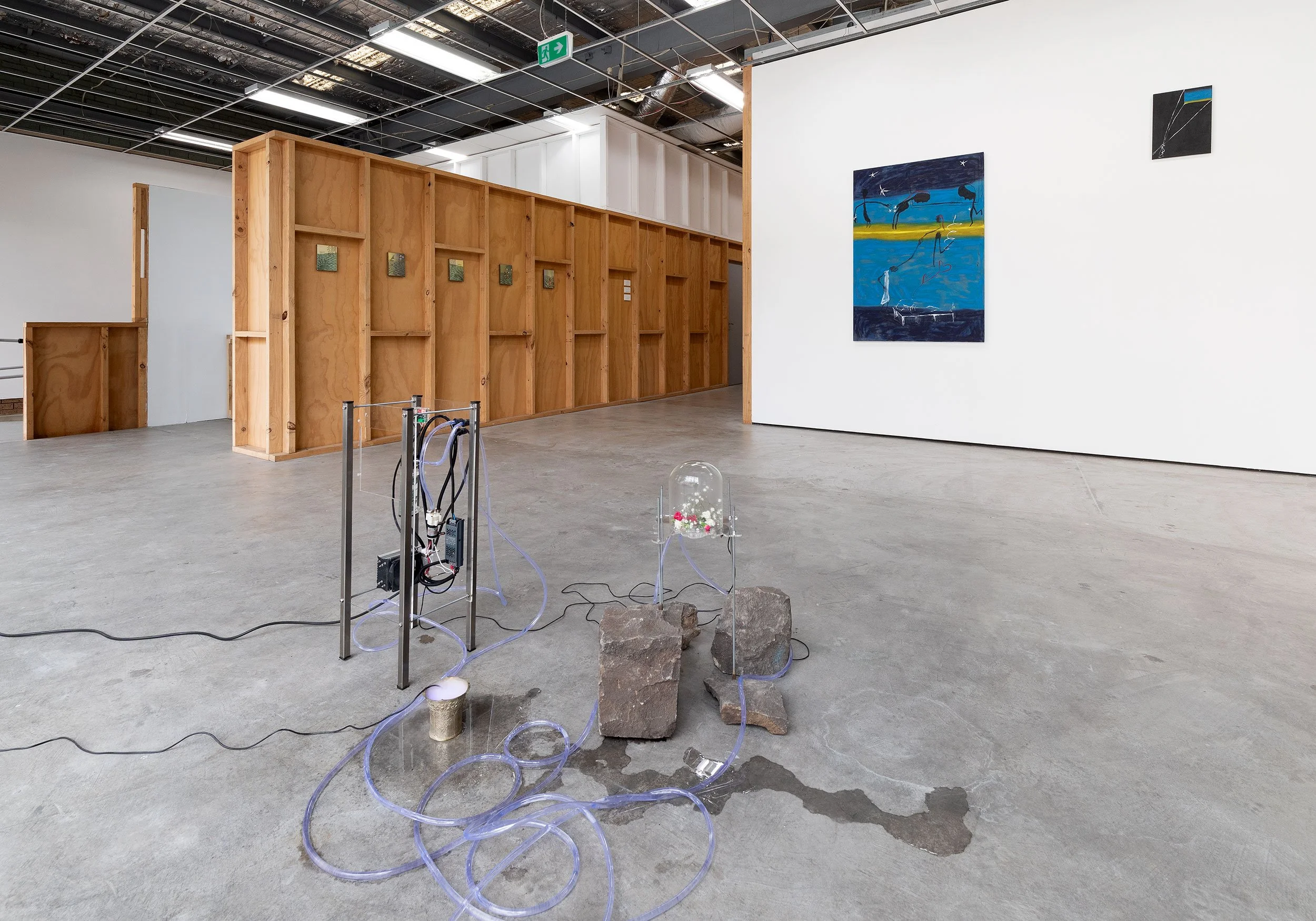
Octopus 26: Melange, 2026, exhibition installation view at Gertrude Contemporary, Naarm Melbourne. Photo by Christian Capurro. Image courtesy of the artists.
The transmission of memory and relational knowledge persists in Mia Boe’s The Preparations (2026). Created in the wake of the artist’s aunt’s passing, these works evoke a liminal, otherworldly space in which four figures – representing Boe and her three sisters – assist their mother with funerary preparations. The figures in Boe's paintings often operate as counterpoints within broader frameworks of inheritance and disinheritance. In the second panel, a sinewy appendage anchors a portal to Country, suggesting an enduring connection between body and place that traverses shifting temporalities.
I often find myself returning to a personal realisation: harapan, dan hal yang abstrak hampir mungkin tujuannya rimpang—that hope, and abstract things, almost certainly find their purpose in the rhizome; sprawling, interconnected, and subterranean. It is with this sprawling, unpredictable energy that the artists resurface those old-world messages from the tutur. By placing them within a modern, speculative landscape, the works act as a bridge. They suggest that identity is not a fixed object to be displayed, but a fragile material that must be melahang; handled properly, sometimes cracked open, to reveal the mixture inside.
This article is presented in partnership with Nonfrasa Gallery.
Octopus 26: Melange is on view from 11 April to 30 May 2026, at Gertrude Contemporary, Melbourne, Australia. To read the full curatorial essay, click here.