Muara Arts opens with ‘A-Z of Southeast Asian Art: A Critical Dictionary’
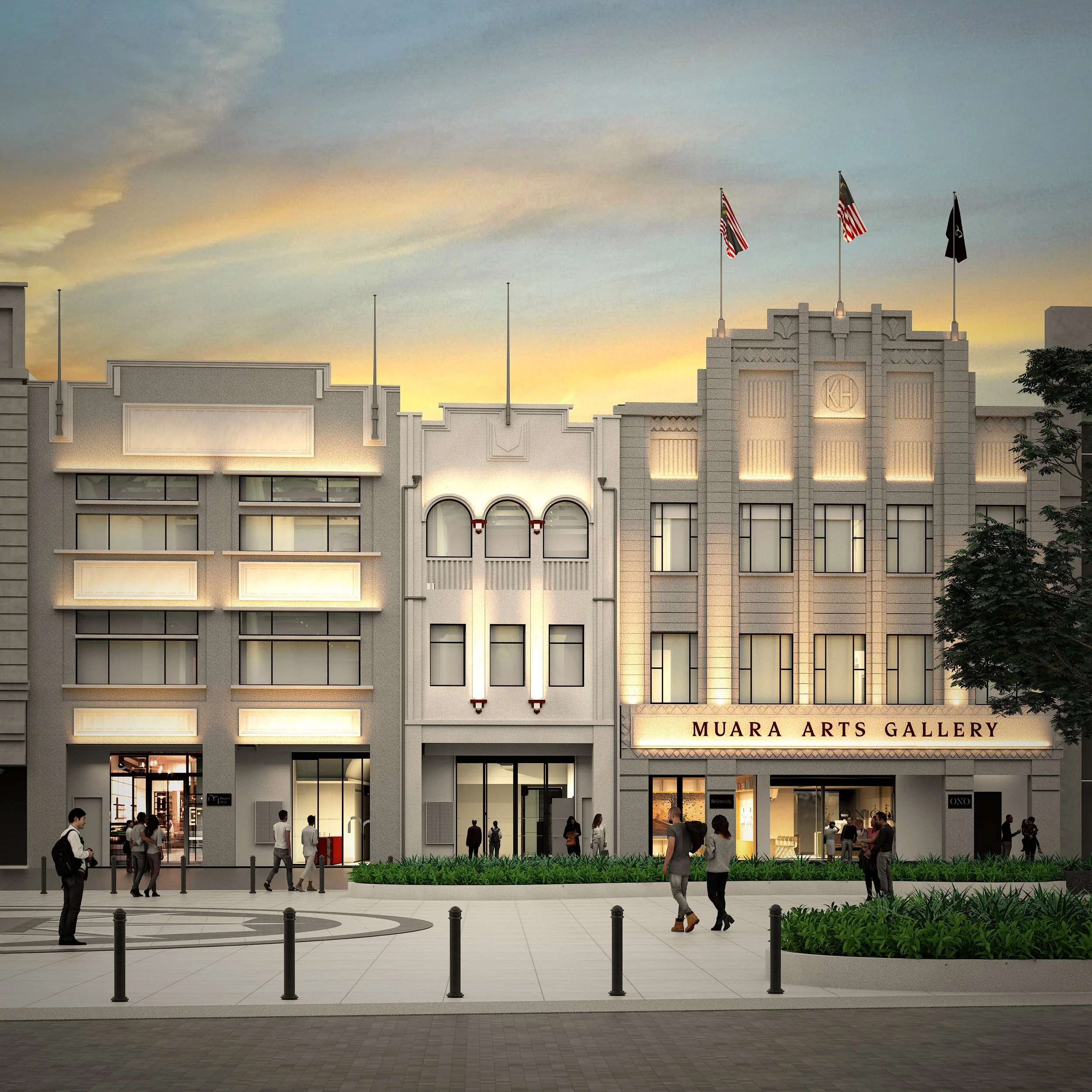
Muara Arts Gallery, Kuala Lumpur, 2026.
Muara Arts enters Kuala Lumpur’s cultural ecosystem as an ambitious initiative backed by the Creador Foundation, established by Shanthi Kandiah and Brahmal Vasudevan. Operating across pillars of education, humanitarian relief, and arts and culture, the foundation’s cultural arm departs from passive patronage. Instead, it anchors an expansive civic and architectural intervention, championing the adaptive reuse of 55 heritage properties across Medan Pasar as part of the broader Warisan KL urban regeneration project.
Muara Arts occupies six restored 1930s Art Deco shophouses at the confluence of the Klang and Gombak rivers, and opens with A–Z of Southeast Asian Art: A Critical Dictionary, co-curated by Consultant Artistic Director Lydia Yee and Assistant Curator Zhen Feng Ang, borrowing its curatorial premise from Ho Tzu Nyen’s ongoing work.

View from inside Muara Arts Gallery. Image courtesy of Muara Arts.
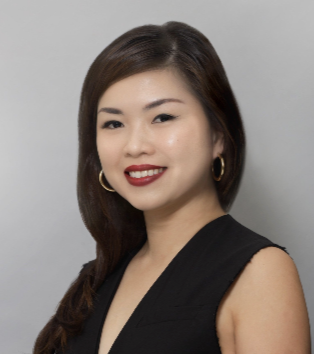
Here, Shanthi and Lydia discuss the architectural and symbolic weight of Medan Pasar, the ethics of curating across borders without flattening context, and what it means to build an art institution capable of listening to its city.

Tuấn Andrew Nguyễn, Balancing on the Weight of the Unresolved, 2024, 155mm bomb shells, brass, hammered brass from artillery shells, 188 x 190.5 cm. Photo by Dan Bradica. © Tuấn Andrew Nguyễn. Image courtesy of the artist and NORR COHAN, New York.
Shanthi, Muara Arts takes its name from “muara”, the Malay word for estuary or confluence—a meeting point. How does this metaphor inform the structural vision of the gallery as a place that bridges Malaysian art practices with the broader regional and international ecosystem?
Shanthi: The name came from the late Valentine Willie, who was a consultant to us and spent his career connecting artists across Southeast Asia. We think of the institution as a meeting point on several levels. It brings together ideas, perspectives and artistic practices that might not otherwise meet. It places Malaysian art in conversation with the rest of Southeast Asia, a region bound by deeply interconnected histories yet shaped by distinct cultures and experiences. And beyond the region, we want it to be a bridge between Southeast Asian practice and the wider international art world.
Our inaugural exhibition, A–Z of Southeast Asian Art: A Critical Dictionary, puts this into practice. The works range across identity and belonging, corruption and the environment. As you move through the galleries, the same concerns keep surfacing, each told through a different lens and shaped by the particular context it comes from. That is what we hope audiences take away: a sense of what we share with our neighbours, and of what makes each place distinct.
Over time, we want Muara Arts to become a platform for discovery, dialogue and artistic exchange, one that strengthens connections within the regional arts ecosystem and raises the visibility of Malaysian and Southeast Asian art on the international stage.

Pacita Abad, The Far Side of Apo Island, 1989, oil, acrylic, gold thread, plastic buttons, lace, sequins on stitched and padded canvas, 224.2 x 175.3cm. Photo by Hyunjung Rhee. Image courtesy of Tina Kim Gallery and Pacita Abad Art Estate.
The venue itself occupies six restored 1930s Art Deco shophouses in Medan Pasar, a historic district originally centered on financial institutions. How do you view this spatial transformation shaping the way local and visiting audiences will encounter contemporary art in Kuala Lumpur?
Shanthi: Medan Pasar is the historic birthplace of Kuala Lumpur, where the city first took shape around trade. Just as this was a starting point for the city, we hope it can become a starting point for something equally meaningful for Malaysian and Southeast Asian art.
Choosing to restore and adaptively reuse six 1930s Art Deco shophouses was very intentional. Contemporary art institutions are often housed in purpose-built spaces, but we felt there was more meaning in bringing contemporary art into buildings that have witnessed nearly a century of Kuala Lumpur’s evolution. We have preserved their architectural character, including their distinctive Shanghai plaster finishes. At a time when the city is modernising so rapidly, these connections to the past matter.
The buildings also carry their own stories. Medan Pasar grew from a bustling trading centre into the city’s financial and legal hub, and our shophouses were once occupied by financial institutions, including the Bank of China and the Bank of Tokyo. There is something quietly poetic about spaces that once served the city’s commercial life now being given over to the arts.
One shophouse was home to the Robinson Piano Company, which sold instruments and records and helped cultivate an appreciation for music in early Kuala Lumpur. It feels fitting that a space that once introduced people to the arts is doing so again.
For audiences, this means a different way of encountering contemporary art, with past and present in dialogue. For locals, it is a chance to rediscover the heart of their own city. For visitors, it is an introduction to Kuala Lumpur through the place where it began. Either way, you are not simply entering a gallery, but stepping into a piece of the city’s history, where the architecture and its stories become part of the experience.
“There is something quietly poetic about spaces that once served the city’s commercial life now being given over to the arts.”
Lydia, having spent three decades leading major public art institutions in London and New York—including the Whitechapel Gallery, Barbican, and The Bronx Museum—you have now taken on the role of Consultant Artistic Director at Muara Arts. What drew you to this role in Kuala Lumpur, and how does shaping a brand-new, non-profit space in Malaysia compare to directing established institutional frameworks in the West?
Lydia: I was drawn by the dynamism and possibilities in Malaysia and more broadly in the region. One of the challenges of working in established art institutions is the institutional mindset and inertia. People get used to working in set ways, sticking to rules and ticking boxes, rather than bringing fresh ideas and new ways of working to the table. Working with the Muara Arts founders, team, architects and consultants over the past 18 months has been refreshing in being able to see that change can actually happen quickly.
“Working with the Muara Arts founders, team, architects and consultants over the past 18 months has been refreshing in being able to see that change can actually happen quickly.”
The debut exhibition, A–Z of Southeast Asian Art: A Critical Dictionary, takes its conceptual premise from Ho Tzu Nyen's work The Critical Dictionary of Southeast Asia (2017–ongoing). What prompted the decision to anchor the opening show of a new regional institution around this framework?
Lydia: Some of the very questions that Ho Tzu Nyen raises in his Critical Dictionary were the questions we were asking ourselves: What are the shared histories and artistic concerns among artists in the region and what are the differences? I also wanted to open with an exhibition that provides an introduction to contemporary art in Southeast Asia and is accessible to new audiences, but that shows the complexity of the region and its art in a way that also engages seasoned art viewers.

Marcos Kueh, Telah Dapat Gading Bertuah, Terbuang Tanduk Kerbau Mati, 2024, industrial weaving, 8 colours, recycled polyester, 510 x 170cm. Photo by Marco Vedana for Kunstverein Ludwigshafen. Image courtesy of the artist.
The exhibition features over 40 artists spanning various mediums and generations across Southeast Asia. Could you discuss how you and co-curator Zhen Feng Ang mapped specific artists and works to the alphabetical entries?
Lydia: We started with Ho Tzu Nyen’s dictionary terms and a list of artists and artworks from across the region, which a group of researchers and writers helped us to identify. It was important for us to include artists from all 11 countries in Southeast Asia and to have diversity in terms of gender, ethnicity, age and artistic media. My co-curator Zhen Feng Ang and I had the task of assembling a puzzle of sorts—fitting artworks to terms and meeting with artists to see if they were amenable to our reading of their work. Ho Tzu Nyen’s dictionary is generative, open-ended and contains multiple terms for each letter so these parameters actually gave us a lot of creative freedom.

Martha Atienza, Our Islands, 11°16'58.4"N123°45'07.0"E, 2016–ongoing, single-channel HD video, no audio, 1'12"00. Image courtesy of the artist and Silverlens (Manila/New York).
In addition to Ho Tzu Nyen's dictionary, the exhibition incorporates other artist-driven reference works, such as Wong Hoy Cheong's The Definitive ABCs series. How does the exhibition challenge the concept of a traditional, authoritative dictionary to advocate for plurality and fluid definitions of Southeast Asian art?
Lydia: We tend to think of dictionaries as authoritative and fixed but language is constantly changing. I would say that Wong Hoy Cheong’s The Definitive ABCs lays the groundwork by undermining the notion of authoritative bodies of knowledge, whereas Ho Tzu Nyen’s Critical Dictionary advocates for plurality and fluid definitions. A–Z of Southeast Asian Art follows not only the alphabetical structure of the latter work but also employs Ho’s strategies of alliteration, repetition, contrast and incongruity.
The exhibition features artists from all 11 Southeast Asian nations, alongside members of the regional diaspora. How have you navigated the challenge of presenting a cohesive cross-border narrative without flattening the distinct cultural, social and political contexts of each nation?
Lydia: I think it would be impossible to present a cohesive narrative. But what you'll see is perhaps more strands that sometimes weave together quite compatibly and, at other times, become entangled. If we take the textile works in the exhibition, for example, we have both handwoven and industrially made works. While some textile works are made in collaboration with communities, others are made by the artist alone in the studio. Some are based on traditional ceremonial cloths, while others are made from mass produced materials. How each artist works and their choice of subject matter has more to do with the specific context in which they work than their national identity.
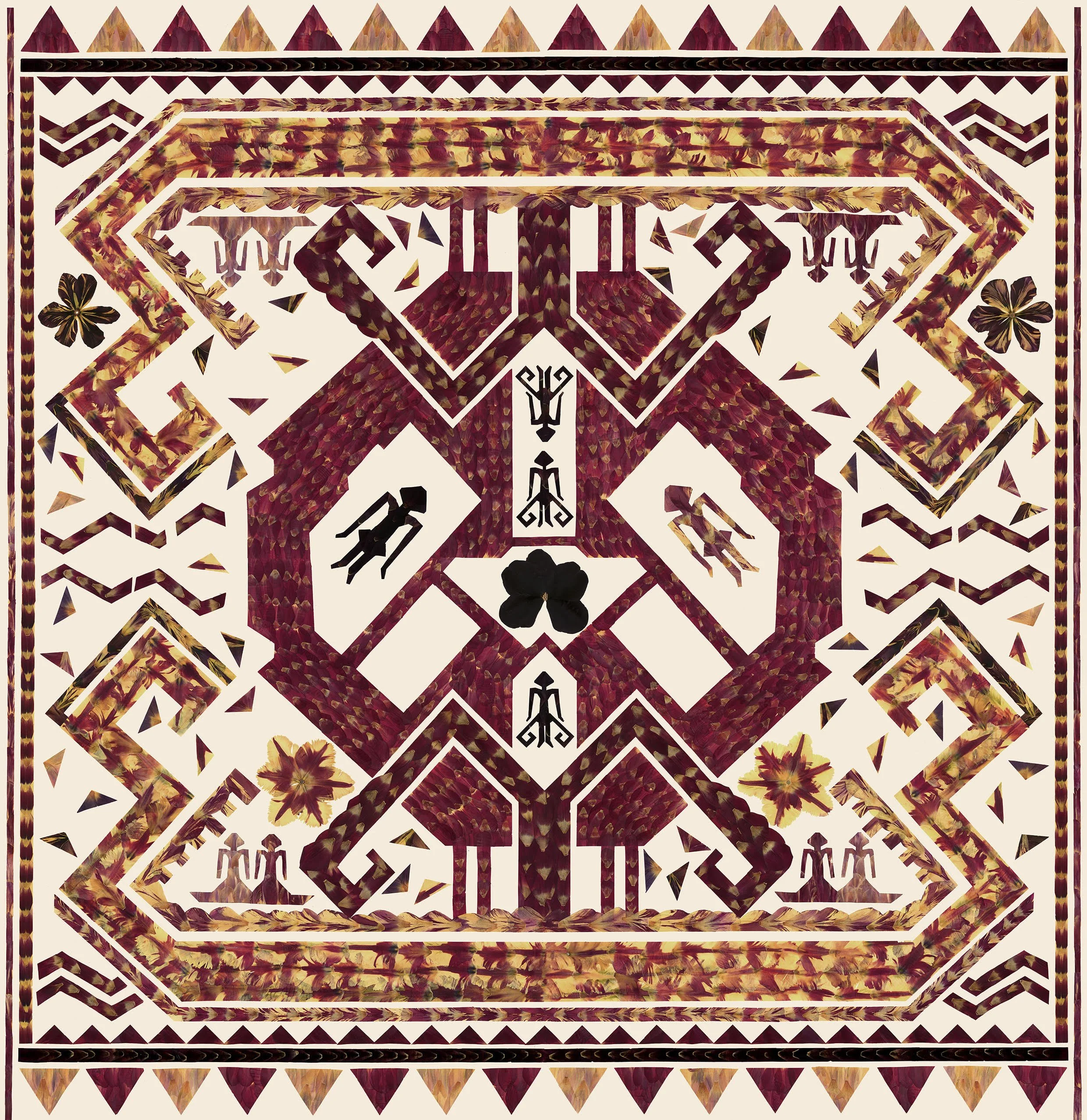
Jennifer Tee, Tampan Womb of Time, 2017, tulip petal collage on paper, 170 x 165cm. Photo by Michiel Elsevier Stokmans. Image courtesy of the artist and Tina Kim Gallery.
Muara Arts is supported by the Creador Foundation and will eventually unite a gallery and a theatre space in Medan Pasar under a single entity. How do you see this multi-disciplinary model contributing to the broader landscape of non-profit art spaces and independent initiatives in Malaysia?
Shanthi: Muara Arts Gallery and Muara Arts Theatre, which is targeted to open in 2029, will anchor our plans for Medan Pasar as an arts and cultural hub with a strong creative economy at its core. The wider precinct will include facilities to support the arts community as a whole, from spaces for residency programmes, exhibition galleries, performance and rehearsal spaces. It is being built not just for Muara Arts, but for the many artists and practitioners we hope will make it their home.
Being not-for-profit is fundamental. The support of the Creador Foundation allows us to put artistic ambition and public engagement at the centre of our programming, while we build a sustainable operating model for the long term. That is a big part of why we appointed Chris Lee, who joins as CEO of Medan Pasar Realty and Muara Arts in mid-December after a decade at National Gallery Singapore.
Bringing a gallery and a theatre together within one institution also lets us introduce audiences to forms of artistic expression they might not otherwise encounter, and gives artists working across disciplines a place to meet.
Most of all, we know a thriving arts ecosystem depends on collaboration. Institutions, independent spaces, artists, curators and cultural practitioners each play important and complementary roles. We hope to work alongside independent initiatives, cultural organisations and educational institutions to share knowledge, encourage exchange and create new opportunities for creative development.
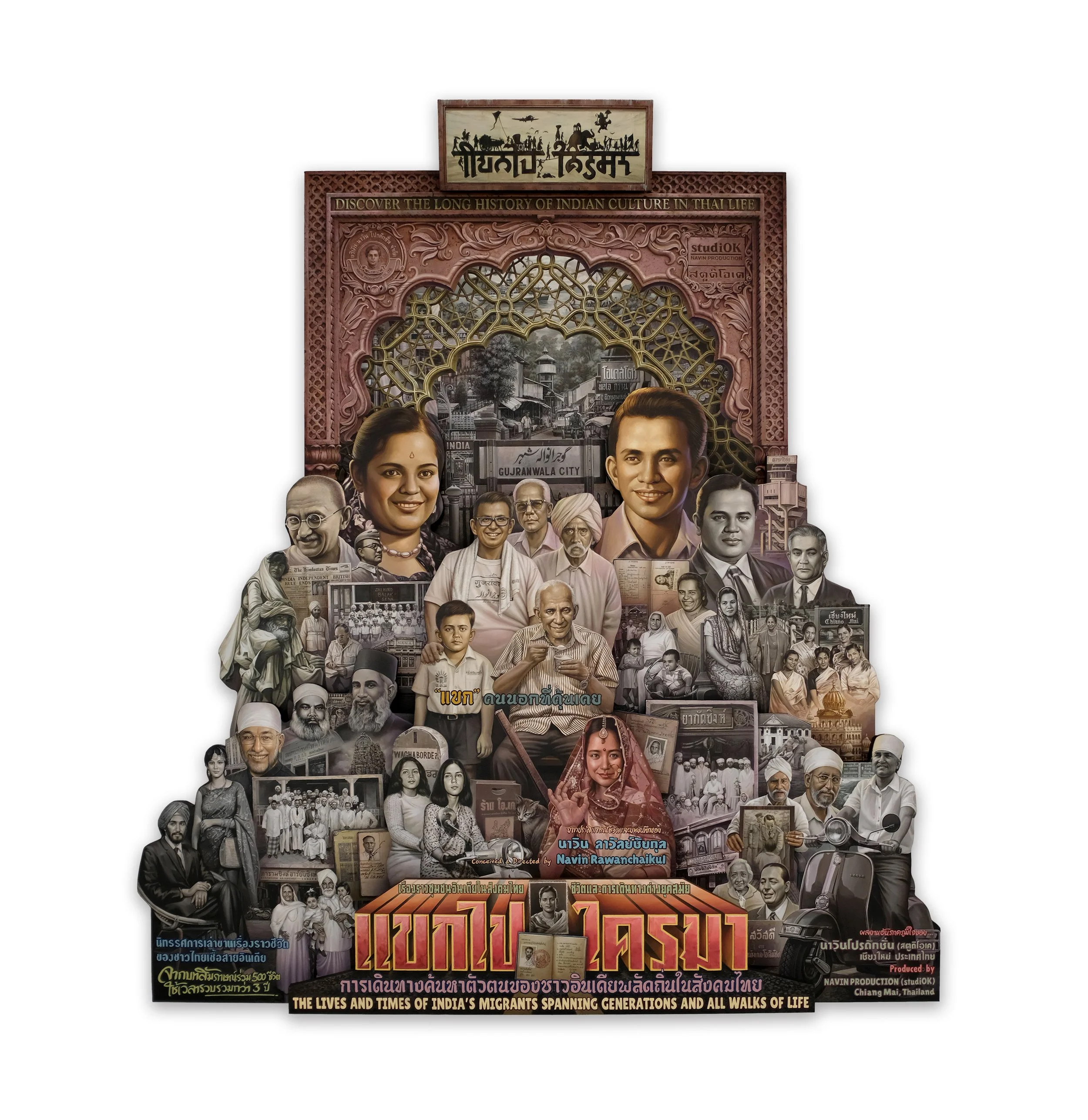
Navin Rawanchaikul, Khaek Pai Krai Ma 3, 2021, acrylic on canvas, 8 panels, 246 x 272 x 28cm. Image courtesy of Navin Production (studiOK).
Beyond exhibition-making, Muara Arts is launching a publication and an extensive learning and interpretation programme. What are your long-term ambitions for cultivating new audiences locally and positioning Muara Arts as a sustained research platform for Southeast Asian art history?
Shanthi: An arts institution’s role goes far beyond presenting exhibitions. It is about giving people reasons to engage with art, get curious and build a deeper understanding of the histories and perspectives that shape the region.
For audiences, that starts with interpretation that welcomes rather than intimidates. Alongside guided tours and public talks, we have created a family looking guide for our opening exhibition, with questions for different age groups built around three simple prompts: Look, Wonder and Imagine. Over time, we will build programmes for children, young people and students, because audiences grow from good first experiences that make people want to return.
On the research side, the exhibition publication is a first step. We will also launch a Southeast Asian art research centre, a resource for artists, curators, scholars and students to study the region’s art and its histories in depth. We want Muara to be a place where knowledge about Southeast Asian art is not only presented but produced and shared.
Both serve the same goal: a place where curiosity matters more than prior knowledge, where Malaysians can discover their own artistic heritage alongside that of their neighbours, and where artists and researchers from across the region can find one another.
“We want Muara to be a place where knowledge about Southeast Asian art is not only presented but produced and shared.”
In broad strokes, can you tell us what to expect from Muara Arts in its first year?
Shanthi: Our first year is about laying the foundations for a welcoming, dynamic and enduring institution.
It begins with A–Z of Southeast Asian Art: A Critical Dictionary, opening on 1 November. We hope it introduces audiences to the diversity and complexity of art across Southeast Asia, and sets the spirit of curiosity and openness that will guide everything that follows.
Around the exhibition, we are building a programme of guided tours, artist conversations, public talks and activities for families, students and young adults, as well as for established art lovers. Audience development is a priority, and we especially want to welcome people who may be visiting an art gallery for the first time.
Institutionally, Chris Lee joins as CEO in December. We will also keep building relationships with artists, curators, artisans, designers, cultural organisations and educational institutions across Malaysia and the region, creating opportunities for collaboration, research and exchange, while laying the groundwork for Muara Arts Theatre and the wider transformation of Medan Pasar.
Above all, we hope our first year marks the beginning of a lasting relationship with our audiences, one in which people see art not as something distant or exclusive, but as a meaningful part of everyday life.
More information at muaraarts.org. There is a Grand Opening this Sunday, 1 November, including an artist panel. See here for the details.