Conversation with Li Chen
At the intersection of spiritual and artistic practice
This article is part of Art & Market’s coverage beyond Southeast Asia. If you would like to work with us to reach audiences from the region, please email us at info@from-the-margins.org.
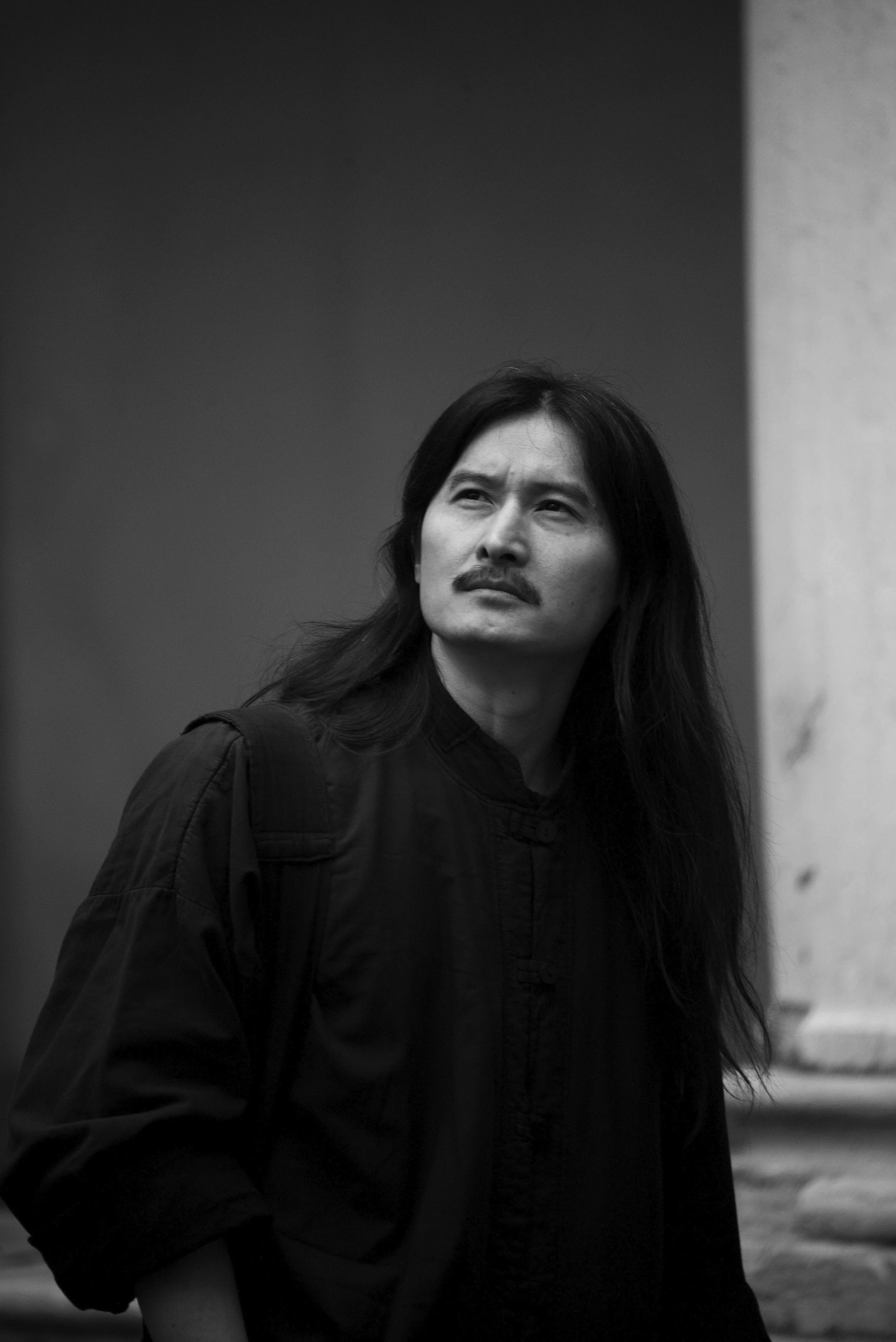
李真 Li Chen. Image courtesy of Asia Art Center.
李真 Li Chen (b. 1963, Taiwan) is a renowned artist who works primarily on sculpture. Taking cues from classical Eastern philosophies, his works meld contemporary thought with keen spiritual awareness to form a distinctive visual style. A prolific artist, he has had 16 solo exhibitions in total over the course of his three-decade-long career. This includes the Asia Art Center and MOCA Taipei in Taiwan, as well as at international venues such as the 52nd Venice Biennale in 2007, Singapore Art Museum in 2009, and Place Vendôme in 2013. He was also the first artist to exhibit at the Cannes Film Festival in 2015. His works are collected by major institutions such as Musée Cernuschi, the Olenska Foundation, and the National Taiwan Museum of Fine Arts.
While he is largely known for his “ink-black” sculptures with child-like faces, his practice resists broad categorisation. His corpus has witnessed major developments in his artistic style as well as spiritual methodology. Series such as 神魄 Soul Guardians (2008-2009) inscribes his sculptures with calligraphic sinograms and the forms of ink paintings, marking his first explicit foray into the literati tradition. This is followed by 青煙 Ethereal Cloud (2011–), which is a breakaway from the artist’s usual use of bronze, harnessing stainless steel to create abstracted, irregular shapes. What remains consistent is his joy of creation and a playful simplicity that renders his works easily legible to viewers of all backgrounds.
A major monograph of Li’s works was recently published by Editions Cercle d’Art, featuring essays by Yuan Chih Cheng, Head of Collections at the Musée d'art contemporain du Val-de-Marne (MAC VAL) in Greater Paris. The monograph also offers an in-depth examination of the artist’s development, presenting key representative works from all of his major series. I was invited on this occasion to visit Li’s studio in Sanyi, Taiwan where we sat down for a chat to discuss the various elements informing his extensive practice.

Li Chen monograph published by Editions Cercle d’Art. Image courtesy of Asia Art Center.
In your latest monograph published by French Art Publisher, Editions Cercle d’Art, you mentioned that, “When I am creating, I try not to think about questions of materiality, of structure or materials… In sculpting, I seek above all to savour the experience.” Could you elaborate more on this?
Materials are used by artists to express themselves. So when I want to depict the imperfection of humanity or the absurdity of humans, I choose the material that best conveys the spiritual system of my creation, guiding the sculpture’s meaning and life force. For instance, in my series 凡夫 (Ordinary People), I used clay as the primary medium to parallel soil, the essence of which mortals come from. I can use any material as long as it fits my goal as I have a sensitivity and an ability to master materials quickly.
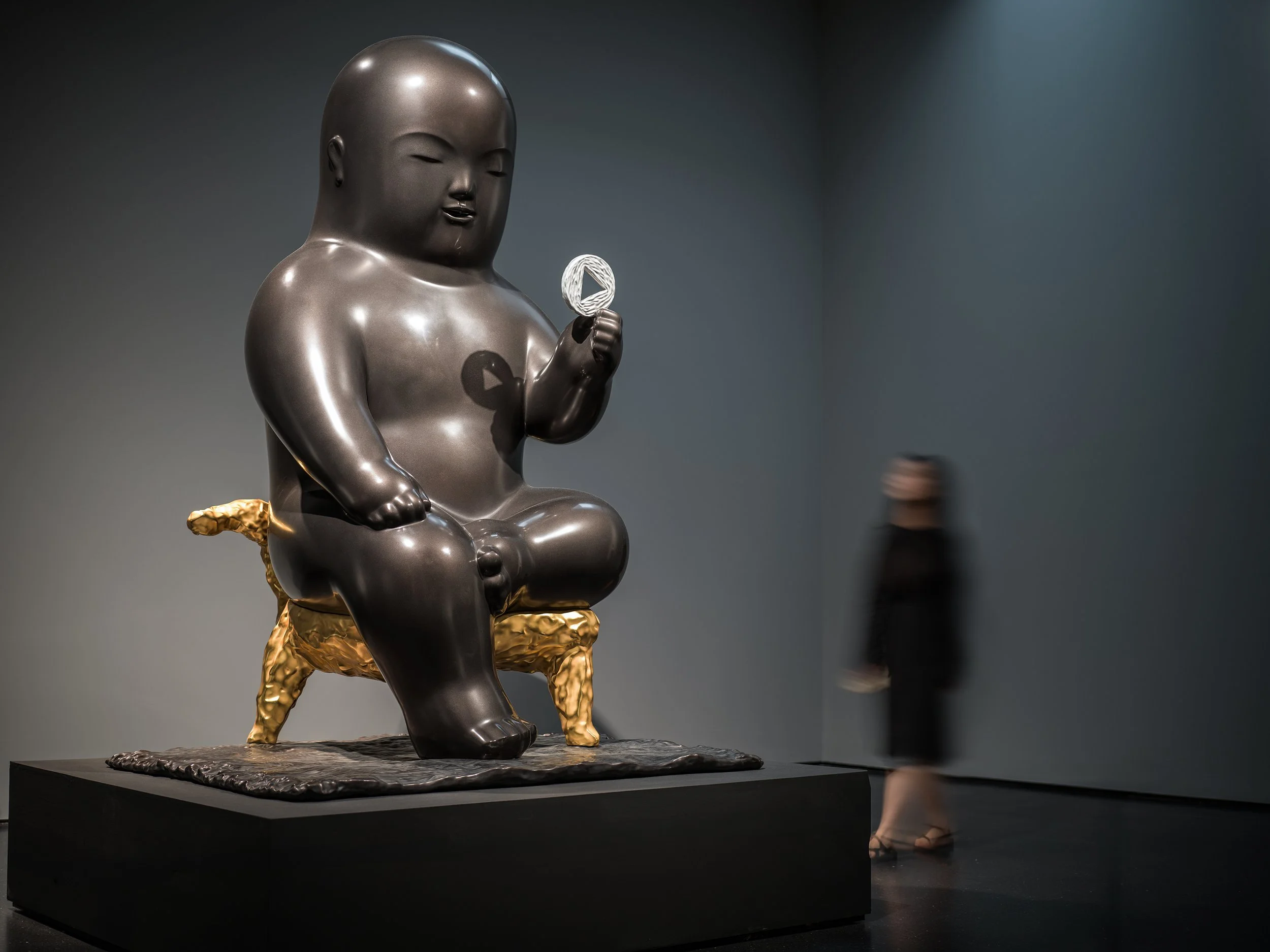
Li Chen, 金剛座.我聞 The Throne of Speech, 2021, bronze, 167 x 137 x 235cm, installation view at Guangdong Museum of Art, Li Chen: Spiritual Journey through the Great Ether (2026). Image courtesy of Asia Art Center.
Your oeuvre has been marked by a pursuit of balance, and is deeply rooted in your own spiritual life. How does your spiritual practice influence your work and vice versa?
What you have said is interesting because I am a person of contradictions. I know my Buddhist principles by heart, but I do not wish to pursue perfection, harmony and the heavenly realm because within me I still have obsessions and attachments. Every work that I have produced also holds my contradictions. Yet at the same time, having exhibited my works globally, I have realised that everyone is like me, longing for the spiritual while having deficiencies in our hearts. So I hope that my sculptures can be used for healing, and as a method to understand imperfection while seeking the heavenly realm.
Maybe one day I will attain true spiritual practice which will influence my practice. My wife’s patient and accepting heart also cultivates my temperament. Because of these two motivations, I do try to correct the lack of balance in my heart. I have already made some small changes to my practice through one of my recent series, 大氣神遊之現相篇 (Spiritual Journey Through the Mundane World). This series merges themes from earlier series, taking that which is imperfect and embedding it into the sculpture, while also still finding liberation. If you take a look at 金剛座•我聞 (The Throne of Speech) (2021) from this series, you will see that balance comes from literally, the sculpted person using its foot as a support since the chair he is on is missing one leg. It is a perfect imperfection. Balanced, and yet unbalanced.
“I have realised that everyone is like me, longing for the spiritual while having deficiencies in our hearts. So I hope that my sculptures can be used for healing, and as a method to understand imperfection while seeking the heavenly realm.”

Li Chen, 光纖之 Optical Fiber (I), 2012, clay, hemp rope, 135 x 116 x 220cm, installation view at Asia Art Center Bewilderment and Enigma ─ A Subversive Sophistry of Humanity (2025-2026).

Li Chen, 赤子 Innocence (left), 2012, clay, wood, iron, sand and Li Chen, 無法根治 Incurable (right), 2017, clay, wood, steel wire, iron. Images courtesy of Asia Art Center.
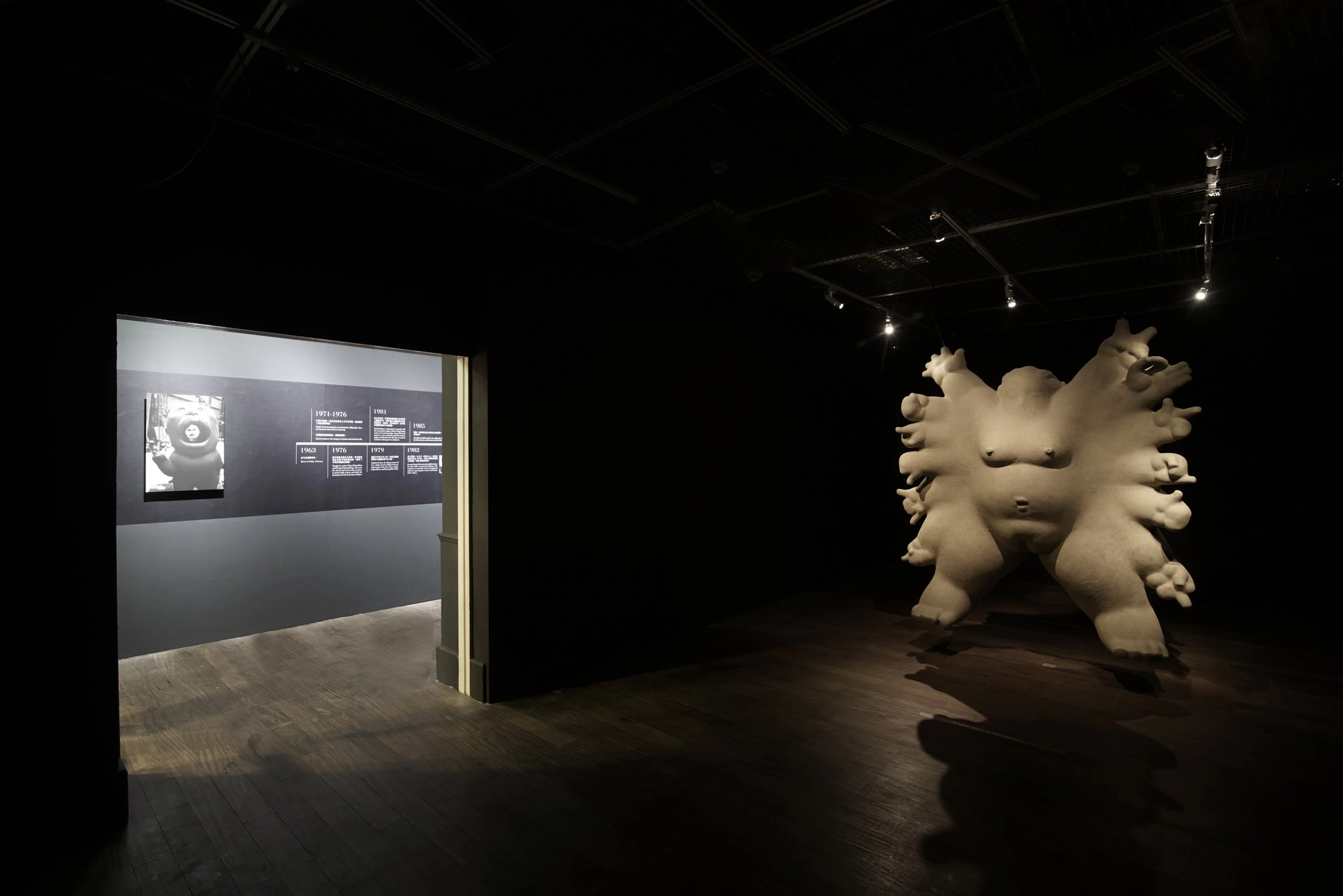
Li Chen, 蝴蝶王國 Butterfly Kingdom, 1999, fiberglass, clay, 184 x 89 x 219cm, installation view at MOCA Taipei Being: In/Voluntary Drift (2017).
How do you view the evolution of your works through the various series you have produced? Has your approach to each series also matured with your life circumstances?
My earlier series from the turn of the millennium, 大氣神遊 (Spiritual Journey through the Great Ether), held a very broad view of human nature which I felt uncomfortable with after working on it for a period of time. As such, I moved to my 凡夫 (Ordinary People) series where I wanted to critique society and confront the weight of human nature. Consider 光纖之一 (Optical Fibre I) (2012). The person is bound by rope and yet he looks content and indifferent despite his shackles. 無法根治 (Incurable) (2017) also embodies a certain violence that comes with obsession: ugly spikes shoot out of the person’s head, while he stands on a crumpled ingot representing worldly wealth.
I had an early work called 蝴蝶王國 (Butterfly Kingdom) (1999), which presents an exaggerated figure with a multiplicity of hand gestures, some peaceful and some vicious. The roots of 凡夫 (Ordinary People) can be traced this work, but its conception was also largely affected by my mood at the time. I was facing many turbulent emotions and if I did not continue creating the works, then I would feel as if I were repressing myself and holding in all the negative energy.
Eventually, I reached a point of acceptance and that is when 凡夫 (Ordinary People) ran its course. I came to a point of realisation that the human world is what it is, and so am I: full of contradiction, absurdity, and struggles. With this acceptance, I penned a new phrase, “優雅中的矛盾” (Paradox in Elegance), and a new chapter in my practice was born. In this series of works, I return to my carefree shapes that transcend the mundane world, but the lessons from 凡夫 (Ordinary People) to be socially engaged remain. My latest series, 空疏•寂境篇 (Void Realms) is a return to stillness, where I start to look for tranquility. Maybe it is because I have been staying in the mountains of Sanyi more frequently, which has led to a sense of “having eaten one’s fill and having nothing to do”—a blessed thing.

Li Chen, 無憂國土 Pure Land, 1998, bronze, 250 x 85 x 142cm, installation view at Place Vendôme (2013). Image courtesy of Asia Art Center.
You have had solo exhibitions at the Venice Biennale in 2007, Frye Art Museum in 2012, and Place Vendôme in 2013, while your works were also acquired by the Musée Cernuschi last year. What does your sustained engagement with Western institutions over the years mean to you?
I want to talk about the differences in Western and Eastern systems of art, since many have described my works as taking on Western sculptural forms with Eastern spiritual methodologies. European and American art systems work through an inheritance of multigenerational influences, with each artist within the canon working off their predecessors. At the same time, American Abstract Expressionism is a great influence on many Taiwanese artists. But has there been any Taiwanese “-ism” that has influenced American or European art? This is in spite of the fact that Chinese classical civilisation has been around for millennia.
What this means is that Europeans and Americans can read my works, but there is no connection that can be made to their art history frameworks. Instead, currently my works have to be read through a Chinese classical history lens, albeit with some Western gestures in colours and forms. I was nurtured in an environment where ancient Chinese antiques and calligraphy were well preserved and displayed in my everyday life, and I am merely following that tradition within a contemporary sphere.
Taiwan itself has a relatively youthful history of 500 years, but we will slowly construct our own art history. So what I want to do in my practice and working within Western contexts, is to embody what I call the “New Eastern Spirit”. You can see this in my work which transforms ancient thought systems into innovative contemporary forms and dialogues. Also, aside from calligraphy, a lot of sculptural Chinese art is functional and religious. This new trajectory I am proposing creates sculptural art for its own sake. Art should be a display of the artist’s perception and spiritual activities transformed into an object. It will take three to four generations to fully engender the New Eastern Spirit, and we must continue to organise and produce works within this context clearly. Then hopefully, we can grow our discourse power to influence the Western art world.
“What I want to do in my practice and working within Western contexts, is to embody what I call the ‘New Eastern Spirit’... Art should be a display of the artist’s perception and spiritual activities transformed into an object.”

Li Chen, four works from the Celestial Manuscripts series, 2025, ink on paper, installation view at Asia Art Center (Taipei) Bewilderment and Enigma ─ A Subversive Sophistry of Humanity (2025).
On top of sculptures, you also have drawings and calligraphic works, such as your 天文 (Celestial Manuscripts) series which was recently exhibited at Asia Art Center (2025-2026). What is the relationship between your sculptural and drawing practice?
Most of my drawings are drafts for my sculptures. I usually begin with sketches to help me visualise as part of my process, and I can draw many variations in the same day as my head is usually full of ideas. There was once that I stayed in a hotel, and I used up their entire notepad on all my drawings for 青煙 (Ethereal Cloud). The final set of drawings are now displayed at my house.
With regards to 天文 (Celestial Manuscripts), I wanted to experiment with modern calligraphy where the written characters are mostly indecipherable. As such, I extracted the cursive script from its semantic meaning, resulting in written forms that appeared more alien-like. Writing is no longer functional, but embodies an emotional and creative spirit. There is also some social critique in this series of works. Our current age is defined by its use of AI and various technologies that summarise or write texts for us, while saturating us with information. Through these words stripped of their linguistic order, I wanted to analyse our inability to read or think properly these days, and to rebel against the way we write and read these days.
What are some principles that you have held steadfast, and have helped you through your career?
I do not discriminate in my treatment of people. I will treat you, a journalist, the same as a collector or scholar because I think that everyone, no matter their ability, wealth, or social status, has to be respected. Unless of course, you make a mistake or you are infringing upon my dignity. Otherwise, all sentient beings to me are deserving of respect. I was exposed to Buddhist teachings from young, and read the Tripitaka, and that has influenced me greatly.
The second is that I do not want to create art purely to earn money. Rather, I create art because it makes me happy. When I first started working with my gallery, I told the director that selling to an individual who understands my work and enjoys it, is more important than selling an extensive number of works. I am blessed to have him because he gives me the freedom to create as I like in my studio, and he handles all the other practical and logistical aspects of my work.
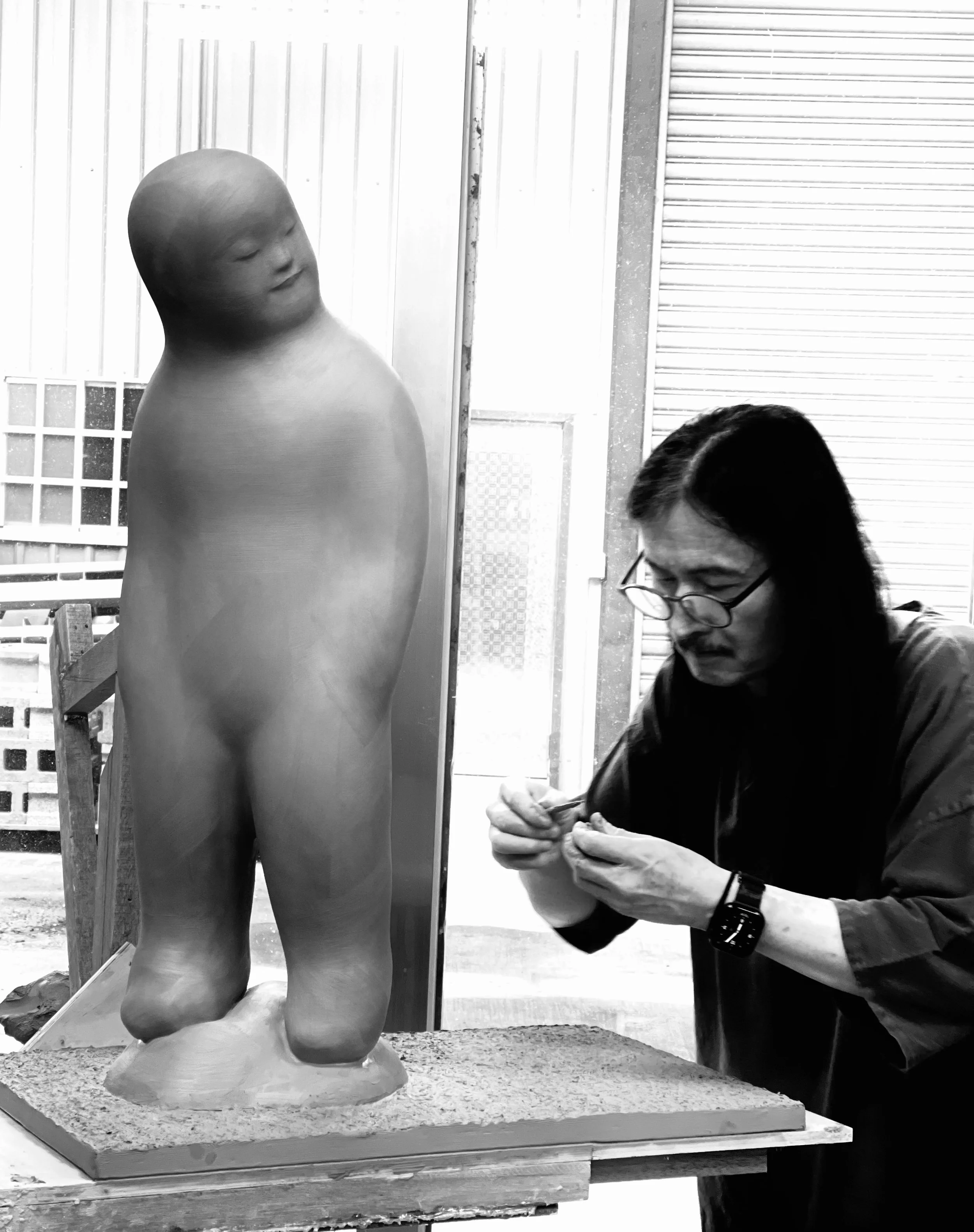
Li Chen in his studio with the work-in-progress clay model of 幾時有 When comes the moon?.
Over the last three decades of your artistic career, you have completed a few hundred sculptures, and as you have mentioned, you are still working on your 空疏·寂境篇 (Void Realms) series. What does the future hold for you and your practice?
I do not know how I will evolve in the future, but right now I am choosing to work at a slower pace. I am already in my sixties and wish to spend more time with my family. The difficulty of sculptural work is that it needs to handle both emotion and rationality simultaneously. This is because creation itself is an emotional thing, but its three-dimensionality and scale require rational management of its structure.
Currently there are some sketches I am working on but have not finished yet. I might also return to an earlier series which I have many ideas for but have not started on. I suppose everything is possible at this point.
The interview was conducted in Mandarin Chinese and translated by Mary Ann Lim.
This article is presented in partnership with Asia Art Center.
The monograph on Li Chen published by Éditions Cercle d'Art is available for purchase through the Asia Art Center website.