Rare Sea, a New Saigonese Art Space
Founded by Nguyen Tra My and Luke Schneider
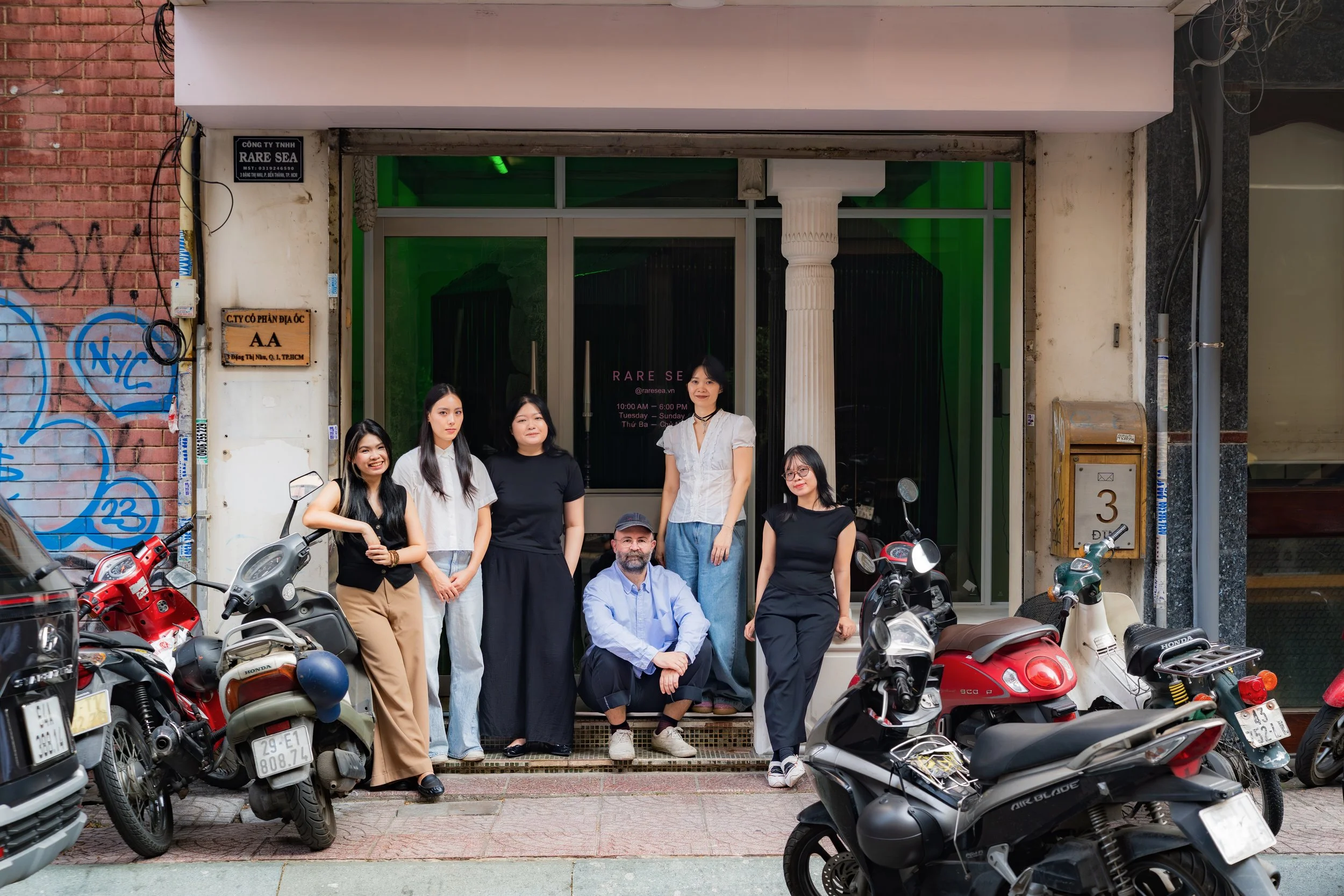
Rare Sea team. From left to right: Chu Tram, Sophia Mai Brown, Minh Thuy (interns & volunteer), Luke Schneider, Tra-My Nguyen (co-founders), and Lai Minh Ngoc (curator). Photo by Nguyễn Lê Tuấn Kiệt.
In a city that never sleeps like Saigon, now christened Ho Chi Minh City, art spaces seem to materialise overnight. With many nestled inside historic buildings, artists and art workers become the subterranean force that upkeeps the Southern city’s rhythm and urban memories, as they continue to produce knowledge and build communities. In Vietnam, where governmental support for contemporary art remains scarce and unpredictable, independent art spaces lend a safe haven to experimental practices, uncomfortable reckonings, and critical questions about life in a metropolis.
Among the latest additions to the ensemble of Saigonese art spaces is Rare Sea. Founded by Nguyen Tra My and Luke Schneider, long-standing members of the local art scene since 2015, this five-story art space is located on a side street with a view of the iconic Ben Thanh Market and the bustling central Metro station. Dang Thi Nhu, the street that houses Rare Sea, is itself a historical memento. Before Reunification in 1975, it used to be a crowded book market, where voracious readers could frequent and search for anything from rare prints to cooking manuals! As censorship on printed materials intensified in the 1980s, the market slowly disbanded, yet the name Dang Thi Nhu continues to echo a legacy of knowledge and cultural exchange. Situated at the meeting point between the old and the new, the rambunctious and the quiet, Rare Sea is a prime location to offer visitors a glimpse into the city’s contemporary art landscape.

Entrance of Rare Sea on Dang Thi Nhu Street. Photo by Sophia Mai Brown.
As I sat down with My and Luke in their light-filled office on Rare Sea’s fifth floor, we were joined by curator Lai Minh Ngoc, the third and youngest member of the team. While Ngoc is a fresh graduate from Fulbright University, who has been assisting with a variety of curatorial projects for the last three years, My and Luke have been involved with many projects in the local art scene as art manager and art technician respectively, most notably for the A. Farm International Art Residency, established in 2018 by Mot +++. The team’s collective knowledge and unique skillsets thus translated into Rare Sea’s hybrid model, combining exhibition, residency, and professional development.
Community building is at the heart of Rare Sea’s mission. During their time working as managers of A. Farm, My and Luke have had the opportunity to meet and work with artists from around the world, particularly from Southeast Asian countries, who share many similarities with Vietnam in terms of potential and challenge. “While we welcome artists regardless of nationalities, we have always felt an affinity between Vietnam and other Southeast Asian countries. Thus, we aim to foster a regional focus, while still expanding our connections to other art spaces and institutions across the globe,” they elaborated. .
This emphasis on Southeast Asian exchange was highlighted in the space’s inaugural exhibition titled the forest lives on as unfinished film reels. Curated by Ngoc, the show examined the lingering presence of spirituality and materiality within an urban environment. On the ground floor, Indonesian artist Aliansyah Caniago built a spiritual refuge from film strips, inspired by a wooden structure built by the Karo Batak people from North Sumatra for the goddess Tor Tor who dwells in the camphor tree. Carrying Caniago’s call of engaging with intangible presence, the Vietnamese artists responded with works across a range of media. Hoàng Vũ activated recorded sound as a means to feel Saigon’s undercurrents. Rab gestured toward a childhood folktale about teeth in her silk paintings and installations as a subtle critique of consumerism. The show ended with Xuân-Hạ's video that explored the concealed domestic labour of women that greased the clogs of a city’s capitalist machine. These works thus presented a transnational spectrum of conceptual practices that stretched from mainland to archipelagic Southeast Asia.

Aliansyah Caniago, In Search of Nan Tar Tar Nan Tor Tor III, mixed-media installation. Installation view in the forest lives on as unfinished film reels (2026), at Rare Sea. Photo by Sophia Mai Brown.

Xuân-Hạ, Fragmentation of memory I, II, III, video installation. Installation view in the forest lives on as unfinished film reels (2019), at Rare Sea. Photo by Sophia Mai Brown.
In addition to exhibition, Rare Sea is also committed to an artist residency programme. At the moment, the building’s second and third floors are dedicated to hosting artist studios. Having a studio is crucial for artistic practice, and it remains challenging to find spaces in Saigon. Thus, Rare Sea supports young Vietnamese artists who need studio space to realise their projects, while still welcoming self-funded residents who want to spend time exploring and researching Saigon. This two-prong approach allows them to foster young local creatives while still maintaining their financial sustainability. "We want our resident artists to feel that they can be fully themselves, to explore their creative potential to the fullest as they respond to the space’s immediate locality and history in their projects," My added. She also stressed Rare Sea’s flexibility in programming, adapting to artists’ needs as they plan public events that stem from the residencies.

Open Studio of Workshop Series: Dummy Photobook 101 on March 22nd, 2026 at Rare Sea. Photo by Sophia Mai Brown.
Last but not least, Rare Sea also wishes to develop art handling skills for local artworkers. As an art technician who has worked extensively in Hong Kong and later Vietnam, Luke identified art handling as a great gap within the country’s contemporary art ecosystem. “I want to activate Rare Sea as a platform to invite seasoned art handlers in our personal network to organise workshops and sharings for local art workers. I believe this forum of knowledge exchange will be fruitful to both sides in the long run,” he enthused. Luke shared that he was fortunate to be a part of a very diverse art handling team from around the world while working with the art logistics company Helutrans in Hong Kong and East Asia. These team members brought valuable knowledge from their distinctive backgrounds, combining industry standards and engineering expertise. Later, when Luke moved to Vietnam in 2015, he quickly noticed the lack of skilled art handlers. Besides some community members, whom people called upon for art installation services, there was no professional presence or interest. As a result, while working with Mot +++ and A. Farm, Luke decided to take on the role of mentoring art handlers, some of whom have now established their own studios.

Quywn, Till the clouds roll by…, performance (2026). Photo by Nguyễn Lê Tuấn Kiệt.
As our conversation went on, a promising picture of this new art space became clearer in my mind. The next day, I returned to Rare Sea for a performance by Quwyn, the first Vietnamese resident artist who just finished her two-month studio residency. Surrounded by a sea of new faces, fresh, curious, and eager, I could not help but feel a warmth returning to my chest. The unease that has sat quietly there since COVID-19, a devastating time for Saigon’s art scene that extended beyond quarantines, temporarily subsided. Spaces like Rare Sea remain crucial, not only because they extend the longevity of Saigon’s art scene, but also because they carve out a collective space for dialogue and experimentation for artists and artworkers alike. New stars are always born, yet they shine brightest when clustered in a constellation.