
Hanoi Children’s Palace: A Love Letter to Hanoi
Curating as a Make-Believe Practice
This article is a part of CHECK-IN 2025, our annual publication. For more information about the physical edition and how to order a copy, click here.
My Own Words is a monthly series which features personal essays by practitioners in the Southeast Asian art community. They deliberate on their locality's present circumstances, articulating observations and challenges in their respective roles.

The curatorial team of Hanoi Children’s Palace: Nostalgia for the Future, Vân Đỗ, Lê Thuận Uyên, Phạm Minh Hiếu, with their heroes, Bùi Thị Thanh Hương and Bùi Thanh Thuỷ, heads of the organising committee of the Hanoi Creative Design Festival 2024.
Working in the arts in Vietnam often feels like bumping one’s head against four walls, with challenges coming from all directions. The same old complaints persist. We lack resources such as public funding, legal frameworks, protections against censorship, as well as trained professionals, including artists, curators, writers and art handlers. At the same time, access to historic sites is tightly controlled. There are no national biennales or large-scale commissions. Further, the art historical and educational foundations remain fragile. And the list goes on. Yet, despite these daily limitations, I wonder: instead of lamenting constraints, can I view them differently? Not as a romanticisation, but as an artistic response. Rather than dwelling on what we lack, can we embrace what we have?
Hanoi Creative Design Festival: The encounter between the “Royal Court” and the “Forest Bandits”
Like many Southeast Asian countries, Vietnam is at a creative turning point, in which new national policies and international engagements are being developed to support a growing creative industry. In 2024, the Ministry of Culture, Sports and Tourism (MOCST) organised a review of the drafted National Strategy for the Development of Vietnam's Cultural Industries for 2030, with a vision toward 2045. The draft
strategy outlines objectives such as increasing the cultural industries' contribution to GDP, fostering creativity, and promoting Vietnamese culture internationally. The art community remains divided: some are wary of the economisation of art, reducing it into mere products and quantifiable figures, while others see potential in public-private partnerships that might allow local sustainability without over-reliance on foreign cultural institutions, which often come with their political agendas as has been the case for the past two decades.
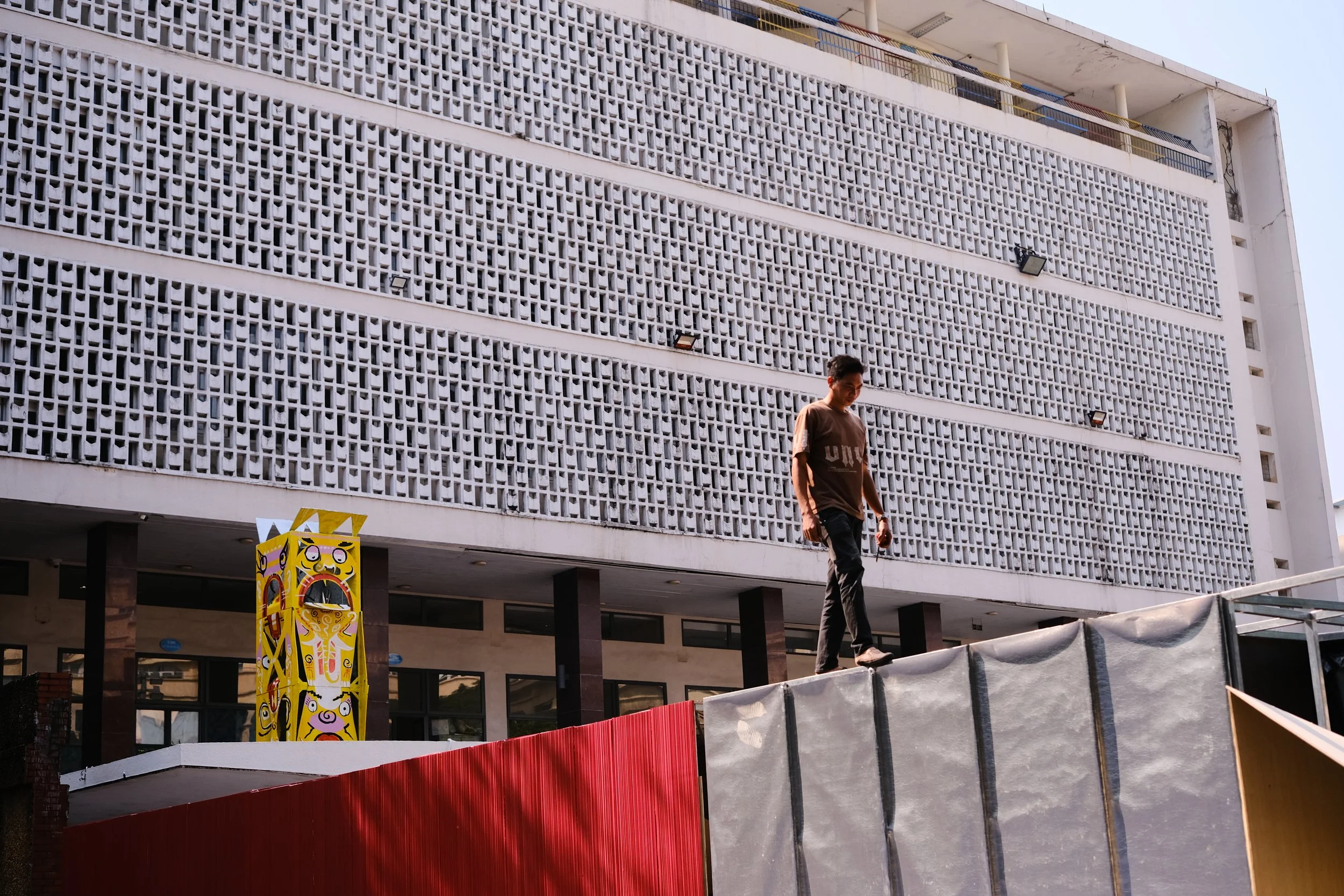
Part of Corridor of Innocence, an architectural design by Gian Giữa, and A Fairytale of Amadeus Vũ Dân Tân, a project initiated by curator Lê Thuận Uyên in collaboration with architect Phạm Kiên and artist Ngô Thành Bắc. Photo by Nguyễn Lê Minh Nhựt.
In 2021, as a member of the UNESCO Creative Cities Network, Hanoi launched its annual Creative Design Festival to fulfill the criteria associated with the title. This city-scale initiative was led by the Heritage Preservation Department under the Hanoi Department of Culture and Sports, in collaboration with the Architecture Magazine of the Vietnam Association of Architects. This combination of diverging interests.
between preservation and innovation resulted in an unintended “curatorial” framework: historic sites—often abandoned, inaccessible, or used for administrative purposes—were radically chosen and opened as festival venues, with an open-ended invitation for creatives across disciplines to propose interventions.
Of course, the government would not frame it in curatorial terms. I understood that establishing a curatorial framework connecting heritage sites with contemporary interventions would be difficult in a system that lacks the mechanisms to support such work. It also required navigating complex negotiations and trust-building among multiple stakeholders with potentially conflicting interests. Still, when I received the invitation to join the festival team, I saw a rare opportunity to curate within Hanoi’s rich historical, architectural, and collective memory landscapes.
But what I found most challenging was that as soon as I approached artists to participate, my proposal was met with hesitation and doubt, especially concerns about ethical integrity and artistic compromise. Within our underground and experimental art circles, we often joke that we are thảo khấu or forest bandits, while the government is triều đình or royal court.

Behind the scenes of A Lưu, an experimental theatre by Tr. A I at the Hoàng Lan Stage in Hanoi Children’s Palace. Image courtesy of Studio Phạm Minh Hiếu.
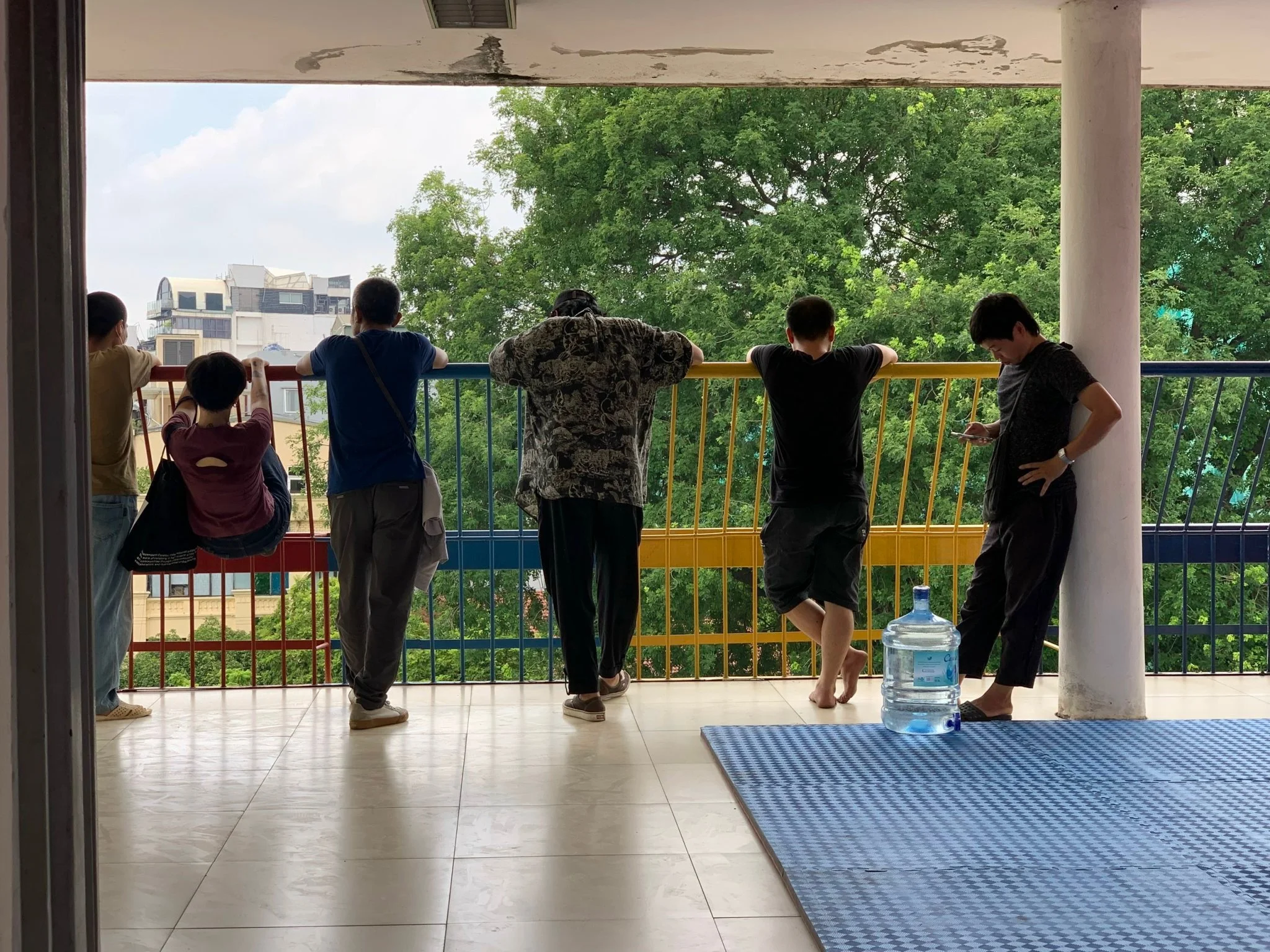
One of our many site visits with artists from the community on the rooftop of Hanoi Children’s Palace. From left to right: Nguyễn Huy An, Vân Đỗ, Mai Thanh Nam, Ngô Thành Bắc, Vũ Đức Toàn. Photo by Đỗ Văn Hoàng.
The metaphor was introduced to us by artist-curator Vũ Đức Toàn, a passionate reader of wuxia, a Chinese genre of action tales with predominant themes of martial arts and heroism. The forest bandits and royal court are two worlds that rarely meet. The scepticism runs deep, rooted in past censorship and institutional trauma. Shifting perspectives is one thing; convincing others to move beyond their embodied fears and fractured trust is another. Maybe it is wishful thinking, but I refused to fall on assumptions.
Working patiently within bureaucracies has proven to me that systems are not monolithic. When I was first invited to curate for the 2023 festival edition, I was given only two months to prepare. For 2024, I asked for more research and development time and was granted six months. Still not ideal, but an improvement. After the festival concluded, I proposed a biennial format, in which a whole year could be dedicated to capacity building and research for the next edition, and the organising committee approved it. My approach continues to be shaped by the recognition of agency within bureaucratic systems.

Installation shot of Nguyễn Huy An’s Musical notes (2023) as part of The Vowels series (2014-2024) presented in the traditional room of Hanoi Children’s Palace. Photo by Cá Con.
Hanoi Children’s Palace: A Proposal for a Site-Responsive Curatorial Framework
The initial step of research and development for the festival, mapping out the multi-site structure, allowed me to see the city from an unfamiliar, critical distance. It involved traveling to the outskirts and peripheral districts, securing permissions for historic spaces, testing public transport routes, conceptually linking locations, and envisioning fitting artworks. As someone who was born and grew up in Hanoi, the experience gave me a shift of perspective from the intimacy I usually have with the city on a daily basis.
For Hanoi Children’s Palace: Nostalgia for the Future, one of the major site-specific exhibitions of Hanoi Creative Design Festival 2024, co-curators Lê Thuận Uyên, Phạm Minh Hiếu, Vũ Đức Toàn¹ and I let the site shape our approach. An after-school centre for children’s extracurricular and artistic education, Hanoi Children’s Palace’s layered histories became the curatorial framework itself, from its French colonial origins to its socialist nation-building functions, and its role in instilling collective ideology to its place in childhood memories of artistic awakenings. We invited artists and curators to visit, walking them through these narratives, inviting them to think along with us.

Installation shot of the music room, part of The Lounge project, curated by Châu Hoàng and Nguyễn Hoàng Thiên Ngân for Hanoi Children’s Palace: Nostalgia for the Future with artists Nguyễn Quốc Thành, Lê Xuân Tiến, Nguyễn Đình Phương, Nguyễn Đức Phương, Nguyễn Nhật Quang, Quỳnh Đông, and teacher Dương Thị Thanh Thuỷ (Hanoi Children’s Palace STEM Club). Image courtesy of The Lounge project.
At its core, the project revolved around the nexus of remembrance: in a rapidly developing city, what is worth remembering? Who decides what deserves to be remembered? What do we do with the memories we inherit but never choose? And if we could be free from the weight of our memories, how might we imagine our world?
Over six months, site visits, archival research, and careful proposal development allowed nearly 30 groups of artists, curators, architects, filmmakers, and musicians to shape their ideas in response to the Hanoi Children’s Palace. It resulted in a week-long programme of exhibitions, film screenings, performances, architectural and playground designs and public programmes. Site interventions were designed with the building’s ongoing use in mind, balancing conceptual rigour with accessibility for its primary occupants, children and their families. Despite the inevitable challenges of curating within the bureaucratic complexities of governmental bodies under a tight timeframe, one of the most memorable moments for me was hearing that two members of the “royal court”, whom I had worked closely with, had confidently given a tour of Nguyễn Huy An’s highly conceptual works to visitors, even in the absence of our curatorial team.

Installation shot of We Never Fell (2010) by Nguyễn Trần Nam inside the Red Scarf Theatre at Hanoi Children’s Palace. Photo by Chimnon Studio.
Curating as a Make-Believe Practice
As a child, locked inside my grandmother’s house with few toys, I often created make-believe scenarios with my cousin. I wrote scripts, assigned roles, and transformed her furniture into props and set designs, treating her house as if it were a castle, a forest, a river. We even built huts from pillows and blankets where dramatic fairy tales unfolded.
In a similar way, we appropriated the UNESCO-informed festival for creative design as if it were an artistically rigorous, site-responsive mega-exhibition. My curatorial practice in Vietnam mirrors a make-believe approach that requires inventiveness to conjure possibilities from nothing, courage to stage imagined scenarios as if they were real, and a sense of play to subvert rigid hierarchies and expectations. Curating the Hanoi Children’s Palace also made me realise that in order to make believe, I first need to somehow believe—with eyes less clouded by prejudice and a willingness to imagine beyond limitations.
This article is a part of CHECK-IN 2025, our annual publication. For more information about the physical edition and how to order a copy, click here.
Notes:
Vũ Đức Toàn was part of the founding curatorial team for Hanoi Children’s Palace: Nostalgia for the Future.