
Review of Singapore Biennale 2025: pure intention
Detours to Lucky Plaza and 20 Anderson Road
Three years after NATASHA, the enigmatic figure behind Singapore Biennale 2022, four curators helm a refreshed 2025 instalment under the curatorial banner of pure intention. Duncan Bass, Hsu Fang-Tze, Ong Puay Khim and Selene Yap from Singapore Art Museum (SAM) lead a roster of over 100 artists, with contributions from four independent organisations: Asian Film Archive (Singapore), Hothouse (Singapore), Hyphen (Indonesia), and The Packet (Sri Lanka). A key feature of the 2025 edition is its ambitious spread of venues, ranging from malls such as Lucky Plaza and Far East Shopping Centre, to the former Raffles Girls’ School at 20 Anderson Road.
The title-as-theme is a sketched backdrop of an active city, often eager to change, but also insists on being seen as a monument to progress. pure intention potentially invites subtle divergences through this trophy city with art as company. Here, this instalment may also be a call for grace as one navigates a curated experience of varying habituses beyond the sheen. Less about the spectacular, a central question could perhaps be: What is seen from the inside out, for instance, from a migrant haunt to a former school?
American philosopher John Dewey, in his book Art as Experience, discusses the boundaries between art and life. He argues that art can be fully experienced only with awareness of life beyond it, or, in other words, as a “recourse to the ordinary forces.”¹ Dewey would continue, that “to understand the meaning of artistic products,” one has to “arrive at the theory of art by means of a detour.”² Perhaps the “detour” in question is an exercise in sense-making rather than a need to make sense. Less of stuffy prerequisites on how to engage, what one requires is curiosity and sensitivity. After all, art offers a critical opportunity to depart from a pragmatic framework, particularly in Singapore, where a suspension of heavy-handed instructions could give in to potentially affective experiences.

Installation view of Eisa Jocson's The Filipino Superwoman X H.O.M.E Karaoke Living Room (2025). Commissioned by Singapore Art Museum for Singapore Biennale 2025: pure intention, and presented at Lucky Plaza. Image courtesy of Singapore Art Museum.
I first began at Lucky Plaza on a Sunday, when the frenzied mall was filled with the weekend movements. Sundays are usually the designated rest days for female domestic workers, and the mall is at its dynamic peak. In Eisa Jocson's The Filipino Superwoman X H.O.M.E. Karaoke Living Room (2025), a mall store space has been transformed into a karaoke lounge featuring music videos produced by members of the Humanitarian Organisation for Migration Economics (H.O.M.E.), a Singapore-based charity that supports migrant workers. A collaboration among the artist, cultural worker Franchesca Casauay, and H.O.M.E., the videos represent personal anthems that reveal creative ways H.O.M.E. members derive strength through performance and celebration. This collaboration brings to mind efforts such as the Migrant Workers Community Museum at The Substation in 2021, where co-facilitators enable workers to “curate” collaboratively.
However, in this permutation, the installation is seemingly kept distinct from the community's lived experiences outside. The opaque division due to the blocked glass doors hindered the community’s access to, or even awareness of, Jocson’s installation. A potent intermingle of art, the public, and the women Jocson honours,beyond the screens, could have further powered this commission. This is unfortunately missed.

Installation view of Gabriela Golder’s State of Assembly (2025). Commissioned by Singapore Art Museum as part of Singapore Biennale 2025: pure intention, and presented at Lucky Plaza. Image courtesy of Singapore Art Museum.
Meanwhile, Gabriela Golder’s State of Assembly (2025) is more porous. The encounter unfolds as an unexpected surprise as one turns a corner in the almost maze-like mall to catch sight of the three screens behind transparent PVC strips. The softer division between “art space” and the nearby mobile phone stores captures an apt ecology of what this biennale may be hinting towards. Golder’s three-channel video is a propositional gathering of women and their collective striving, primarily through the invocation of texts by contemporary thinkers such as Judith Butler and Sara Ahmed. As a symbolic illustration of public assembly and a desire for change, the work feels too close, if not ironic, to home than one may recognise.

Installation view of Riar Rizaldi’s Mirage: Agape (2025). Commissioned by Singapore Art Museum as part of Singapore Biennale 2025: pure intention, and presented at 20 Anderson Road. Image courtesy of Singapore Art Museum.
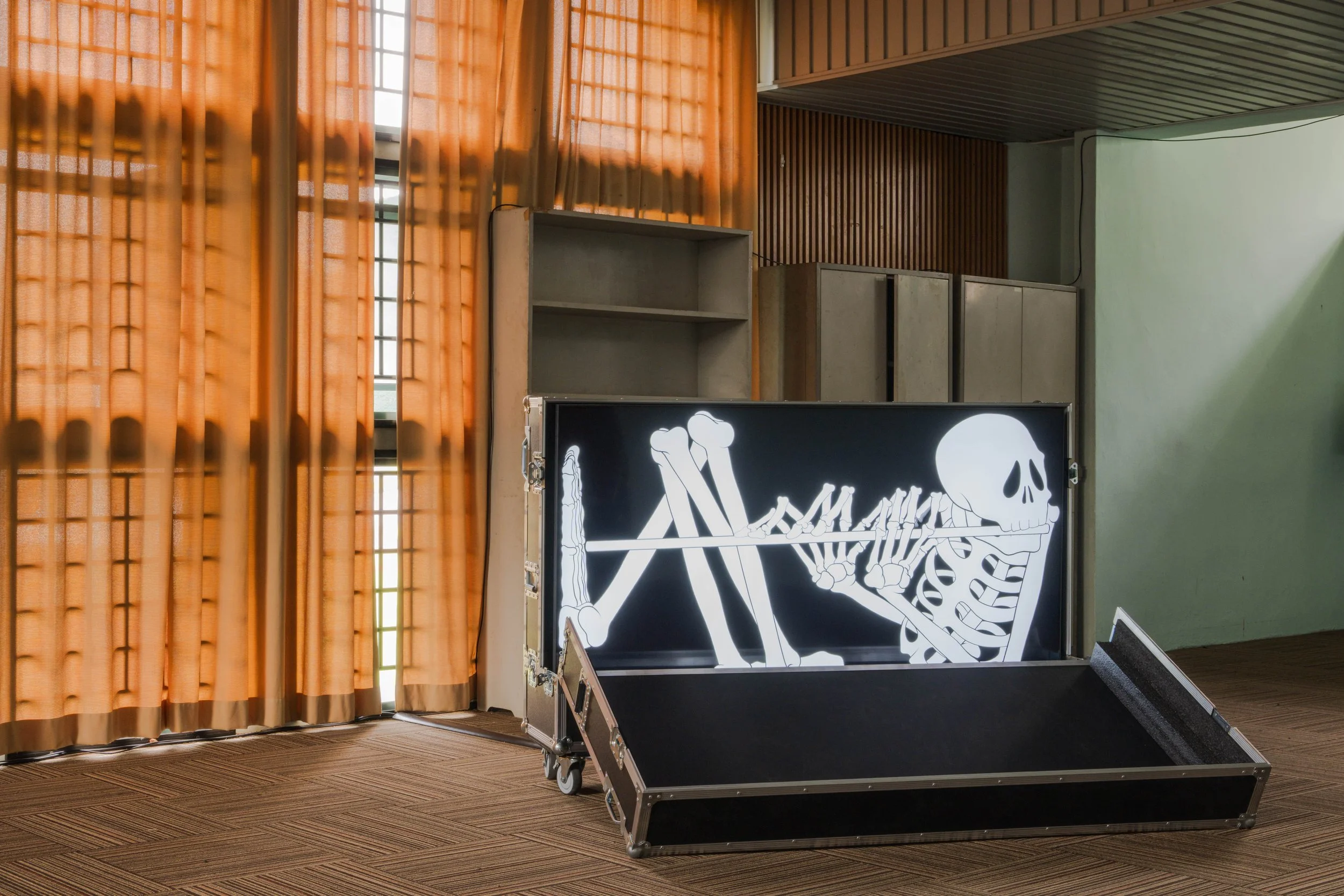
Installation view of Özgür Kar's Death with Flute (2021), presented at 20 Anderson Road as part of Singapore Biennale 2025: pure intention. Image courtesy of Singapore Art Museum.
Nearby, at the Anderson site, the repurposing of a hallowed compound of the former Raffles Girls' School captures an attitudinal sleight of hand, like a curatorial hide-and-seek. For one, the deflated air of school memories is jolted by the calculated selections of artwork. The curatorial approach is no-nonsense and daring; both the site and the curatorial intervention teem with mutual energy. This venue proposition also recalls the heydays of the Singapore Biennale, particularly in 2011, when the Old Kallang Airport was reused.
“This venue proposition also recalls the heydays of the Singapore Biennale, particularly in 2011, when the Old Kallang Airport was reused.”
One highlight is Riar Rizaldi’s Mirage: Agape (2025), a video work alongside a bloodied animatronic head that works as a curious accompaniment. This cartoon-like protagonist is most likely the controversial figure Jan Pieterszoon Coen, who was a colonial governor of the former Dutch East Indies capital, Batavia. Here, Rizaldi’s work is a mash-up of themes that transcends the simple logic of linear narratives, abstracting Sufi mysticism into the far-flung fields of quantum biology. Set in an audio-visual aids (AVA) room with its own disturbing lore that involves an alleged death, the film and its accompanying prop harness the space's affective context to their fullest potential. We also see this played out in more apparent ways through Özgür Kar’s Death with Clarinet, Death with Flute, and Death with the Little Bell, in the Band Room, where videos installed in flight cases sit alongside a dishevelled arrangement of musical paraphernalia.
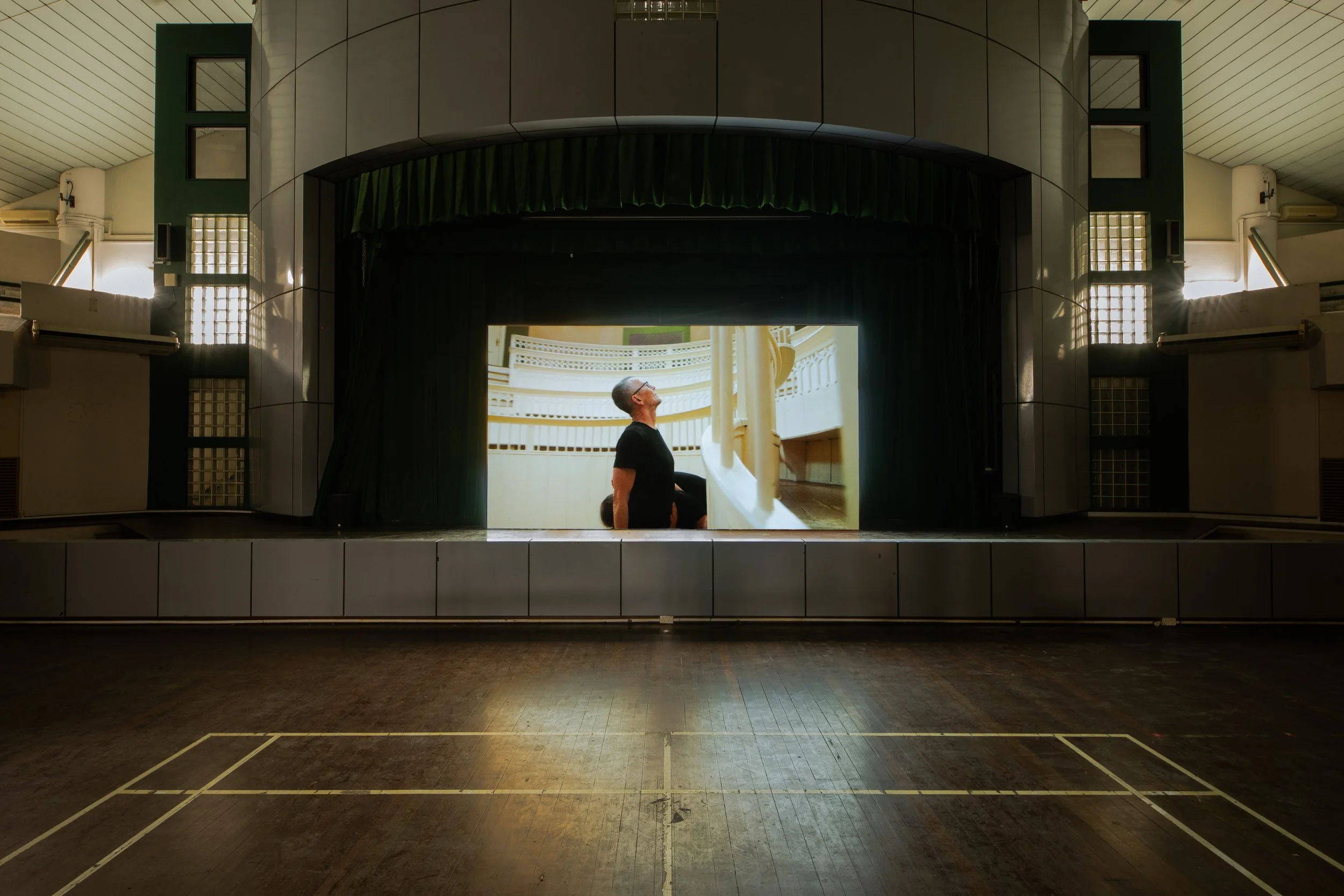
Installation view of Young-jun Tak's Love Was Taught Last Friday (2025), commissioned by Singapore Art Museum for Singapore Biennale 2025: pure intention. Image courtesy of Singapore Art Museum.

Installation view of Young-jun Tak's Love Was Taught Last Friday (2025), and Kei Imazu's Pelvis and Rhizome (2023), Harvesting from the Buried Goddess Body (2023) and Memories of the Land/Body (2020), presented at 20 Anderson Road as part of Singapore Biennale 2025: pure intention. Image courtesy of Singapore Art Museum.
Another unmissable commission is Young-jun Tak's Love Was Taught Last Friday (2025), a single-channel video that focuses on the body as choreographic extensions, gracefully pairing two seemingly disparate professions. We witness this through the hands of woodcarvers and the collaborative movements between the choreographer Christopher House and his former students. For one, House mentions a “choreographic thinking” in the video, where touch beckons generative responses that are equally languid and intimate. I was most excited by the realisation that the articulation of choreographies and its allusions is present beyond the screen. This is felt through the proximity of Kei Imazu’s painting Pelvis and Rhizome (2023) to Tak’s video. Imazu’s gigantic oil paintings are vivid and luscious as bodies in their own sprawling ecology. They visually narrate the story of the goddess Hainuwele, from Indonesian folklore, as a source of emerging offspring. Themes of creation in Imazu’s work are in dialogue with the production of religious idols in Tak’s video and the creation of bodily scores through House and his collaborators.

Installation view of Elizabeth Gabrielle Lee’s TOTAL-PLEASURE-SUITE (2025) as part of Hothouse's contribution PRIMAL INSTINCT’(2025). Commissioned by Singapore Art Museum for Singapore Biennale 2025: pure intention, and presented at 20 Anderson Road. Image courtesy of Singapore Art Museum.
True to the spirit of experimentation, propositions are tested in the School Field as ideas, but also formally across the three installations in proximity. Curatorial contributor Hothouse, an interdisciplinary outfit and design agency, presents an assembly titled PRIMAL INSTINCT. In one installation, TOTAL-PLEASURE-SUITE (2025) by Elizabeth Gabrielle Lee, the artist composes displaced school tables synonymous with order into makeshift barricades as defiance. From a distance, they also look like sculptural scores, albeit too short when set against the expansive field. These notations extend the genre of “tropical gothic,” which the artist seemingly deploys as an illustration of simultaneous threat and order, or to some extent, a conjuring of gloom.³ Here, the School Field appears to be a palimpsest for play or a test bed of ideas; experimental in the purest sense, but somehow premature.
In completing the partial routes of pure intention, the Lucky Plaza and Anderson sites work as great starting points to the biennale and the experiential shift of the city. It has pivoted on novel moments among the bustle of the everyday, where respite is within and around buildings. While the symbolic skyline is often insistently in the periphery, enough to be a reminder of a storied past, the curators turn away from this backdrop as a reflexive move. Likewise, the future is critically inward, and not always measured through the constructed image that looms and pervades. As a counterpoint, mainly through the affective deployment of the selected venues, pure intention has orchestrated a chorus of artworks that fulfil a Biennale rubric while simultaneously enabling a curious meditation on time and place.
Notes:
John Dewey, Art as Experience (1934; reprint, New York: Perigee Books, 1980), 4.
Ibid.
Anita Lundberg, Katarzyna Ancuta, and Agnieszka Stasiewicz-Bieńkowska, "Tropical Gothic: Arts, Humanities and Social Sciences," eTropic: Electronic Journal of Studies in the Tropics 18 (2019): 2.
