‘From One Sky to Another’ at Haridas Contemporary
Melissa Tan’s return to painting

Melissa Tan, Evening Light, 2025, acrylic on canvas, 85 x 115cm. Image courtesy of Haridas Contemporary.
Stitched into the fabric of From One Sky to Another is the conceptual weave and migration of practice within Melissa Tan’s latest solo exhibition at Haridas Contemporary. Taking cues from the Latin etymology of the word “map”, which refers to a cloth or napkin, her new series of canvas works renders celestial cartography onto a painterly horizon. Though Tan is known for her metal and resin sculptures, painting has brought her back to the foundations of her artistic practice, having been trained in painting while studying for her Bachelors of Arts in Fine Arts at Lasalle College of the Arts. It has also allowed her to evolve and refine her reinterpretations of mythologies. She describes the movement as a liberating one, saying, “I found that the parameters of painting are more open compared to focusing on the metallic forms, and this is especially true for colours and elements that unfold within the paintings.” The necessary inclusion of illustrated detail gently extends her longstanding practice in allegorical nuance. What is yielded is a mature and inventive retelling of mythology that triangulates new ways of reading and resonating with the stories.
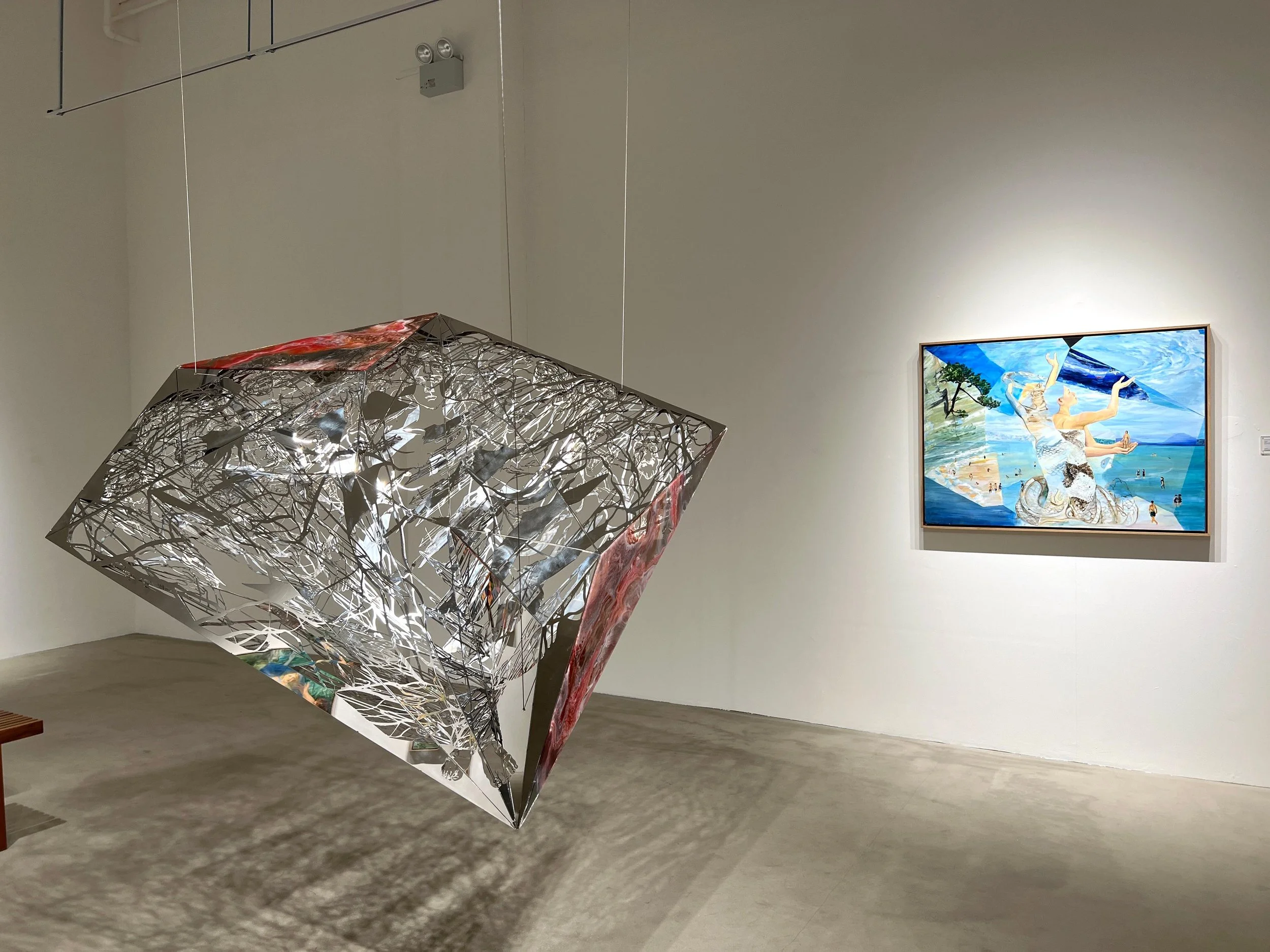
Melissa Tan, From One Sky to Another, 2026, exhibition view at Haridas Contemporary, Singapore. Image courtesy of Haridas Contemporary.
The artist’s preoccupations with mapping began more than a decade ago through her paper and metal works examining psychogeographies. Within this oeuvre, she traced the scars of geologic and planetary spines as a means of tracking changes in time. Take for instance If you can dream a better world you can make a better world or perhaps travel between them (2016), presented at the Singapore Biennale 2016. Tan captured the subtle vestiges of time etched into the surfaces of walkways and roads in Singapore by transferring these data points onto perforated paper and laser-cut metal. Her love for stories eventually cleaved to her sculptural practice. From 2019, she began a fresh trajectory of constructing constellations named after female goddesses into three-dimensional forms with her series of metal and resin works in Under the Arched Sky presented at Richard Koh Fine Art. In these works, she plotted what she calls “portals”, or gaps, in these networks. Within these gateways, she houses the mythological women who give stars and asteroids their names, making the goddesses the central figures in their stories. To this end, her latest work from two years ago in Parts, Shared & Allotted Portions (2024) marked an advancement in her techniques. Through highly layered sculptural forms, viewers could engage with the works from all sides, viewing the sophisticated narratives from a multitude of perspectives.
In an essay titled Ulysses, Order and Myth, the famed poet T. S. Eliot described literary depictions of Greek mythologies as “simply a way of controlling, of ordering, of giving a shape and a significance to the immense panorama of futility and anarchy which is contemporary history.” His assertion speaks to the time-worn return to Greek mythology as a wellspring of inspiration for both writers and artists alike. Yet, Tan’s practice that examines womanhood through ancient Greek divinities locates itself within a more contemporary, even feminist, milieu. Her artistic research makes reference to current female novelists such as Madeleine Miller, who treat the classics less like a means to exercise mastery over the course of human affairs as Eliot describes, but as a flexible body of work that can be reshaped and adapted.
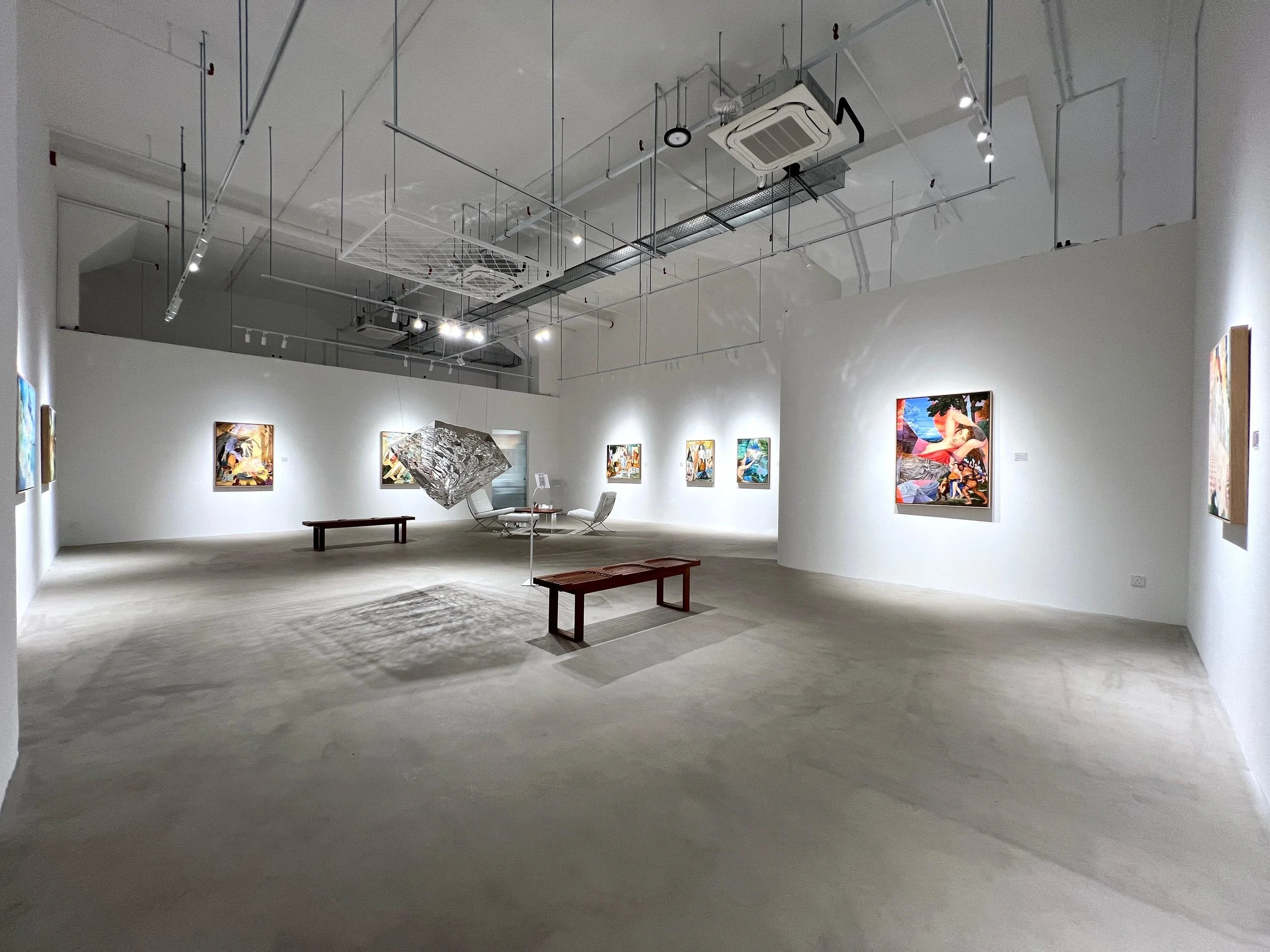
Melissa Tan, From One Sky to Another, 2026, exhibition view at Haridas Contemporary, Singapore. Image courtesy of Haridas Contemporary.
The 11 new paintings in From One Sky to Another strongly mirror the same elaborate process from her earlier works, while advancing the richness in her storytelling. Phryne (2025), a stainless steel and resin work forms the central core from which the paintings orbit and reflect their explorations. The juxtaposition extends Tan’s continuous efforts at redefining the limits of her practice by deftly “carving” facets onto two-dimensional canvas, evincing the sculptural stratification of her metal works. The vectors are aligned to constellations that fragment the figures and their landscapes, and each fragment acts as a rift, holding different time periods and stories. Coming together, the painting paradoxically unites and bifurcates the shifting portrayals of each goddess within a moment.

Melissa Tan, Do Sleeping Gods Dream?, 2025, 115 x 85cm. Image courtesy of Haridas Contemporary.
Tan’s clever splicing allows the work to reject exactitude and embrace the destabilisation of the myth and its readings. For instance, in Do Sleeping Gods Dream? (2025), the artist begins by overlaying a map of the asteroid 32 Ariadne in January 2025 amongst the constellation Taurus. From there, the geometries created by the star coordinates provide the fault lines that splinter the work, and in this piece, divide the story of Ariadne into its spiraling variants over time. At the centre is the protagonist, her sleeping form a direct allusion to John William Waterhouse’s oil painting, Daphne (1898). She unfurls across extracts of Renaissance painter Titian’s Bacchus and Ariadne from the early 16th century, and her lower torso morphs into a statuesque form found in Sleeping Ariadne, a Hadrianic copy of an early 2nd century BC Hellenistic sculpture. The aim is not coherence, but an almost dream-like survey of how Ariadne’s story has morphed over time. Where Tan’s previous metal works froze the characters into stoic, impenetrable forms, the vivid colours and emotive depictions in her new paintings invite the audiences to view them as real women occupying reincarnated lives.

Melissa Tan, Leaves Into Shields, 2025, acrylic on canvas, 115 x 85cm. Image courtesy of Haridas Contemporary.
Another modulation that painting has opened the door to is the inclusion of symbolic detail. For Tan, the utilisation of symbols gesture towards subtle ways of imbuing agency in her characters. Leaves Into Shields (2025) depicts the story of wood nymph Daphne, who upon being pursued by the same god Apollo, turns into a laurel tree. Tan has tackled this subject before in her showcase Under the Arched Sky (2019), where she focused on transformations that are sometimes seen as undesirable. In her new painting, Tan calls attention to a water jar, knocked over, that stands between Daphne and Apollo, an invocation of Daphne’s divine ability as the daughter of the river-god Peneus. The result is an ambiguous mediation of the nymph’s agency. It sketches a complex thesis of womanhood, marked by both unenviable choices and artful liberties.

Melissa Tan, Patching, 2025, acrylic on canvas, 85 x 115cm. Image courtesy of Haridas Contemporary.
Asian deities have joined the pantheon of Grecian figures in the cosmic imaginary of her new works, and through them, Tan’s painterly hand shines. Patching (2025) is one such example, where Tan depicts Nüwa, Chinese folk goddess. Iconography of Nüwa is generally limited to stone murals and rubbings, or Chinese ink paintings. Through deft and gentle brushstrokes, the artist brings Nüwa and her modern subjects to life, the deity’s physicality bleeding into the vivid hues of blue that piece the sky and sea together. Tan’s handling of acrylic paint evokes the fluidity and lightness of watercolours, providing a refreshed understanding of the ancient goddess in our present day.
Dealt with great sensitivity and deep research, From One Sky to Another holds across the same fabled plane she has engaged with from previous years, opening up a new wealth of possibilities. It presents a point of departure for the artist, opening up a firmament of light, colour and flesh that beseeches her audiences to explore multi-faceted points of view with her.
This article is presented in partnership with Haridas Contemporary.
From One Sky to Another runs from 17 January to 15 February 2026 at Haridas Contemporary. More information here.