Excerpt: Erasing and Resurfacing
Documentation Project for Myanmar Contemporary Art Vol. 5
Over the years, we have republished parts of long-form writing, from catalogue essays to book chapters. This practice is now formalised as part of our Excerpt series. If you would like to work with us to republish a text, please email us at info@from-the-margins.org.
Here is an excerpt from Aung Myat Htay’s curatorial note for Morphology of the Claud: Artistic Responses of the Invisibility Myanmar (2023-2024). The publication is the fifth volume in a documentation series collaboratively produced by Aura Contemporary Art Foundation and the School of Contemporary Art (SoCA).

A temporary wall of a construction site in Yangon, after the erasing of graffiti art. Photo by Aung See Phyo.
Following the political shifts in Myanmar from 2022 to 2025, we witness changes in Myanmar’s urban landscape, including manifestations such as graffiti. Graffiti art embodies a sense of freedom, speed, impact and a new lexicon that is often absent from the commercial art galleries of the mainstream art world. Generally, street art or graffiti is grounded in anti-art movements. It represents a departure from the systematic art world and propaganda-lad established art institutions, offering instead a reflection of contemporary realities.
One of the first significant events following the 2021 military coup was the whitewashing and erasure of colourful murals, spray-paint signs on the walls of a flyover at a busy intersection in Yangon. How can painting become a symbol of resistance? In reality, decorative art lacking explicit imagery or text is not directly political. However, these works were likely targeted because they were perceived as reflections of the previous era, under the former government. Subsequently, these whitewashed surfaces appeared across Yangon. Paradoxically, they offered a new visual aesthetic, resembling portraits of clouds against the backdrop of the sky. This is a concept of this volume.
Over the past decade, art has played a significant role in social movements during periods of rapid changes. The landscape shifted sharply once again after 2021. Could this transformation coincidentally open a new space for art? These conditions have the potential to give rise to new artistic forms unlike anything seen before. Supported by Aura Asia Art Project, the SoCA Documentation Series Project continues archiving these new works. For this year's programme, seven artists were selected and the volume explores how their work adapts to the current environment and society.
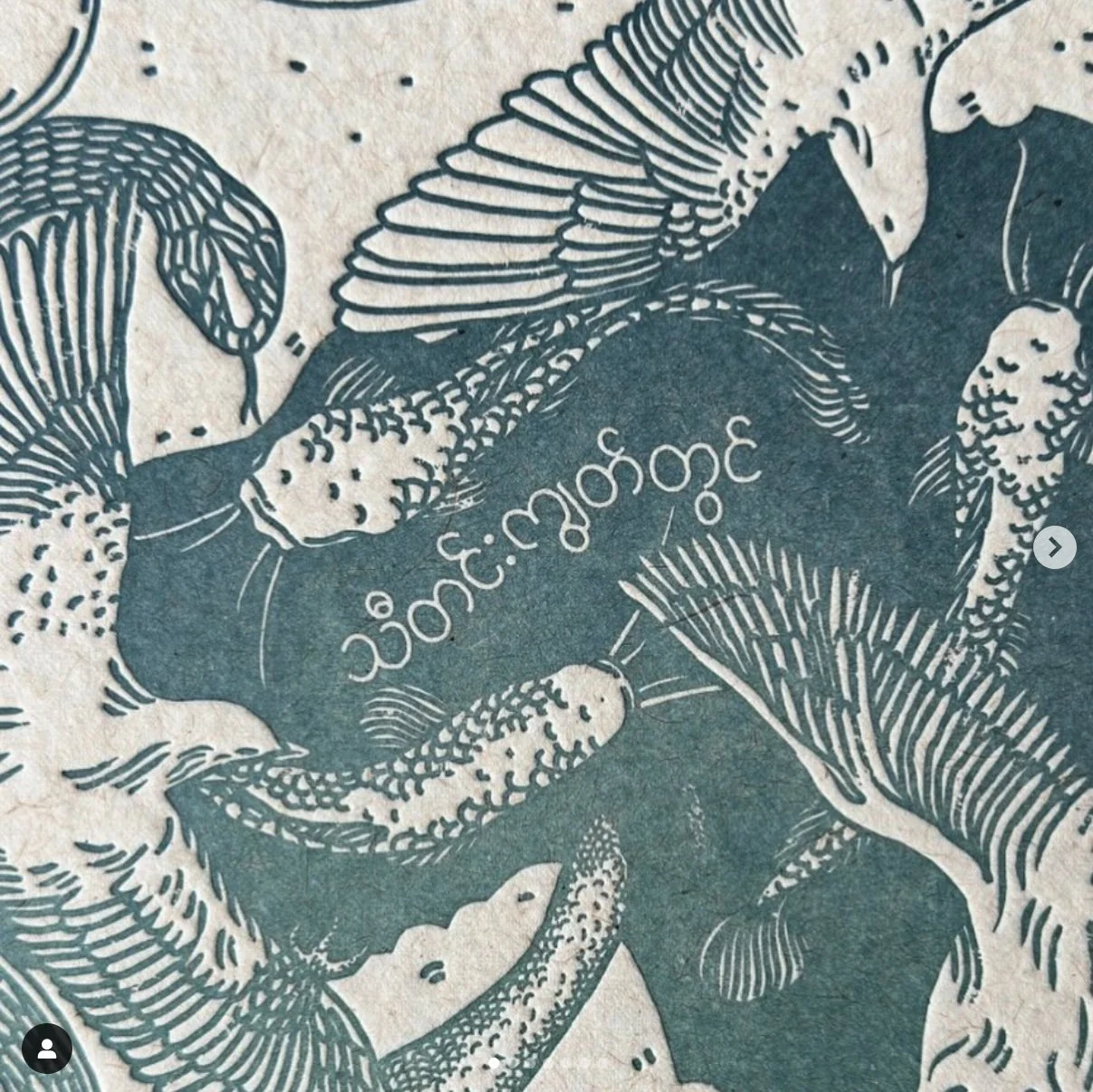
Thee Oo Thazin and Lauren Smith, Record of Rain (detail), 2024. Image courtesy of the artists.
Our Life, coexistence in nature
In ancient times, before calendars, people lived in harmony with nature, observing natural phenomena to understand and adapt to environmental changes. In Burmese culture, paying attention to the external environment is a crucial part of life.
Record of Rain is a set of artworks created as part of a cultural exchange project by Burmese illustration artist Thee Oo Thazin, in collaboration with Lauren Smith, a printmaking artist from the United Kingdom. The poetic and illustrative prints contain both the literal and symbolic meanings of rain, in our memories, and share our feelings on the climate.
Record of Rain is a beautiful collection of illustrations that lives up to its title. It presents a thought-provoking way of life by connecting it with literature and poetry. In the images, you can see and feel humans and animals surviving natural disasters together. The unique aspect of these works is that the handmade paper was created using rain water and printed with a traditional printing press, which provides a deeper sensory experience than regular prints.

Ri, What We Remember When We Remember, 2023, photo series. Image courtesy of the artist.
A Transformation of Memory
In the series What We Remember When We Remember by the artist “Ri”, the photos show blurry faces, fading human figures who seem to be merging into their surroundings and transforming. The artist asked people around her about their fears and their opinions on the past, present, and future. Then documented their blurry answers as images. These portraits are immersed in their surroundings, and their identities are indistinguishable.
The artist calls the work a psychological landscape, which breaks down the distinction between character and external scenery, and between inner self and external reality. This removes the boundaries between humans and nature. In this way, the scenes are no longer ordinary landscapes, but become the unseen things within a person's mind and the transformed forms of memory. This artwork is not just a record of fear, but an exploration of how humans continue to survive amidst uncertain questions.
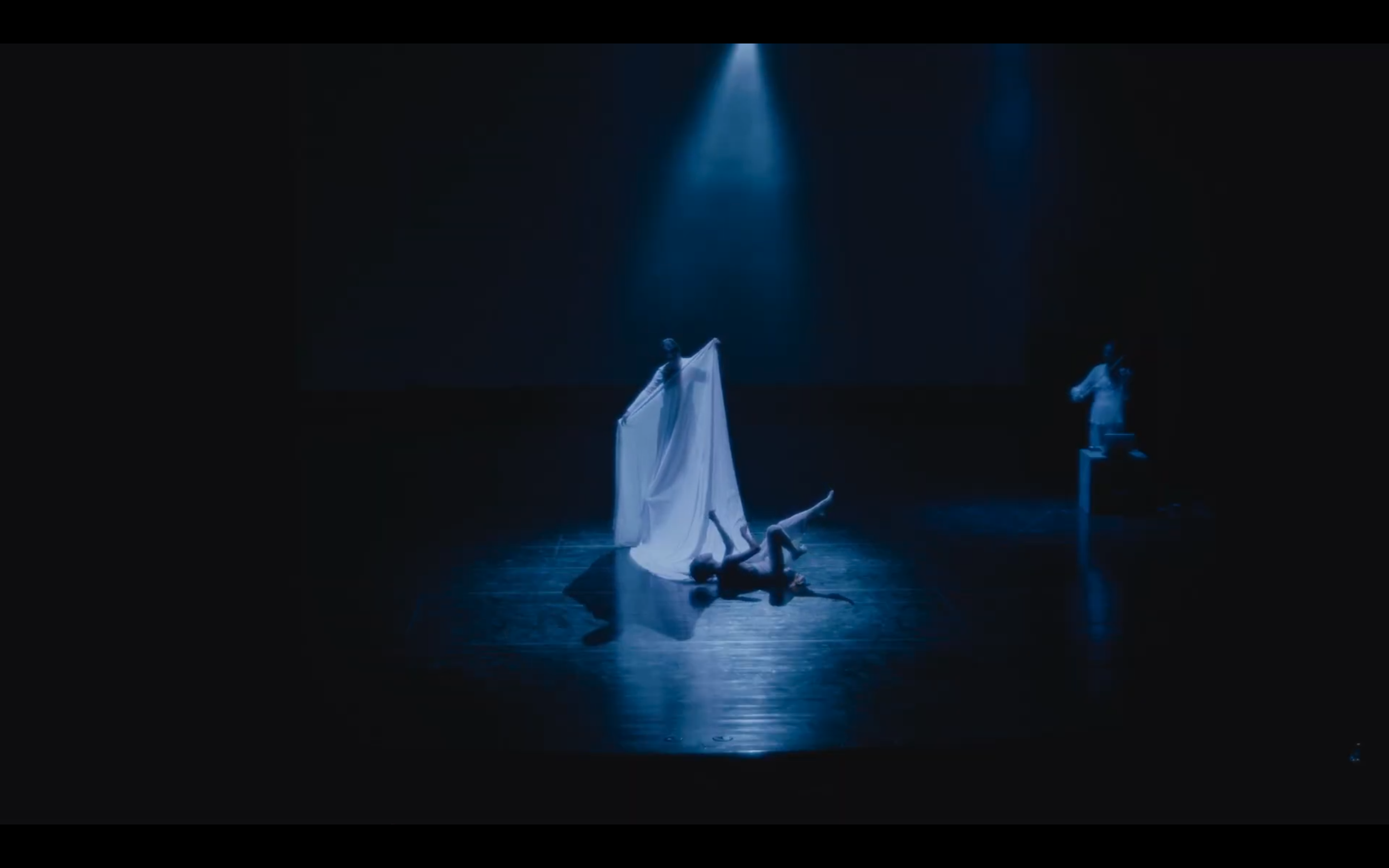
Performance image from Dear Son, a contemporary theatre performance by Kelvin Shine Ko, at Lanyim Theatre, Chiang Mai.
Body and the Soul
In the theatre performance Dear Son, the performer and director Kelvin Shine Ko, reflects on his own existence by comparing it to the growth of a son born to a mother whale. The theme is changing climate and how humans cannot live apart from nature. Nature, like a living being, operates with its own biological processes. The artist uses body language to express this point by comparing it to the natural elements of earth, water, fire and air that he has come to understand.
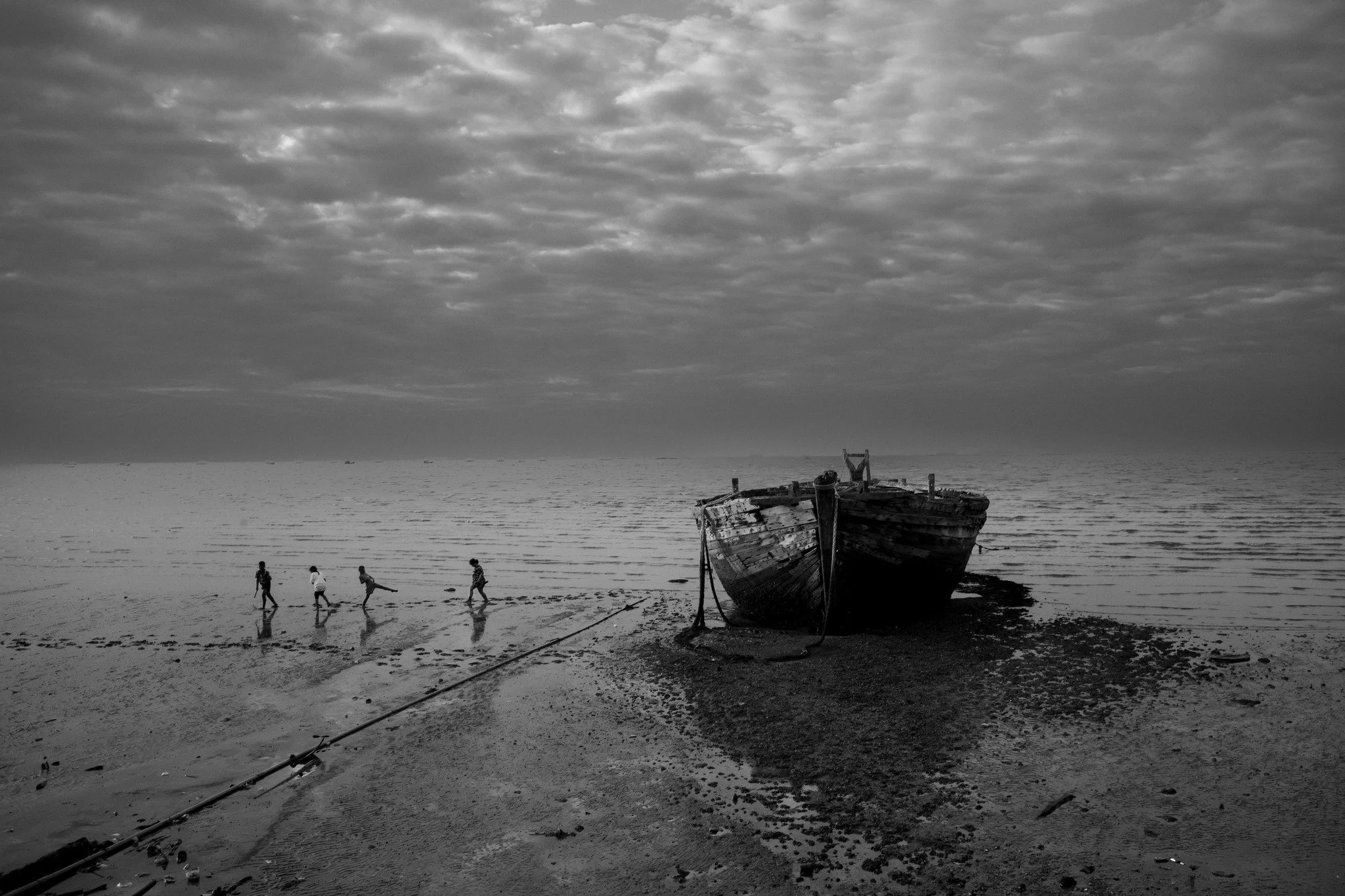
Street photography by Andy Chen. Image courtesy of the artist.
Human Theater or Scenes from the Street
Andy Chen @ Aung Win Htut is a street photographer and art collector. He grew up in Mandalay from the 1980s to 1990s, and is part of a community influenced by important modern artists in painting, sculpture, photography, and literature. His mentor was the photographer U Chit Wein, who belonged in the same generation as prominent modern Burmese painters such as U Khin Maung Bank, Paw Oo Thet, and U Win Pe.
In Andy’s candid photos, you can see these spontaneous movements of people, rather than focusing on race, skin colour, beliefs, or other sensory perceptions, show a broader and deeper view of human-centered gestures, urban life, time, and open spaces.

Installation view of works by Aung See Phyo in Timeline (2023) at Lokanat Gallery, Yangon, Myanmar. Image courtesy of the artist.
Birth and Re-birth
After earning his degree in design from the LASALLE College of Arts in Singapore, Aung Sie Phyo was inspired to create works with Readymade ideology. In 2023, Phyo and Toe Wai collaborated to create an art exhibition titled Timeline at the Lokanat Gallery, an important venue in the history of modern art in Myanmar. In this exhibition, Phyo’s Memento-mori series and a readymade installation were included. The exhibition emphasised the role of the viewer. The viewers' participation was the key to the installation, a pile of cotton, randomly moved day by day due to the artist stepping on it. The images on the wall are paintings of walking tables. The artist represented these tables as portraits of someone who passed away, so these are the portraits of death. The large piece of cloth in the middle changes shape daily and represents life, as the viewers walk around it. Therefore, it is a portrait of birth.
His main idea is that while human life is full of desires and movement, it eventually comes to an end. The artist compares the impermanent nature of living things with how inanimate objects can change and exist in harmony with nature. We accept that nothing in this world is permanent. In that situation, what remains is only the nature of change or impermanence. This artwork provides us to reexamine the meaning of life.
This article is edited by Ian Tee and features sections from Morphology of the Cloud. To read the original publication, click here.
To learn more about the curators of this documentation series, read our interviews with Aung Myat Htay and Yuto Yabumoto, Founder of Aura Contemporary Art Foundation.