
Conversation with Singaporean Artist Esmond Loh
‘Intermission’ at Haridas Contemporary

Esmond Loh. Image courtesy of the artist and Haridas Contemporary.
Esmond Loh (b. 1995, Singapore) is known for his paintings which depict dramatic and ambiguous scenes. Constructed from fragments of personal experience and imagination, his work explores themes of longing, nostalgia and struggle. Esmond graduated with a Bachelor of Fine Arts (First Class Honours) from the Slade School of Fine Art in London, United Kingdom (UK), in 2019. His works are part of private collections in Singapore, Malaysia and the UK.
I spoke with Esmond on the occasion of his sixth solo exhibition Intermission (2026) at Haridas Contemporary, Singapore. In this conversation, we discuss how performance and film influence his approach to narrative, the evolution of his painting practice and the theme of rest in this new body of work.

Esmond Loh, Intermission, 2026, exhibition installation view at Haridas Contemporary, Singapore. Image courtesy of the artist and Haridas Contemporary.
I would like to start our conversation by referring to your exhibition titles. Your latest solo exhibition Intermission refers to a term from performance. In our prior conversation you also brought up an earlier exhibition title Cliffhanger (2024) which is another narrative trope. How do you think about time within your paintings?
I think about time in two ways. I am interested in painting’s ability to capture and memorialise a moment. A painting can freeze a fleeting gesture, expression or event and allow it to be contemplated for much longer duration. Many of my earlier works operate in this way, presenting figures suspended in the middle of action.
More recently, my interest in theatre, film and storytelling has led me to think about time less as a single frozen instant and more as something elastic and non-linear. In the works featured in Intermission, I am interested in moments that feel as though they belong to a larger narrative without fully revealing what came before or what comes after. Sometimes, multiple events unfold within the same scene, creating a sense that different moments in time are coexisting. Rather than presenting a complete story, I want the paintings to feel like fragments from an ongoing performance, inviting viewers to imagine the wider narrative beyond the frame.
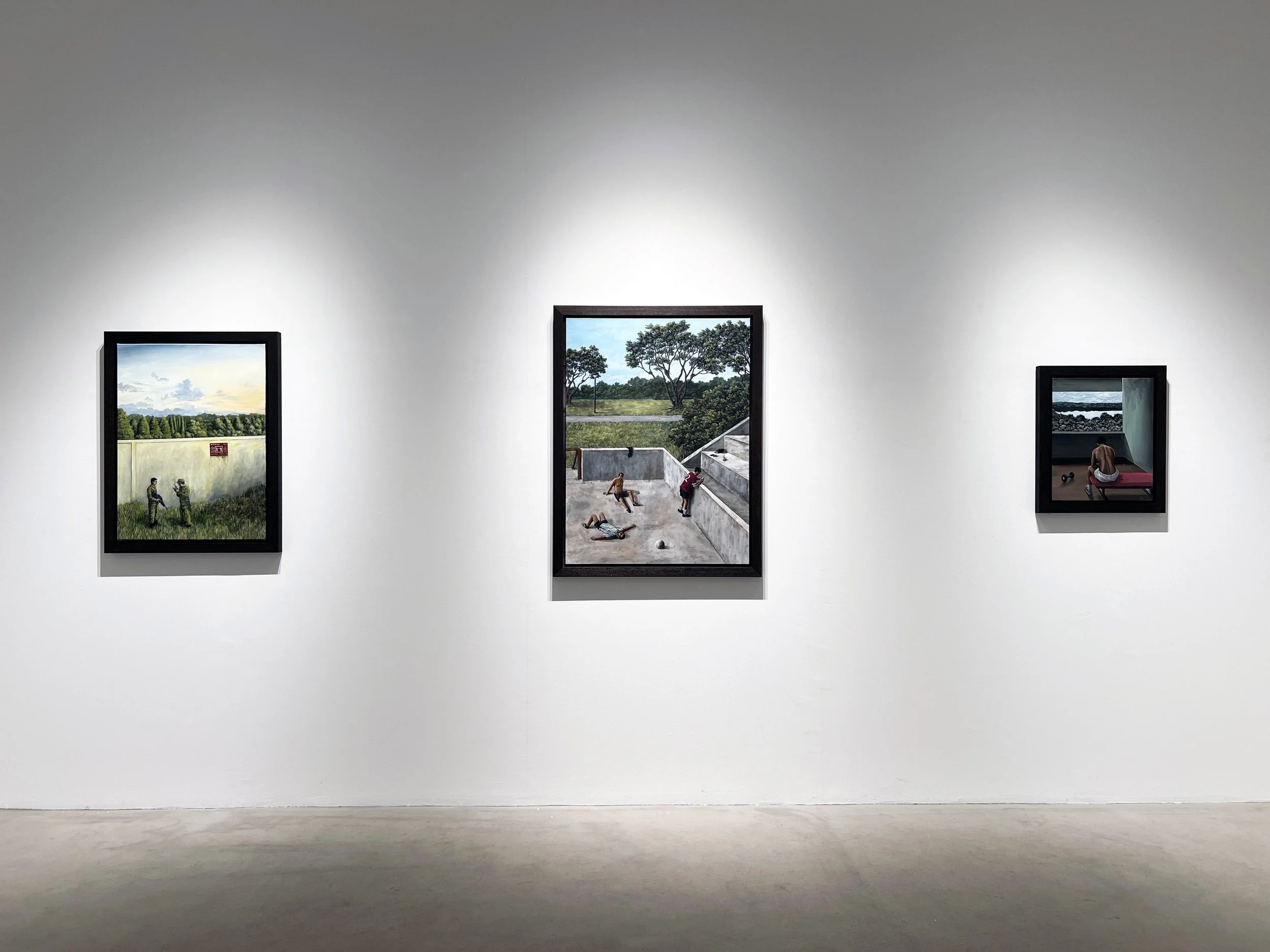
Esmond Loh, Intermission, 2026, exhibition installation view at Haridas Contemporary, Singapore. Image courtesy of the artist and Haridas Contemporary.
In common parlance, an intermission is a break or rest time before the next part of a performance or event. How do you interpret the word within the context of the show?
As someone who is passionate about film and theatre, I often think of painting as a form of directing. I construct scenes, position characters and choreograph relationships between figures and their surroundings. Because of this, I have become interested in borrowing concepts from performance and film to frame my exhibitions. Cliffhanger emerged from this interest in 2024, and Intermission continues that line of thinking.
The idea of intermission resonates strongly with my own experience of balancing a full-time teaching career with an active painting practice. Much of life can feel like a continuous cycle of responsibilities, deadlines, and routines, punctuated by brief moments of rest before the cycle begins again. I suspect this is a universal experience, though it may be especially pronounced in Singapore.
The works in the exhibition explore different forms of intermission. A recurring “salaryman” figure appears in several paintings, moving through MRT train cabins, bridges, void decks and underpasses. He is never shown working; instead, he occupies the spaces between work and home, moments that function as temporary respites from routine. Other paintings examine leisure as intermission: a woman gazing out to sea, a man fishing by a pond, people resting by a swimming pool. Some focus on pauses within physical activity, such as runners catching their breath or footballers resting during half-time. There are also pieces that depict interruptions that emerge unexpectedly through weather, distraction or chance encounters. Collectively, the works consider what surfaces when momentum slows down and the script of everyday life briefly loosens.
“Collectively, the works consider what surfaces when momentum slows down and the script of everyday life briefly loosens.”
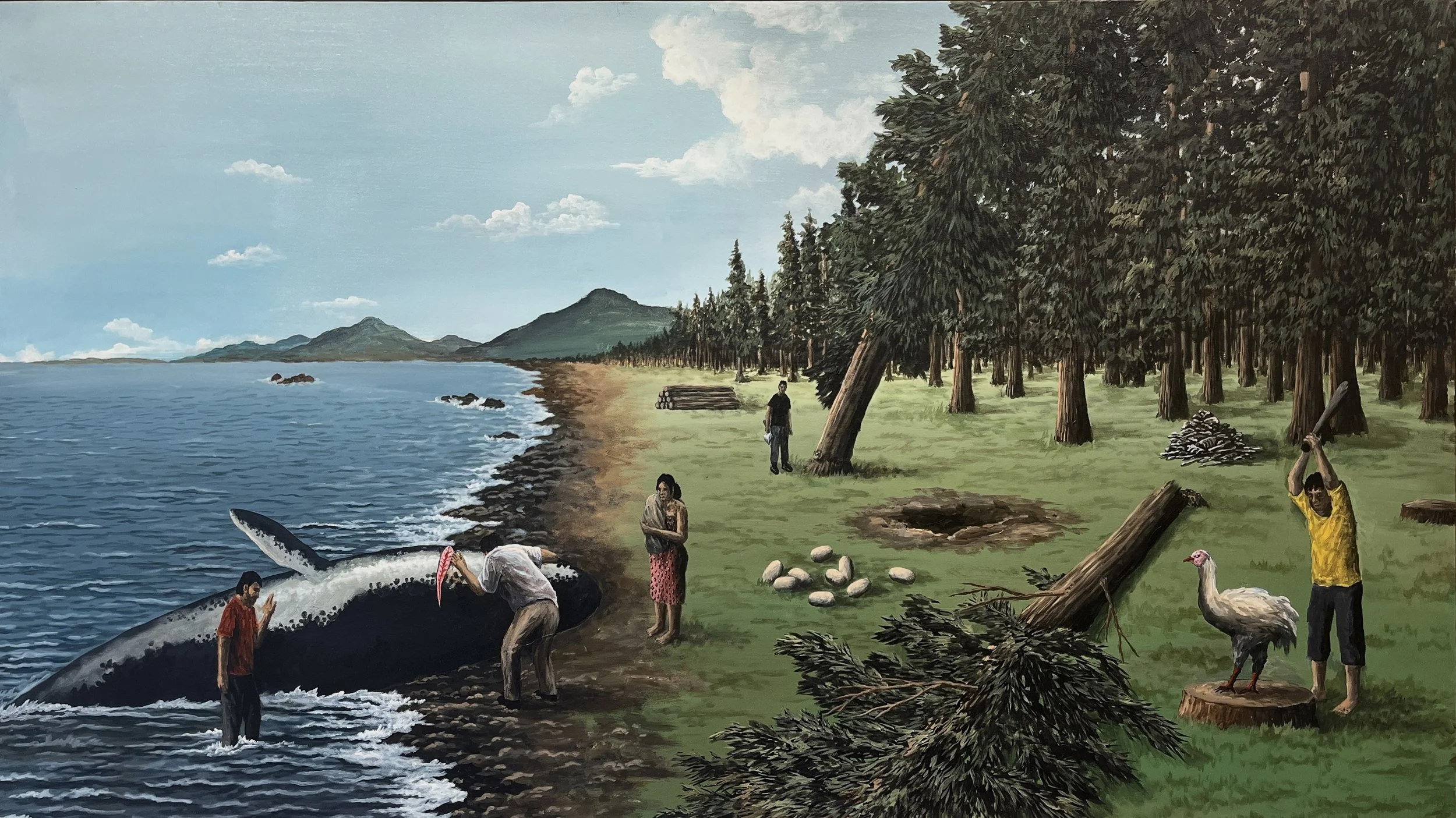
Esmond Loh, First Contact, 2024, acrylic on canvas, 80 x 140cm. Image courtesy of the artist and Haridas Contemporary.
In earlier works such as Pig Farm (2018) and First Contact (2024), animals feature prominently at the centre of the action or suggest symbolic meanings. In the new paintings, the protagonists are mainly human figures who are at times seen in solitude. To continue the theatre metaphor, do you think of them as performers for the viewer?
All of my characters, whether human or animal, are fictional to some degree, and I do think of them as performers within a scene that I have constructed. Their role is not unlike that of actors on a stage. I direct their gestures, relationships and positions in order to create a particular atmosphere or tension.
I love animals, so they have naturally found their way into my paintings. They often bring an element of unpredictability, symbolism or humour into a composition. However, because Intermission is rooted in experiences and observations that feel more personally relevant to me at this stage of life, I found myself thinking more about human experiences and behaviours. The figures in these paintings may appear ordinary, but they are still performing in a sense. They inhabit carefully staged situations that invite viewers to project narratives and emotions onto them.
“The figures in these paintings may appear ordinary, but they are still performing in a sense. They occupy carefully staged situations that invite viewers to project narratives and emotions onto them.”

Esmond Loh, Pig Farm, 2018, acrylic on canvas, 152 x 366cm (overall). Image courtesy of the artist and Haridas Contemporary.
What was one past project or artwork that marked a significant moment in your practice?
Pig Farm (2018) and Bear Mountain (2018) were pivotal works because they marked the beginning of the approach that continues to define my practice today.
Pig Farm emerged from a week-long stay and work experience on a pig farm in the United Kingdom. Rather than documenting what I saw, I became interested in constructing a dramatic and imagined scene inspired by the experience. The resulting triptych combined observation, memory, and invention in a way that felt new to me. Bear Mountain developed from a dream in which I ventured into a forest searching for a rare cultivar of durian and unexpectedly encountered a bear. Like Pig Farm, I transformed a personal experience into a fictional narrative through the painting process.
These works represented a significant departure from the abstract paintings I was doing immediately before them, which relied heavily on spontaneity and automatic processes. As a result, I realised that I was most interested in constructing worlds and telling stories through images. Much of my subsequent practice can be traced back to that discovery.
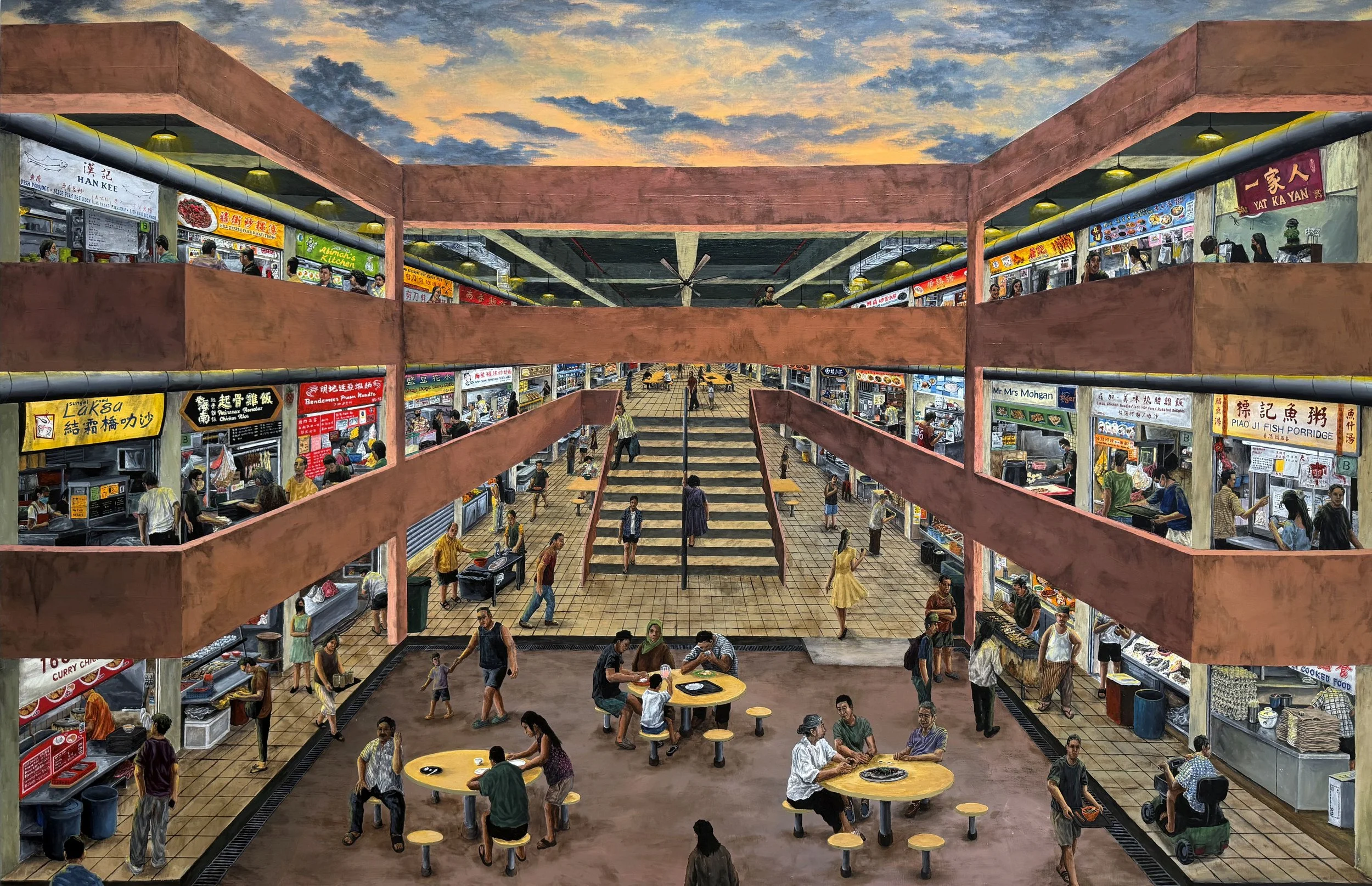
Esmond Loh, All in One, 2025, acrylic on canvas, 150 x 230cm. Image courtesy of the artist and Haridas Contemporary.
The inclusion of real-life places or references is a recent development in your practice. A notable example is All in One (2025). What prompted this shift and how does it influence your painting process?
My paintings have always been constructed from a combination of observation, memory, and imagination. I am interested in creating scenes that feel believable but do not actually exist. Earlier in my practice, I deliberately avoided referencing specific places because I wanted the freedom to invent worlds without being constrained by expectations of accuracy and representation.
Over time, however, I realised that many of the observations and experiences that mattered most to me were rooted in real places. Rather than limiting my imagination, these references actually enriched it. They allowed the paintings to become more personal and specific while remaining fictional.
All in One (2015) is a good example. The painting gathers some of my favourite hawker stalls from different parts of Singapore under one roof, something that is impossible in reality. Although the work incorporates recognisable references, the final image remains imagined. I have become increasingly interested in this space between documentation and invention, where personal memories can be reorganised into alternate realities.

Esmond Loh, Yellow Sugar, 2026, acrylic on canvas, 90 x 120cm. Image courtesy of the artist and Haridas Contemporary.
The blending of the real and imagined can be seen in another food related image titled Yellow Sugar (2026). It transports a well-known bean curd shop from Hong Kong into the setting of a Singaporean hawker centre. What fascinated you about this image?
What fascinates me is precisely its impossibility. Yellow Sugar depicts a scene that does not exist, yet it feels entirely plausible at first glance. The painting imagines Kung Wo Beancurd Factory, one of my favourite food establishments in Hong Kong, transplanted into a familiar Singapore hawker centre.
The work stems from a very simple desire: wanting easier access to food that I enjoy. But beyond that, it reflects a broader tendency within my practice to reshape reality according to memory, longing and imagination. Many of my paintings are built around these small personal fantasies. They are less concerned with documenting the world as it is than with exploring how we mentally reconstruct places and experiences that hold meaning for us.

Esmond Loh, 1314, 2026, acrylic on canvas, 120 x 90cm. Image courtesy of the artist and Haridas Contemporary.
Another painting I would like to discuss is 1314 (2026) which depicts a busy interior of a Thai night disco or siam diu. The atmosphere in this work is markedly different, with multi-coloured lights and clusters of figures painted in a looser style. Could you talk about the experience of making this work and how it relates to the theme of intermission?
Creating 1314 was definitely a departure from my comfort zone. I tend to favour muted palettes and restrained colour relationships, but the atmosphere of a siam diu demanded something more saturated and visually intense. Capturing the coloured lights, crowded interiors and heightened energy of the space required a different approach to colour and mark-making.
A siam diu is a form of Thai nightclub where patrons, most of whom are men, are accompanied by hostesses. Through drinks, conversation, games and the gifting of flower garlands, an environment of intimacy and companionship is created. For many patrons, it functions as a form of escape–an intermission from loneliness, work, or the disappointments of everyday life. Within its walls, attention, affection and connection appear more accessible.
At the same time, I became interested in the perspective of the hostesses themselves. For many of them, working in a siam diu may also represent a temporary chapter in life–a means of supporting themselves while pursuing other opportunities.
The title refers to a $1,314 flower garland, a number that sounds like yīshēng yīshì (一生一世), meaning “for eternity.” There is an irony in that promise of permanence, because the relationships within the nightclub are often fleeting and transactional. That tension between fantasy and reality is central to the work.

Esmond Loh, Youth Day, 2024, acrylic on canvas, 130.5 x 100cm. Image courtesy of the artist and Haridas Contemporary.

Esmond Loh, Adrift, 2026, acrylic on canvas, 80 x 60cm. Image courtesy of the artist and Haridas Contemporary.
Concrete surfaces and structures are a recurring motif in your paintings. What function does architecture play in your composition?
I am drawn to the visual language of concrete, particularly brutalist architecture and the grey, industrial surfaces that are so prevalent in Singapore. There is something appealing about the neutrality of concrete. It can appear monumental and imposing, yet also ordinary and familiar.
In my paintings, architecture often functions as a stage set. It provides the framework within which events unfold and characters interact. The relatively subdued textures and colours of concrete create a backdrop that allows figures and narratives to take centre stage. Many of the architectural motifs in my work are derived from places I encounter in Singapore. Even when the scenes themselves are fictional, these architectural elements help anchor them in lived experience and lend them a sense of familiarity.
What types of artworks are you drawn to?
I am most drawn to figurative paintings that contain a sense of drama, tension or ambiguity. These can range from the quiet, contemplative scenes of artists such as Zhang Yingnan, Serban Savu and Jing Zhiyong to the densely orchestrated and theatrical compositions of Neo Rauch.
I am also deeply interested in historical painting traditions. Chinese shanshui and figure painting, as well as Indian Pahari painting, continue to fascinate me because of the inventive ways they organise space and narrative. These traditions often prioritise storytelling over realism, which resonates strongly with my own interests. One work that recently caught my attention is Admonitions of the Instructress to the Court Ladies, traditionally attributed to Gu Kaizhi and housed at M+ in Hong Kong. I am captivated by its narrative structure and dramatic imagery: guards rush forward to confront an escaped bear and protect the emperor. The painting possesses a remarkable sense of theatricality.
More broadly, I am attracted to works that combine nature, architecture and human presence. I am especially interested in artworks that engage with Singapore's landscapes, built environment and visual culture. I think there remains a vast reservoir of imagery and experiences here that has not yet been fully explored through painting.
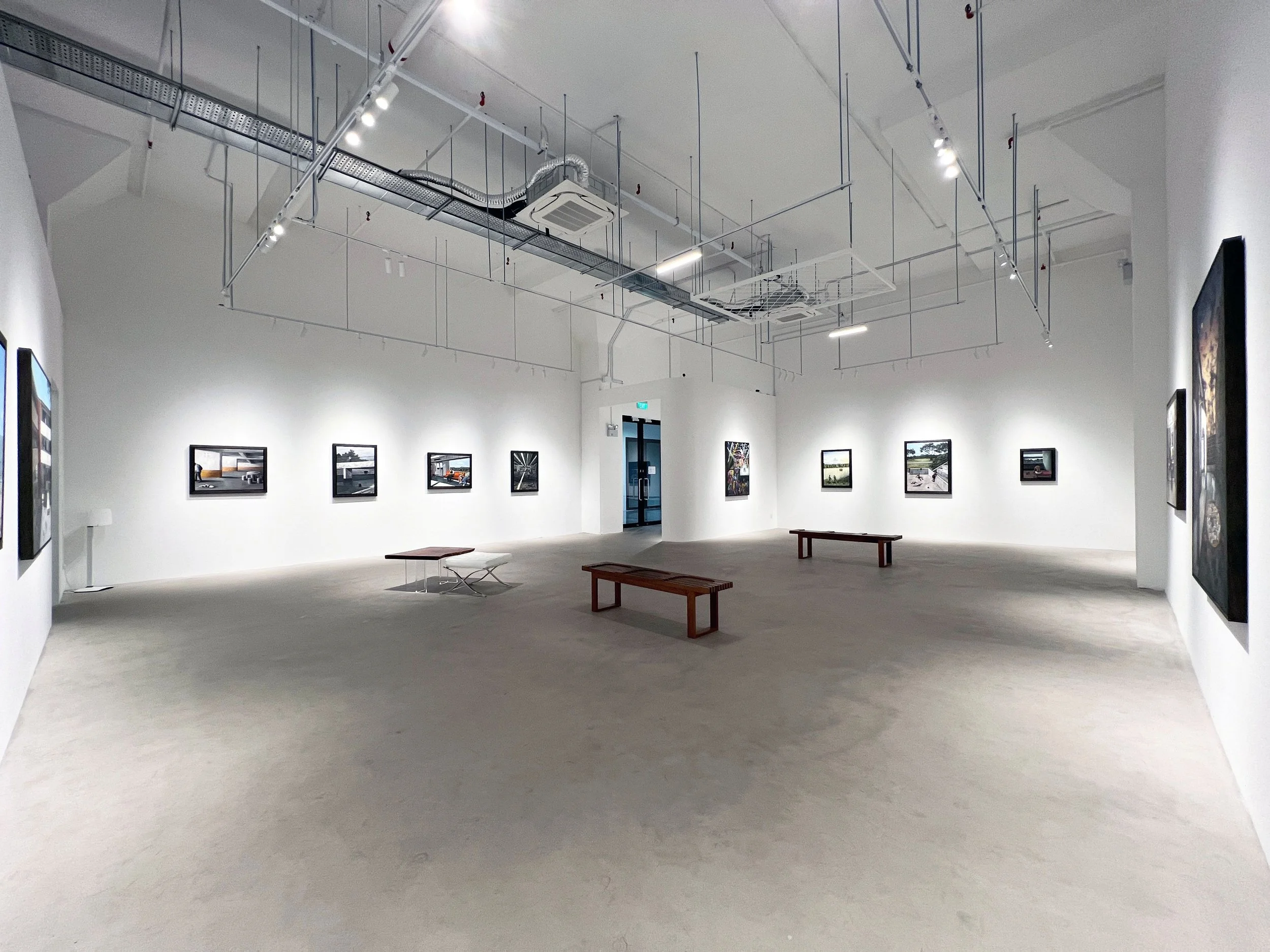
Esmond Loh, Intermission, 2026, exhibition installation view at Haridas Contemporary, Singapore. Image courtesy of the artist and Haridas Contemporary.
How would you describe your relationship with painting? And what qualities or attributes do you look for in your work?
In many ways, painting today feels very similar to how drawing felt when I was a child. I still begin by imagining scenes and following my curiosity wherever it leads. The difference is that paint allows me to build much richer worlds through colour, light, texture, atmosphere and scale.
I rarely think about an audience while I am painting. The work begins as a conversation with myself, a way of processing observations, memories, experiences, and ideas. If viewers find their own meanings within the paintings, that is wonderful, but it is not the primary motivation. I am drawn to images that suggest narratives without fully resolving them, leaving space for ambiguity and imagination. Ideally, a painting should feel familiar enough to invite entry, yet strange enough to resist complete explanation.
When evaluating my own work, I look for a few things. First, on a formal level, the painting has to succeed as an image. It should be visually compelling enough that I enjoy looking at it. Beyond that, it should be able to hold my attention for more than a passing glance. Ideally, I want to feel immersed in the world that it depicts, as though I have been transported into an alternate reality. At other times, it might be details within the painting that reward sustained looking, or unanswered questions that invite contemplation.
Ultimately, the paintings I value most are the ones that take me on an adventure. They continue to reveal something over time, whether that is a new observation, a new narrative possibility or simply the pleasure of spending a few more moments inside the world they create.
This article is presented in partnership with Haridas Contemporary.
Intermission by Esmond Loh is on view from 18 July to 16 August 2026 at Haridas Contemporary in Singapore.