
Conversation with Chinese Artist Xie Fan
Painting practice and culinary arts
This article is part of Art & Market’s coverage beyond Southeast Asia. If you would like to work with us to reach audiences from the region, please email us at info@from-the-margins.org.

Xie Fan in his studio, Chengdu, 2025. © Xie Fan. Image courtesy of the artist and Marguo.
Xie Fan (b. 1983, Jiangyou, Sichuan Province, China) is an artist who examines the material essence of painting and its dialogue with craft and sculpture. His practice began with oil painting on silk, with works that explore light, colour and perception. This interest in elemental painting supports led him towards long-term research on clay and terracotta, which serve as the primary surfaces for current bodies of work. His solo exhibitions were presented at Maison Ming (Hong Kong, 2026), Bangkok Kunsthalle (2025), Marguo (Paris, 2023) and Sifang Art Museum (Shanghai, 2022), among others. In addition to his painting practice, Xie Fan also runs two restaurants 皴 / CUN in Shanghai and Datenbank in Chengdu.
In this conversation, I speak to Xie Fan about his relationship with painting as well as recent projects that engage with craft and architecture. He also shares his perspective on the resonances between painting and the culinary arts in his practice, as “parallel acts of perception and transformation”.
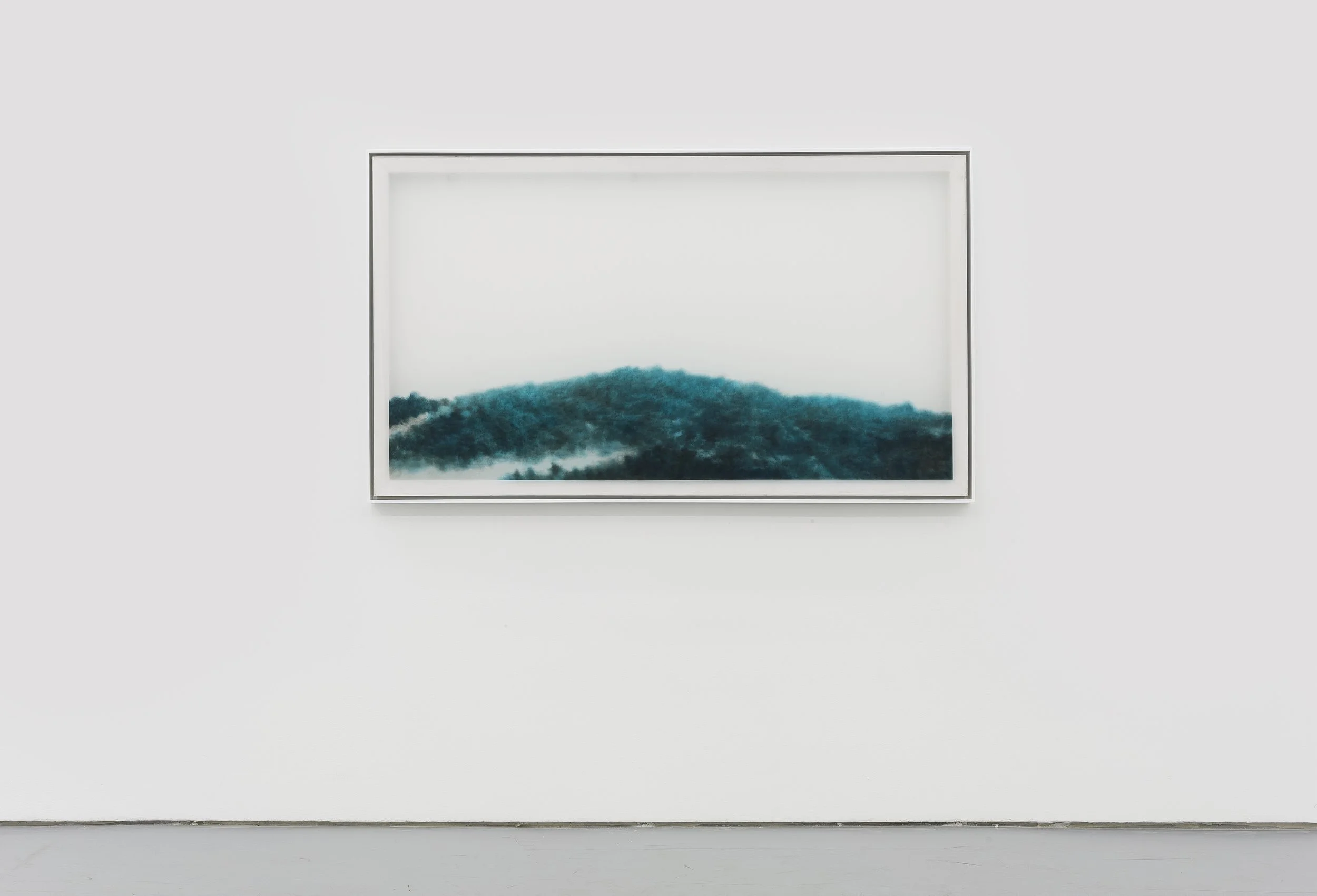
Xie Fan, 远山 Distant Mountain, 2016, oil on silk, 90 × 160cm (35⅜ x 63in). © Xie Fan. Image courtesy of XIEFAN STUDIO.

Xie Fan’s studio, Chengdu, 2025. © Xie Fan. Image courtesy of the artist and Marguo.
Prior to working with ceramics, you were best known for painting on silk. Did your relationship with painting evolve as a result of this material shift?
It was not until I returned to ceramics and began painting on clay that I truly engaged with painting in its deepest sense. At the time, I had already gained recognition for my silk works, yet that approach did not lead me to confront painting in the way I did with ceramics. Painting on silk emphasised visual precision and craftsmanship; working with clay is what finally brought me face to face with the essence of painting.
What significance does painting on clay hold for you?
Painting on clay feels like peeling away the layers accumulated over tens of thousands of years of painting history and returning to its very origin. It allows me to strip away inherited techniques, styles and conventions, and reconnect with the most primal state of painting.
“It allows me to strip away inherited techniques, styles and conventions, and reconnect with the most primal state of painting.”

Datenbank, Xie Fan’s restaurant in Chengdu, 2025. © Xie Fan. Image courtesy of XIEFAN STUDIO
You run two restaurants 皴 / CUN in Shanghai and Datenbank in Chengdu. Could you talk about the decision to start these ventures and the directions for each restaurant?
What began as an unexpected coincidence eventually became an important part of my creative vision. Through this experience, I gradually realised how essential it is for artists to draw inspiration from everyday life. These restaurants evolved into living laboratories for my conceptual practice, offering perspectives and depth that I could not have gained within the confines of the art world alone.
Although they are connected, the two projects have distinct focuses. Datenbank functions as a visual archive, exploring the subtle intersections and contrasts between Eastern and Western culinary traditions and aesthetics. CUN, by contrast, employs contemporary culinary methodologies to examine China’s inland landscapes through a global lens, with a particular focus on the Hengduan Mountains, one of the world’s most remarkable geological regions.

Xie Fan working in his studio, Chengdu, 2025. © Xie Fan. Image courtesy of the artist and Marguo.
How do you manage your time between running the restaurants and your work in the studio?
For me, the restaurants and painting are simply two different forms of creative expression. Running the restaurants is closely tied to my conceptual practice. In terms of daily operations, however, the chefs oversee the fundamentals, which allows me to devote most of my attention to my artistic work.
In your opinion, what is the relationship between the culinary arts and your painting practice?
Cooking and painting are, at their core, parallel acts of perception and transformation. Cooking transforms natural ingredients into experiences of taste, scent and sight, while painting turns clay, pigment and emotion into visual language. Both require a deep respect for materials, an understanding of time, and a continual re-examination of everyday experience.
In the restaurant, I approach ingredients much as I approach clay slabs in the studio: studying their origins, properties and processes of transformation. Likewise, in the studio I work almost like a chef, mixing pigments, controlling kiln temperatures and allowing time to “cook” the work. These are not simply metaphors, they are two complementary aspects of my creative practice. Whether creating a dish or a painting on ceramic, I am exploring the nature of materials and humanity’s relationship to them.
“Cooking and painting are, at their core, parallel acts of perception and transformation.”
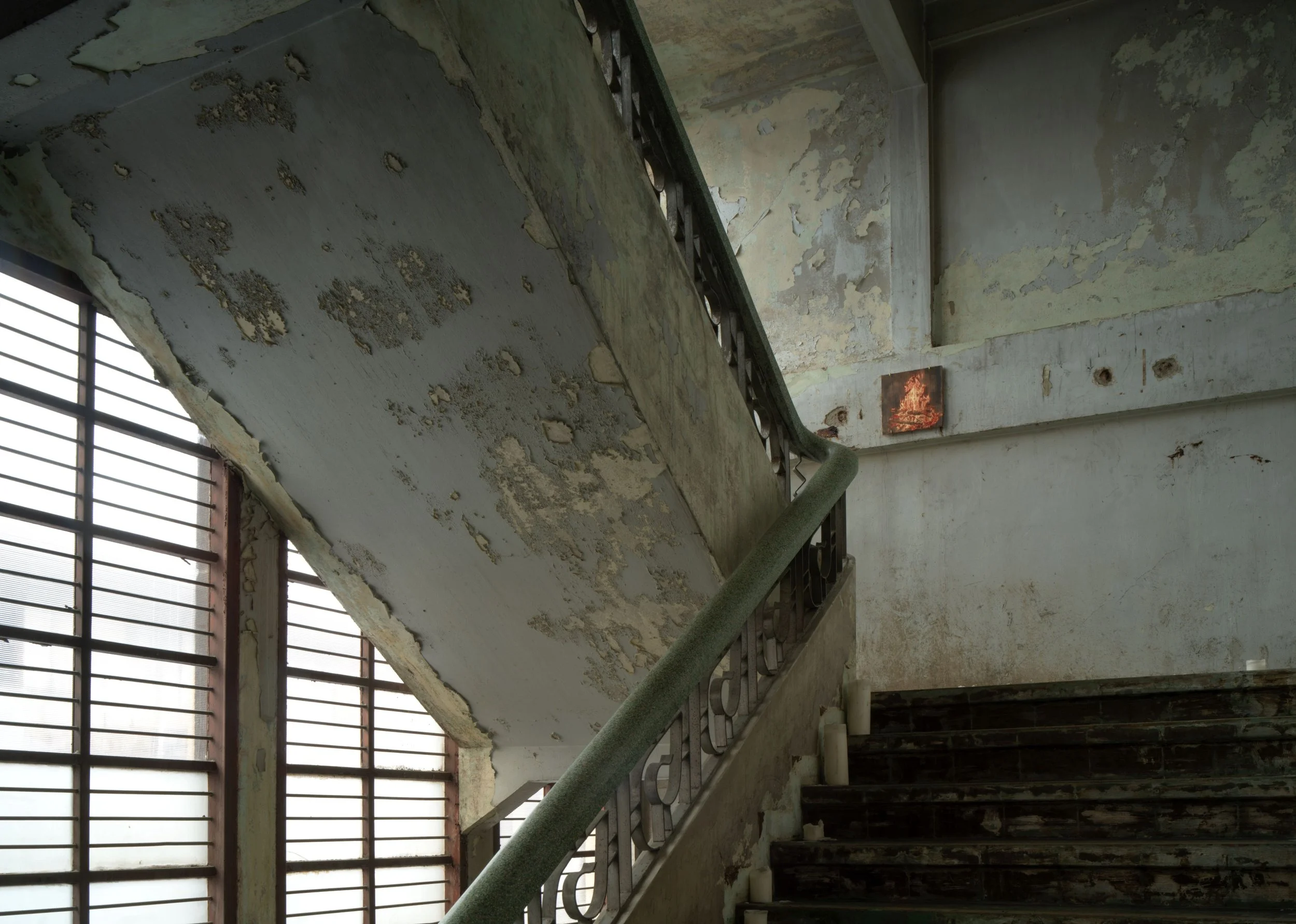
Xie Fan, Painting as Event, 2025, installation view at Bangkok Kunsthalle. Photo: Zhang Yangrang. Courtesy of the artist, Marguo and Bangkok Kunsthalle.
In 2025, you presented a solo show at Bangkok Kunsthalle which included a dinner activation. What was your experience working on this project?
The project was profoundly site-specific. To me, the value of an artist residency lies in stepping outside one’s habitual routine and becoming immersed in a new environment, local culture and native produce. During the month-long residency, I drew upon my understanding of architecture and exhibition space to create works that entered into dialogue with the site itself. The dinner event became the culmination of those experiences, and a way of expressing my accumulated impressions of the landscape, culture and people through all five senses.

Xie Fan, In Between, 2026 exhibition installation view at Maison Ming, Hong Kong. Photo by @commonstudio. Image courtesy of the artist and Marguo.
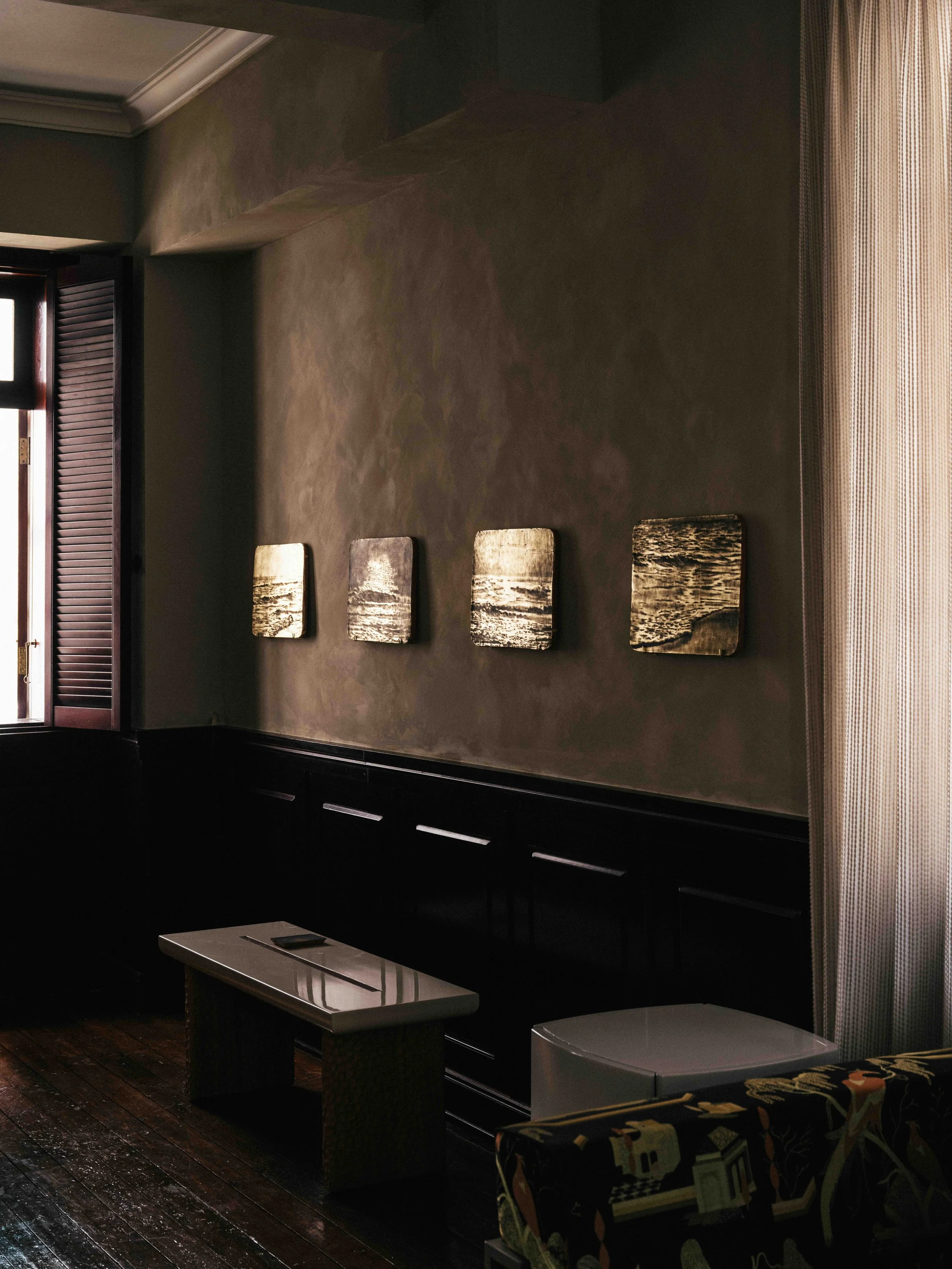
Xie Fan, In Between, 2026 exhibition installation view at Maison Ming, Hong Kong. Photo by @commonstudio. Image courtesy of the artist and Marguo.
In Between (2026) was exhibited within a historic shophouse in Hong Kong. What interested you the most about this space? And how did you respond to it in your works for the exhibition?
The space was designed by a French architect who carefully preserved the original structure and materials of the traditional Chinese tenement building. The flooring, ceiling, and grey terrazzo façade all possess a powerful material language. On its own, it is simply a building; but when placed among the glass-and-steel skyscrapers in Central, Hong Kong, it becomes a distinct visual vocabulary.
I see my paintings in a similar way. Compared with acrylics, plastics and other contemporary materials, clay tiles might appear outdated. Yet today, they constitute an independent artistic language. I wanted to create a dialogue between that material language and the architecture that is defined by both resonance and contrast.
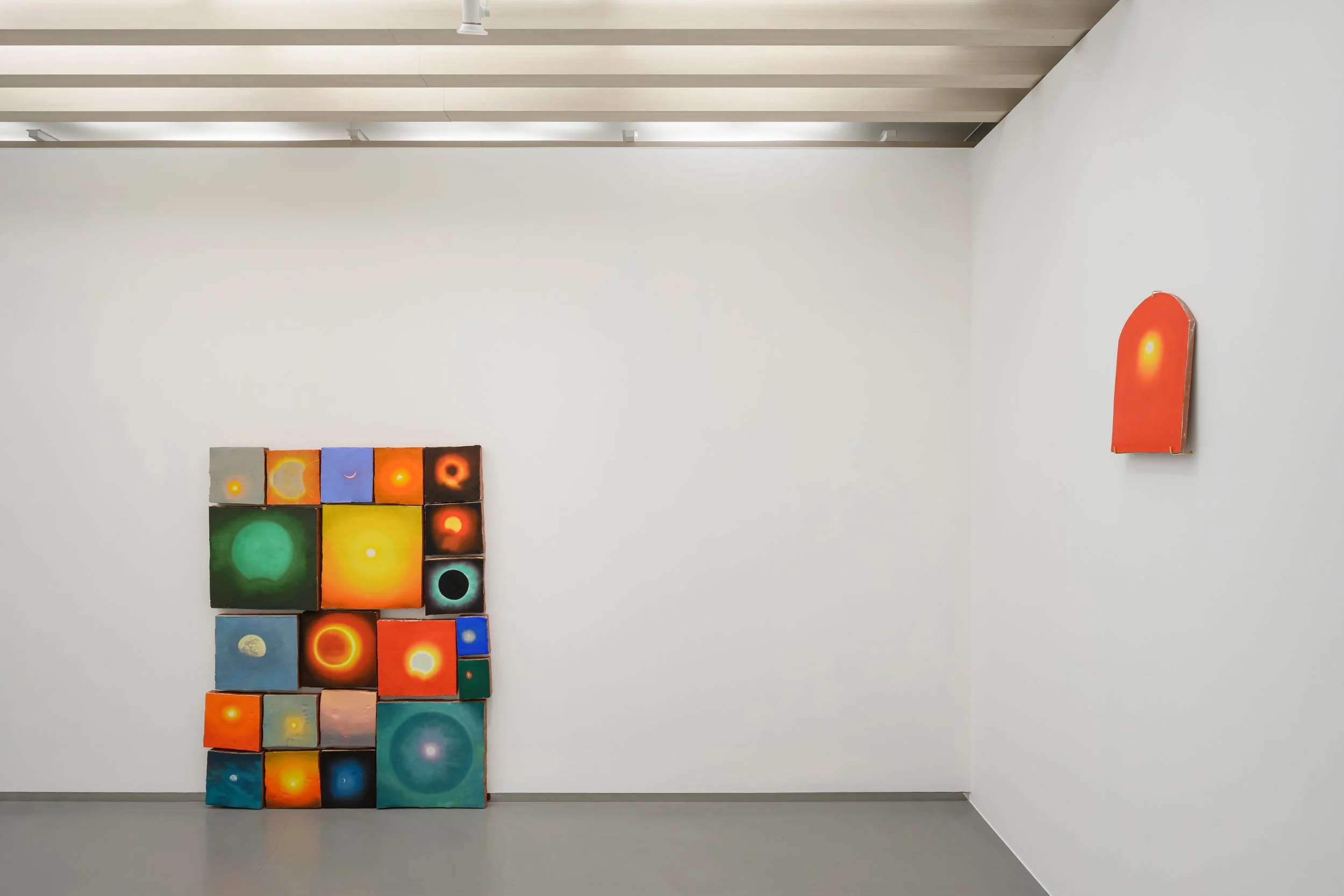
Installation view of Xie Fan’s works in Light Remains (2026) at Tao Art Space, Taipei. Photo by @anpis. Image courtesy of the artist, Tao Art and Marguo.
In your latest duo exhibition Light Remains (2026) at Tao Art, the stacked forms on the floor seems to be a new approach in presenting your ceramic works. Could you say more about this presentation as well as the concept(s) behind the Celestial Signs series?
The stacked presentation feels both innovative and deeply rooted in the history of ceramic tiles. It is simultaneously contemporary and ancient. Since returning to clay tiles as a painting surface, I have been investigating the origins of painting itself: its language, materials and subjects.
Tens of thousands of years ago, paintings appeared in caves and on stone surfaces, depicting celestial phenomena, extraordinary beings and supernatural events. These images sought to record experiences beyond ordinary life. Later, painting entered sacred architecture, where clay tiles functioned both as construction materials and as surfaces for images. Celestial imagery remained a recurring spiritual motif across cultures, as an enduring totem within the history of painting. In this sense, my work returns to those origins, using present-day experience to observe once again the sun and moon of our everyday lives.
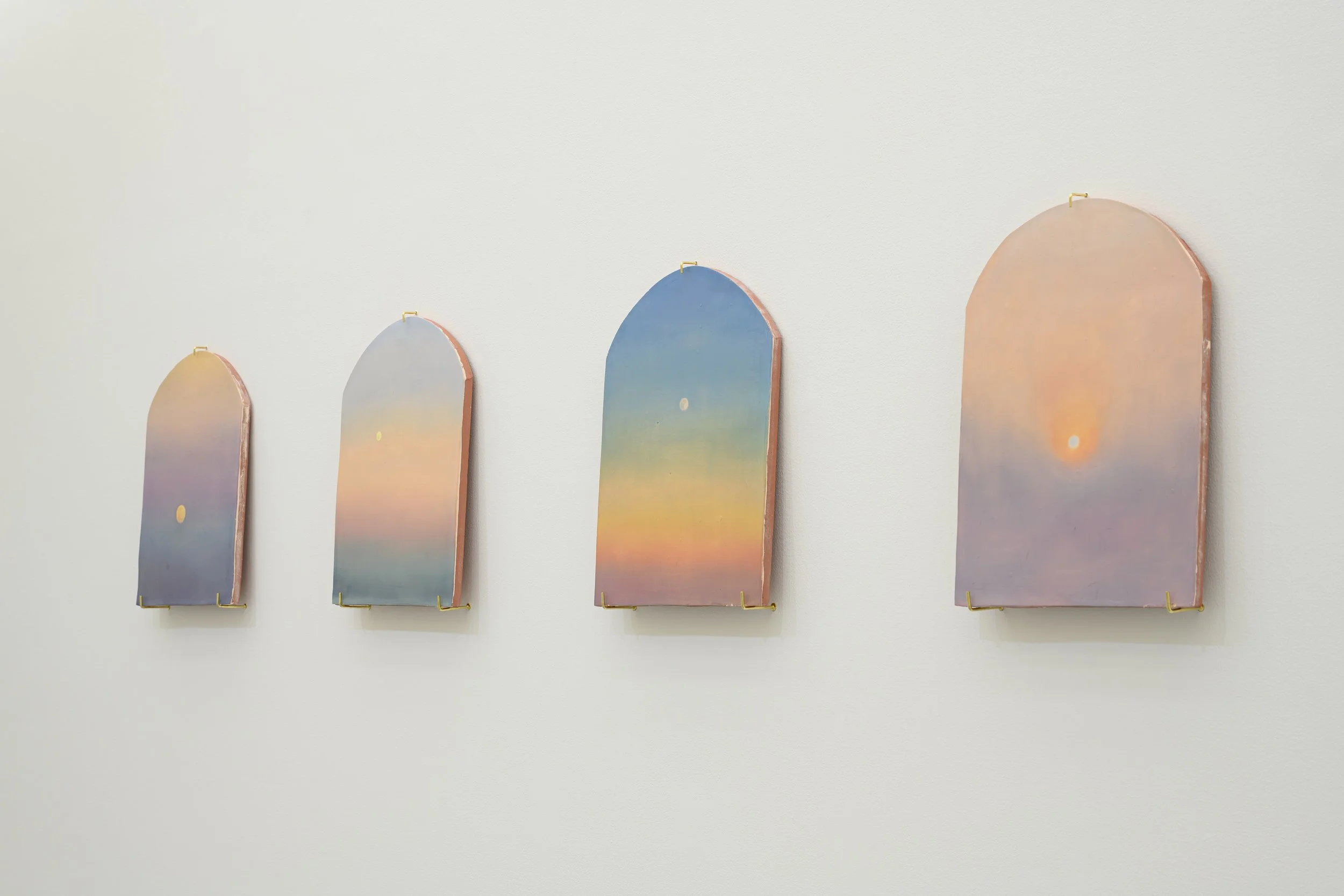
Installation view of Xie Fan’s works in Light Remains (2026) at Tao Art Space, Taipei. Photo by @anpis. Image courtesy of the artist, Tao Art and Marguo.
Are there upcoming projects you wish to share?
I have recently been developing two new bodies of work.
The first, Mirror Image, serves as a companion to my earlier series Celestial Phenomena. Its core methodology is straightforward: I suspend everyday objects above ceramic tiles and paint their reflected images directly onto the clay surface. The physical object partially obscures the painted motif, creating a tension between organic and inorganic matter. Organic objects naturally decay over time. For example, an apple eventually rots, releasing malic acid that etches away the paint beneath it. The object disappears, yet its painted trace remains. By contrast, inorganic forms such as mineral sculptures permanently conceal part of the composition, preserving an unresolved relationship between object and image.
My second project focuses on the Yi people of southwest Sichuan and explores a cross-cultural dialogue between Yi traditions and those of Andean communities. My research centres on the sacred significance of the colour black in Yi culture, as well as black sheep, one of their most important forms of livestock. Expanding beyond painting and material experimentation, the project will ultimately take the form of a performance, culminating in a communal mutton feast.
This article is part of Art & Market’s coverage beyond Southeast Asia.
Light Remains: Xie Fan and Dennis Miranda Zarmorano (2026) is on view from 23 May to 18 July 2026 at Tao Art, Taipei. For more information, click here.