
Conversation with Irfan Hendrian
An artistic and design practice rooted in Bandung’s print industry
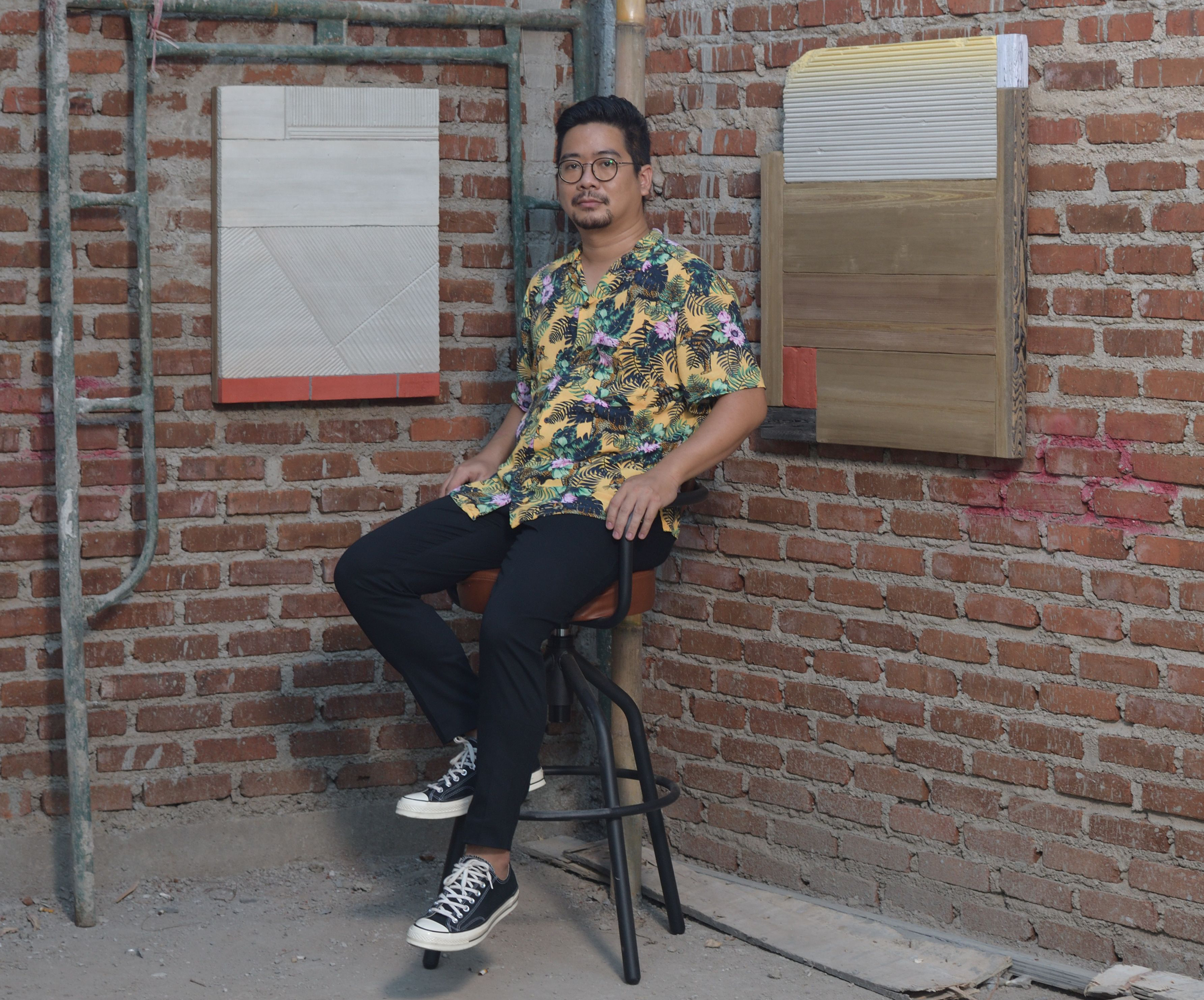
Irfan Hendrian.
Irfan Hendrian is an artist, industrial printmaker, and graphic designer known for his formal explorations in abstraction. His practice engages with paper as a raw material with sculptural capabilities and deep social significance. His works are in the collections of Deutsche Bank (Germany), Jeonbuk Museum of Art (South Korea), Museum MACAN (Indonesia), Singapore Art Museum (Singapore) and Tumurun Museum (Indonesia). In this conversation, I invite Irfan to reflect on his relationship with paper and printmaking, as well as the community of printshops in Bandung, Indonesia, where he lives and works.

Irfan Hendrian, Untitled Untitled Untitled, 2024, risography and dye cut on layers of paper, wood, dimensions variable. Image courtesy of the artist and Sullivan+Strumpf.
You completed a Bachelor in Graphic Design at Wanganui School of Design, New Zealand, and a Master of Fine Art at Bandung Institute of Technology (ITB). Could you briefly describe your education experience?
I miss New Zealand a lot; it felt like time stopped there. It was isolated, so nothing else mattered besides study and experimentation. It did not follow world trends; instead, the design industry developed its own needs. Each design had to be functional, clear, and environmentally friendly. The lecturer pushed us to avoid plastic and that was what drove me to develop paper products during my studies. I came to see working with paper as an interesting challenge.
When I returned to Bandung, I set up my studio to design publications for artists, while using my own artworks to experiment with the limits that design projects placed on me. I was lucky that my postgraduate batch at ITB included some great emerging artists, such as Feby Babyrose who is part of Tromarama, and Zico Albaiquni. Through them, I learned about the art market, and we became friends who could sharpen each other's ideas.
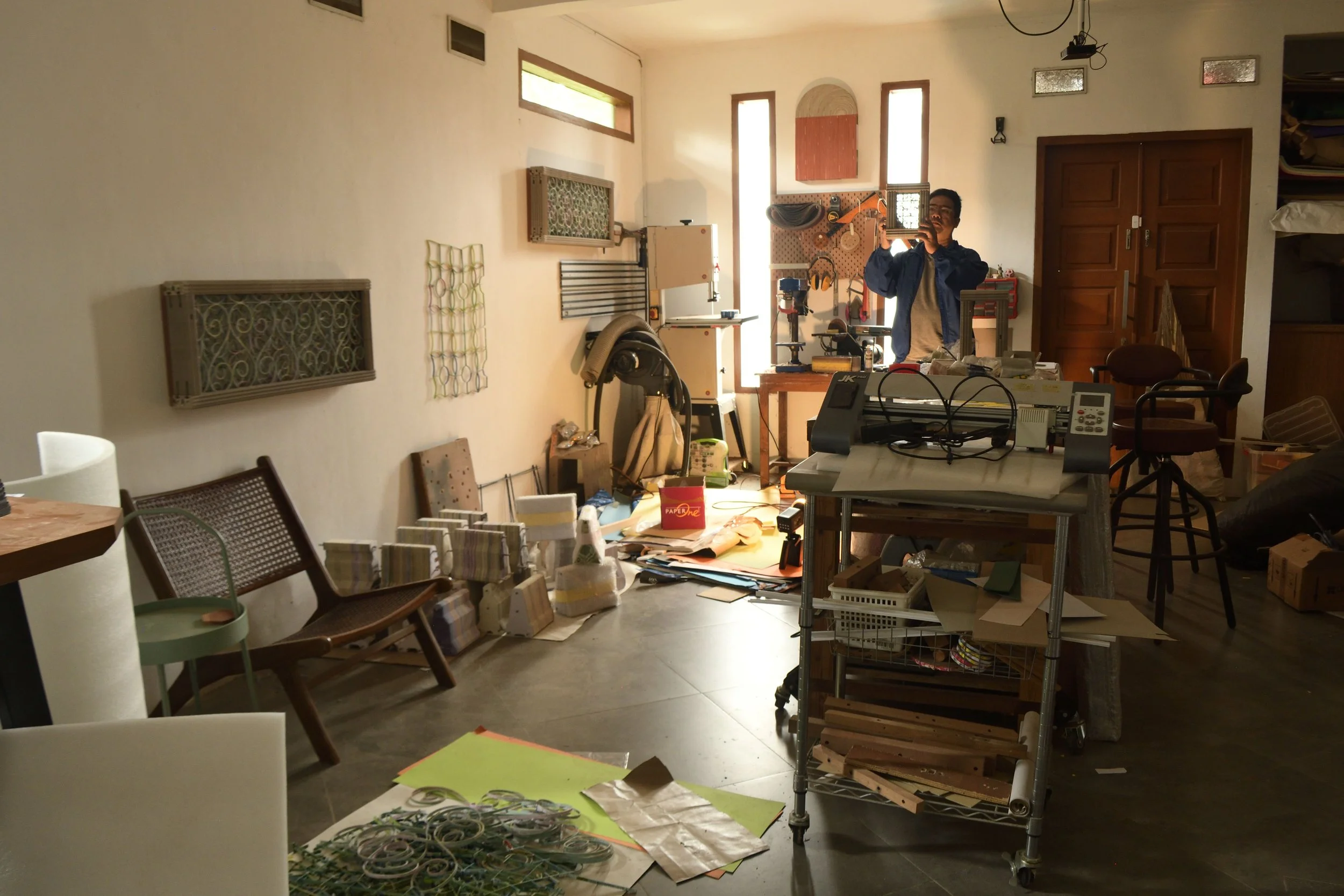
Irfan Hendrian at work in his studio. Image courtesy of the artist.
The Bauhaus approach is often cited as a key interest in your practice. How does it shape your sensibility as an artist, printmaker, and graphic designer?
For me, the strongest resonance with the Bauhaus is viewing the designer or artist as an engineer, or someone constantly searching for a problem and inventing a solution, rather than just waiting for inspiration. It is someone who keeps searching for novelty as well. I try to master industrial techniques without losing the level of craftsmanship found in the human hand. My goal is to combine those two worlds to balance efficiency and affordability with quality.
These are the core principles I keep while running my studio. The focus on efficiency also drives my concern for sustainability. In print design, even paper creates waste, especially in mass production. Applying an “engineering” mindset helps me minimise waste.
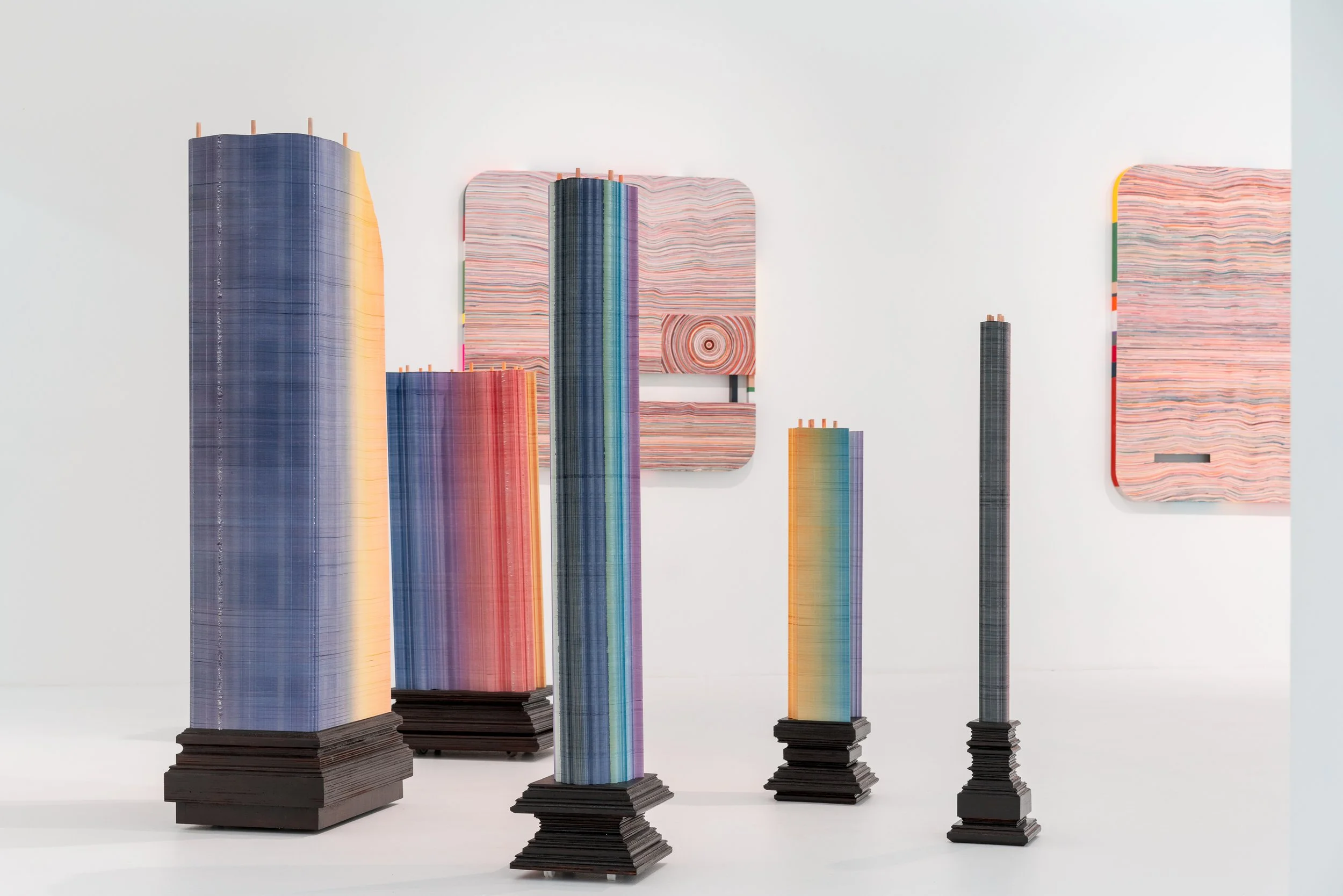
Irfan Hendrian, SANS, 2018, exhibition installation view at Sullivan+Strumpf Singapore. Photo by Ng Wu Gang. Image courtesy of the artist and Sullivan+Strumpf.
You have intensively worked with paper as a medium across different bodies of work, exploring its sculptural possibilities and cultural contexts. How would you describe your relationship with the material? And has its significance or meaning evolved over time?
I began my art-making journey right after the art market “boom” around 2007 and 2008 wound down. At that time, there seemed to be a bias against paper as a medium among curators, the market, and even other artists. It was seen as less important, fragile, and secondary to painting. For me, proving them wrong became an obsession.
Therefore, my early works focused intensively on paper, establishing it as the primary medium and context. I aimed to make it solid, strong, and heavy, or the opposite of what paper usually is. My relationship with paper is also influenced by the printing industry. When working there, we buy hundreds of kilogrammes of paper, and seeing how paper stacked high after printing and die-cutting forms its own kind of sculpture.
I have developed my techniques independently, modifying methods from bookbinding, woodworking, and industrial printing. Because my practice does not have roots in any established art tradition, my early explorations felt limiting. But now, with a mastery of various techniques, those limitations are gone.
“I have developed my techniques independently, modifying methods from bookbinding, woodworking, and industrial printing.”
What is one major turning point in your practice and why?
During the COVID-19 pandemic, my family had more time to talk together as mature adults, and we began opening up conversations about our experience as Tionghoa or Chinese Indonesian. My father had not wanted to talk about it before, including how the New Order regime systematically erased our identity and made us feel ashamed of ourselves. My parents raised me as Javanese, and I did not think I was Tionghoa. But my grandmother, out of fear of the past recurring, kept sending me a Chinese talisman for protection when I entered public high school. It was the longest piece of paper I have, and I kept it near my body every day. This talisman began my new exploration of embracing that lost identity, relearning, and recovering our erased history.
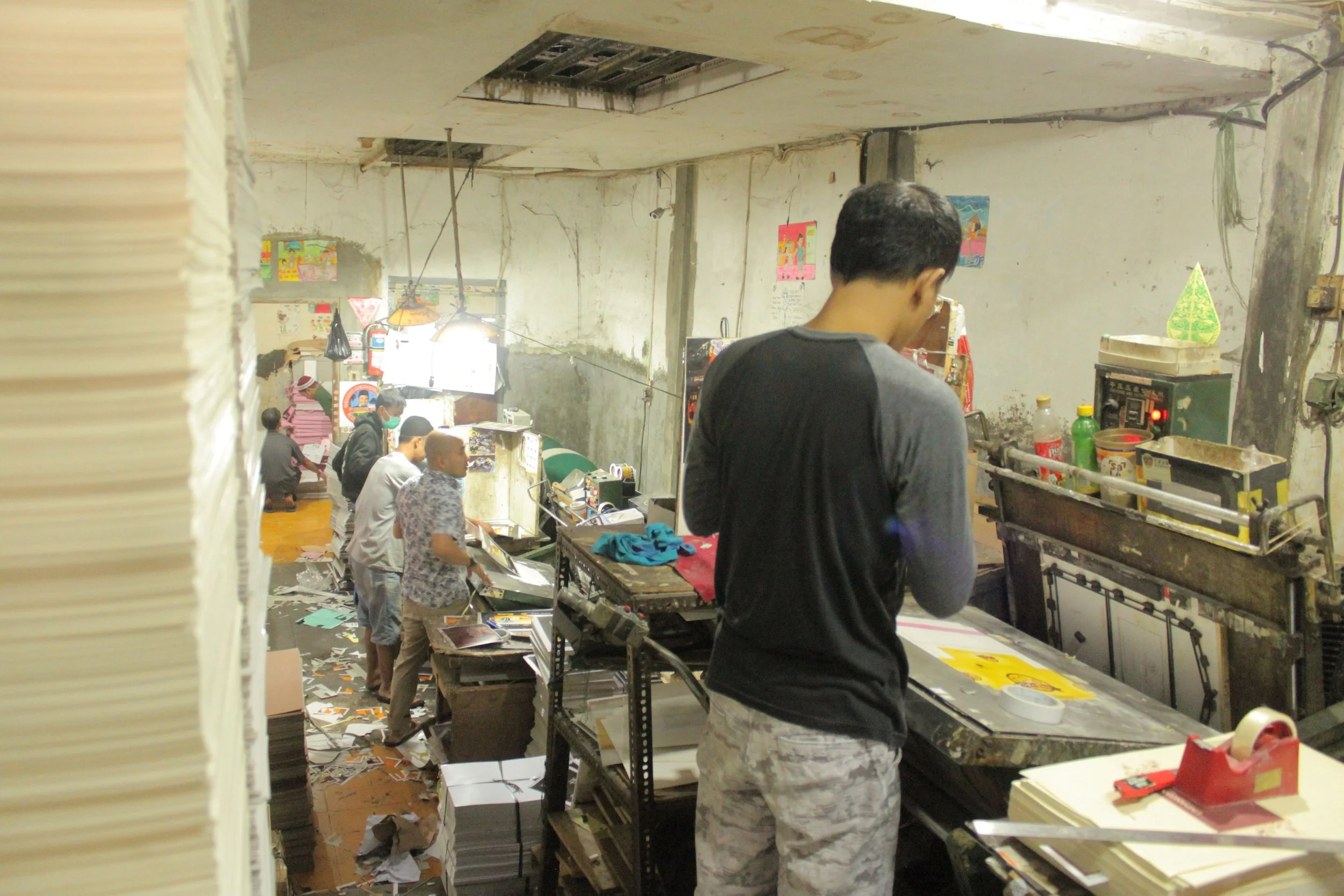
Print shops line Pagarsih Street in Bandung, Indonesia. Photo by Irfan Hendrian.
Your practice is situated within an ecosystem of printshops in Bandung. What does it mean to you to be embedded in and producing work in this context?
Bandung is our nation's printing capital. The printing industry was essential in helping the city recover economically after the 1998 crisis, and it remains the backbone of Bandung's creative industry today.
Most of the paper and printing shops are situated along a two-kilometre stretch of Pagarsih Street, run inside shophouses, predominantly by Tionghoa families. Different shops specialise in different machines and processes, and they readily accept small-scale production. I do not think any other city could offer me the affordability and freedom to experiment with the shops here. The relationships I have developed with the shop-owners made these shophouses the focus of my recent exploration. I am learning the community's history and how they modified their buildings, especially after riots and crises.
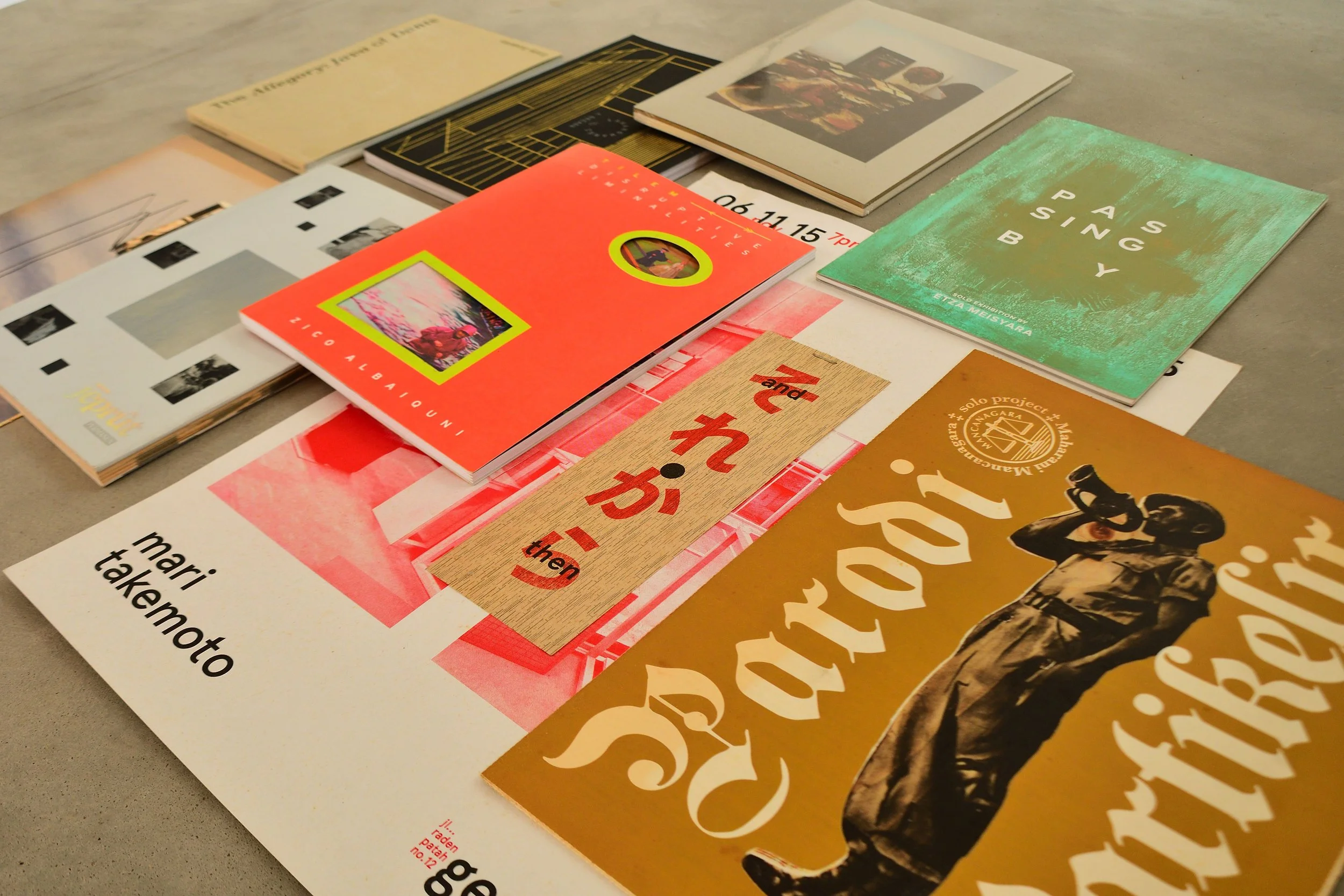
Publication design and print production outputs for various artists and art spaces. Photo by Irfan Hendrian.
Through your print studio and graphic design work, you have produced publications for other artists and visual identity for institutions. What is an important lesson or skill you learnt through these activities?
Working on publications for artists and art institutions has been my gateway to the professional art world, beyond making art. The experience has taught me the essential practicalities of the industry. I learned how to prepare an exhibition and how to work collaboratively with galleries and institutions. I remember personally distributing exhibition posters around Bandung; those were the early days when posters were the main announcement tool. The simple act gave me time to chat with programme managers and artists, which was a vital way to build connections and understand the ecosystem from the ground up.

Irfan Hendrian, Unearthly Matter #4, 2024, risography and dye cut on layers of paper, 56 x 69 x 8cm. Image courtesy of the artist and Sullivan+Strumpf.
Could you talk about the artwork(s) you are presenting in The Print Show Singapore 2026?
The Unearthly Matter series is a journey to rediscover a Chinese identity on the island of Java. For generations, Chinese Indonesians have been deemed an "alien" race, non-native, and unimportant to Indonesian culture. This perception is a direct result of the New Order regime's forceful assimilation efforts, which deliberately erased any trace of Chinese contributions from Indonesian history. My own upbringing reflects this: my parents did not raise me in Chinese culture, leaving me to find my identity through pop culture, specifically the Journey to the West television series. I was captivated by its visualisation of heaven in unearthly blue and pink tones.
Seeking to affirm the long-standing integration of the Chinese diaspora in Indonesia, I embarked on a journey across Java, visiting even its most remote cities in search of Chinese temples. These temples stand as silent, steadfast monuments amid the government's efforts to erase them, guarded by Foo dogs, mythical heavenly creatures. The series is a testament to the resilience of this heritage, using the "unearthly" visual language of my childhood memories to re-imagine and reclaim a lost history.
The photos are first printed in hundreds of copies using a risograph machine, with each copy slightly shifted. These layers are then sliced and die-cut before being reassembled. In the final structure, only the ink on the very edge of the paper is visible, manifesting the history as a subtle, layered artifact.
What sustains your interest or keeps you excited about print and paper as artistic mediums?
I think there are still so many unexplored techniques, cultures, and contexts surrounding paper. That constant potential keeps me excited about the future possibilities. The limitation of the medium is not a barrier but a challenge I am happy to explore, as it always yields a different result and effect than any other material. The development of printing technology seems to have slowed with the rise of the digital age, but I believe there are many possibilities still unexplored with the technologies we currently have.
“The limitation of the medium is not a barrier but a challenge I am happy to explore.”
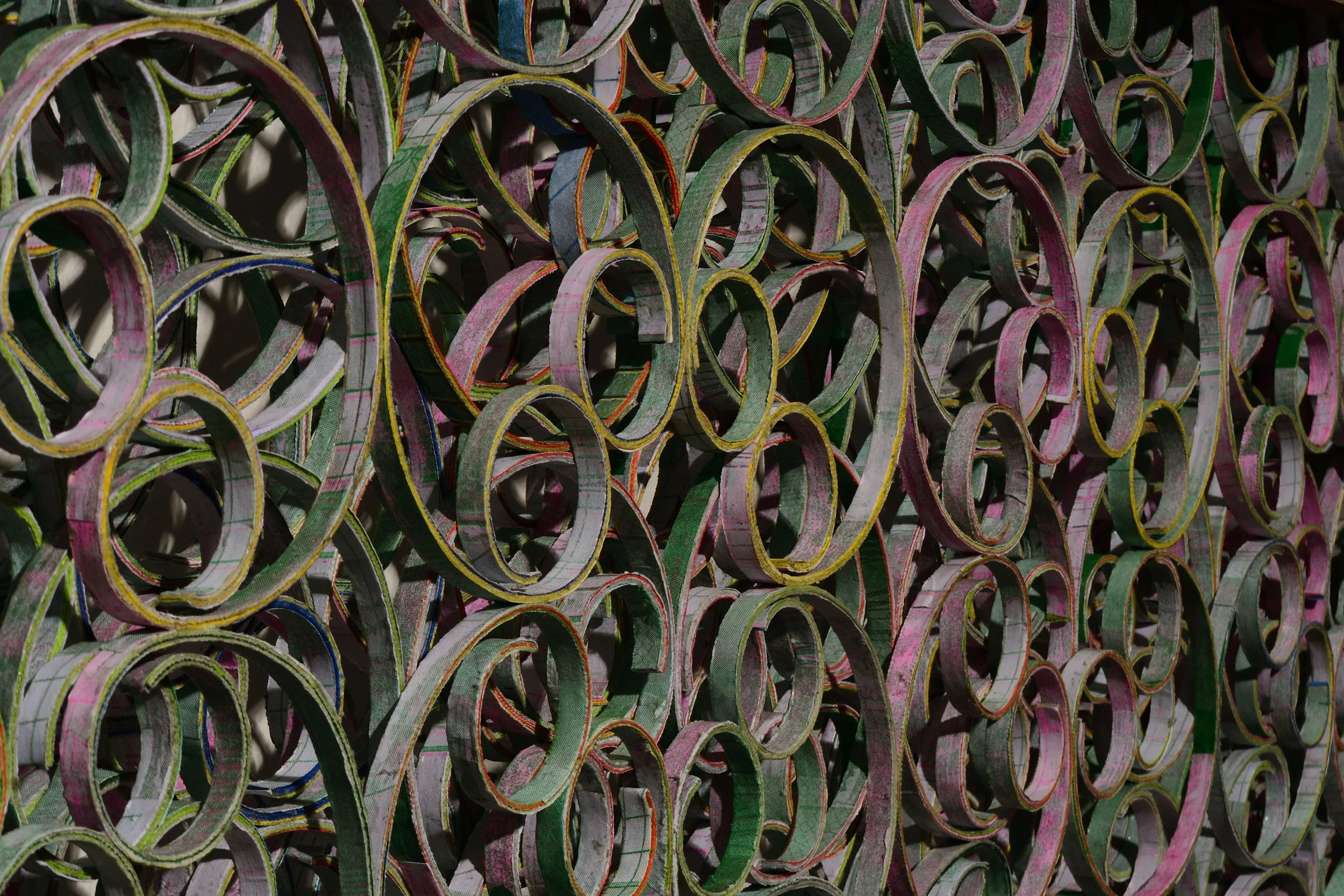
A preview image for Irfan Hendrian's upcoming solo exhibition titled CLOSED, opening soon at ARA Contemporary in Jakarta, Indonesia. Photo by Irfan Hendrian.
Are there other upcoming projects you wish to share?
I am preparing a solo exhibition titled CLOSED, which is about paranoia that is shown through the exterior of shophouses. Many of these buildings are left to decay, their neglect a premonition of future threats. In a desperate gesture of self-preservation born from historical anxiety, owners seal off everything but the essential front entrance. Every political upheaval adds another defensive layer. Even in Bandung, perceived as a relatively peaceful city that avoided the worst of the 1998 riots, the barricades are ubiquitous. My research reveals that Bandung’s iron trellises proliferated in the 1970s and 1980s, in a delayed architectural response to the race riots of 1963 and 1973. While these trellis patterns often mimic designs found in vintage architectural magazines, I believe they subconsciously echo the trellis of traditional Chinese temples, a heritage that was forcibly suppressed during the New Order. The effort to "beautify" the cage is a paradox: a sign of hoping for a better future, while the steel itself remains a monument to an enduring mistrust.
This interview is presented in partnership with STPI.
Irfan Hendrian’s works are included in The Print Show Singapore 2026. It opened on 22 January, and has been extended to 7 February 2026. For more information, click here.