
Conversation with Chinese Artist He An
‘A Wind-Blown Fire Needs Little Effort’ at Blank Canvas
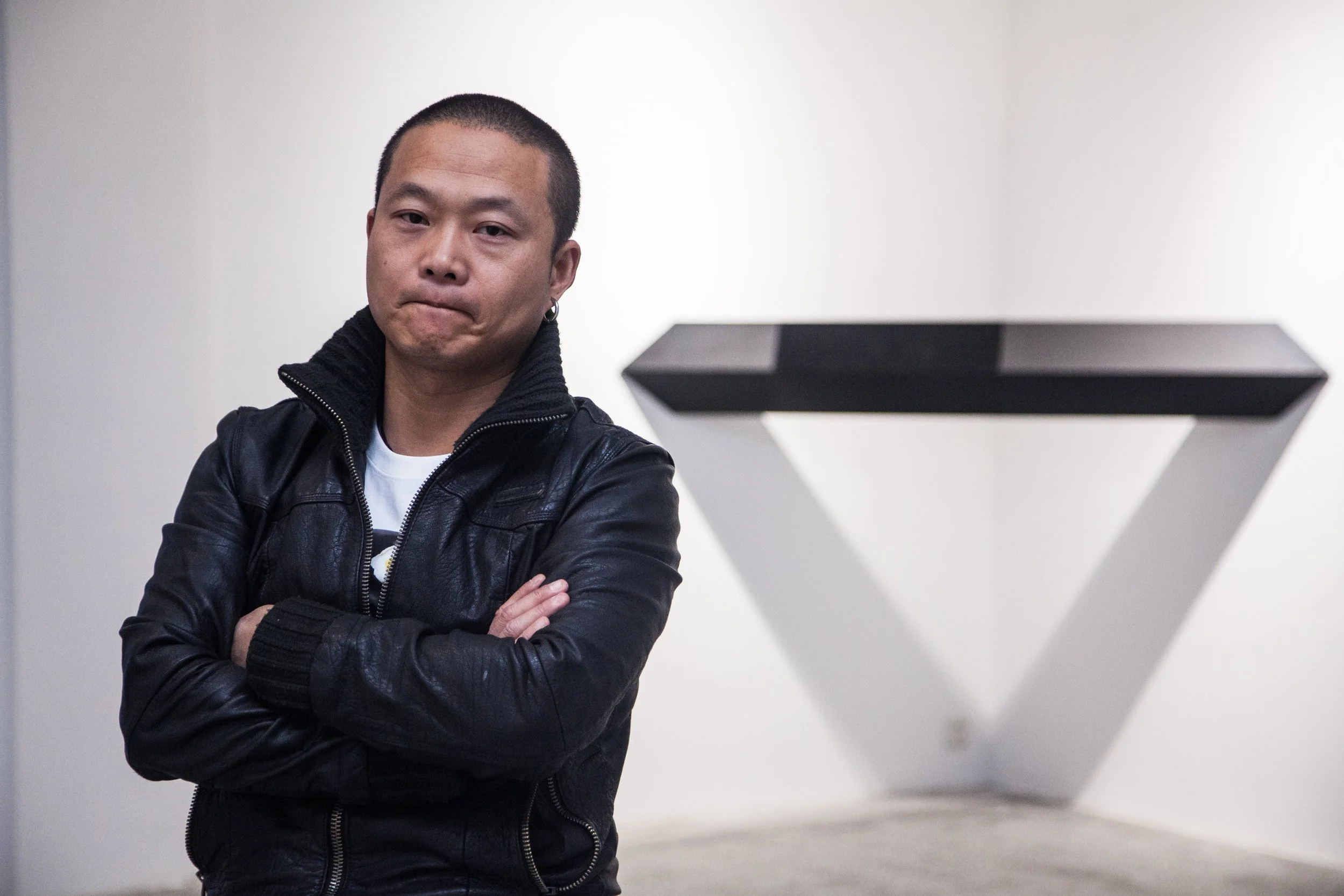
He An.
He An (b. 1970, Wuhan, China) is part of the generation of artists who came of age after the Cultural Revolution. His works speak to the transformations of Chinese society and the atmosphere of China’s growing cities. He presented solo exhibitions around the world at venues such as Oct Box Museum, Australian Centre for Contemporary Art, Ullens Centre for Contemporary Art, Galerie Templon, and Magician Space, among others.
I sat down for a chat with the artist about his latest show A Wind-Blown Fire Needs Little Effort 因风吹火用力不多 (2026). This presentation is a result of the residency hosted by Blank Canvas in Penang in 2025. In this conversation, he talks about the impactful road trip he took around Malaysia, how his faith became a key to unlock connections with the local context, as well as the collaboration with Penang-based paper effigy artisans.

He An’s first visit to 358 Custom Effigies Workshop in George Town, Penang, on 5 July 2025. Image courtesy of Blank Canvas.
Prior to arriving in Penang, did you have any expectations or ideas about what you wanted to do in Malaysia?
I came to Penang three times. The first trip was in August 2024 for a week, and I arrived like a blank sheet of paper. Malaysia is still the only country I have visited in Southeast Asia and to be honest, I am not familiar with the region prior to that. When I studied contemporary art, the external points of reference came from the West. Of course, during the preparation process, there were many conversations with Blank Canvas about potential research topics and site visits based on my interests. During the residency in July 2025, which was my second time here, I spent 25 days driving across the western and eastern coasts of peninsular Malaysia. The third visit was in January 2026, to learn from local artisans and prepare for the exhibition.


Snapshots from He An’s road trip in Malaysia. Image courtesy of the artist.
Could you talk about the road trip experience and what you saw?
The experience exceeded my expectations. My assumptions about the identity and culture of Malaysian Chinese were debunked after interacting with the local communities. While there are similarities with ethnic Han identity from mainland China, particularly from Fujian, the reality here is much more complex. This has to do with languages and racial dynamics in Malaysia.
For instance, I met a museum director in Kelantan, Malaysia, who could speak Mandarin. His ancestry traces back to the Ming Dynasty in China, and he identifies as a Kelantanese Malaysian Chinese. They have developed a kind of creole or language that combines these different cultures. This encounter made me rethink my assumptions about the so-called Nanyang movement of diasporic Chinese coming South. For me, it triggered broader questions about cultural formation and agency. In Malaysia, there are powerful contradictions in the process of finding coexistence amidst diversity. This is fascinating and meaningful to me.
I also saw interesting traces of vernacular architecture in the rural towns. These structures are often made by hand to serve mundane purposes, using scrappy materials. But I recognise elements that come from a far deeper cultural memory, such as joinery techniques and roof shapes. Overall, this experience left a strong impression.
This encounter made me rethink my assumptions about the so-called Nanyang movement of diasporic Chinese coming South. For me, it triggered broader questions about cultural formation and agency.

Behind the scenes look at the artwork production in collaboration with Koh Eng Keat and his team of traditional paper effigy artisans from Penang. Image courtesy of Blank Canvas.
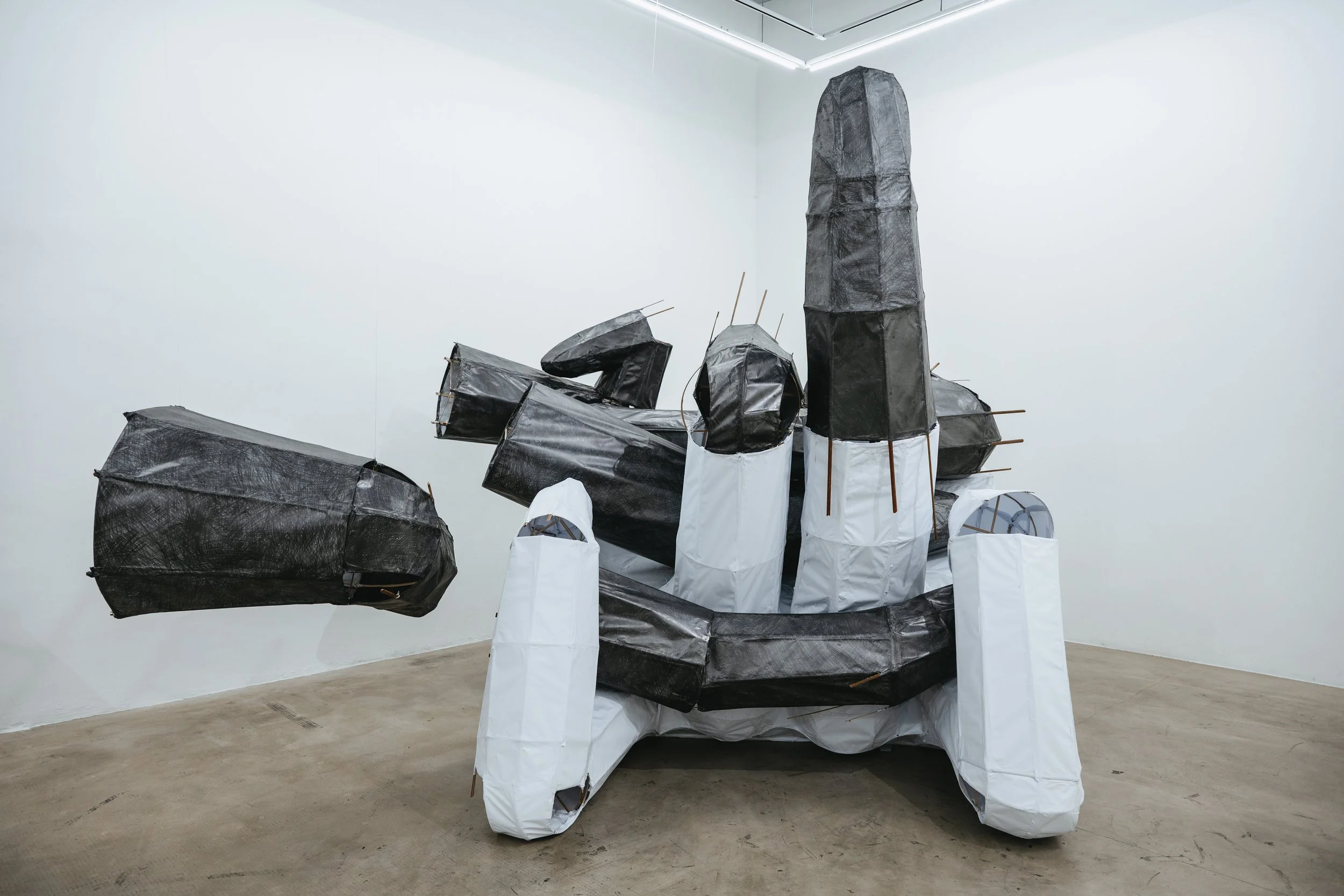
He An, Swan (天鹅), 2026, bamboo, paper, pencil. Main Work:258.5 x 280 x 245cm (H x W x D); Thumb:92 x 96 x 72cm (H x W x D). Fabricated by Koh Eng Keat (Traditional paper effigy artisan, Penang). Image courtesy of the artist and Blank Canvas.
What is the thought process behind the new exhibition at Blank Canvas?
I had the option to bring existing resolved artworks for the exhibition at Blank Canvas, but wanted to create something related to Malaysia. This is a challenge I set out for myself. My practice speaks to the context in China where most people are still discussing economic development, people’s livelihoods, and the global landscape. Except for the older generation of Chinese Malaysians who listen to media in simplified Chinese and remain in touch with what is happening in China, these issues may not hold significance to the local context. This situation is very different from exhibiting in a Western context, which is the “dominant” culture. In that scenario, I could do my own thing as it would be absurd to make new artworks related to the Western context. Therefore, I needed to find my connection with Malaysia.
I studied with craftsmen from a paper effigy workshop in Bukit Mertajam for a week. It was hard work sitting on low stools in the heat, some of the craftsmen had deformed spines from this. But simply walking around and looking is not enough, one needs to participate and observe closely. This kind of engagement makes it easier to develop a relationship.
The works in the exhibition are made in collaboration with Koh Eng Keat. In many ways, he exemplifies my understanding of what it means to be contemporary. He is a paper effigy artisan, who provides funeral services. He is also a musician in an experimental band 䰱 Ling. We agreed that for this project we will be changing up how traditional techniques are used in making paper effigies. The sculptures are a co-creation.

He An in his exhibition A Wind-Blown Fire Needs Little Effort 因风吹火用力不多 at Blank Canvas, Penang, 2026,. Image courtesy of the artist and Blank Canvas.

He An, 能够所有的痛苦和悲伤还能够死亡, 2009, installation view. Image courtesy of the artist and Gallery daSein.
Talking about holding multiple identities, your faith as Taoist practitioner also surfaces strongly for the first time in this new set of works. Could you talk about your relationship with Taoism?
I am part of the generation that grew up during the era of reform and opening up. Religious sentiments entered my life when I started high school, in the 1980s. I think this identity enriched my life culturally, especially in terms of ideas from my work. It gave me a non-western approach.
My faith is a key that I am using for the first time. In Malaysia, when I say I am a Taoist priest, people become curious about me. Because of our shared beliefs, the ice is broken very quickly and I feel a sense of closeness. During my 2024 visit to Penang, it was during the Hungry Ghost Festival in the lunar seventh month. I witnessed large paper effigies being burnt in a marketplace, and its scale was limited by the ceiling of the place. For example, the locals had to use bamboo poles to push overhead electric cables aside to make way for the 大士爷. I was impressed not by the size of the event, but how its significance was conveyed in relation to spatial constraints.
The number of religious believers in China has increased drastically, particularly in the last 10 years. In theory, the practice of burning effigies should not exist in mainland China, but it is a folk belief that came back in recent times. That said, this aspect of culture is increasingly related to tourism and branding. Even the faces of deities are made to look more handsome and appealing so it circulates better.
My faith is a key that I am using for the first time.

He An, What Makes Me Understand What I know 是什么让我理解我的知道, 2009, neon signs, dimensions variable. Image courtesy of the artist and Gallery daSein.
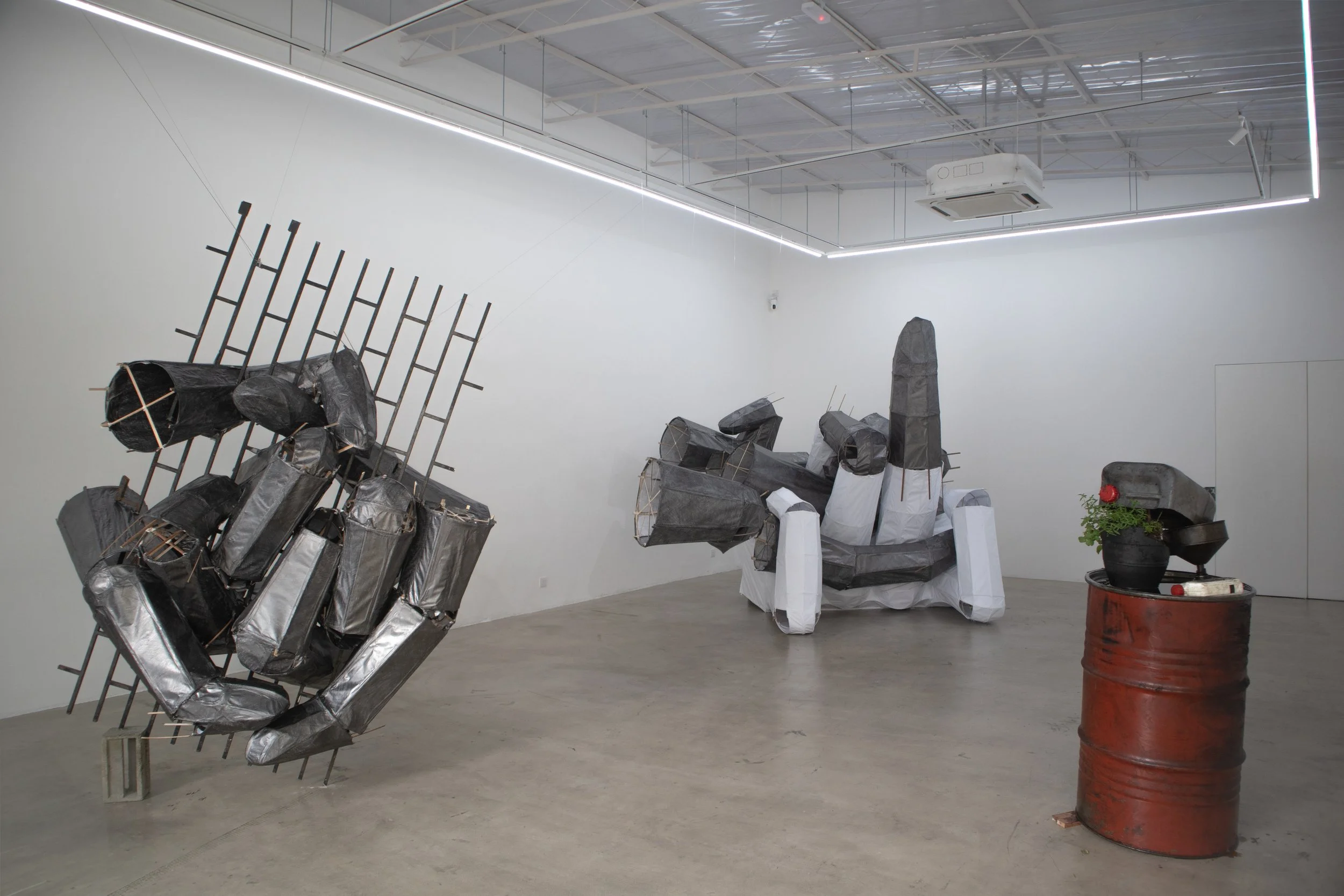
He An, A Wind-Blown Fire Needs Little Effort 因风吹火用力不多, 2026, exhibition installation view at Blank Canvas, Penang. Image courtesy of the artist and Blank Canvas.
I want to discuss the exhibition title, which is appropriated from a common saying. Within the context of this show where there are paper effigies, it evokes a vivid imagery in my mind. This is my interpretation of the title.
That is the feeling I want to evoke. The mental image you described might surpass your knowledge of what the phrase means, or where it originated from. Because you know the meaning of each Chinese character in the saying, the mental image can be a common cultural vein. Going deeper, it might be related to blood ties. This saying does not work in the West; they may think it is describing a simple physical phenomenon. But why does this phrase resonate with Chinese people? Why can it create a mental image?
Although the sentence can be translated, narrated, and explained by me, what you just mentioned is exactly what I want. In the context of Southeast Asia, this shared understanding might produce a certain kinship.
My experience in Malaysia is interesting because the sense of familiarity and differences come simultaneously. What I mean is that they are on a flat plane, rather than a spatial relationship. Rather than finding similarities within differences, or differences within the familiar, I feel and understand both at the same time. I have spent only three months in Malaysia thus far, so I cannot explain what is the reason behind this feeling but it is an area worthy of further exploration.
The interview was conducted in Mandarin Chinese and translated by Ian Tee.
A Wind-Blown Fire Needs Little Effort 因风吹火用力不多 is on view at Blank Canvas, Penang, from 7 March to 10 May 2026.