
Preview of Art Jakarta Papers 2026
Expanding the regional fair’s ecosystem
Art Jakarta is launching the inaugural edition of Art Jakarta Papers, happening from 5 to 8 February 2026 at City Hall, Pondok Indah Mall 3. It will bring together 28 galleries, majority of which are from Indonesia. The new fair arises from a desire to provide focused attention and develop market support for paper-based contemporary art. Director Tom Tandio situates Art Jakarta Papers in relation to growing recognition for and presence of artistic practices that prioritise paper in major biennales, art fairs, and institutional exhibitions. He says, “Through Art Jakarta Papers, paper-based artworks are positioned not only as historically, conceptually, and economically relevant, but also as works with their own distinct and inherent merits.”
By nurturing the growing market for paper works, the fair hopes to open up possibilities for a new network of Indonesian and regional collectors. “We encourage galleries and artists to challenge expectations towards paper,” Tandio adds. “All sorts of paper-based works will be presented at the fair, from drawings, prints, illustrations, photography, artists' books, to archive-based and experimental works.” There will also be a series of six panel discussions that explore a range of topics such as the position of paper in global artistic discourse, and paper conservation in a tropical climate. Building upon the main Art Jakarta fair as well as Art Jakarta Gardens, this expansion affirms the fair’s commitment to fostering depth of discourse, diversity of practice, and the sustainability of the art industry.
Ahead of Art Jakarta Papers’ debut, we speak with five participating galleries to find out about the artworks they are bringing to the fair.
kohesi Initiatives

Dede Cipon, [The Veil that Shrouds 1], 2025, pencil, coloured pencil, watercolor, acrylic, vinyl on paper, and mirrored acrylic sheets, 75 x 55cm. Image courtesy of kohesi Initiatives.
Jogjakarta-based kohesi Initiatives will be presenting works by Agugn, Dede Cipon, Riono Tanggul, Ruth Marbun, and Timoteus Anggawan Kusno, among others. One highlight are new works by Cipon, who recently closed his solo exhibition with the gallery, titled Spectral Echoes; The Side of Human (2025-26). Cipon examines how information is filtered, obscured, and transformed within digital environments. Through his handling of the tactile qualities of paper, the artist slows down the velocity of the coded world and creates space for contemplation and reinterpretation.
Director Benedicto Audi Jericho sees the fair as an opportunity to contextualise and strengthen understanding of the paper medium and its possibilities among collectors and the public. From a collecting standpoint, he remarks, “Paper-based artworks may be more accessible for new and younger collectors to engage with contemporary art, through a more reasonable artwork size and price point. Particularly in Jakarta, there is a strong potential in the first-time and second-time buyer segment for this medium, and we hope that the fair can help nurture these collectors in Indonesia.” The gallery is also collaborating with Ruang MES 56 artist collective in the SPOT section to host a live printing workshop throughout the fair, allowing participants to create their own photogram prints using objects of their choice.
ara contemporary

Aurora Arazzi, Cabinet, 2025, paper, Balsa wood, eggshell, wood shavings, dowels, glass, iron, wooden clips, coin, bottle cap, nylon string, 65 x 50 x 10cm. Image courtesy of ara contemporary.
ara contemporary will feature works by Indonesian artists Agan Harahap, Aurora Arazzi, Enggar Rhomadioni, Enka Komariah, Irfan Hendrian, Iwan Effendi, and Miranda Mazuki. The presentation includes Agan Harahap’s artist book The Border Line, a fictional work that reflects on how social and cultural boundaries shape human life amid modernisation. The gallery is also presenting a site-specific wall installation by Aurora Arazzi, which explores paper as a spatial and material presence rather than a conventional surface.
Co-founder Megan Arlin highlights the importance of paper for the artists they closely work with, who understand it as a conceptual framework integral to their practice. “In these works, paper emerges as both form and subject, activated through texture, line, color, and shape, while bearing traces of history, labor, time, fragility, and memory,” she says. “This layered engagement sits at the core of ara contemporary’s programming, opening space for narratives that invite a more attentive engagement with the work and its material presence.” She expresses the gallery’s aim of contributing to a broader exchange around how works on paper are positioned and developed within the local art ecosystem.
ROH
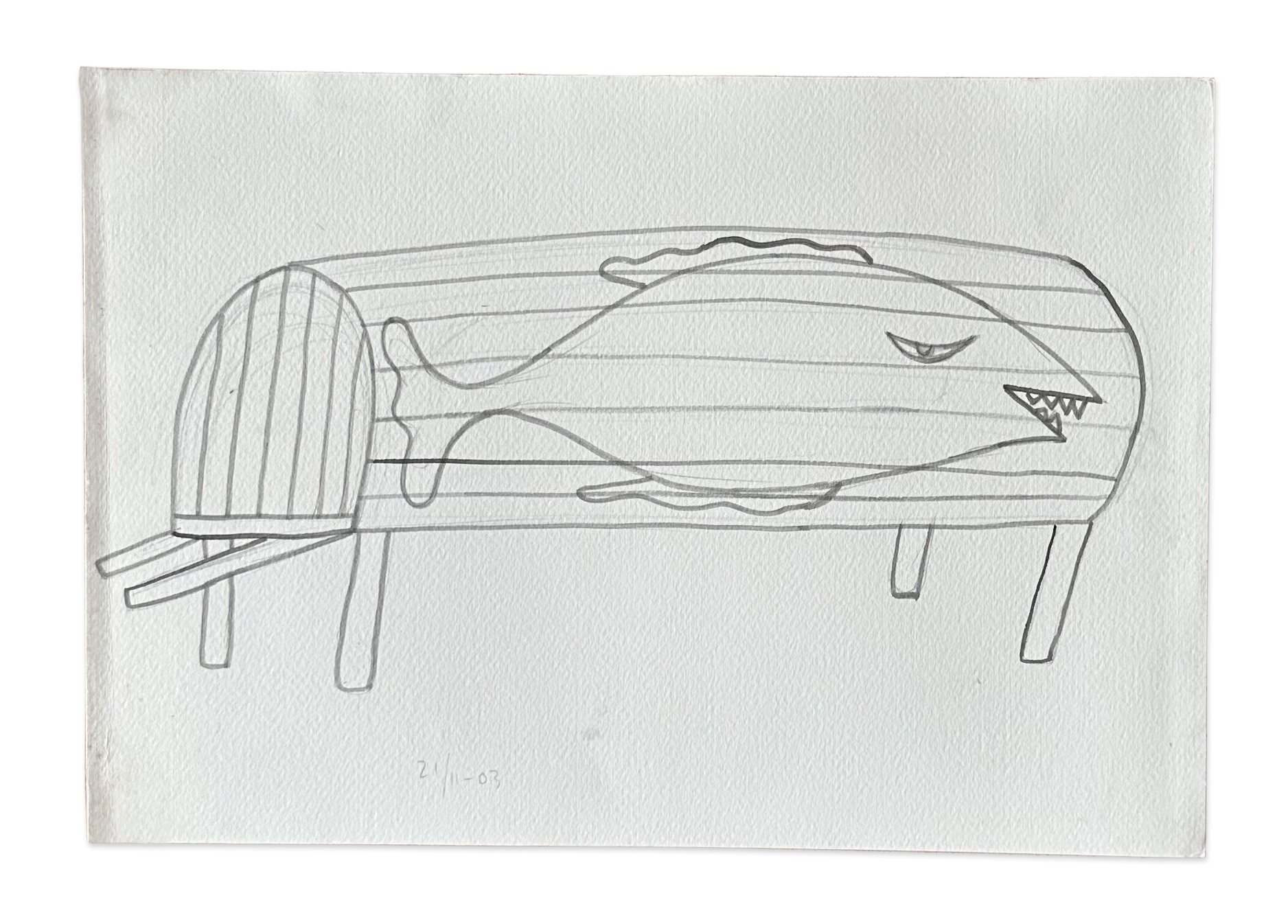
I Gusti Ayu Kadek Murniasih, Untitled, 2003, pencil on paper, 25 x 36cm. Image courtesy of the artist and ROH.
ROH is presenting a selection of paper works by the late Balinese artist I Gusti Ayu Kadek Murniasih “Murni”. Though widely recognised for her paintings, Murni also produced a significant body of works on paper throughout her lifetime. Founder and Director Jun Tirtadji is excited for audiences and collectors to see this intimate side of Murni’s practice. He elaborates, “This presentation underscores how drawing functioned for her as both psychic release and record, offering diagrams of an inner world where desire, threat, and humour are explored in direct line work.”
Tirtadji also points to how paper features consistently in the gallery’s programme, through dedicated presentations and as integral components of broader exhibitions. For instance, Unbearable Lightness (2024) was an exhibition of paper works, with artists including Agung Kurniawan, Davy Linggar, Maria Taniguchi, and Syaiful Aulia Garibaldi who work with or against paper's apparent fragility to carry significant psychological and material weight.
Lanö Contemporary Art Gallery

Suarimbawa Dalbo, Nature and Protection, 2025, aluminium and paper, variable dimensions. Image courtesy of Lanö Contemporary Art Gallery.
Bali-based Lanö Contemporary brings together works that consider paper as a material shaped by cultural memory and craft traditions. Exhibiting artists include Agus Mediana ‘Cuprux’, Agus Saputra, Asmudjo Jono Irianto, Darmika ‘Solar’, Dedy Ferdian, Kadek Dwi Darmawan, Kemalezedine, Kuncir Sathya Viku, Made Chandra, Niko Wiratma, and Suarimbawa Dalbo. Aligned with the gallery’s programme that explores notions of “post-tradition”, the artworks revisit inherited forms and extend them through contemporary, material-driven experimentation.
An example is Dalbo’s textured paper assemblage that evokes organic forms and landscapes. He presents imagery of forests, the sea, or living spaces that appear fragile and under threat. For the artist, the technique of layered collage reflects a central metaphor: that a damaged natural world can only be restored through a process of reassembly. Much like scattered pieces of paper, the natural ecosystem requires a collective consciousness to be reconstructed into a new harmony.
THEO Gallery
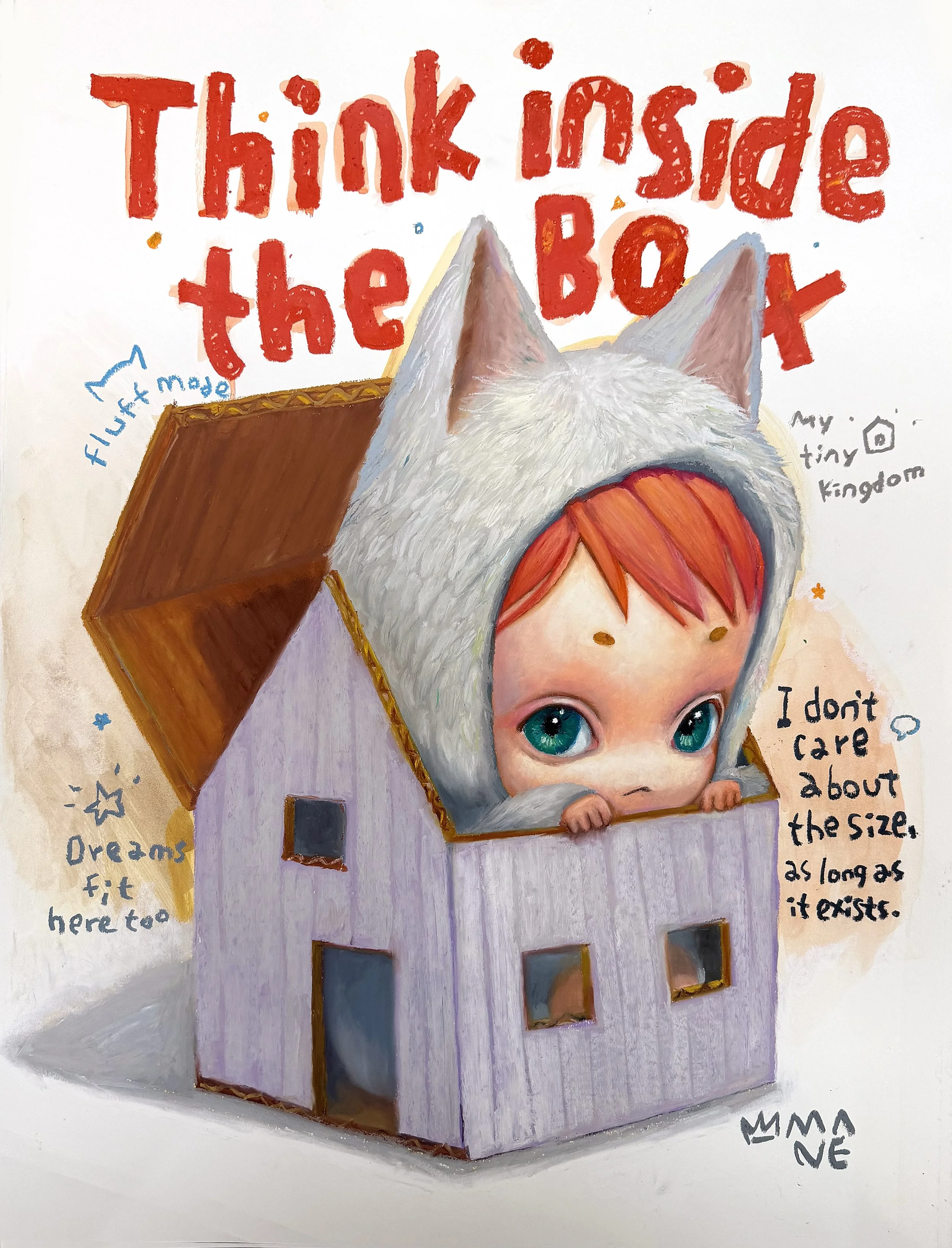
MANE, My tiny kingdom, 2026, oil pastel, acrylic on cardboard, 56 x 76cm. Image courtesy of THEO Gallery.
THEO Gallery, which has spaces in Seoul and Jakarta, will feature recent paintings by Korean artist MANE. Created directly on cardboard, the artist actively incorporates the material’s inherent fragility, texture, and traces of use into the painted image. Moving fluidly between painting, drawing, and object, the works reflect MANE’s recent exploration of the boundary between image and support, and his interest in how modest materials can carry strong visual and conceptual density.
Director Hyun Min Kim sees Art Jakarta Papers as an important platform that explores the expanded possibilities of contemporary art. He mentions that a portion of THEO’s proceeds from Art Jakarta Papers 2026 will be donated through UNICEF to support educational programs for children in Jakarta. “This decision reflects our belief that the value generated within the art market can, and should, circulate back into society in meaningful ways,” he explains. “As a gallery that operates an exhibition space in Jakarta, we feel a responsibility to remain attentive to the lives and futures of the children growing up alongside this cultural ecosystem. This contribution is intended as a modest but sincere step toward building a more sustained relationship between artistic practice, the local community, and social responsibility.”
Art & Market is proud to be a media partner of Art Jakarta Papers 2026.
Art Jakarta Papers 2026 will take place from 5 to 8 February 2026 at City Hall, Pondok Indah Mall 3. For more information, click here.