Inside the Machine: How Artists Are Disassembling the Material Politics of Technology
Bagus Pandega and Ioana Vreme Moser
Artists working with technological media increasingly confront the foundations of the systems their own medium depends on. As clean technology becomes more central to climate policies, its production has intensified demand for critical minerals such as lithium, nickel, cobalt, and silicon. While these materials promise a decarbonised and more liveable planet, their extraction and disposal reveal far less sustainable material realities. For artists such as Bagus Pandega and Ioana Vreme Moser, this contradiction becomes a site of critical inquiry. Through their works, the material infrastructures of sensors, processors, and memory chips are brought into sharper focus, along with the social and environmental conditions that bear the weight of technological overproduction.

Bagus Pandega, L.O.O.P. (Less Organic Operation Procedure), 2026, programmed motorised conveyor machine, tropical plants, nickel ore and customised electrical biofeedback receiver, dimensions variable. Collection of the artist. Image courtesy of Singapore Art Museum.
Bagus Pandega’s work L.O.O.P. (Less Organic Operation Procedure) (2026), on show as part of Nafasan Bumi ~ An Endless Harvest (2026) at the Singapore Art Museum, vividly materialises the relentless nature of mining economies sustaining technological development. Pandega’s looped conveyor belt of nickel ore pellets traces the mineral’s journey from its red earth mining sites in Sulawesi, Indonesia, to industrial smelting and large-scale fabrication. Focusing on a key Southeast Asian mineral, the work compresses the over-harvesting of finite resources and habitats into a brutally poetic, singular, infinite circuit.
Mimicking the motorised belts used for the transportation of ore across extraction and processing points, the work’s ten-metre conveyor structurally enacts the mining mechanisms enabling rapid unchecked economic growth. In the case of L.O.O.P., however, the system logic and speed are organically reconfigured. In a botanical switchover, agency is instead redirected to the tropical plants growing within the conveyor system, enabling them to influence the belt’s turning speed via a customised electrical biofeedback receiver. Once part of the extractive cycle, the plants’ states of agitation and relaxation now direct the pace. Blending botanical agency and machine rhythm, the work introduces a slower-paced rest-and-response framework which considers the necessary downtimes for environmental regeneration. At intervals, the ore fragments drop into metal sorting basins, marking the passing of time with their clanging before repeating the same journey.

Bagus Pandega, L.O.O.P. (Less Organic Operation Procedure), 2026, programmed motorised conveyor machine, tropical plants, nickel ore and customised electrical biofeedback receiver, Dimensions variable. Collection of the artist. Image courtesy of Singapore Art Museum.
Nickel’s properties, from its structural flexibility and oxidation resistance to high recyclability, make it a critical metal in the transition to net-zero emissions. The move from fossil fuel-powered technologies towards renewables is steadily increasing nickel’s annual demand and could continue to do so fivefold by 2050¹, given its use in the production of solar panels, wind turbines, and green hydrogen. But the price of this green economy is anything but green for the territories involved. From Congolese cobalt and Argentinian lithium to Indonesian nickel, global mining fuels the technology of our time. Smart devices, high-speed data channels, artificial intelligence all rely on the cycles of mineral extraction that Pandega’s L.O.O.P stages. Its continuous circulation of nickel ore pellets performs a self-perpetuating production without product. Such routine extraction practices accumulate pollution that is borne by Indonesia’s ecologies. Air is clouded with sulphur dioxide, nitrogen oxides, and coal ash from processing factories in Morowali. Earth is overturned in excavation sites around North Konawe. Water is contaminated by industrial runoff in Kabaena, rendering shorelines and seawater uninhabitable as fish are displaced to deeper waters and fishing communities' livelihoods collapse.
“But the price of this green economy is anything but green for the territories involved. From Congolese cobalt and Argentinian lithium to Indonesian nickel, global mining fuels the technology of our time.”
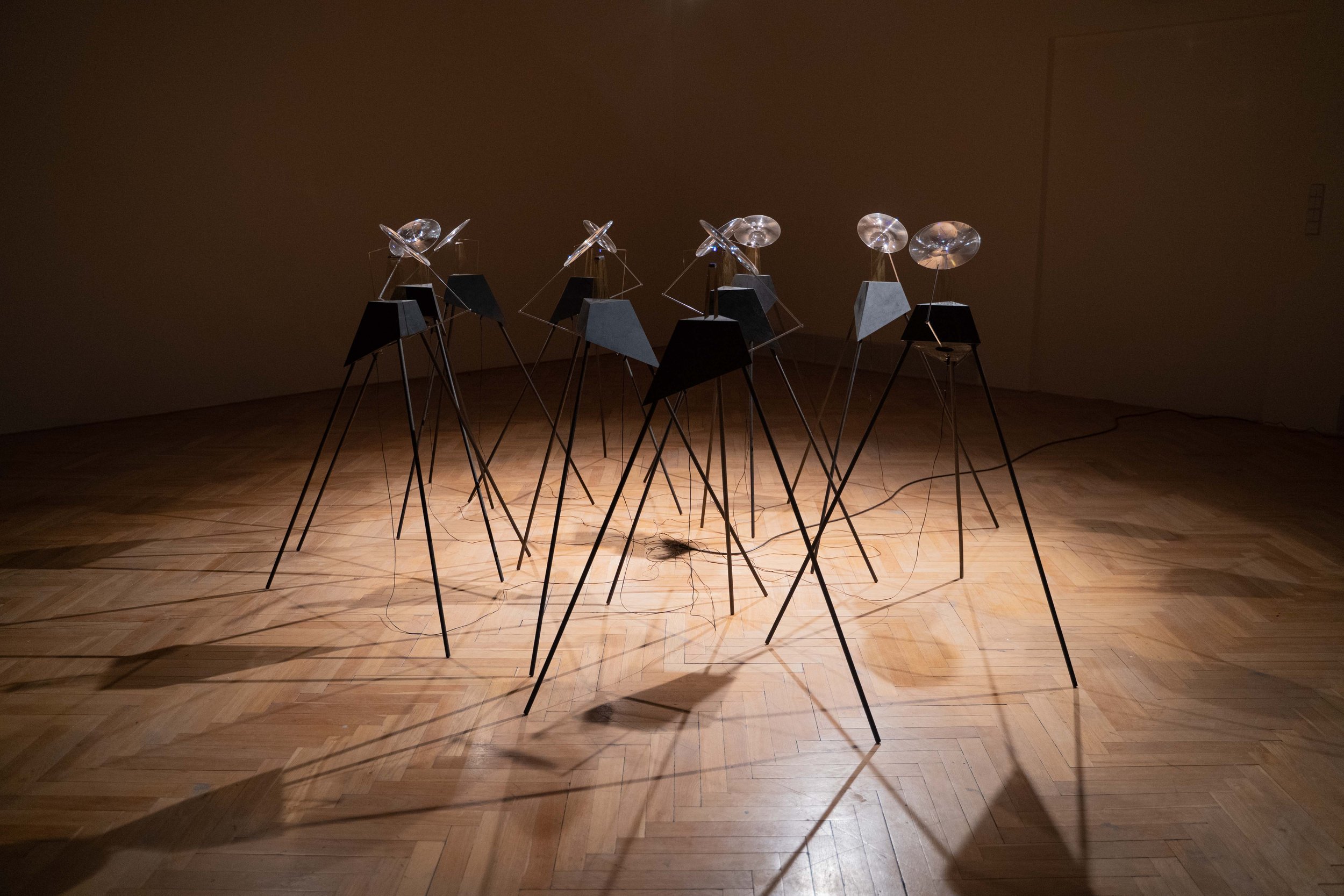
Ioana Vreme Moser, Mineral Amnesia, 2023, durational sound installation, 13 objects, 13 EPROMS, dimensions variable. Commissioned by Simultan Association (RO) and Galerie Nord (DE). Curated by Levente Kozma, Carsten Seiffarth, Veronika Witte; technical support by Dorian Largen; assisted by Alin Rotariu, Gloria Vreme Moser, Theo Vreme Moser; woodwork by Alex Matusciac. Image courtesy of the artist.
Where Bagus Pandega’s work reveals the extractive origins of technological materials, Ioana Vreme Moser turns to their abandoned afterlives. In Mineral Amnesia (2023), presented at the Prix Ars Electronica 2025, Vreme Moser conjures the ghosts of past technologies as data-bound sound carriers of loss. The work’s thirteen salvaged EPROM chips, each storing between eight kilobytes and one megabit of decades-old memory, function as vanishing data repositories. Arranged as a field of asynchronously activated units, the chips emit sounds ranging from partially coherent conversational snippets to indecipherable static, depending on the extent of erasure in their encoded data. This orchestrated decay occurs through tiny ultraviolet LEDs exposing the chips’ silicon memory to light, irreversibly altering the stored data with each exposure. The declining coherence of the chips’ audio output echoes growing incompatibilities between past and present formats.
By bringing early computing hardware back into operation, the work reflects how the conditions that produce technological advancement simultaneously generate its accelerated obsolescence. As formats fall out of use, the hardware that carries them is discarded. This leaves behind vast quantities of e-waste containing unretrievable historical and personal data, in what has come to be described as the digital dark age. Mineral Amnesia brings this in-built auto-obsolescence of technology to life, as pioneering hardware is rendered a mute relic by its own speed of development and deterioration.
“Mineral Amnesia brings this in-built auto-obsolescence of technology to life, as pioneering hardware is rendered a mute relic by its own speed of development and deterioration.”

Ioana Vreme Moser, Mineral Amnesia, 2023, durational sound installation, 13 objects, 13 EPROMS, dimensions variable. Commissioned by Simultan Association (RO) and Galerie Nord (DE). Curated by Levente Kozma, Carsten Seiffarth, Veronika Witte; technical support by Dorian Largen; assisted by Alin Rotariu, Gloria Vreme Moser, Theo Vreme Moser; woodwork by Alex Matusciac. Image courtesy of the artist.
Developed in 1971, EPROM was one of the first erase-and-reuse memory chips. Having replaced prior write-once chips, it was itself soon superseded by newer memory formats driven by the ever-increasing demand for faster computing. Silicon semiconductors and their chips form the essential building blocks for both contemporary computing and renewable power generation, enabling the conversion of solar and wind energy into electricity for the grid. Yet their entanglement in resource-intensive and carbon-heavy supply chains further contributes to the green tech paradox. Much of the global semiconductor industry is concentrated in Taiwan, where fabrication plants, or fabs, such as Taiwan Semiconductor Manufacturing Company (TSMC), consume vast amounts of fossil-fuel-derived energy and freshwater to manufacture microchips. As chip fabrication advances, existing hardware such as Mineral Amnesia’s EPROMs is frequently scrapped. Once discarded, these chips persist as e-waste, leaching into soil and water as one of the fastest growing global waste streams, projected to surpass 80 million tonnes by 2030. As sites of e-waste processing, Nigerian landfills, Ghanaian dumping grounds, and Southeast Asian informal recycling networks increasingly become wastelands of the forgotten in pursuit of the next “next”.
By materialising both extraction and afterlife, Pandega and Vreme Moser reveal different stages in the lifecycle of contemporary technologies from within the medium itself. The nickel conveyor belt in L.O.O.P., and the silicon microchips in Mineral Amnesia embody a paradox of expanding resource depletion even as they are heralded as crisis solutions. While improved speed, performance, and cost reduction are celebrated in technological and economic contexts, these artists show the environmental and social costs embedded in the materials we mine, process, and ultimately discard to build our technology-driven futures.
Notes:
International Energy Forum (IEF). Nickel - a mineral with a challenging role in clean tech. Accessed 3 March 2026, 10:02.