Creating a Living Cognitive Archive Through Conversation
Reclaiming the concept of data
My Own Words is a monthly series which features personal essays by practitioners in the Southeast Asian art community. They deliberate on their locality's present circumstances, articulating observations and challenges in their respective roles.
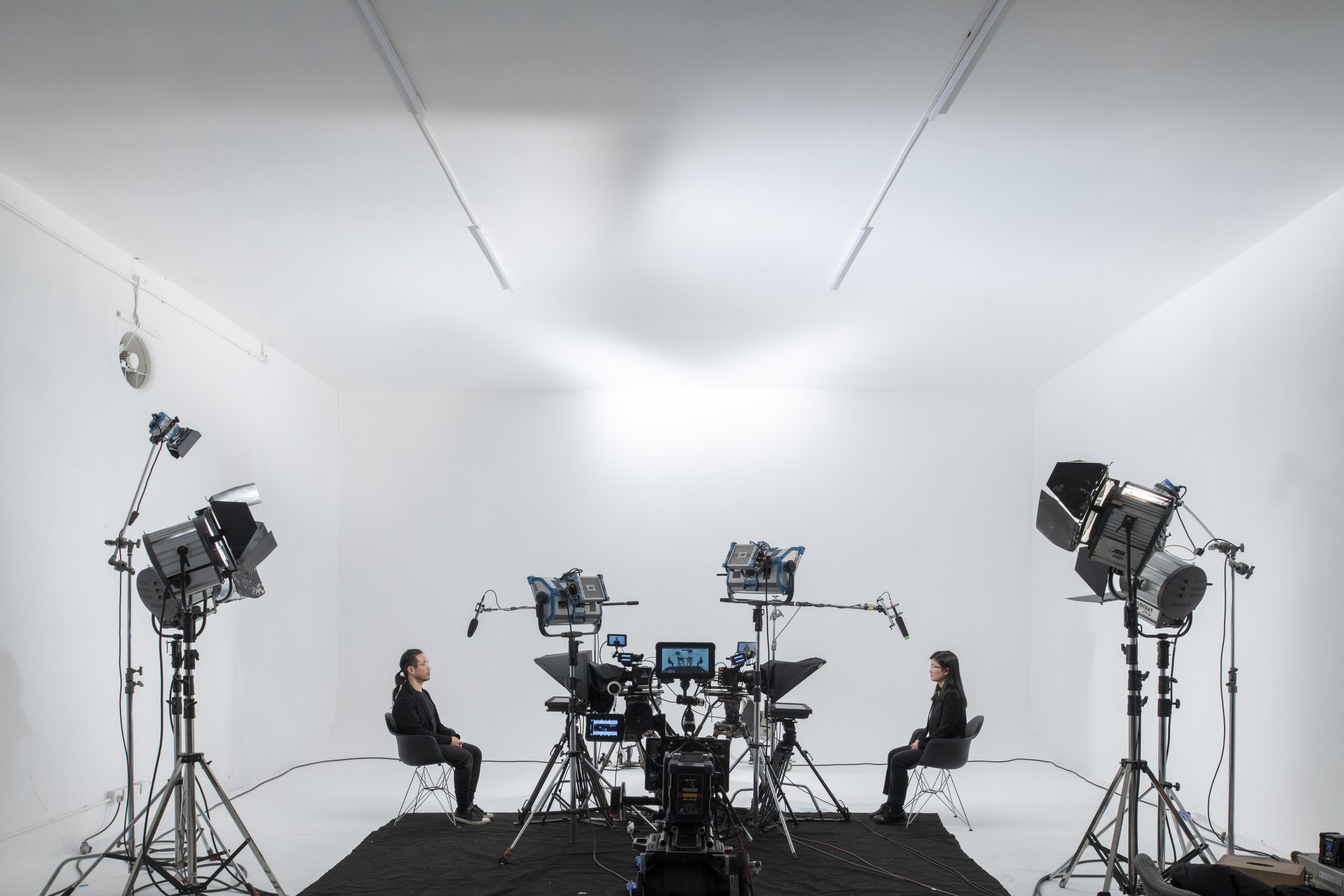
Chow and Lin, The Conversation – A Long View, 2021-2061, video and stills, variable dimensions. Image courtesy of Chow and Lin.
In 2021, when we sat down in a studio in Beijing to begin The Conversation project, we were 41 years old, a midpoint where one begins to feel the weight of years already spent. We planned to carry out the project over 40 years, a timeline based on the respective life expectancies of a Malaysia-born male and Singapore-born female, roughly 79 and 81 years old respectively. Like so many others, we were operating under a sense of profound uncertainty during the pandemic. The world had stalled, forcing us to take a step back and observe our existence. We looked at how time creates the world we live in, carving mountains while civilisations fall. In the vast stretch of history, a single human’s presence and perspective is but a fragile and fleeting yardstick.
We felt an acute sense of urgency to make the project happen. The logistics were a nightmare, navigating a team through COVID-19 lockdowns that threatened to derail our move. When we finally recorded that first 12-hour dialogue, we were relieved. We chose the dialogue duration to reflect the daily time cycle originating from ancient Egypt and Mesopotamia. It is a metaphorical rotation that allows for the exhaustion of social masks, where one moves beyond polite surface-talk into a territory of fatigue where unfiltered versions emerge.
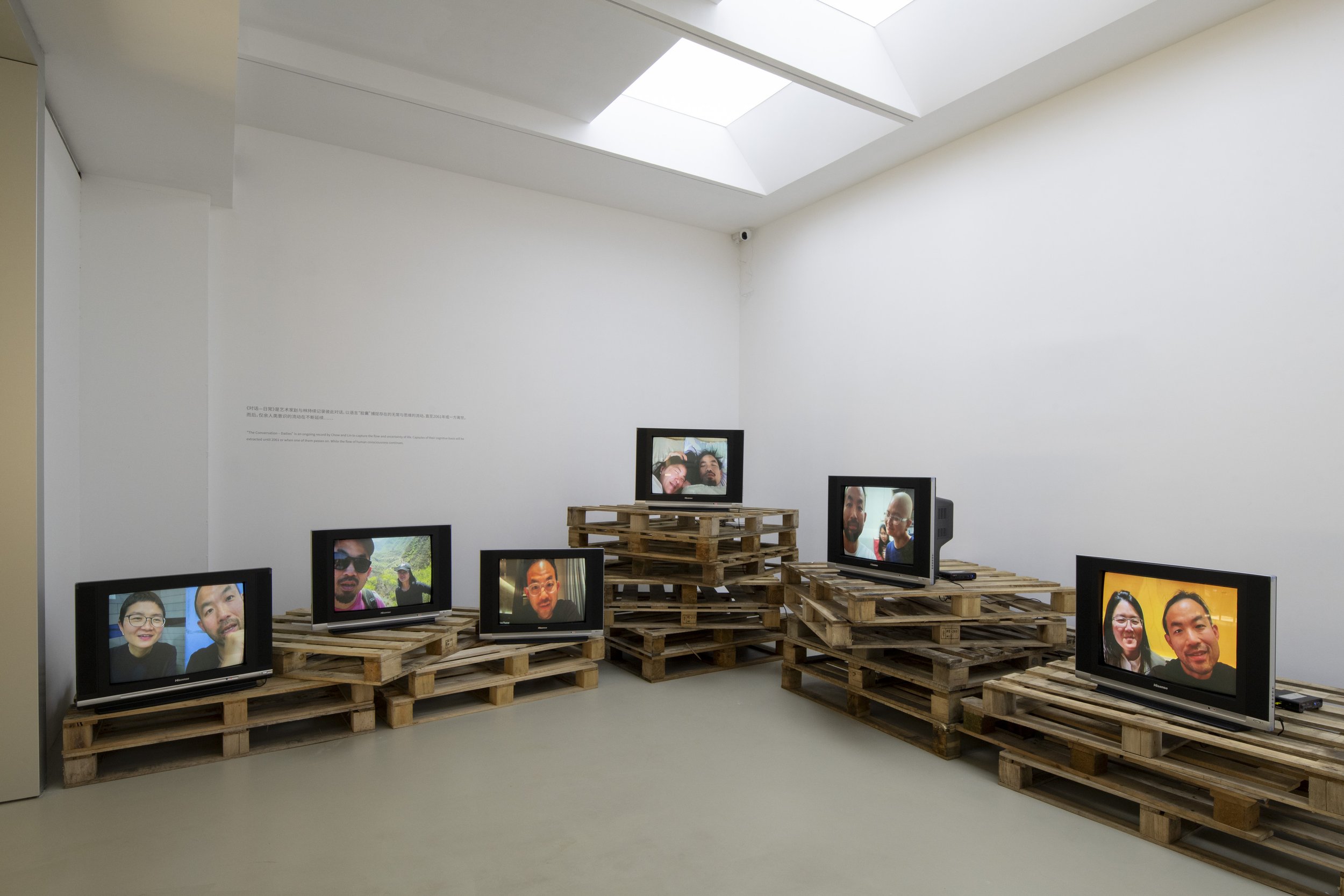
Chow and Lin, The Conversation – Dailies, 2021-2061, Video Installation at Even If It Looks Like Grass – Chow and Lin Solo Exhibition At Bounded Space Gallery, Beijing, 2025. Image courtesy of Chow and Lin.
Complementing the formal structure are our everyday exercises. The Conversation – Dailies are informal, recordings of a minute or two on the go. These are the immediate happenings from our day: mundane updates, reflections or disagreements. While the 12-hour session The Conversation – A Long View is deep synthesis, Dailies are the unpolished, unpredictable pulses running in parallel.
Central to this process is the technological structure we have built around our intimacy. It becomes a rigid framework for viewing the humanness of the subjects. In a digital era defined by algorithmic feeds, the digital video and audio archive becomes an authentic, objective reference contrasted to our emotional subjectivity. It grounds memory in the physical, aging body rather than the "cloud". We resist the now-or-never culture of the internet, prioritising depth and accumulation.
The Conversation is a pivot from our previous societal projects, such as The Poverty Line, which looked at global systems through a wide lens. We apply the same rigorous methodology to a microsystem: marriage. It reclaims the concept of data, using 40 years of speech as a cognitive archive to understand the changing of human values. This is akin to longitudinal qualitative research, capturing how people negotiate life transitions in real-time. By recording for 40 years, we eliminate recall bias, catching raw reactions as they happen. It provides a "thick description" of human evolution that a one-time interview could not achieve.
“We apply the same rigorous methodology to a microsystem: marriage. It reclaims the concept of data, using 40 years of speech as a cognitive archive to understand the changing of human values.”
Having spoken to each other daily since the 1990s, we were naïve enough to think things would stay the same. We did not expect mortality to knock quite so early. Only three years into the project, Lin was diagnosed with cancer. It was a stark reminder that life is unpredictable; whatever we intend to do tomorrow may not come through. Suddenly, the work became valuable because it was made in a time that cannot be reclaimed. This period forced us to confront the commitment to keep the recorder running, tracing the rawness of the bond through crisis.
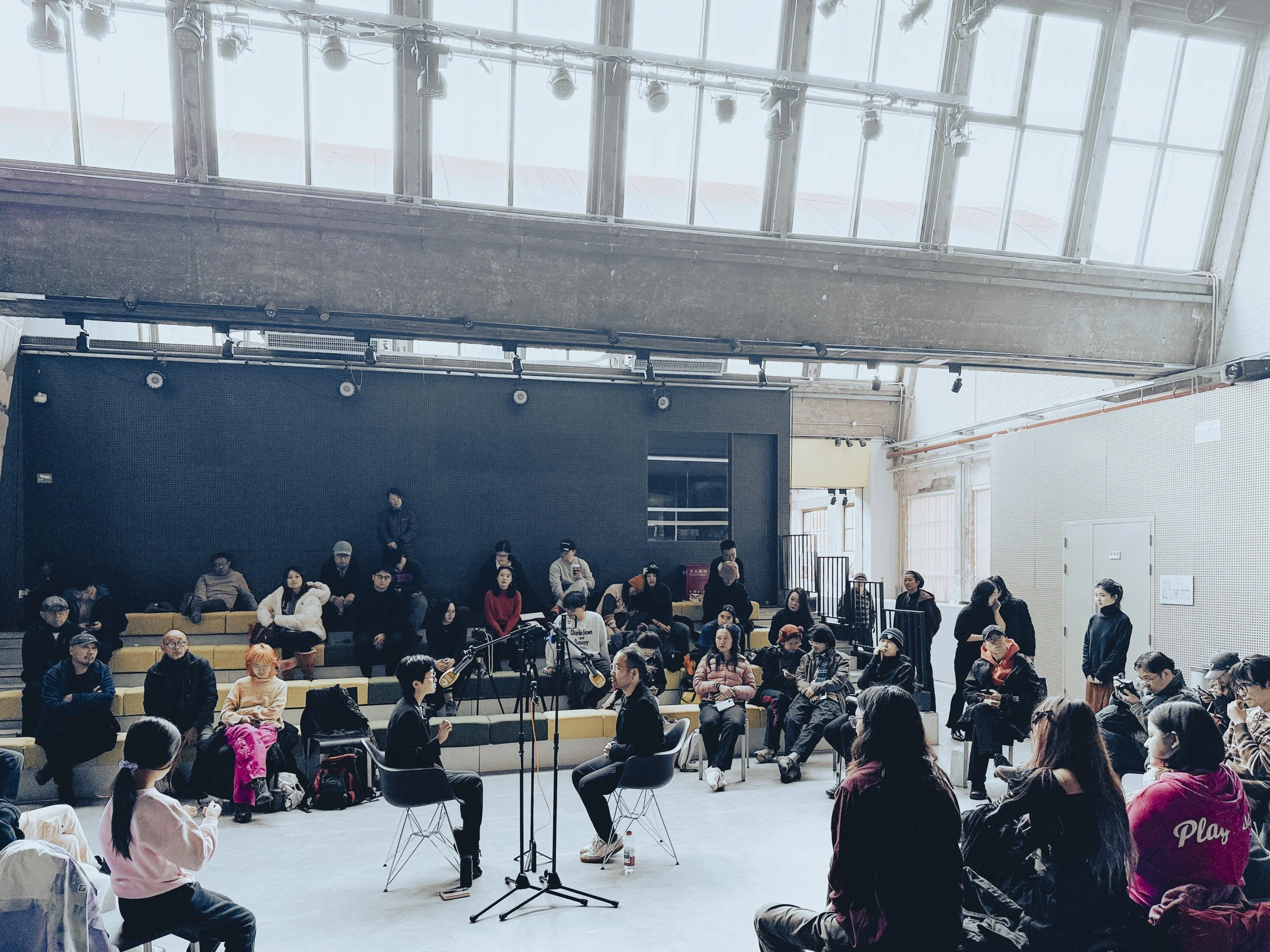
Chow and Lin, The Conversation – Live Performance, 2025, presented as part of Lost Contact (2025) at Goethe-Institut China, Beijing. Image courtesy of Chow and Lin.
In December 2025, we brought this private archive into the public sphere with a four-hour live performance at the Goethe-Institut China in Beijing. Curated by Karen Lin and Cora Luo of Social Practice Lab as part of the Lost Contact project, more than 50 people attended in person, with a few staying for the entire duration. There were also thousands of views online, extending into a digital collective. The format was fluid; audience members could join or leave anytime. We pre-released topics for each hour, which included identity, mental health, AI and capitalism. For the last 15 minutes of each hour, we opened the floor, welcoming thoughts and questions.
The questions from the audience catalysed deeper reflection and connection. Someone asked if we had considered filming our daily lives instead. Another asked if any topics were “too personal” for the performance. One participant noted the performance felt like marriage counselling in a time where many were fearful about love. These observations showed the project's ability to touch upon universal anxieties and curiosities.
The work connects to contemporary art movements we respect, such as life-art and relational aesthetics. We align with the durational rigor of Tehching Hsieh, the "Maintenance Art" of Mierle Laderman Ukeles, and the confrontational endurance of Marina Abramović. While Abramović uses silence to test limits, we use speech and time as a dimension of life to test the bounds of shared existence.
From a linguistic perspective, the project is a massive, evolving corpus. Diachronic analysis allows us to see how language changes over time. Tone and metaphors shift as societal changes, political movements or technological shifts "leak" into our private vocabulary. This shows the porous boundary between the public world and private speech. In a world dominated by AI-generated content, this project stands for human-to-human authenticity, looking for "proof of life". Our unique quirks and moral stances, peculiar to our individual selves, is also found in every other human being. We are different, yet similar.
We are mapping how a shared reality is constructed against global and personal shifts. We find ourselves walking a path similar to Felix Gonzalez-Torres in Untitled (Perfect Lovers), using the "space between" two people as our primary material, grounded in dialogic aesthetics. While his clocks eventually fall out of sync, our daily recordings attempt to stay in rhythm, acknowledging the inevitable impermanence of our bond. We look forward to the next 35 years of the project, including our upcoming long-form recording A Long View in 2031. The Conversation is an exercise of radical patience to understand what it means to be human through these times. It is a breathing vessel that holds our emotions and slippages with honesty and compassion.