Five Must-See Exhibitions at Singapore Art Week 2026
chapalang, The 6th VH Award Exhibition,
Reworlding, Exposure_Exposure, Turning Points III
A cornerstone of Singapore Art Week 2026 (SAW) is the gathering of diverse practices and presentations that will set the tone for the region’s art programming in the year ahead. With more than 160 programmes happening in this 10-day festival, here are five must-see SAW projects that are distinctive in their approaches and meaningful in their discourse. These exhibitions are pitched at different cadences, moving from key international collaborations featuring innovative frameworks, to independent local productions rife with tongue-in-cheek concepts and artistic triumphs.
chapalang, Artspace @ Helutrans
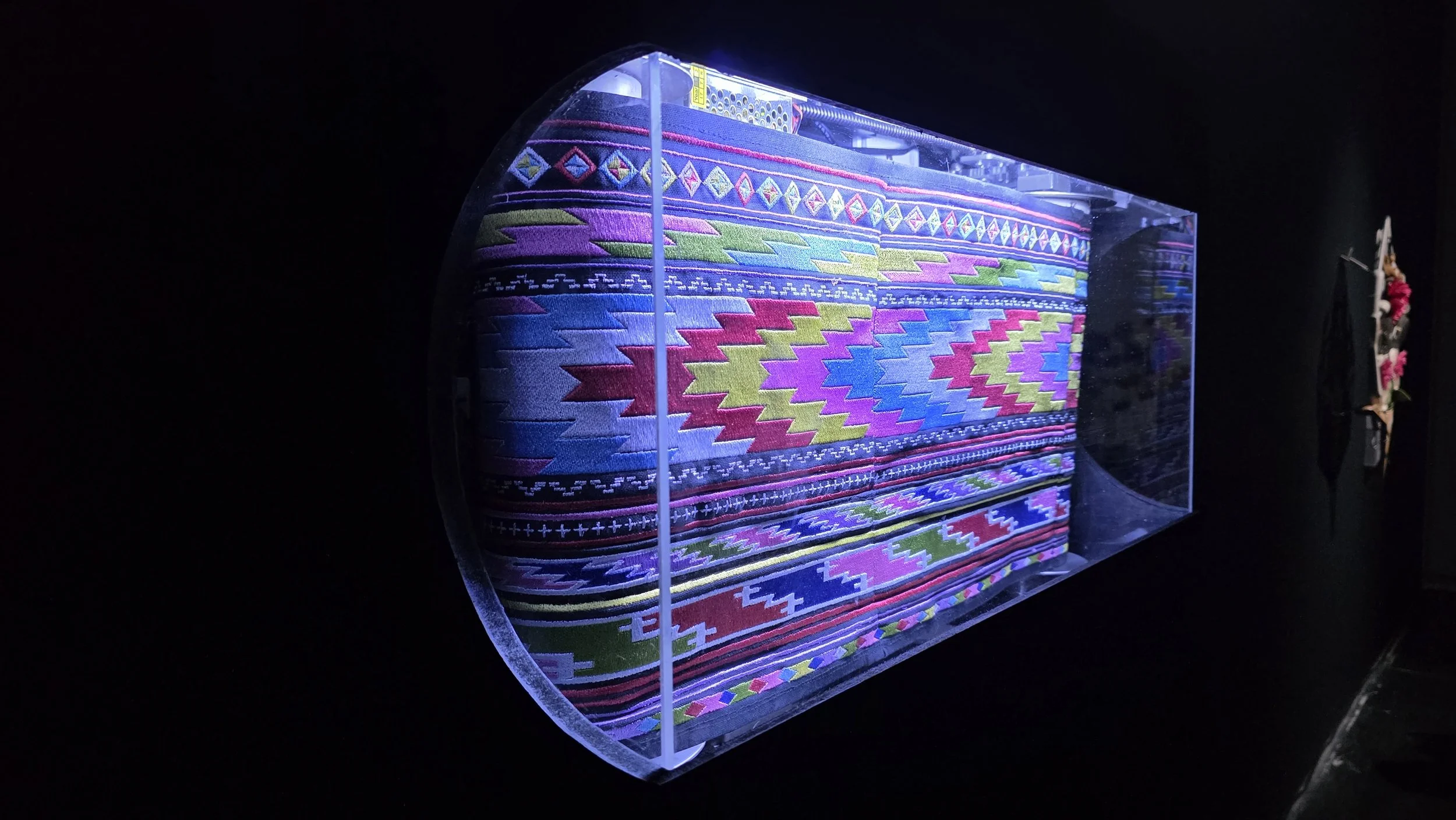
Witaya Junma, Textile Story, 2018, pattern embroidered fabric, custom made rotor, stroboscopic lamp, variable dimensions. Image courtesy of the artist.
Part of what makes SAW compelling is its ability to attract inventive projects that pioneer off-kilter research. Emphasising this spirit of oblique connections is chapalang, curated by art theorist Gunalan Nadrajan and multidisciplinary practitioner Roopesh Sitharan. This unique exhibition invites audiences into new ways of seeing by pulling together the seemingly incongruous works of ten artists including Tisya Wong and Hoo Fan Chon. The title takes from the Hokkien dialect phrase, jiak pa lang, meaning “to have had one’s fill”, and typically refers to a random and chaotic assortment of objects put together. However, the exhibition frames haphazardness as a clever strategy in ensuring individual freedom within restrictive networks. Against the backdrop of burgeoning interest in open-source and maker movements, chapalang reminds us that unique and heterogeneous expressions can also be created within the strictures of systems.
Nadrajan and Sitharan have both chalked up a long tenure of international curatorial projects. Nadrajan’s experience includes Documenta XI (2002), Singapore Biennale (2006) and Mediating Asia (2012), while Sitharan has worked on Gwangju Biennale (2009) and ISEA2009: 15th International Symposium on Electronic Art. chapalang follows their enduring research on “hacking” and appropriating technologies. Building upon the groundwork they laid in an earlier iteration displayed at ILHAM Gallery last year, visitors can be confident in the lasting impact this current SAW presentation will have on artistic research.
VH AWARD Exhibition, Artspace @ Helutrans

Wendi Yan, Dream of Walnut Palaces, 2025, single-channel video, 10 min. 09 sec. Commissioned by VH AWARD of Hyundai Motor Group. Image courtesy of Hyundai Motor Group.
Having established itself as a strategic landing point for major art exhibitions, SAW also sees the return of the VH AWARD Exhibition for the second time. Organised by Hyundai Motor Group, the 6th edition of this award continues to champion transcultural and transhistorical perspectives from Asia. The exhibition spotlights works by the six finalists that push the boundaries of audiovisual art.
Of note is the CGI animation film, Dream of Walnut Palaces (2025) by the Grand Prix winner Wendi Yan. The film is a revisionist account of history that reimagines knowledge exchange between China and Europe in the late 18th century, using AI to turn archival images into 3D models. Taken together, the works in the VH Award Exhibition are appropriate to Singapore’s ambition as a cosmopolitan “Smart City”, tackling relevant complexities inherent to contemporary society such as ecological anxieties, spiritual displacement, and speculations on a post-human age. Visitors who are eager for sophisticated responses on our digital futures should consider this exhibition a non-negotiable during their SAW journey.
Reworlding, s t a r c h
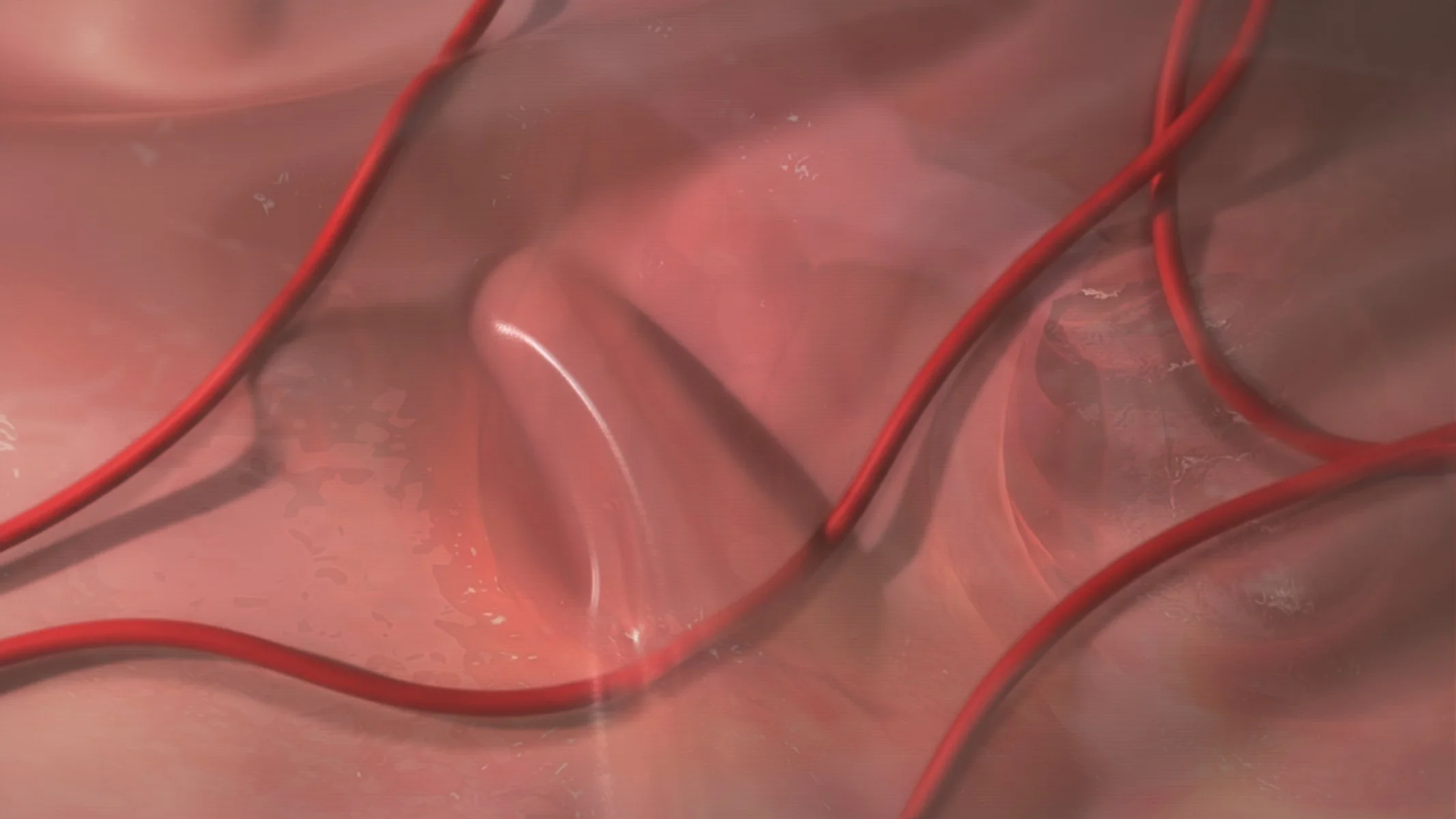
Jo Ho, Flesh Drive (still), 2026, video projection, silicone/rubber screen, audio, wires, flash drive, headphones. Image courtesy of the artist.
This year’s SAW sees a considerable number of new media art projects, and it comes as no surprise that the medium continues to have a chokehold on the artistic landscape. Reworlding offers a surprise twist to this recurrent topic through its mischievous approaches to technology. Curated by artist Debbie Ding, the exhibition brings together the multimedia works of seven Asian female artists including Priyageetha Dia and 00Zhang. They pry open technological shells, turn AI avatars inside out, and haunt modern infrastructures with the ghosts of longstanding folk practices.
Ding is well-known for her work at the intersections of art, technology and game studies, and this exhibition extends her reflexive approaches to virtuality. While the showcase is held away from the city centre, audiences who make the trip out to experience Reworlding will find themselves rewarded with an immersive and humorous display that posits relatable and achievable distortions in our everyday use of technology.
Exposure_Exposure, Objectifs – Centre for Photography & Film
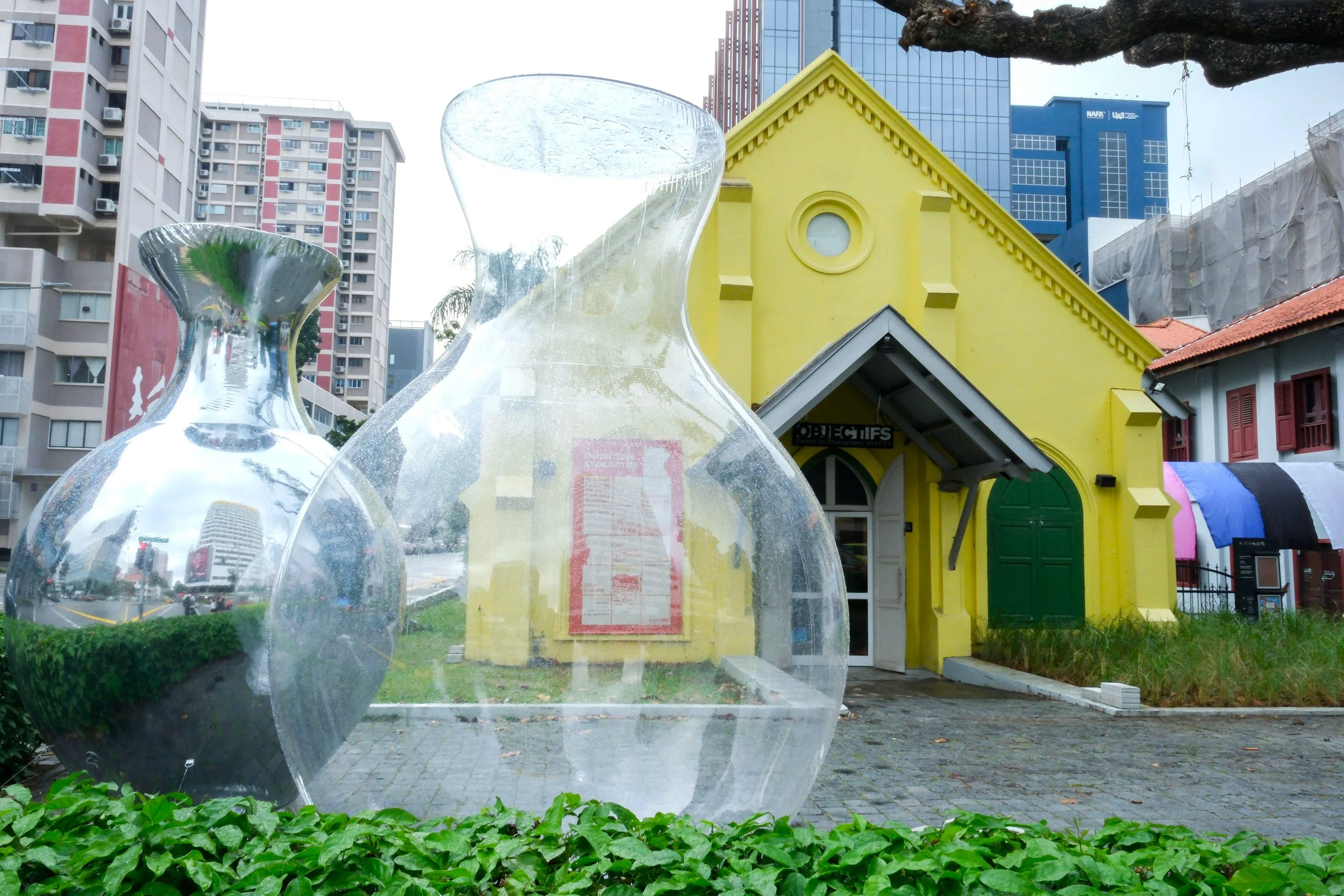
Exposure_Exposure, 2026, exhibition view. Curated by Daniel Chong and Dylan Chan. Image courtesy of Objectifs - Centre for Photography and Film.
Audiences with a penchant for locating art propagated around the island’s cityscape will have Exposure_Exposure to look forward to. Found around transitional outdoor spaces circling Objectifs – Centre for Photography & Film, this showcase curated by Daniel Chong and Dylan Chan unfolds as a constellation of public works by five artists including Chok Si Xuan and Ian Tee. Exposure is a mode of meeting, and each work introduces a different interval, transforming the facade of Objectif’s iconic yellow chapel. Tee’s coloured curtains interfere with the architecture to create a soft threshold while PG Lee has grown a patch of lalang on top of soilless cobblestone as a way to talk about the curation of nature in the city.
Beyond the usual white cube space, visitors can experience how art works transfigure when they are subject to the vagaries of daily movements in this presentation. The curators Chong and Chan have spoken of how the title has a double meaning, the first a cheeky nod to competition for attention and exposure during the hustle and bustle of SAW. It also refers to more intimate encounters, where works placed along the city’s edges rub against the everyday, shifting the way passersby sense, feel, and pivot through the space. Located along the active intersection of Middle Road and within the Bras Basah.Bugis art and heritage precinct, these public artworks bring to light both the quiet flux and frictions that persist in these urban pockets.
Turning Points III, The Arts House
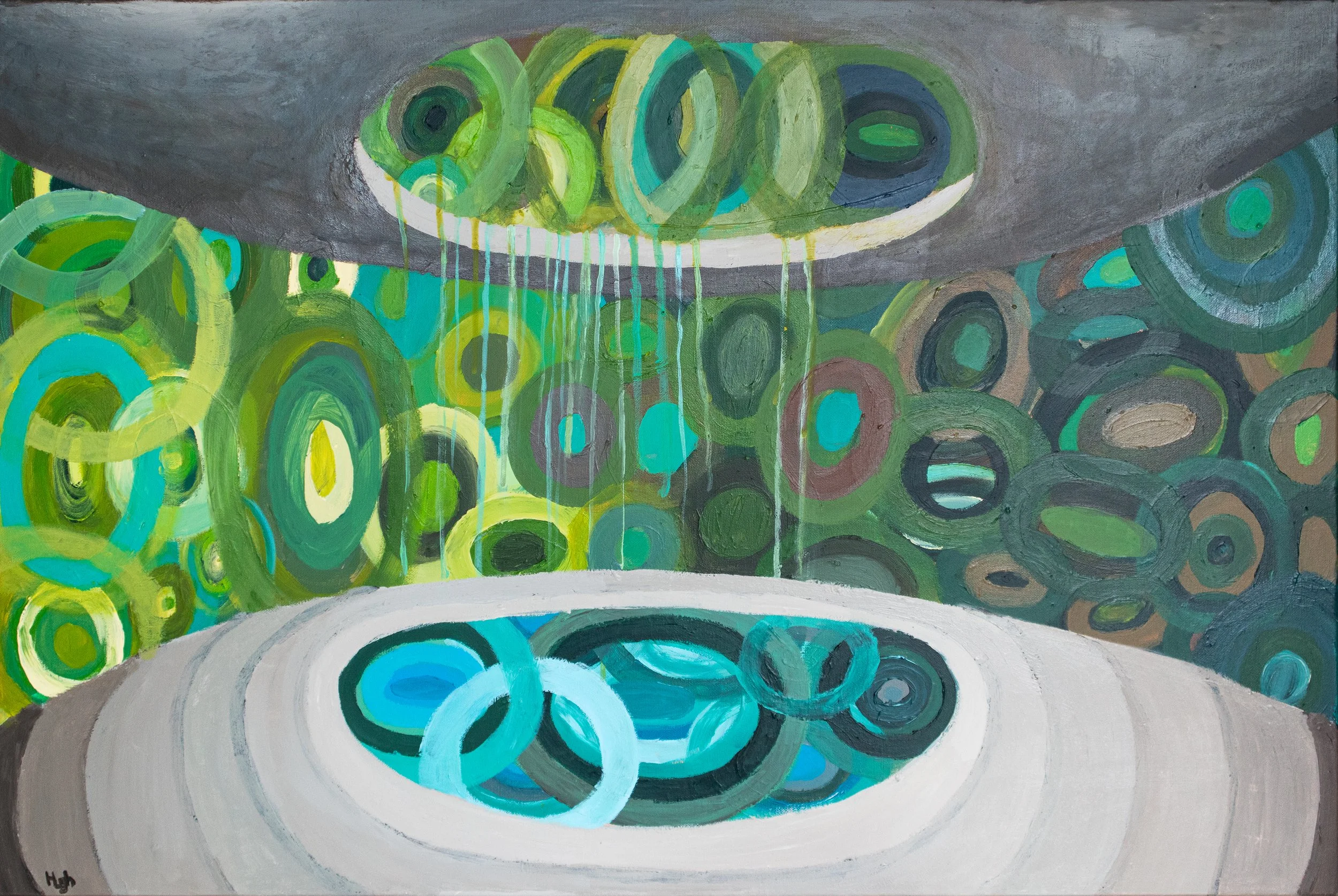
Hugh Lee, Sunken Garden, 2025. Image courtesy of ART:DIS.
Last but not least, SAW finds its true transformative power with Turning Points III. Presented by ART:DIS, a leading non-profit organisation working within the fields of arts and disability, Turning Points III is a showcase of works by five emerging artists who underwent a year-long mentorship with experienced professionals in Singapore, including Mary Bernadette Lee and Joshua Yang. The resulting output reflects a diverse range of media and interests including Hugh Lee’s boldly coloured paintings that draw from his fascination with transit spaces. Fans of ceramic art can also enjoy Zack Ling’s functional ceramic wares produced through a close study of precise forms.
This is the third and final iteration of ART:DIS’ Turning Points project. Previous editions were also presented during SAW as a strategic means of generating visibility, cultivating professional pathways and fostering recognition for neurodivergent artists. With several participants from earlier editions having taken on commissioned work or contributed to other creative projects since their mentorship, the platform is a testament to how art can be a bridge for access and social inclusion. ART:DIS’ empowering mission enriches the cultural landscape by nurturing underrepresented voices and creating avenues for their long-term development. Visitors can expect to learn more about the artists’ stories and witness how their practices have grown through the programme.
With a diversity of approaches and themes that these five SAW projects speak to, art becomes a mode of discovering different facets of Singapore and its place in broader ecosystems.
This article was presented in partnership with Singapore Art Week 2026. For more information about the projects mentioned, as well as the full SAW programme, click here.
Read our preview on Singapore Art Week 2026 here.