‘Blazing’ at Nova Contemporary and the 2026 Bangkok Art Biennale
A&M Fresh Face is where we profile an emerging artist from the region every month and speak to them about how they kick-started their career, how they continue to sustain their practice and what drives them as artists.
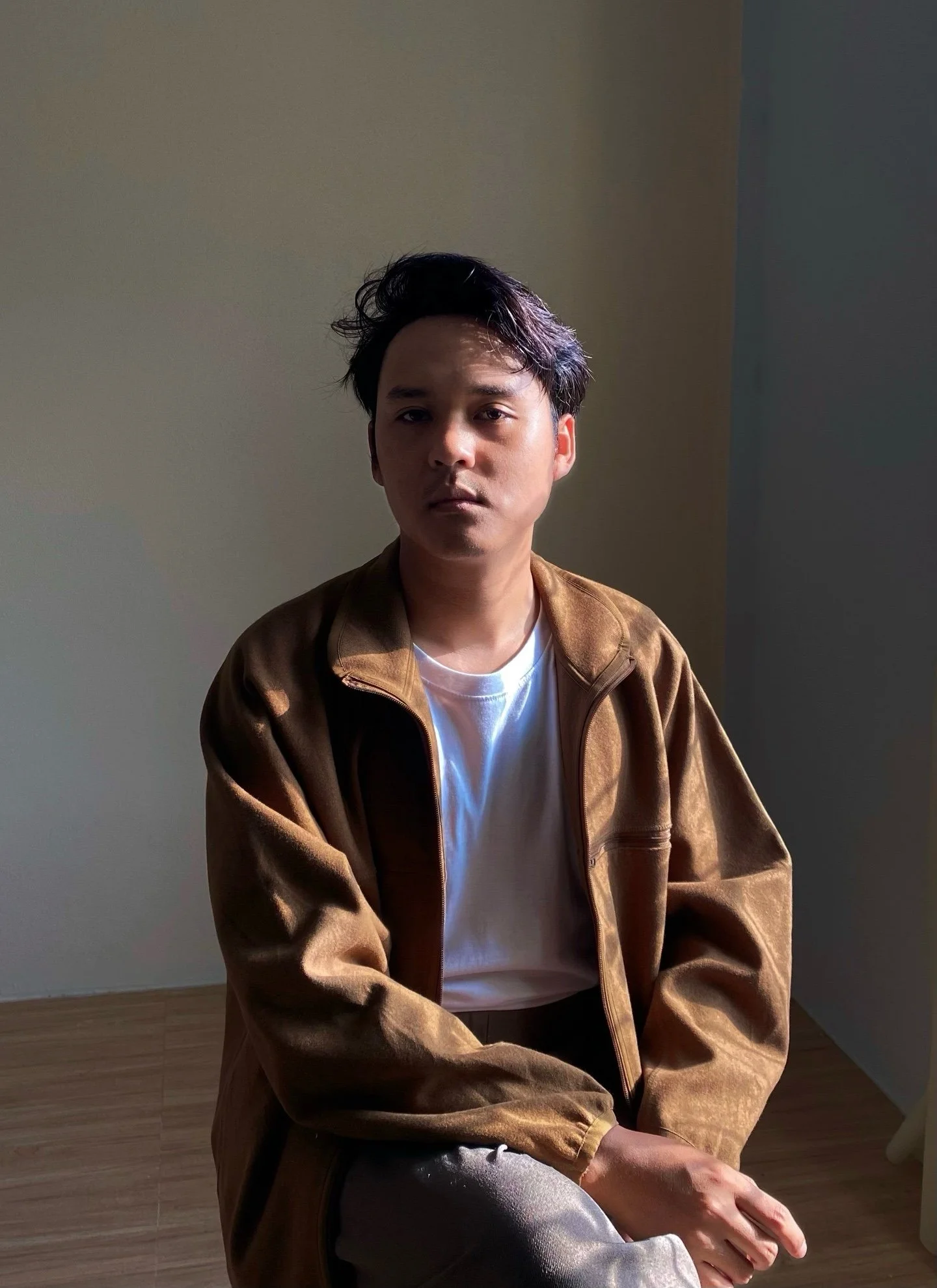
Chetsada Phuwiang, artist portrait. Image courtesy of the artist.
Chetsada Phuwiang is a Thai painter whose work draws on the lighting of queer nightlife spaces to examine the politics of body, desire and intimacy. He builds his paintings in a sequence by applying sand to the canvas as a textured base, oil paint to set tonal values and fields of colour, and airbrush to diffuse the transitions between them.
In 2023, Chetsada graduated from Silpakorn University with a Bachelor of Fine Arts in Applied Arts from the Faculty of Decorative Arts. His solo exhibitions include his self-titled debut at RATS Bangkok (2024) and Blazing at Nova Contemporary (2026). He has exhibited in group shows in Bangkok and Seoul, including the Bangkok Art Biennale this year. His work is part of the collection of Sunpride Foundation, Hong Kong.
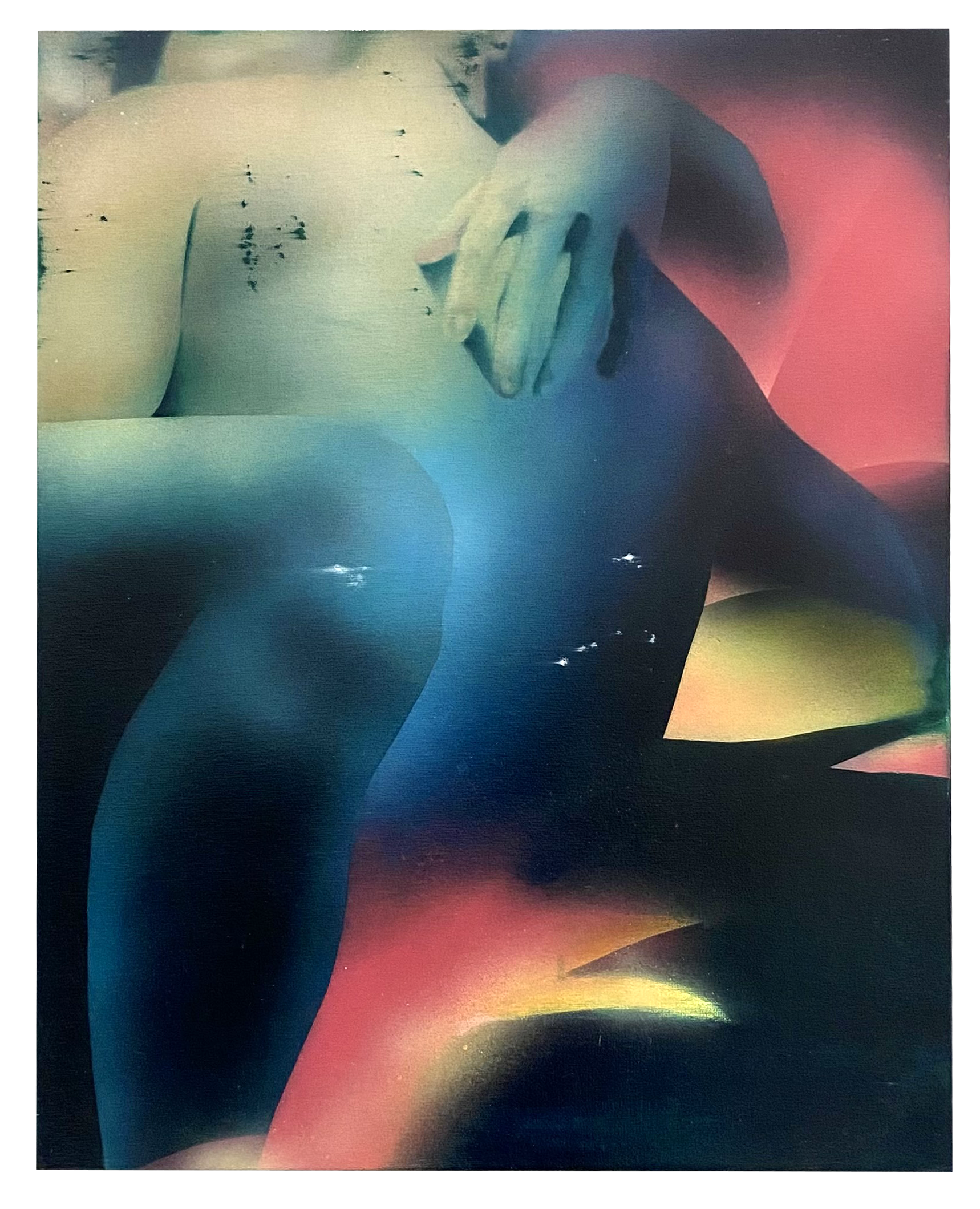
Chetsada Phuwiang, Synesthesia 1, 2022, oil and acrylic on canvas, 50 × 40cm. Image courtesy of Nova Contemporary.
Chetsada works mainly with colour and light, building tactile surfaces using sand and air-brushed paint. His early work Synthesia 1 (2022) takes its title from the condition in which one sense is experienced through another. A cropped torso is painted in muted flesh tones, with a hand resting on the hip. Below the waist, the body turns a cold blue on one side and a warm magenta on the other. In colour theory, blue reads as coolness and magenta as heat. Thus, the dual effect of surface and colour begin to suggest something felt, temperature and touch on skin.

Chetsada Phuwiang, Lime light, 2024, oil, acrylic, sand, and airbrush on canvas, 200 x 160 cm.
In Lime light (2024), shown in the group show Gold Old Neon (2024) at Nova Contemporary, Chetsada pulls the perspective back by exploring the body’s position to light, flirting with dispersion and visibility. But where light in Synesthesia 1 (2022) falls across the body and defines it, the body here is only intimated. The painting raises the question about what it means to cast a light on someone: does being placed under the light mean to be revealed? It also raises the question of agency and consent: who casts the light and does the subject want to be seen?

Chetsada Phuwiang, Blazing Exposure I, 2026, oil, acrylic, sand, and airbrush on canvas, 150 × 270 cm.
Chetsada further explores the themes of sensation and visibility in Blazing (2026), his first solo presentation at Nova Contemporary. In one of the works, Blazing Exposure I (2026), red, orange and green fields softened with airbrush almost entirely absorb the body. In the lower left is a hand, the most clearly defined form, spread flat against some type of surface or skin. Throughout his work, Chetsada explores the multivalence of exposure, photographic and personal, and tracks how it changes form in a particular light.
Interview
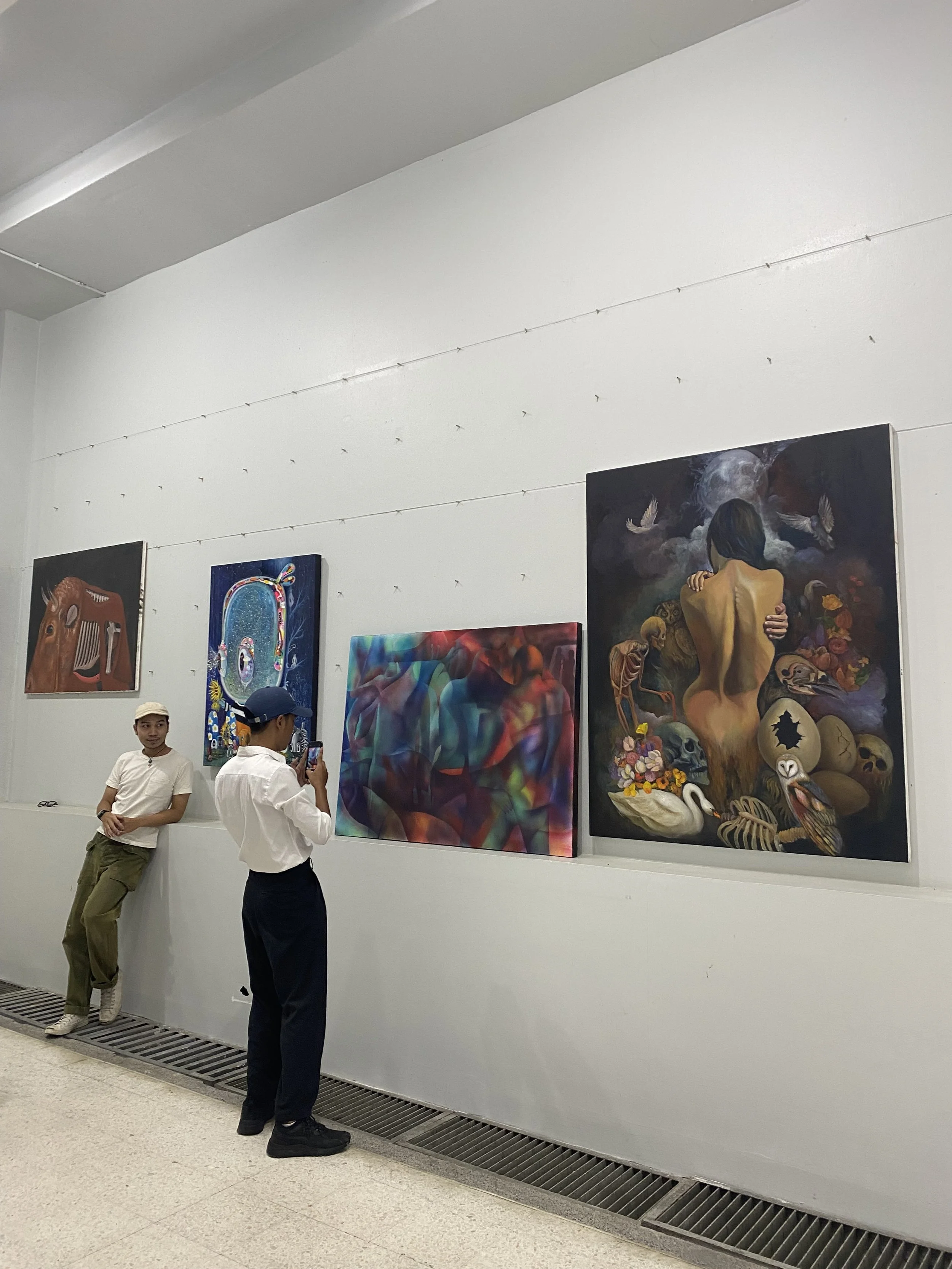
Chetsada Phuwiang at Silpakorn University. Image courtesy of the artist.
In 2023, you graduated from Silpakorn University with a Bachelor of Fine Arts in Applied Arts from the Faculty of Decorative Arts. Could you describe your experience during this period, both the education you received and the cohort you interacted with?
It was an amazing life experience, going from a kid with a passion for the arts to studying at a famous art university. On top of that, I made friends with people who shared the same passion and interests. It feels like a part of my dream has been fulfilled.
Then the COVID-19 crisis happened, which forced studies to go online. Can you imagine how boring studying art online feels? It was beyond boring. For me, I prefer drawing in a real environment, with a teacher right in front of me and real people bustling around the studio. It feels so much more alive, rather than staring at a computer screen in a boxy room at home. Eventually, I was able to return to my normal campus life, even though the situation had not improved much then.
Back in high school, people told me that once I was in university, nobody would care about me and that everyone would mind their own business. That turned out to be untrue. On the contrary, my friends in the faculty helped each other with work and had each other's backs. We might argue sometimes, but even that counts as a good memory. I did not expect that my university studies would introduce me to friends with completely different styles, yet we would get along so well.
Who has been a mentor or an important artistic influence in your development as an artist? And why?
I must admit, I spent quite some time thinking about this question. I realised that I could not really name one particular person whom I consider an idol or role model. I suppose I never thought too much about influences in that way. I knew that I wanted to study art, and I was determined to pursue it. My family initially had other hopes for me, preferring that I become a civil servant. But I was stubborn about following my own path, and it was this persistence that eventually allowed me to call myself an artist.
What was one important piece of advice you were given?
It happened back when I was still in university. The faculty invited an alumni artist as a guest speaker to share insights and future career paths. I remember someone in the audience asking him, “What’s one experience everyone should have at least once in their lifetime?” His answer made me chuckle inwardly and think deeply at the same time: “At least once in your life, you should taste the feeling of heartbreak”. Those simple words turned out to be the little spark behind many of my artworks. Although some memories and details have started to fade over time, I still vividly remember the ache of past heartbreak and what that speaker said.
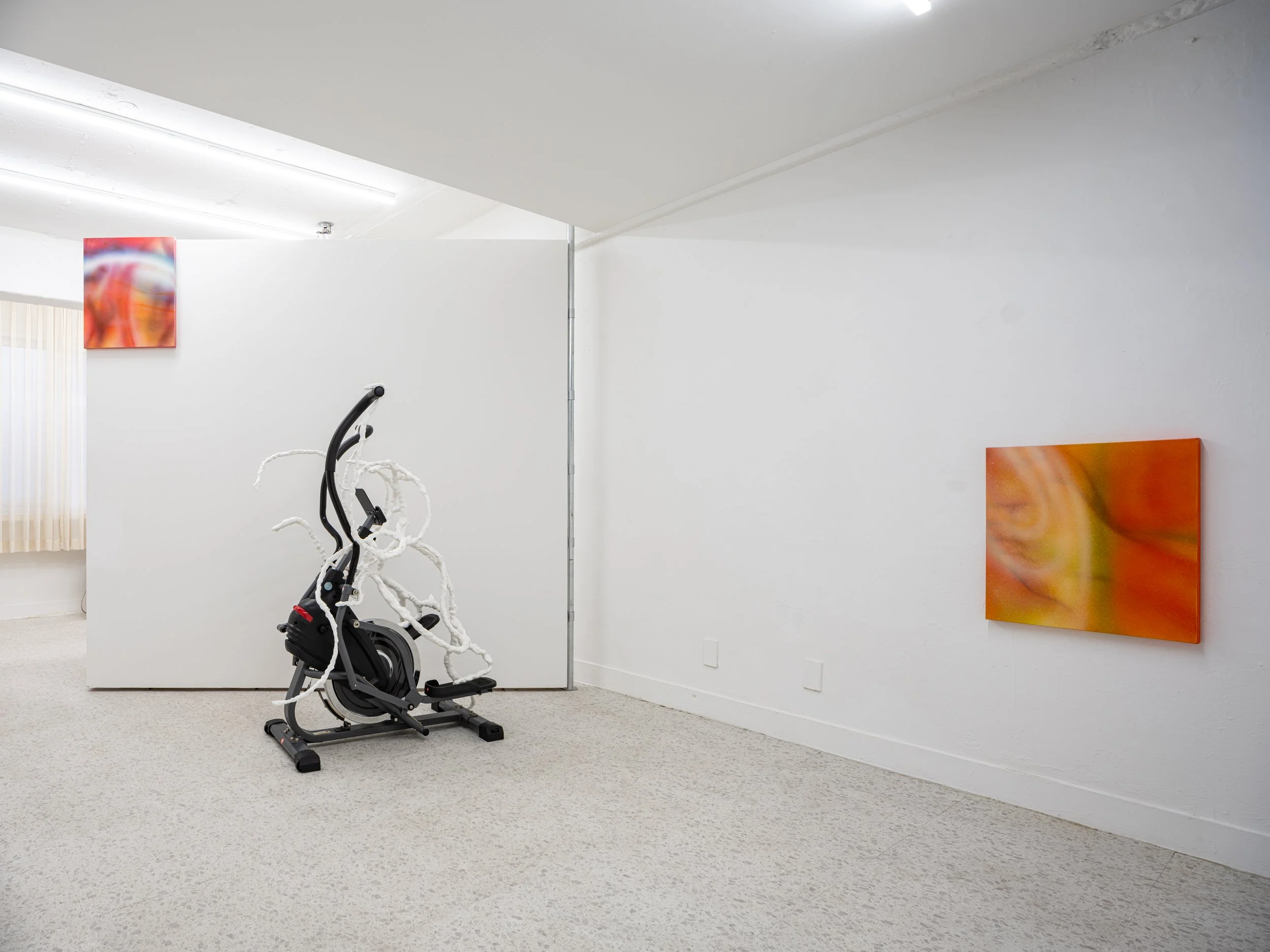
Chetsada Phuwiang, Push Pull Breath, 2025, installation view at A-O-Y, Seoul, South Korea.
Do you make a living entirely from your work as an artist? If not, could you share what other types of work you take on, and whether they inform or affect your practice?
Right now, being an artist is my full-time career, and I make a living solely from my art. Since I do not live in Bangkok and am mostly based in my hometown in Suphan Buri, the cost of living is not very high, which keeps my expenses manageable. When I am not painting, I lend a hand with my family’s business to keep myself busy while coming up with ideas for my next artwork.
Your debut solo exhibition was jointly hosted by TARS Unlimited and Nova Contemporary at RATS Bangkok in 2024, a year after you graduated. How did that opportunity come about, and what did it mean for you as an emerging artist at the time?
This began when I met Sutima Sucharitakul, founder of Nova Contemporary, at my graduation thesis show at Bangkok Art and Culture Centre (BACC). She took a keen interest in my work and eventually reached out to represent me. My journey began with the group exhibition Good Old Neon at Nova Contemporary, followed shortly by a solo show with TARS Unlimited at their second-floor project space RATS. This was made possible through a collaboration between both galleries.
Everything that has happened means the world to me. At the time, I was a recent graduate fresh out of university, with no answer as to what kind of job I should pursue. Becoming an artist had always been my dream, yet I had no idea how to reach that point. That is why receiving that opportunity holds such special meaning for me. It is not just about having a career to make a living, but the pride of finally becoming something I never quite had the confidence to say out loud that I wanted to be—an artist.

Chetsada Phuwiang, Blazing, 2026, installation view at Nova Contemporary, Bangkok, Thailand. Image courtesy of Nova Contemporary.

Chetsada Phuwiang, Blazing, 2026, installation view at Nova Contemporary, Bangkok, Thailand. Image courtesy of Nova Contemporary.
Your most recent solo exhibition, Blazing (2026), is your first with Nova Contemporary, and it coincides with your inclusion in Angels and Mara, the 2026 Bangkok Art Biennale. Could you tell us about these new works? What are the central themes and ideas they explore?
Blazing goes beyond the light we see with our eyes; it is a space where memory, feeling, and identity intersect. I am fascinated by the shifting light and colors found in both nature and nightlife that alter our perception and connect the body to our deepest desires. This body of work reflects the paradox of existing within queer nightlife spaces. It is a space that grants us the freedom to reveal our desires free from external labels, yet simultaneously exposes our vulnerability between wanting to get close to someone and fearing being truly seen. Blazing captures those moments when what is hidden within emerges under intense light, while the body remains in motion between revelation and disappearance.
For the Bangkok Art Biennale 2026, Angels and Mara, the works I am presenting reflect on the liminal state between desire and restraint. I interpret the biennale theme through the lens of queer experiences and the feeling of belonging. The paintings explore relationships as an ever-changing state through traces of touch and intimacy.
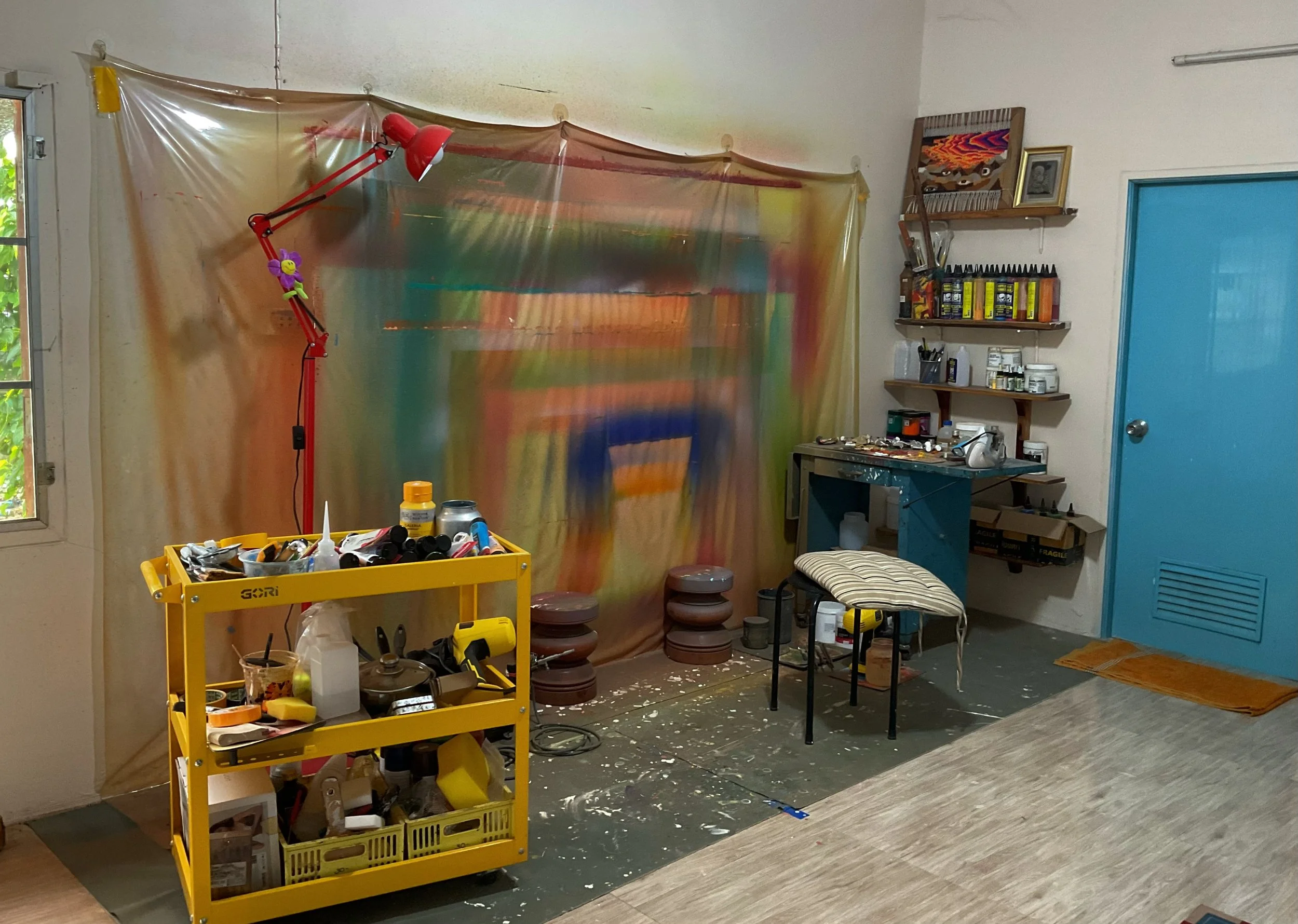
Chetsada Phuwiang’s workspace. Image courtesy of the artist.
Your paintings are built through layers of sand, oil, acrylic and airbrush, with soft gradients that recall the artificial glow of nightlife. How did you arrive at this material language?
It all began with a fascination with the light and colors I encounter in everyday life, both natural light shifting throughout the day and artificial lighting in nightlife venues. The latter possesses a distinct quality that shapes the atmosphere and alters how we perceive things under it, particularly the human body. I started translating these experiences and sensations into my painterly language by experimenting with different techniques and materials. I begin by mixing sand onto the canvas surface to build a rough, tactile texture, followed by applying oil paint to control tonal values and define color fields, and finally using an airbrush to create a diffused haze that blurs the image into soft transitions. For me, the interplay between rough texture and atmospheric spray bridges the tangible and the intangible, rendering the body as fading rather than being clearly defined. Beyond serving as visual effects, these processes are how I convey memory, emotion and desire toward the body, and a fluid sense of identity that refuses to be fixed.
“The interplay between rough texture and atmospheric spray bridges the tangible and the intangible, rendering the body as fading rather than clearly defined.”
Could you share your favourite art space or gallery in Thailand? Why are you drawn to that space, and what does it offer to you and your practice?
The first place that comes to mind is Nova Contemporary. It is also where I have come to know many other fellow artists in the contemporary art scene. Another significant venue is the Bangkok Art and Culture Centre (BACC). It is a hub that brings together diverse art forms while offering exhibition spaces and opportunities to established artists, emerging talents and students alike, helping make art accessible to youth and the general public. I first exhibited my work at BACC, and that has also given me a deep bond with the place.
What are your hopes for the Thai art scene, and for Southeast Asia more broadly?
I hope to see the art scene grow and expand further, both in Thailand and across Southeast Asia. We recognise that there is still room for greater openness towards diverse artistic expressions and identities within contemporary art spaces. That is why I envision a future where these artists can freely share their lived experiences and true selves without fear or being restricted by social norms.
I would also love to see more opportunities created for the next generation of artists, providing them with platforms to showcase their work and share ideas and experiences with fellow artists.
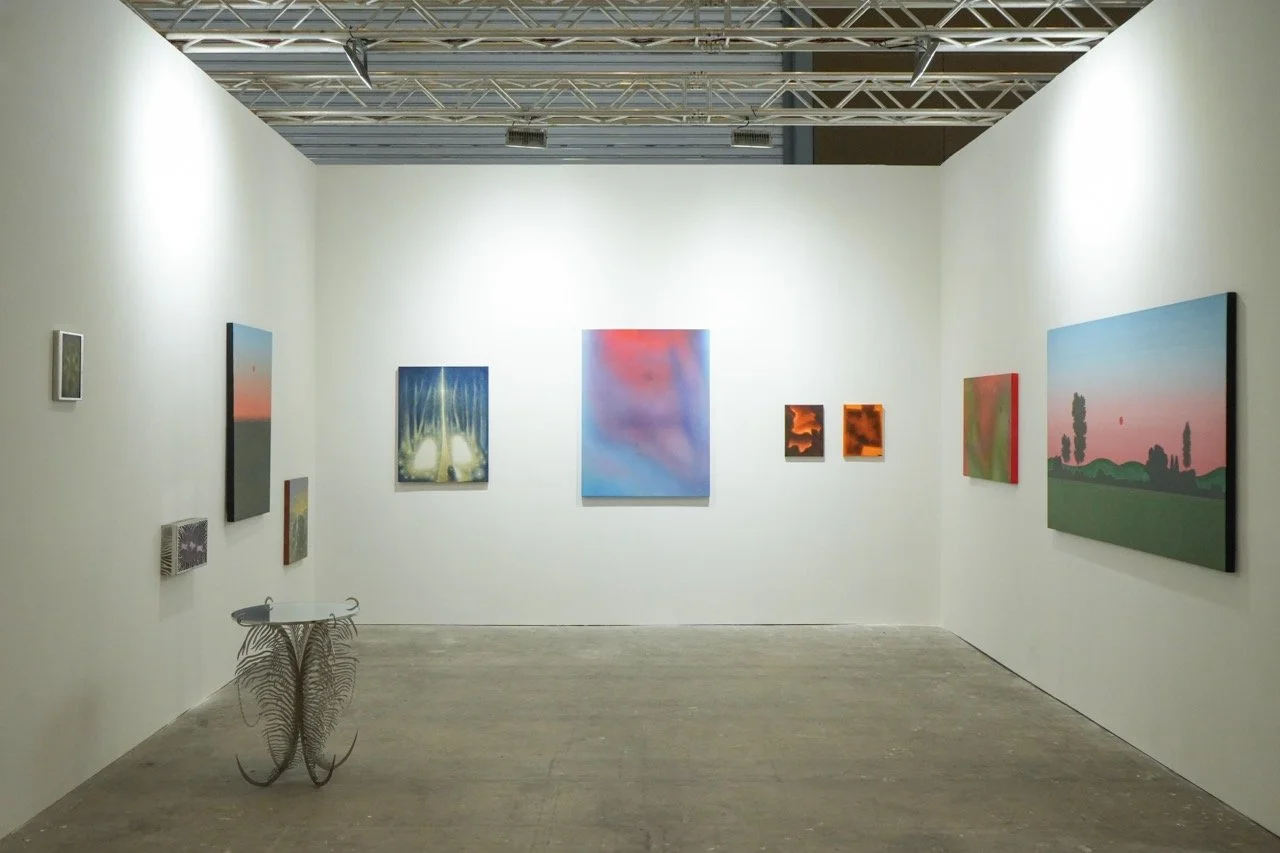
Chetsada Phuwiang, Art Jakarta, 2024, installation view.
Are there any other upcoming exhibitions or projects you would like to share?
I am focused on evolving my artistic practice and looking for fresh ideas to build upon in my future pieces. I want to experiment with different narratives and perspectives while pushing the boundaries of painting materials and processes. When the opportunity arises, I would love to exhibit my work in diverse contexts and venues, both in Thailand and internationally. To me, making art is an ongoing process of continuous learning, so I remain open to new opportunities and possibilities the future holds.
Follow Chetsada to see more of his works here. Blazing runs from 24 October to 19 December 2026 at Nova Contemporary, Bangkok, Thailand. More information here.