Excerpt: On the cusp
Torlarp Larpjaroensook’s ‘Cosmos of Nostalgia’
Over the years, we have republished parts of long-form writing, from catalogue essays to book chapters. This practice is now formalised as part of our Excerpts series. If you would like to work with us to republish a text, please email us at info@artandmarket.net.
Here is an excerpt from the exhibition essay written by curator Lu Xiaohui for On the cusp (2026), presented by NTU Museum, Singapore. This is the first in a three-part excerpt, introduces the show’s curatorial premise and takes a deep dive into Torlarp Larpjaroensook’s work.
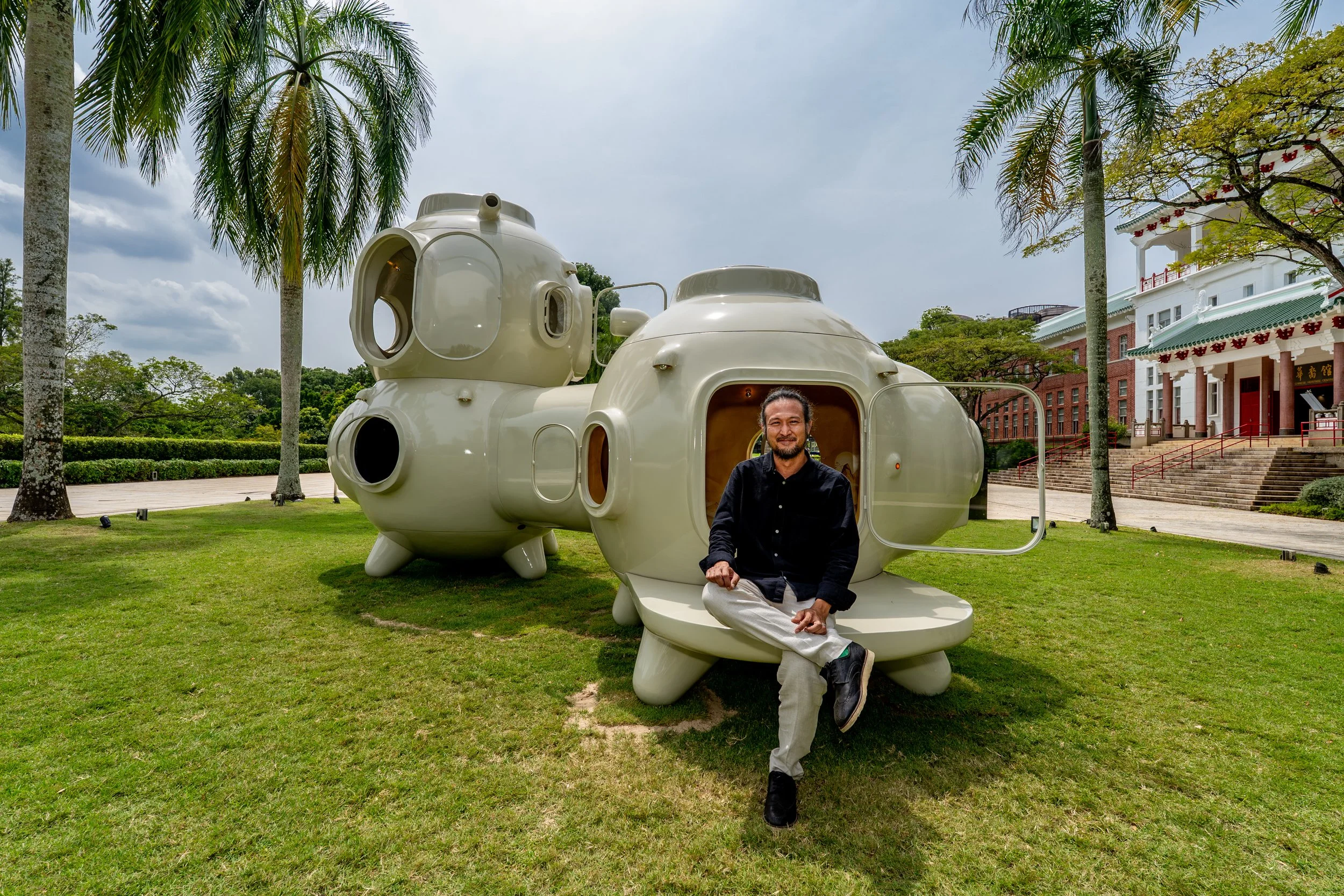
Torlarp Larpjaroensook with his work Cosmos of Nostalgia (2025). Photo by Third Street Studio. Image courtesy of NTU Museum.
The phrase “being on the cusp” describes a turning point, signalling the threshold between different states of being. In astronomy, the cusp refers to the points where the moon’s illuminated and unlit surfaces meet, forming the crescent. This light, borrowed from the sun, lends itself to a poetics of becoming: the moon’s shifting form shaped by the dialogue between celestial bodies. This exhibition responds to the cusp as a metaphor for transition. What happens when distinct realms—past and present, virtual and physical, earthly and spiritual—converge? How do they converse with each other and what is exchanged at points of transition and contact? Through distinct artistic approaches, Boedi Widjaja, Torlarp Larpjaroensook and Tromarama explore how these exchanges shape our sense of self and relationship with the world.
Using memory as a conceptual frame, On the cusp delves into the complexities and nuances of finding identity and belonging in an ever-changing world. The act of remembering is an intrinsic part of human existence. Memory reveals much of who we are and what shapes our being. Embedded in body, language, place and shared experience, it is not a static repository of the past but a living force carried within us. The artists draw on memories that reside in the practices we inherit, the stories passed down through generations and relationships formed with the spaces we inhabit. Occupying three distinct sites on the campus grounds, the works allow new or hidden narratives to surface and engage with their audience.
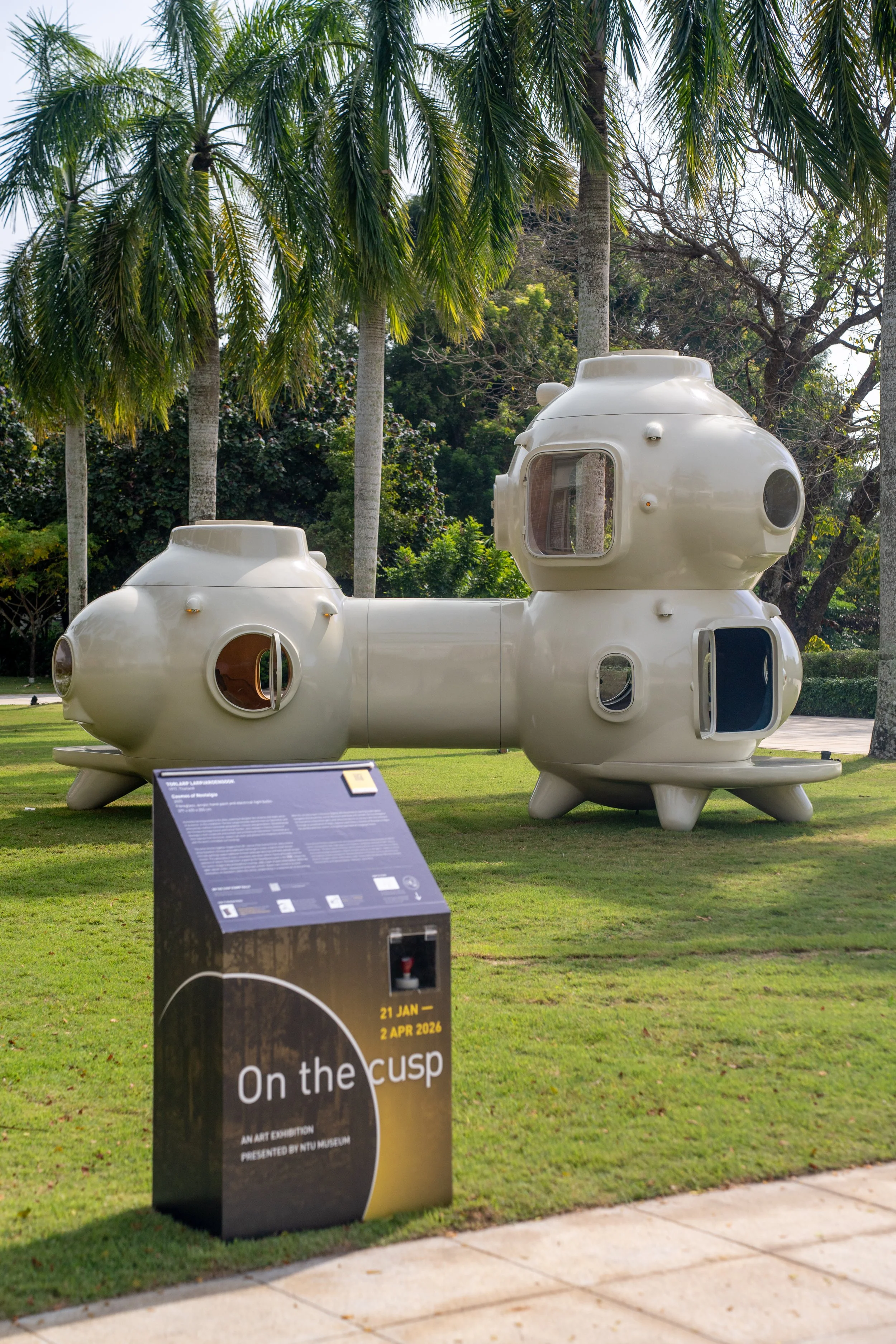
Torlarp Larpjaroensook, Cosmos of Nostalgia, 2025, exhibition view, installed at Chinese Heritage Centre Lawn, as part of On the cusp (2026). Photo by Third Street Studio. Image courtesy of NTU Museum.
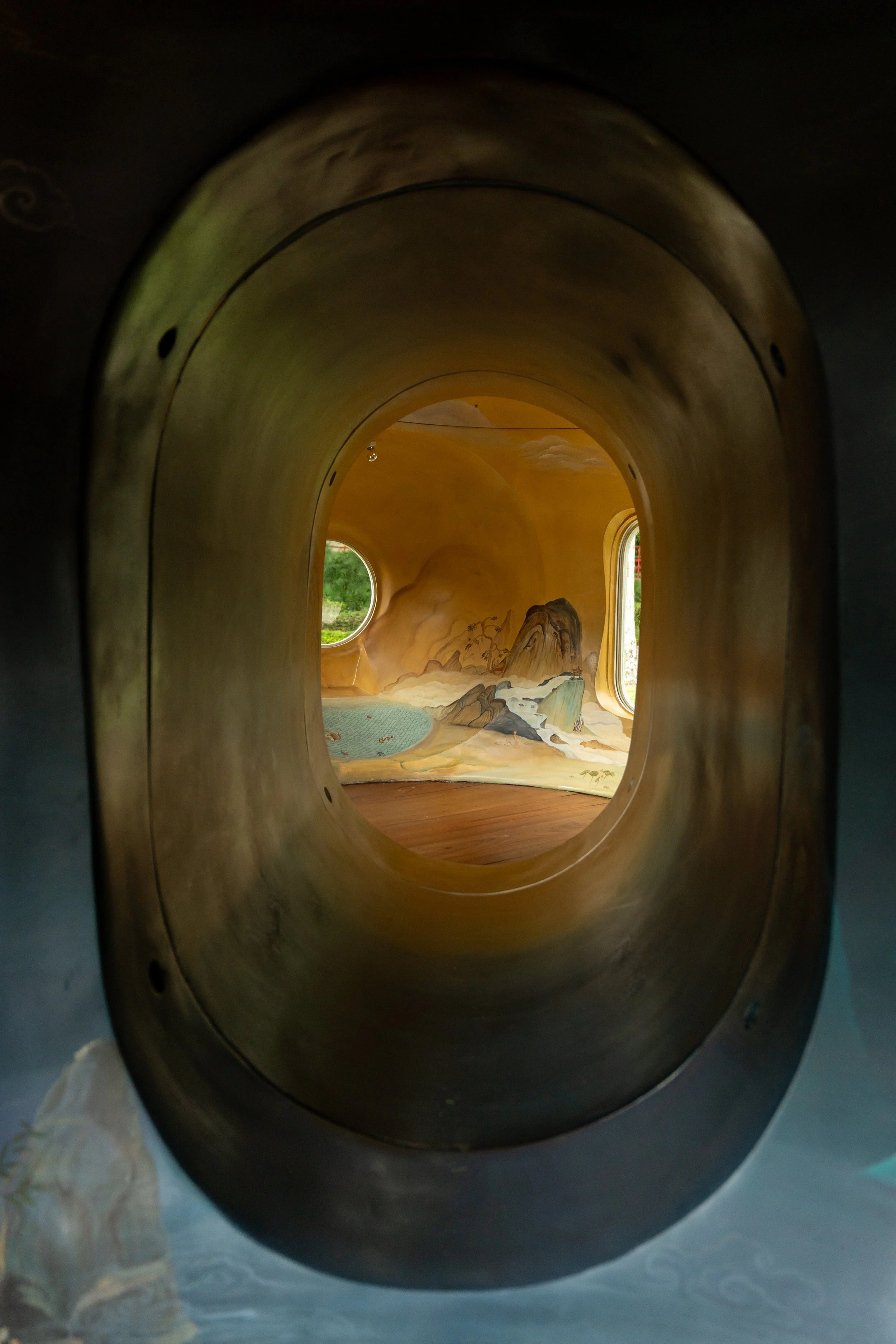
Torlarp Larpjaroensook, Cosmos of Nostalgia, 2025, installation interior view. Photo by Third Street Studio. Image courtesy of NTU Museum.
Cosmos of Nostalgia expands on Torlarp Larpjaroensook’s worldbuilding impulse and his longstanding interest in the power of myth and memory. Resting on a sprawling lawn between the Chinese Heritage Centre and Yunnan Garden, sites steeped in history, the work combines cultural tradition, history and speculative fiction. Conceived as a time capsule from the future, it is both a sculptural environment and an architectural intervention. Wan Hu is the pivotal character in this imaginary world. Chinese legend recounts the tale of this Ming Dynasty court official who embarked on a mission to reach the Moon by fastening himself to a bamboo chair strapped with gunpowder-filled fireworks. Upon launching, the rudimentary rocket-chair exploded mid-air with its passenger vanishing forever. This story of an aspiring astronaut’s indomitable spirit endures. Wan Hu has become a metaphor for humanity’s longing to comprehend and engage with universal realities.
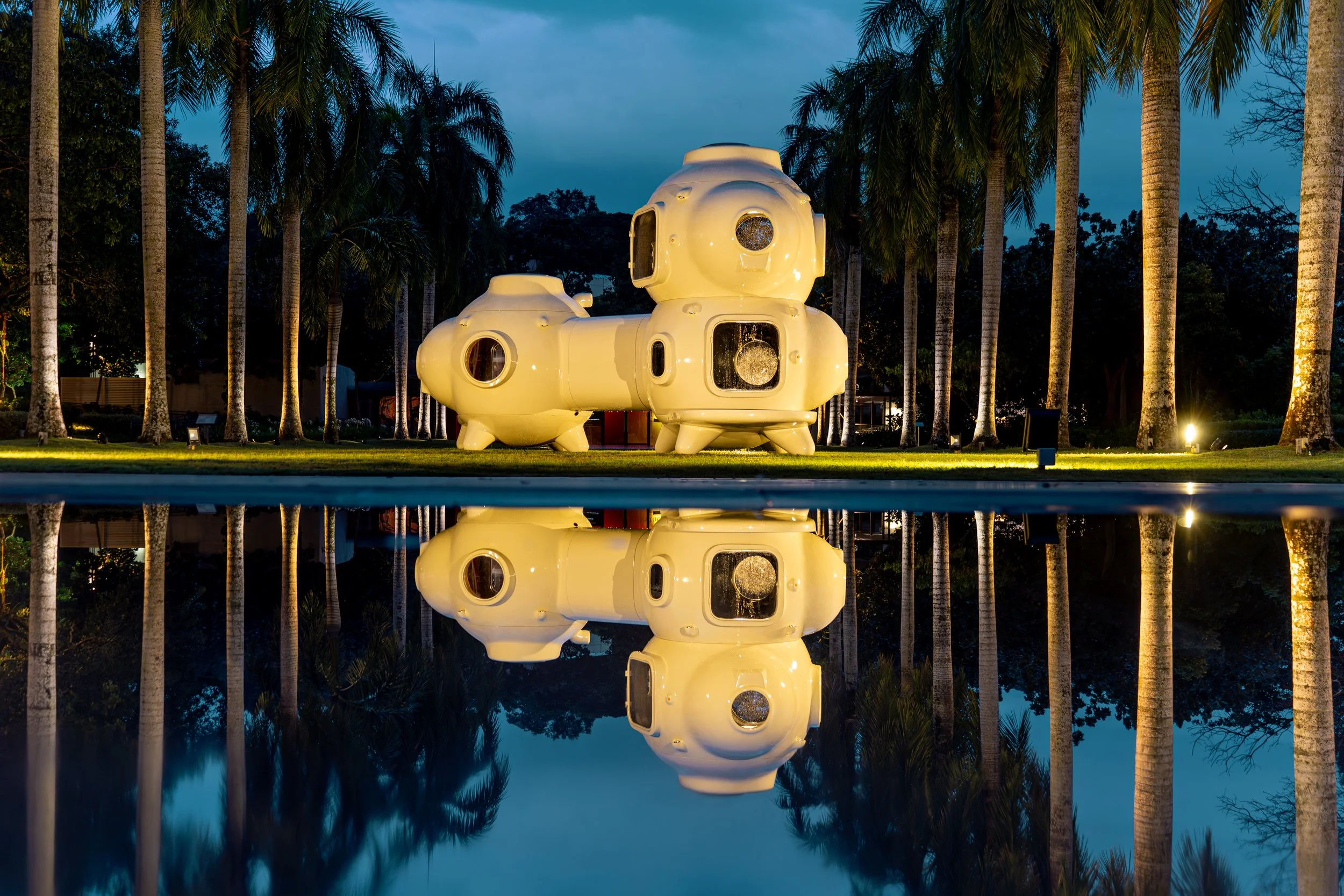
Torlarp Larpjaroensook, Cosmos of Nostalgia, 2025, fibreglass, acrylic hand paint and electrical light bulbs, 377 x 625 x 255cm. Installed at Chinese Heritage Centre Lawn, as part of On the cusp (2026). Photo by Third Street Studio. Image courtesy of NTU Museum.
Space travel has been a recurring theme in Torlarp Larpjaroensook’s practice. He recalls childhood memories of his grandmother, who journeyed from war-torn China to Ayutthaya, Thailand. During the Mid-Autumn Festival, she would offer incense and prayers to the Moon as an act of faith and connection with tradition. Running parallel to this was the space race between the United States and the former Soviet Union in the late 20th century. In Torlarp’s practice, ‘space travel’ carries an added layer of meaning. It does not just gesture toward outer space, but also the idea of bridging different dimensions: past and present, the earthly and the spiritual, fiction and lived reality. Space has a psychological dimension, a realm that exists beyond the tangible. Torlarp’s practice demonstrates a keen attunement to the ways in which voices speak across time and space.
Torlarp’s works give form to this intrinsic desire for connection. Earlier works, such as Spiritual Spaceship (2018) and The Spiritual Station (2023), explored migration, technological progress and the enduring value of belief and memory. The spaceship is not just a vessel for space exploration; it is a medium that carries stories and connects past and present. By incorporating found objects and everyday materials into his installations, Torlarp harnesses the memories and experiences embedded in these objects for his storytelling endeavours. While rooted in specific cultural references, his works resonate on a more universal register, speaking across cultures, generations and geographical borders.
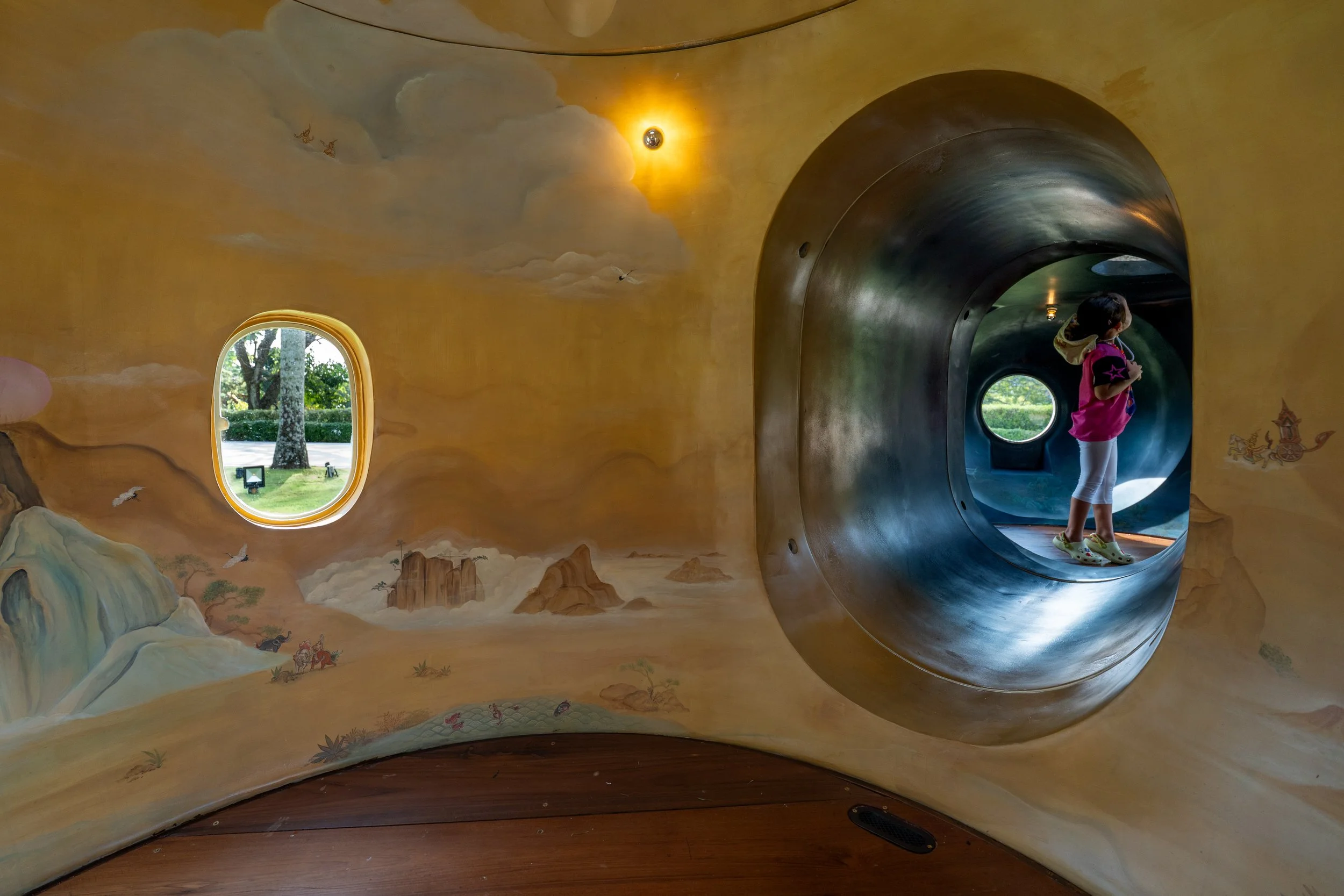
Torlarp Larpjaroensook, Cosmos of Nostalgia, 2025, installation interior view. Photo by Third Street Studio. Image courtesy of NTU Museum.
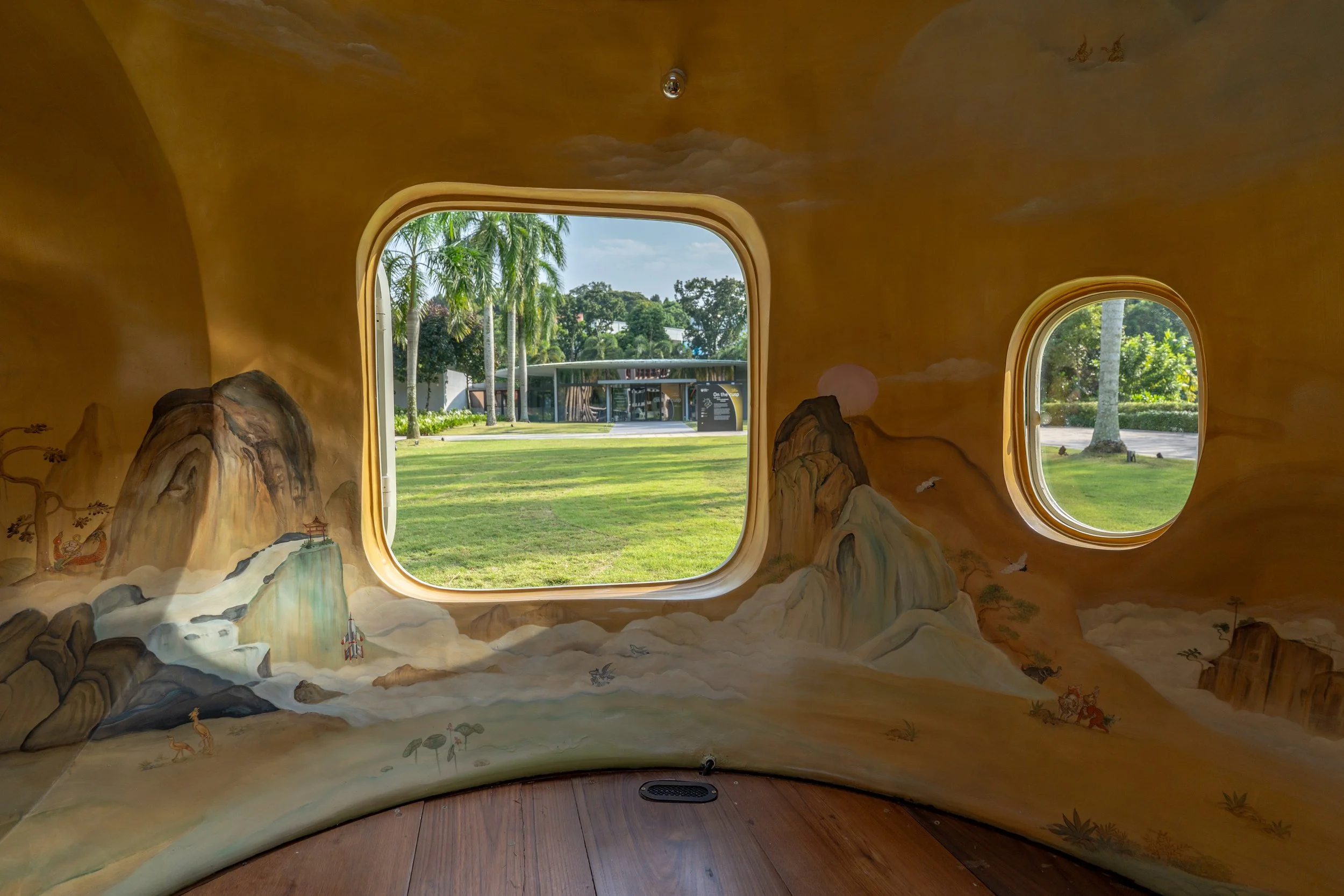
Torlarp Larpjaroensook, Cosmos of Nostalgia, 2025, installation interior view. Photo by Third Street Studio. Image courtesy of NTU Museum.
Cosmos of Nostalgia brings multiple dimensions into conversation: the artist’s multicultural imagery and the layered histories of its surroundings. Torlarp describes this work as one where “viewers will feel as though they are entering an inner world of the past, one filled with fantasy, dreamlike visions and stories that connect the outer universe and inner imagination.” The installation’s interior features intricate paintings that draw on imagery, philosophy and myths from Thai and Chinese cultures. Visual motifs from 20th-century Thai science fiction, early science encyclopaedias, Chinese philosophy and mythology are interwoven into a hybrid lexicon. The visual style employed in the paintings is influenced by traditional Chinese shan shui (山水) landscape paintings and murals found in Thai temples. This sweeping panorama of rivers, mountains and skies pays tribute to Taoist philosophy and the grandeur of nature.
The artist regards his works as a form of “moving architecture” that engages in close dialogue with the environment and audience. Viewers can enter and witness this imaginary world merge with its immediate surroundings. The character of Wan Hu appears, attempting to ascend to outer space and cross the threshold between dream and reality. The work offers viewers the opportunity to do likewise by climbing to the upper chamber of the installation. Here, they are enveloped by a bare, unpopulated landscape where they become characters in this fictional world, participating in a communal act of storytelling. Through a constellation of myth, memory and history, Cosmos of Nostalgia bridges the earthly and the cosmic, a forgotten past and an imagined future. Stepping into this spaceship-like time capsule, we too become space explorers, collaborating in an unfolding narrative where history speaks into the present.
This article is presented in partnership with NTU Museum.
On the cusp, presented by NTU Museum, is on view at various locations around Nanyang Technological University, Singapore, from 21 January to 2 April 2026.
In conjunction with the show, NTU Museum is holding an art writing competition open to all currently enrolled NTU and NIE students. The submission deadline is 22 February 2026. For more information, click here.