‘东邪西毒 I Want to Infect You with History’ by Boedi Widjaja
‘On the cusp’ by NTU Museum Excerpt 3
Over the years, we have republished parts of long-form writing, from catalogue essays to book chapters. This practice is now formalised as part of our Excerpts series. If you would like to work with us to republish a text, please email us at info@from-the-margins.org.
Here is an excerpt from the exhibition essay written by curator Lu Xiaohui for On the cusp (2026), presented by NTU Museum, Singapore. This is the third in a three-part series, where Lu examines Boedi Widjaja’s treatment of memory and history as living cellular material that can transmit, mutate, and infiltrate culture.
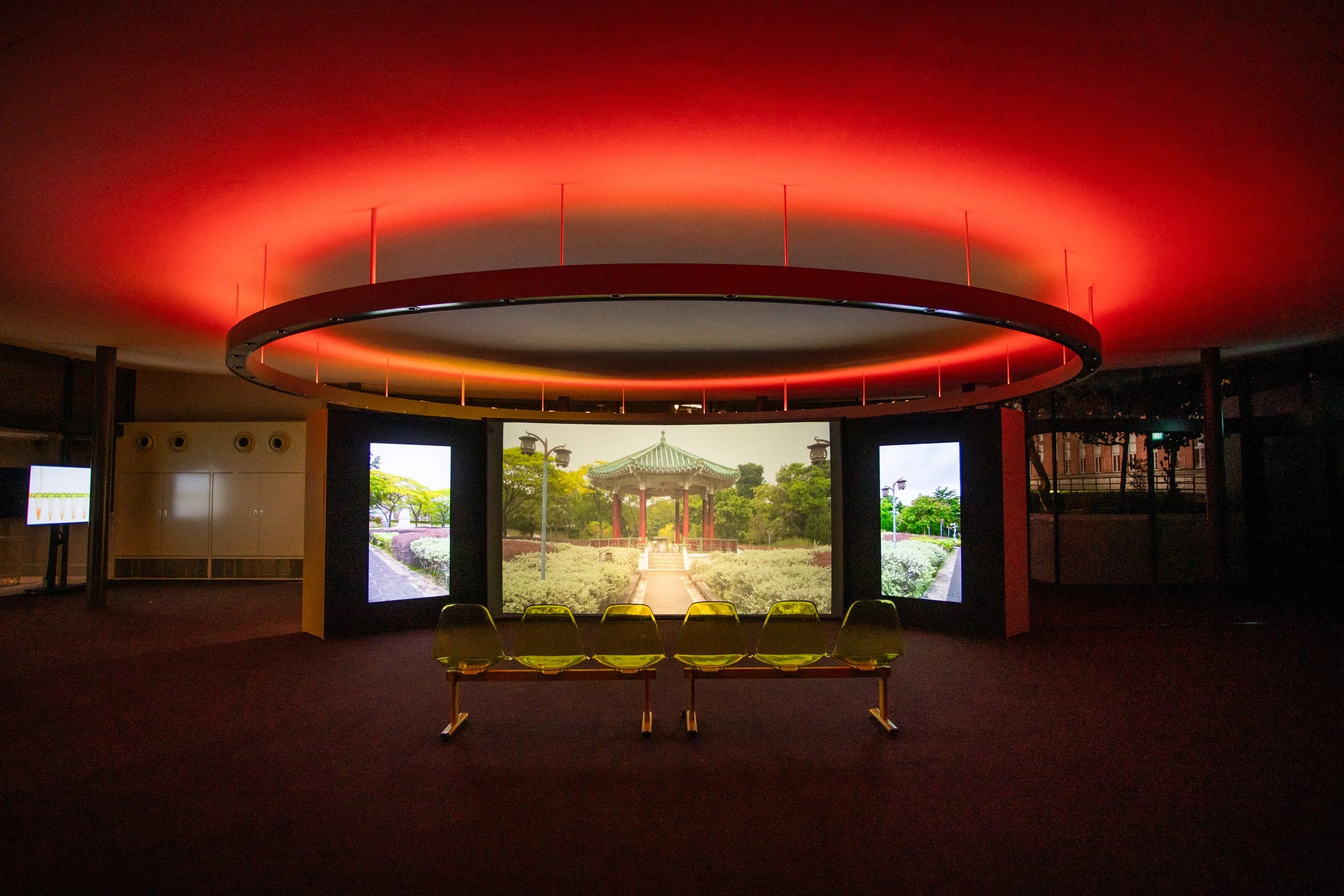
Installation view of 东邪西毒 I Want to Infect You with History, Boedi Widjaja, 2025. Image courtesy of NTU Museum. Photo by Kee Ya Ting.
With the grounds of Nanyang Technological University as the setting, the exhibition unfolds across three sites with distinctive characters and histories: the lawn at the Chinese Heritage Centre, the Nanyang Lake Pavilion and the INDEX: Stories in Motion media screen. Over time, these spaces have absorbed imprints of human activity: bearing witness to historical events and stories that unfold around them. Memory takes on a spatial dimension, attesting to the tangible and intangible connections between us and the environments that we exist in. The works engage in close dialogue with these spaces, layering new memories to the sites they inhabit, prompting the psychological and conceptual contours of these spaces to shift and evolve. The works bring together a medley of voices, ancestral, communal and cultural, that weave through spaces of heritage, learning and gathering in the university. Through this, bonds are rekindled and stories are given agency to surface and speak.
In the titular moving-image work in his installation 东邪西毒 I Want to Infect You with History, Boedi Widjaja reflects, “When I wrote this four-line poem, I was not crafting words, but following the body’s memories that had moved with me between worlds.” Having migrated to Singapore as a child following ethnic tensions in Solo, Indonesia, Boedi’s lived experience of displacement has shaped his engagement with diasporic experience and estranged origins. His practice asks what becomes of histories erased through dispossession. How can marginalised narratives reclaim agency?

Installation view of 东邪西毒 I Want to Infect You with History, Boedi Widjaja, 2025. Image courtesy of NTU Museum. Photo by Third Street Studio.
Through multiple strategies of transmission and translation, hidden narratives embedded within the body surface and take form. Boedi’s work probes diasporic memory and the volatility of identity and belonging. His poem Rivers and Lakes / Tanah dan Air / Land and Water / Sungai Sejarah, written in English and Bahasa Indonesia, was encoded and synthesised into DNA. In the moving-image work 东邪西毒 I Want to Infect You with History, the poem mediates a speculative dialogue between the artist and a human cell. This exchange circles around the installation’s central proposition: history is like a virus, inhabiting bodies and seeping across geographical borders.
Boedi sees language and genetic code as carriers of history and memory, the keys to understanding personal and collective pasts and identity. These concerns manifest in two bodies of work presented at the Nanyang Lake Pavilion: 东邪西毒 I Want to Infect You with History and Islands of Remembering and Forgetting. Boedi continues his sustained, generative collaboration with Dr Eric Yap, Clinician Scientist and Associate Professor in Human and Microbial Genetics at the Lee Kong Chian School of Medicine and Principal Investigator at the Institute for Digital Molecular Analytics and Science. With molecular code as a starting point, the installation presents explorations that manifest in poetry, sculpture, performance and photography.
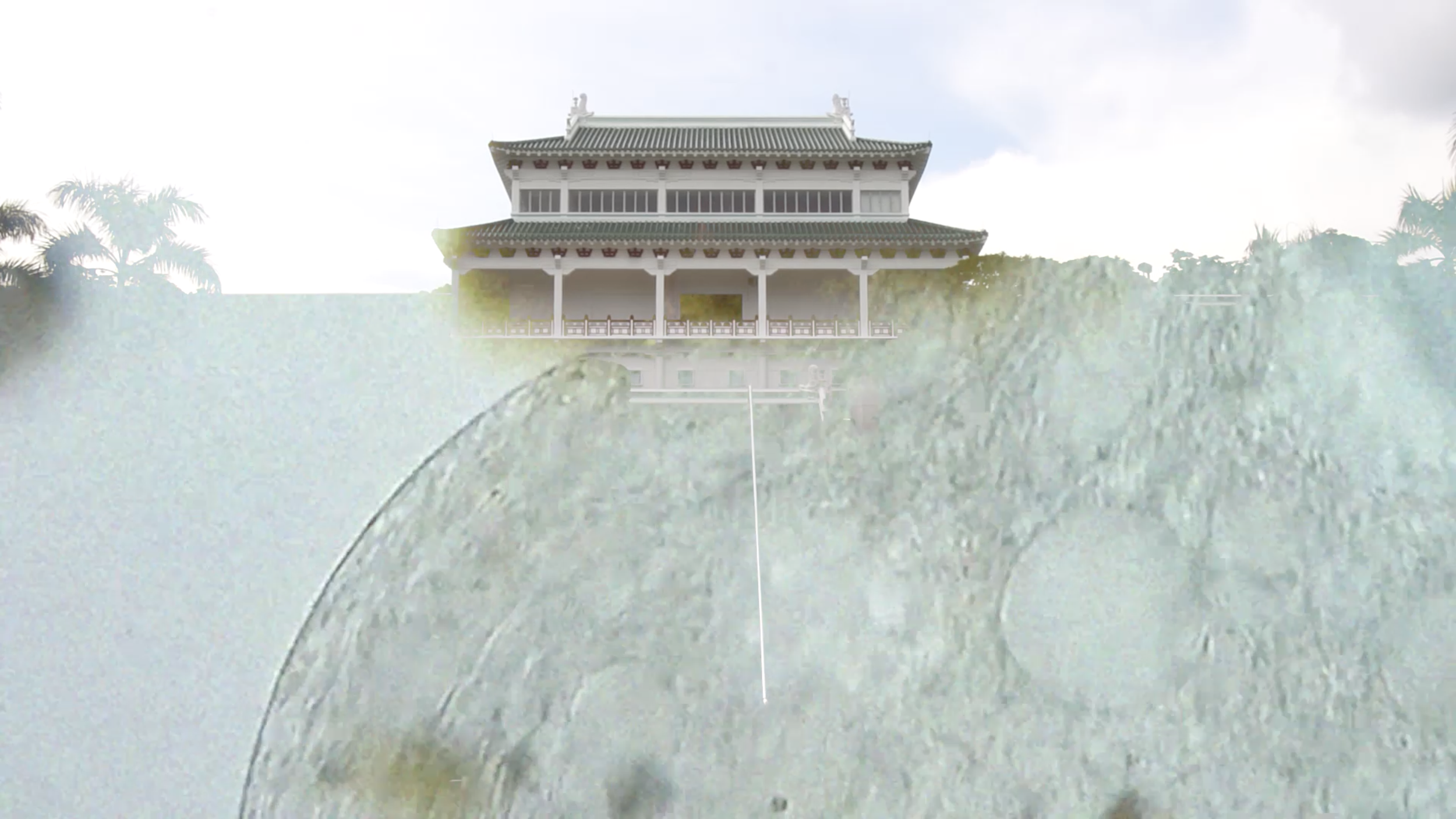
Still from 东邪西毒 I Want to Infect You with History, Boedi Widjaja, 2025. Image courtesy of the artist.
The installation unfolds in dialogue with its surroundings. Nearby landmarks—the Chinese Heritage Centre, Yunnan Garden and the Nantah Arch—survived from the era of the erstwhile Nanyang University, or Nantah as it is affectionately known. Established in 1956 through support from the Chinese diaspora in Southeast Asia, Nantah was the first and only Chinese-language university outside China. It became a symbolic bastion for the community: “an icon, a keeper of the identity of the Chinese, and a promise of Chinese cultural efflorescence.”1 Nantah offered a sense of grounding: an anchor of identity and familiarity in the new environment they found themselves in. Boedi responds to this charged historical landscape, situating his work within a site shaped by migration, memory and diasporic aspirations.

Installation view of 东邪西毒 I Want to Infect You with History, Boedi Widjaja, 2025. Image courtesy of NTU Museum. Photo by Kee Ya Ting.
Space hosts life. It carries layers of history that accumulate over time, as well as the many relationships that circulate around these spaces. Embracing the Pavilion’s porous architecture, Boedi reimagines it as a living cell that metabolises memory, language and genetic code. The balcony interstices are activated with works that engage in dialogue with the surroundings. In petri dishes are DNA-encoded poetry sitting alongside soil and lake water from Yunnan Garden. Exposed to fluctuating environmental conditions, the work mutates over time, foregrounding memory as unstable and susceptible to change.
Boedi positions his personal history of displacement against broader national and geopolitical narratives. In 东邪西毒I Want to Infect You with History, he recounts postwar episodes in which Chinese Indonesians were forced to choose a nationality and the optimism of postcolonial solidarity at the 1955 Bandung Conference. These moments reveal how macro forces, including political alignments and ideological shifts, can impact the individual. History is porous, a fluid membrane through which personal and collective memory circulate and converge.
“History is porous, a fluid membrane through which personal and collective memory circulate and converge.”

Still from 东邪西毒 I Want to Infect You with History, Boedi Widjaja, 2025. Cinematography by Harry Chew. Image courtesy of the artist and performer.
Agency is a central tenet of Boedi’s practice. He turns to the body as a site of transmission. In the moving-image work, Boedi navigates Yunnan Garden and the Chinese Heritage Centre, releasing embodied memory into sites rich in historical significance. Through this performative gesture, he becomes a vector enabling the circulation of diasporic narratives across time and space. A balcony is transformed into a zone reminiscent of a laboratory containment chamber. Inside this charged space, the audience can pull the trigger of a spray bottle of DNA solution, initiating a voluntary “self-infection with history”. In this moment of transmission, history infiltrates through bodily contact.

Installation view of 东邪西毒 I Want to Infect You with History, Boedi Widjaja, 2025. Image courtesy of NTU Museum. Photo by Third Street Studio.
Memory serves as a fulcrum that allows a gradual reclamation of voice and space. History is carried in and through bodies and inscribed into place. Boedi’s installation is an invitation to be part of this unending dissemination. Moving from absence to presence, history reclaims agency as it replicates across the Pavilion, surviving through transmission and the shared act of carrying one another’s stories. Like a virus, history moves between us, through spaces and across worlds. Even in the midst of contending with the afterlives of displacement, there are still new stories to be told, written and experienced.
On the cusp is a journey in storytelling: it acknowledges the human yearning to connect with narratives larger than us and reflects on how the bonds we forge, with one another and the world, are intertwined with what and how we choose to remember.
This article is presented in partnership with NTU Museum. Read the other parts of this Excerpt series here.
On the cusp, presented by NTU Museum, is on view at various locations around Nanyang Technological University, Singapore, from 21 January to 2 April 2026. For more information, click here.
Notes:
Edwin Lee, “Nantah: Between Community and Nation,” Singapore, The Unexpected Nation, (ISEAS-Yusof Ishak Institute, 2008), 443.