Passing Through, Pausing Through
Lai Yu Tong’s ‘The World (Postcards)’ at Esplanade Tunnel
A&M Creative Edit is where we publish a creative response to an ongoing exhibition or display every month. These pieces can take a range of forms, from ekphrasis, to poetry, microfiction, creative nonfiction and more.
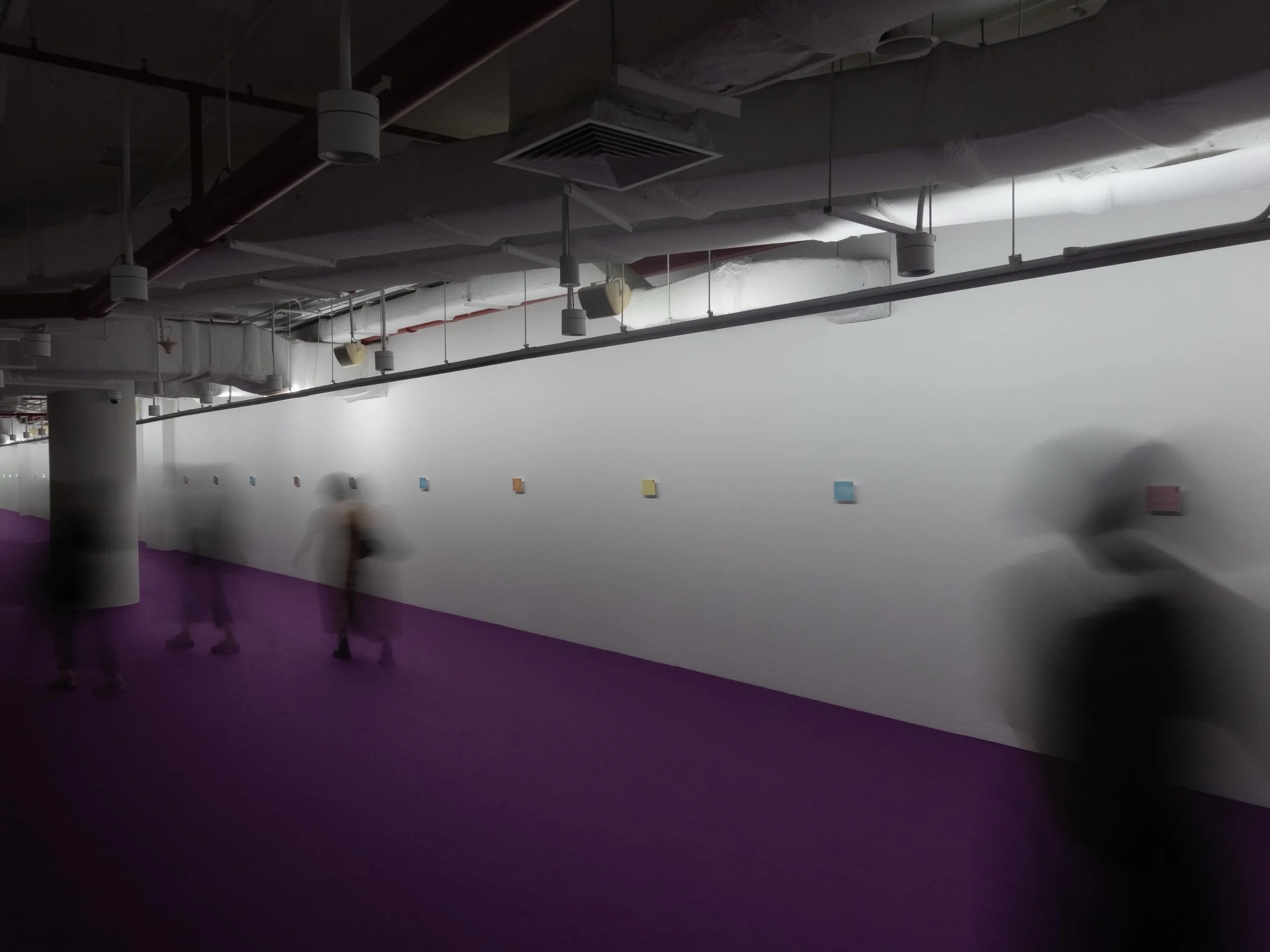
Lai Yu Tong, The World (Postcards), 2023-2026, exhibition view at Esplanade Tunnel, Esplanade – Theatres on the Bay. Image courtesy of ShanghART Singapore.
The World (Postcards) is Lai Yu Tong’s solo exhibition at the Esplanade Tunnel. Featuring a series of soft pastel powder works, the postcard-sized drawings were created by the artist between 2023 and 2024, depicting things he encountered during this period. Accompanying them are several benches handmade by the artist, as well as a soundtrack composed of various industrial hums produced by machines in built environments: cars, trains, fridges and air-conditioners.
In this lyrical response, encounters with the presentation are used to reflect on diametrical tensions between attention and distraction, speed and resonance. Reading the works against philosophical and sociological theories, this piece posits Lai’s works as antidotes to our postmodern culture of alienation and scarcity.

Lai Yu Tong, The World (Postcards) – Button, 2023-2024, soft pastel and postage stamps on archival matboard in clear plastic sheet. Image courtesy of ShangART Singapore.
How to peel a memory: first the soft fuzz, then a bruise of plastic, flesh, gnawed twine.
As I slip through the Esplanade Tunnel, I consider Lai’s postcards, thinking of their collection as a life calendar of details missed and items lost. A warm touch I had long forgotten about must have found itself in the same discarded pile as my trawl of homeless buttons and last week’s to-do list.
I cannot recall the number of times I have hurried through the same tunnel, tote bag crumpling off my shoulders while I give a quick, gratuitous glance to the artworks on the walls. I cannot recall the number of times, attention deficit, I have mistaken June for July, wires for worms. I cannot recite past journeys; only the points at which I began and ended.
In the background of my life, which ghosts linger, and which encounters are erased?
Something crackles amidst the unbroken hum overhead. I only notice its aberrant sound because the exhibition catalogue mentions it. Across the purple carpet stretching wide beneath this wormhole, another traveller stops, gaze transfixed on the same milky orange crow I had lingered upon moments ago. The philosopher Byung-Chul Han writes that things are points of stability in life.¹ In the end, it was not self-disclosure nor casual intimacies that cleaved both of us strangers together, but the grounding effect of an object drawing us in towards its real, continuous presence.² As if by nudging us beyond our precarious points of attention, the unconscious world of mechanical reverberations and ghostly items became demystified, became almost magical.³
*
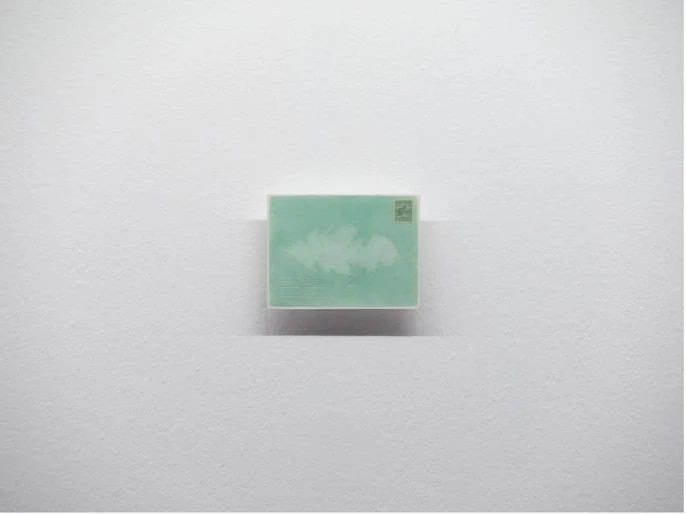
Lai Yu Tong, The World (Postcards) – Bitten Leaf, 2023-2024, soft pastel and postage stamps on archival matboard in clear plastic sheet. Image courtesy of ShangART Singapore.
Is it guilt that the postcards make me feel, or melancholy? The powdery edges where his kneadable eraser imprints into pastel reminds me both of my inability to hold onto precious, fragile things and the limits of knowability. Both contained within my smudges of failure, the soft tissue of a day.
Or an absence.
It is entirely unremarkable, the way a paper clip could be considered a footnote. Or a bitten leaf disintegrated into an unrecognisable contraction. To live means to work within capital and its precise yet tepid logic, grasping at the spoils of data repositories. Everyday movements are a cumbersome acceleration, like a knife gracelessly slicing through the heavy lard of lethargy. In fact, there is only enough energy to have your body slowly disintegrate with the quickening momentum. Sociologist Hartmut Rosa encapsulates the paradox of time moving at unimaginable speeds and yet spinning wheels:
Run, run always faster, not to reach an objective, but to maintain the status quo, to simply remain in the same place.⁴
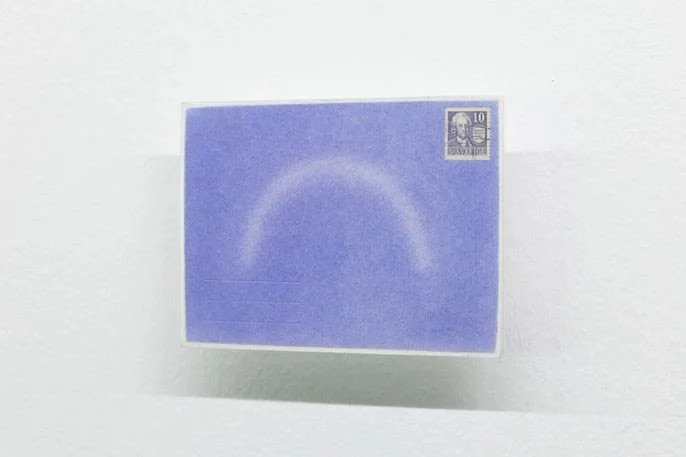
Lai Yu Tong, The World (Postcards) – Wire, 2023-2024, soft pastel and postage stamps on archival matboard in clear plastic sheet. Image courtesy of ShangART Singapore.
If pause is merely the thin fuel for running faster to nowhere, then Lai’s works speak instead of resonance.⁵ Each postcard is a tuning fork, a vibrating portal that draws me into unneutered, fertile worlds erring and unseen. A thin, arced line hangs before me and I read it as a metaphor for surrender. It does not matter that my understanding leaks like a sieve. It speaks and I answer. I speak and it answers. That is how we shall measure our encounters. This is how we shall measure our time.
Even as I pass through the tunnel into another space, I can no longer ignore the works’ trembling weight.
The World (Postcards) runs from 19 March to 28 June 2026 at Esplanade Tunnel, Esplanade – Theatres on the Bay, Singapore. More information here.
Notes:
Byung-Chul Han, Undinge: Umbrüche der Lebenswelt (Berlin: Ullstein, 2021), 7.
Ibid.
Conversation between Lai Yu Tong and Tamares Goh, in The World (Postcards), exhibition brochure (Singapore: Esplanade Tunnel, 2026), 3.
Hartmut Rosa, Social Acceleration: A New Theory of Modernity, trans. Jonathan Trejo-Mathys (New York: Columbia University Press, 2013), 119.
Ibid.