‘Rivers They Don’t See’, and the Flood Catastrophes They Don’t Hear
Som Supaparinya at Kestner Gesellschaft
A&M Creative Edit is where we publish a creative response to an ongoing exhibition or display every month. These pieces can take a range of forms, from ekphrasis, to poetry, microfiction, creative nonfiction and more.
In this Creative Edit essay, Kukasina Kubaha blends her reflections of Som Supaparinya’s solo exhibition Rivers They Don’t See with recent news of floods across Southeast Asia. This exhibition is the Northern Thai artist’s first institutional show in Germany. Its fluvial and critical mapping calls into question the colonial and neo-imperial borders drawn along waterways of Southeast Asia. Curated by Natalie Keppler and Alexander Wilmschen, the show ran from 26 April 2025 to 16 November 2025 at the Kestner Gesellschaft, Hannover, Germany.
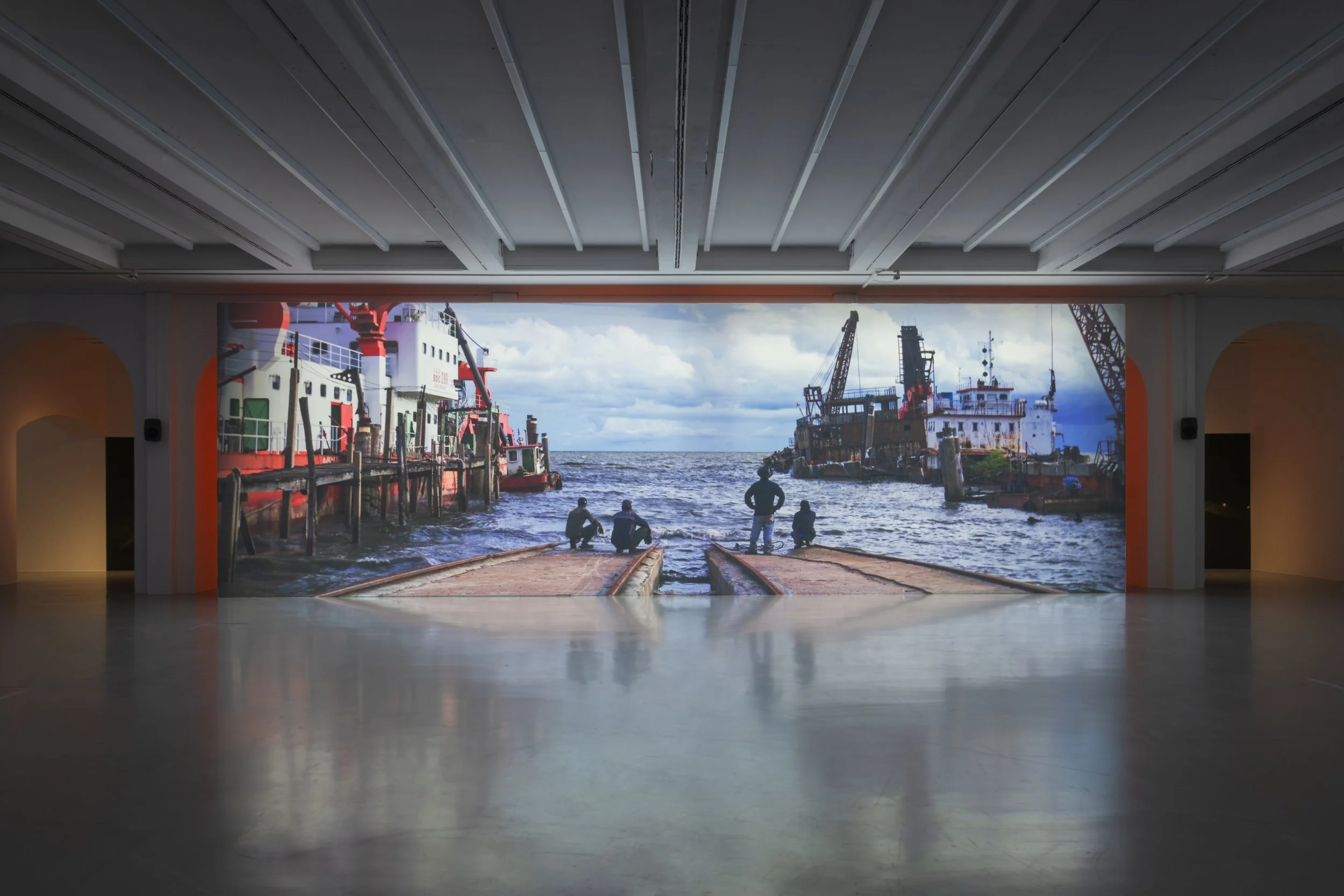
Som Supaparinya, The Rivers They Don't See, 2025, exhibition installation view. Image courtesy of Kestner Gesellschaft. Photo taken by Volker Crone. Curated by Natalie Keppler and Alexander Wilmschen.
5 November 2025
Concerned influencer on TikTok asks about the beach clean out; worried that her
holiday plans for late November have been washed away as the typhoon in Cebu, the Philippines hits. Locals cry, bodies drown. No one hears.
I check the news and the BBC says that at least 85 lives have been taken.
25 November 2025
My family group chat buzzes with recent photos and videos of the downpour in Hat Yai, Songkhla, Thailand. My cousin is trapped in her apartment. The water level already surpassed car roofs, but mostly everyone in the town is safe, at least for now. Yet, just a day later, the Bangkok Post publishes a story of a woman who had to store the corpse of her deceased mother in a floating fridge. Electricity shocks no longer linger, but you can feel the horror from citizens waiting for help as the government slowly responds.
I am here in the Atlantic, more than 16,000 kilometers away from my homeland. The temperature is jarringly different, and I shiver in the 0 degrees Celsius that cloaks me. The tides have not washed and the reverberations of the Cebuanos and the Southern Thais ripple to me. As the philosopher Astrida Neimanis writes “if we are all watery, then we harbour the potential of watery gestationality within our corporeal selves… according to this ontologic, water is also body and milieu; water is what comprises bodies but also that which bathes bodies into being.”1 Thus, in certain waves, my body also reaches my fellow sea-blings (or so, I hope) even though my corporeal self cannot stretch far across the ocean. My worries are carried through me to Cebu, Patani, Chiangmai, Laos and further. Water has no borders.
7 November 2025
I took the ME RE3 from Hamburg to Hannover. The tracks of the train followed the Elbe River down to the Leine, and I arrive in front of Som Supaparinya’s video constellation. One massive screen projecting the artist’s latest work greets me right when I walk into the exhibition room. Anchored in the ground floor of the Kestner Gesellschaft, three different screens are scattered across like islands floating in the blue hues that make our globe.
In this room that felt like the underbelly of a big ship, the video work The Rivers They Don’t See (2024) demanded to be seen. The screen curves along the walls of what once used to be the city’s largest indoor swimming pool—a fact which was taken into the curatorial direction, since the curators, Natalie Keppler and Alexander Wilmschen, mentioned how the exhibition “was specifically developed for the architecture of the Kestner Gesellschaft.”2 Yet, unlike taming chlorine water to fit in an indoor space, the waters through Supaparinya’s camera flow in multiple directions and bring along multiple voices.
In the background, I hear piano keys tinkling in minor. Minor keys for minor lives. On screen, we see displaced Karen villagers from the Myanmar border paddling over to Thailand to escape armed conflicts. The jump scare of landmines hurt humans, animals, and trees alike. The Salween river holds as many stories as the Atlantic where we hear stories of how refugee boats disappear off the radar.
Flowing between waterscapes, dried up riverbeds, and rainy winding roads through the forest, The Rivers They Don’t See follows the stream of the Salween river, to the Ping and Chao Phraya. At some point, the camera reveals a vignette; you hear Supaparinya’s voice conversing with a young man and woman from Myanmar, who have found temporary work in a Thai fish sauce factory. Waters hold bodies, and bodies hold water, too.
Some time in 1825
Ink fissures into paper. A nursery rhyme song is printed for the first time. The English school
teacher, Eliphat Oram Lyte is attributed to have composed this short tune of Row, Row, Row Your Boat. The song comes with movements meant to teach children body and tune synchronisation, which works through repetition.
At many points in the 1990s
My mother used to sing me to sleep with a song she claims is her own mother’s favourite. Melodies passed down to me, from fantasies of a mother to fantasies of another mother. “พายเรือน้อย คล้ายเคลือนในสาคร ค่อยพาจร ห่างไป ในกลางน้ำ” or, “Rowing the boat, gently into the stream. Slowly drifting away into the body of water”3 It’s interesting, isn’t it, that there’s no ‘I’ in this song? It’s as if the ‘I’ could be interchanged with anything. It could be the singer, or even water itself that is narrating.
7 November 2025
Just as the way children repeat nursery rhyme melodies, history also repeats itself in A Separation of Sand and Islands (2018). In this dual-channel video, the artist lays bare the ways in which 21st century Chinese investment of hydropower dams along the Mekong ride on the same waves that the French colonial expedition did in between 1866 and 1868.
In the 19th century, the French restructured natural flows to expand ways for their ships. While the Chinese, in the 21st century, had plans of profiting off building dams. This plan would have only brought destruction along the Mekong. If the people did not succeed in protesting against these so-called green development projects, I wonder what would have happened…
Perhaps water is the protagonist in all of the songs. Again in A Separation of Sand and Islands, Supaparinya shows us how the fishermen on screen have to navigate the flows is also a way to say that the water has a mind of its own, or Khwan in the Lanna logic, or even Neak Ta in Khmer.4 The water is not a mindless entity that could be cut and pasted.

Installation view of Som Supaparinya, A Separation of Sand and Islands, 2018. Image courtesy of Kestner Gesellschaft. Photo taken by Volker Crone. Curated by Natalie Keppler and Alexander Wilmschen.
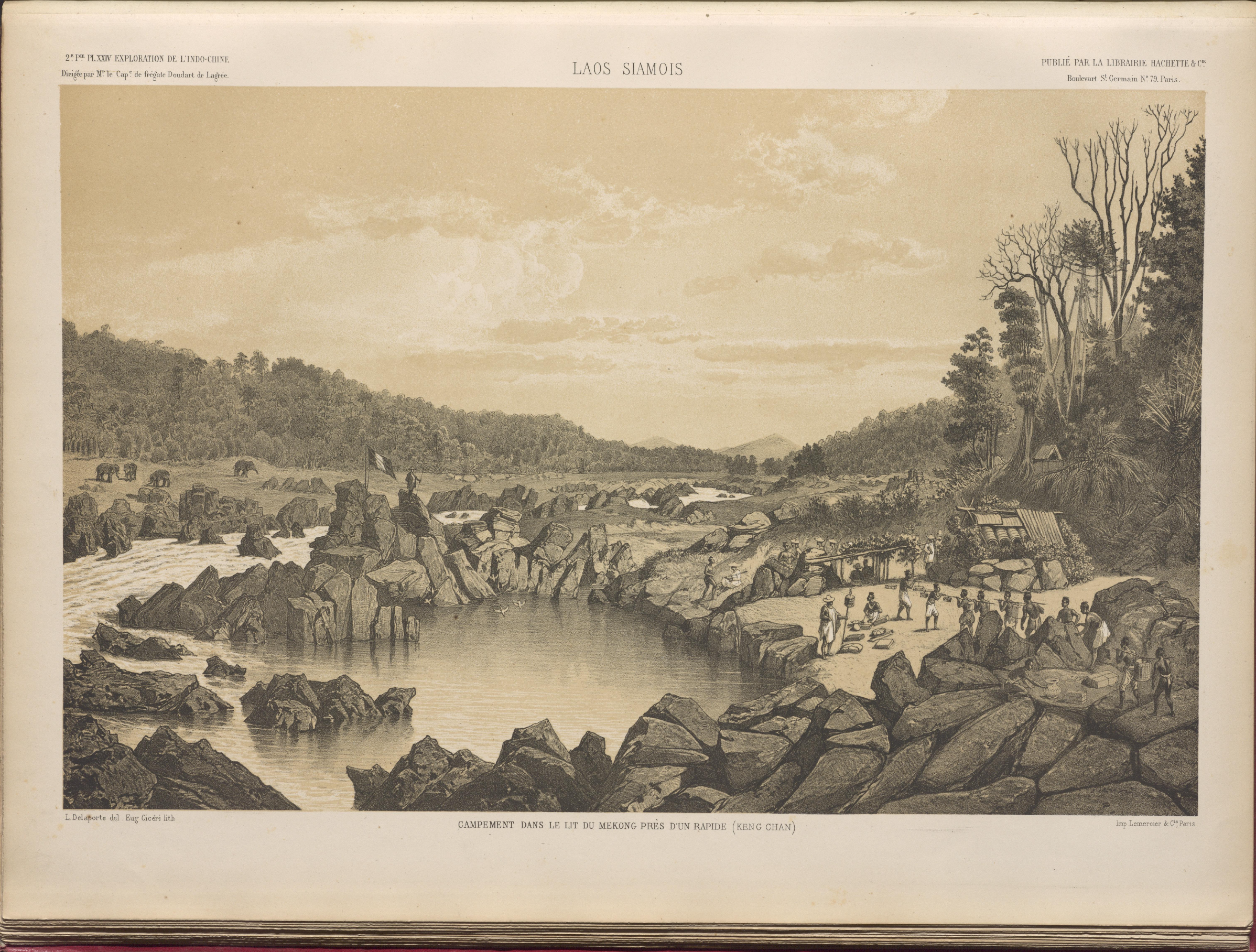
Scene of the Mekong from A Pictorial Journey on the Mekong: Cambodia, Laos and Yunnan (1866–68) made during the French Expedition of Indo-Chine. Image courtesy of the author.
25 November 2025
Row, row, row your boat gently down the stream
Merrily, merrily, merrily,
Life is but a dream
Life is truly but a dream. Imagine one day you receive a warning from the local government that it might flood in the next few days, and immediately the next day, you are trapped inside your own house while water levels rise to the second floor.
The rescue boats did not row fast enough and all the unsung songs of the Sungai Kolok took me back to the old Lanna folksong echoing in the background of Som Supaparinya’s latest work, The Unsung Lyric of The Ping (2025). What if there was no one to sing about the aftermath of this flood like there was in Chiangmai when the Bhumibol Dam exacerbated the damage done by the typhoon Yagi in 2024? What if? What if?
Notes:
Neimanis, Astrida. Bodies of Water: Posthuman Feminist Phenomenology. London: Bloomsbury Academic, 2016.
บัวขาว [Bua Khao] or “White Lotus” was composed in 1937 by Mom Luang Puangroi Apaiwong. The text was written by Prince Bhanubhandhu Yugala for the film Old Flame (1938) that he also directed. Like many things that are considered a Thai classic, the song was written by the elite, during a time of militaristic rule. See: https://sirindhornmusiclibrary.li.mahidol.ac.th/thai_contemporary_mu/plengthaisakol-25/
https://hardstories.org/stories/environmental-justice/reviving-the-soul-of-the-mekong