Conversation with John Tung
A Forest and an Open Call
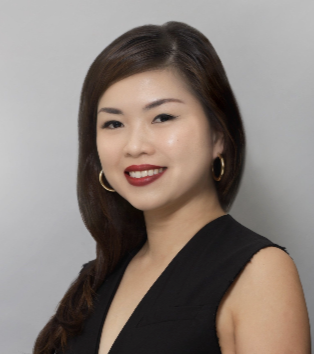
John Tung is an independent curator and exhibition-maker. Recently, he opened A Forest, the workshop of his long-running curatorial atelier From the Woods. With the new physical space, it aims to support a presentation of exhibitions, programmes and workshops. John has also announced a year-round open call for creative endeavours. In this interview, he speaks about the roots of A Forest, the team he works with, and his aspirations for how a Forest can contribute to the art ecosystem in Singapore.
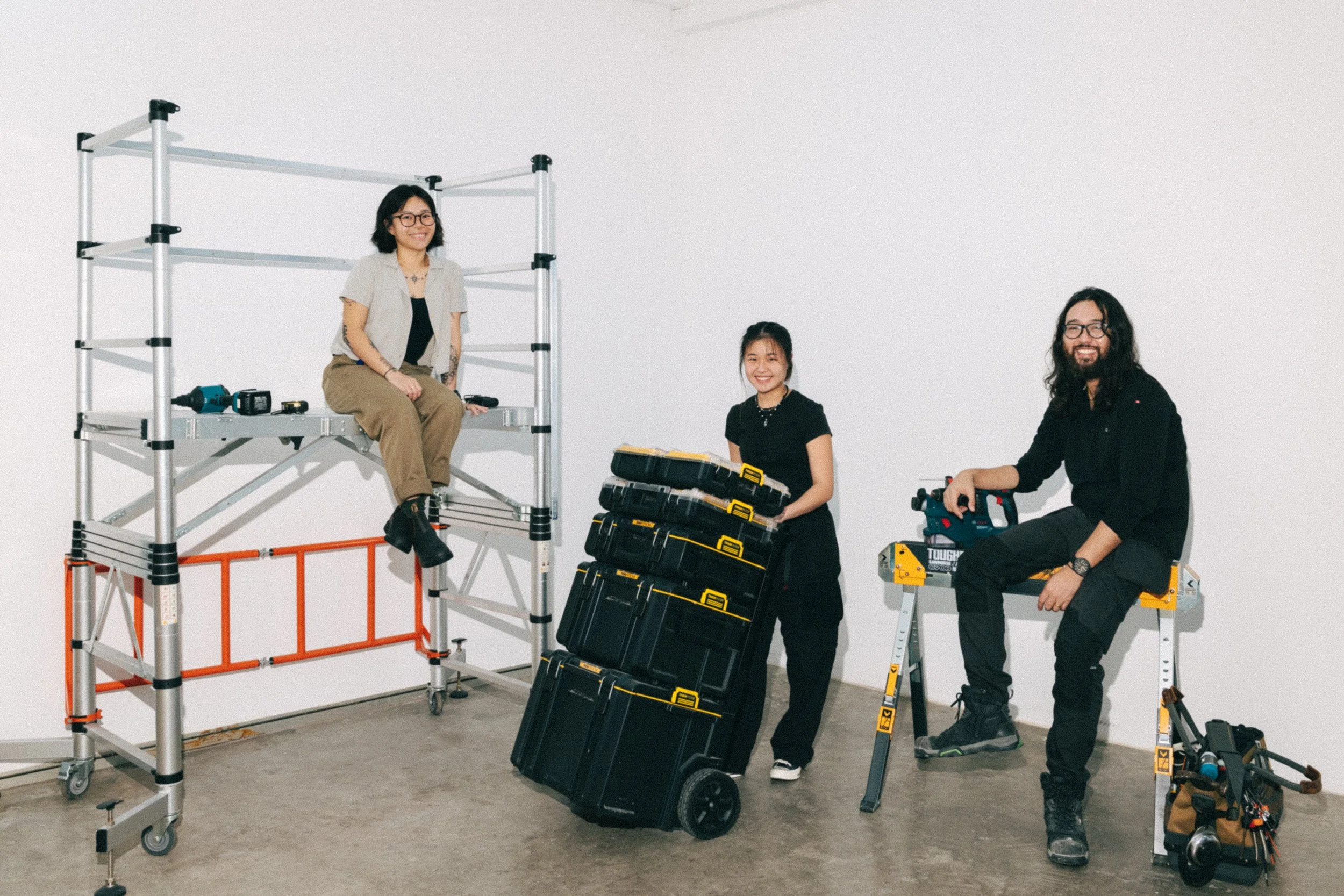
Edith M. Lee, Soh Chihiro and John Tung at A Forest. Image courtesy of A Forest.
Hi, John! Congratulations on the opening of A Forest. Why the name A Forest? What does it mean to you?
While John Z.W. Tung is the name that is emblazoned across exhibition walls, most of the time, there remains a small demographic that knows me by John the Savage. It is a moniker I have kept for close to two decades now, that started with a classmate writing “Go, my brave Ahaiyuta”, a phrase uttered by Popé to John the Savage in Aldous Huxley’s Brave New World, in my academic planner.
Savage, from latin Silvaticus, translates as From the Woods, which is also the name of the curatorial atelier I established 15 years ago.
A Forest continues with this naming convention, but at the same time, is a name that represents all that I relate a forest to being. It is a space of vitality, peace, promise, resources, and as far as Ursula Le Guin is concerned, a world. I want A Forest to be all of these things for all who encounter it.
How would you describe A Forest as a concept, and as a physical space?
A Forest is first and foremost the work space of my curatorial atelier. It consists of a storage space for my sizeable assortment of tools and equipment, an office space for the seated aspects of curatorial work, and finally, the large workshop space to get one’s hands dirty. That doubles up as an ad-hoc exhibition and programming space.
I have never been able to–and neither do I want to– separate the “clean” and “dirty” aspects of curatorial work. I want to be dusty, dirty, sweaty, intelligent and empathetic for as long as I can. It was therefore essential to me to enfold these two aspects into a singular space.
At the same time, I was cognisant of a dire need of a space for experimentation and for community, or a space to dream and build together. I am opening up the space to others because I want A Forest to be part of the change I would like to see in the ecosystem. This is why we have established the first A Forest open call with very low barriers to entry: a completely sponsored space for 9 days, contingent on an authentic proposal, in exchange for a framed poster.
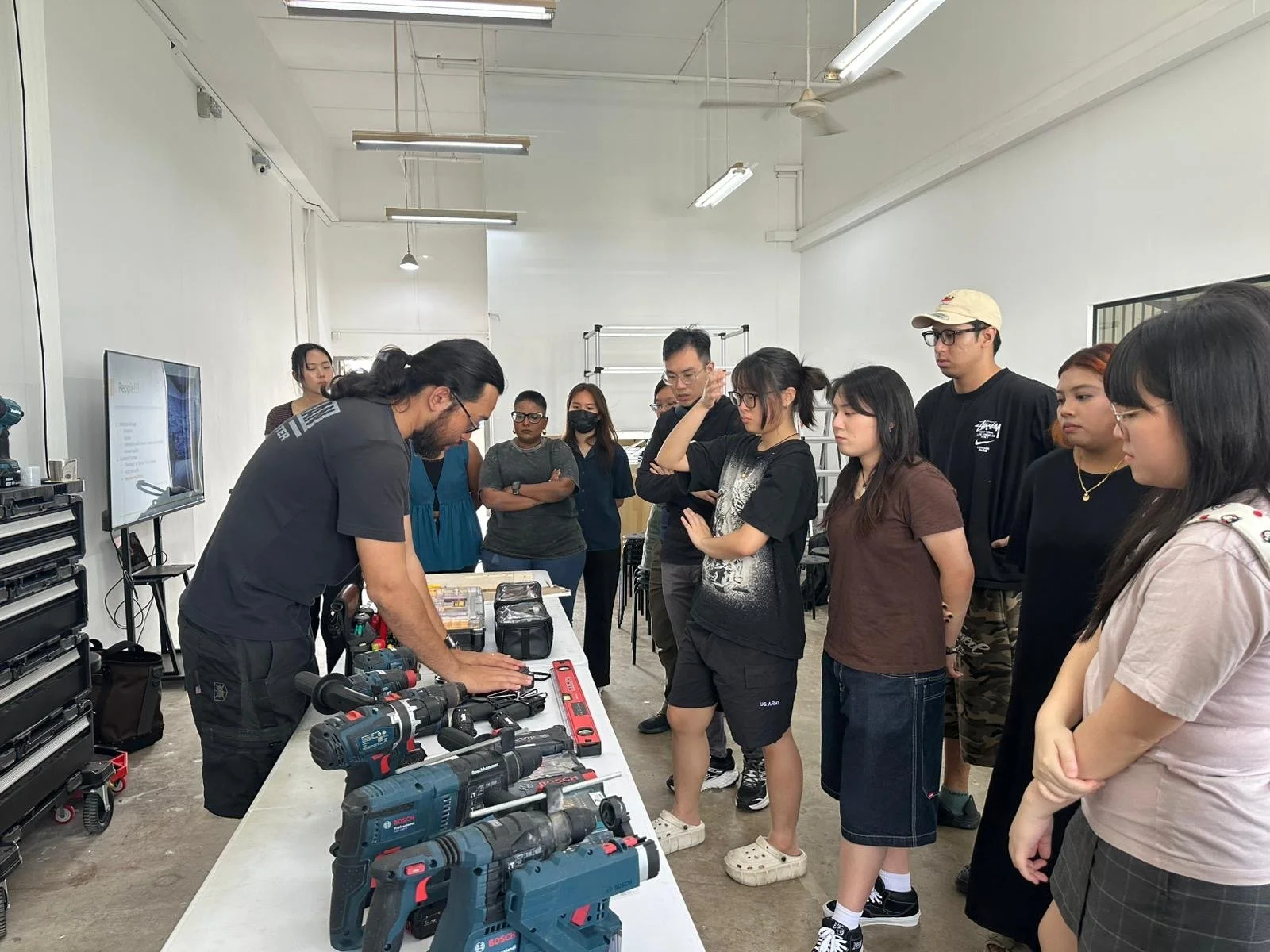
First workshop in A Forest with students from LASALLE College of the Arts, University of the Arts Singapore. Image courtesy of Wang Ruobing.
What kind of exhibitions, programmes and workshops do you envision being held at A Forest? How much of it will be your own, and how much of it in collaboration with others?
The strongest desire for me now is to keep the possibilities open, beyond our day-to-day work. I believe that the open call, and more broadly A Forest will be a portal to introduce me to new artists and practices. At the same time, we are looking to host a number of invited artists whom I have had the pleasure of knowing, but have not had the opportunity of working with closely.
It is no surprise that the first workshop held in A Forest was an introduction to basic artwork conservation, installation, and the tools involved. This took place even before the launch and the signboard for the space went up! I am looking forward to more opportunities to share these learnings, and equally for others to make use of the space to share their capabilities and capacities. I think that is how we will grow together.


Installing for Next Stop: Together! with ART:DIS Singapore for Singapore Art Week 2026. Images courtesy of A Forest.

Installing for S.E.A. Focus 2026. Image courtesy of A Forest.
You have a team that works closely with you to execute your various projects. Please elaborate on their roles, responsibilities and capabilities.
I work with Edith M. Lee and Soh Chihiro on projects. We are supported by a large pool of freelancers who are usually practising artists. With this expanded pool, From the Woods covers everything involved in the exhibition-making process from conceptualisation to execution. At times, this extends to the installation of exhibitions, assisting artists in the development of commissions and the fabrication and building of artworks.
I asked Chihiro a few weeks ago about why she applied to join From the Woods. She said that I promised to transform the successful applicant into a “beast”, and that is what she wanted to be.
I often joke that Edith and Chihiro are going to be my clones: sleepless, tireless, multi-hyphenated, adept at orchestrating multiple roles and projects simultaneously. But my real wish for them is to be even more than that. And most importantly, their own people.
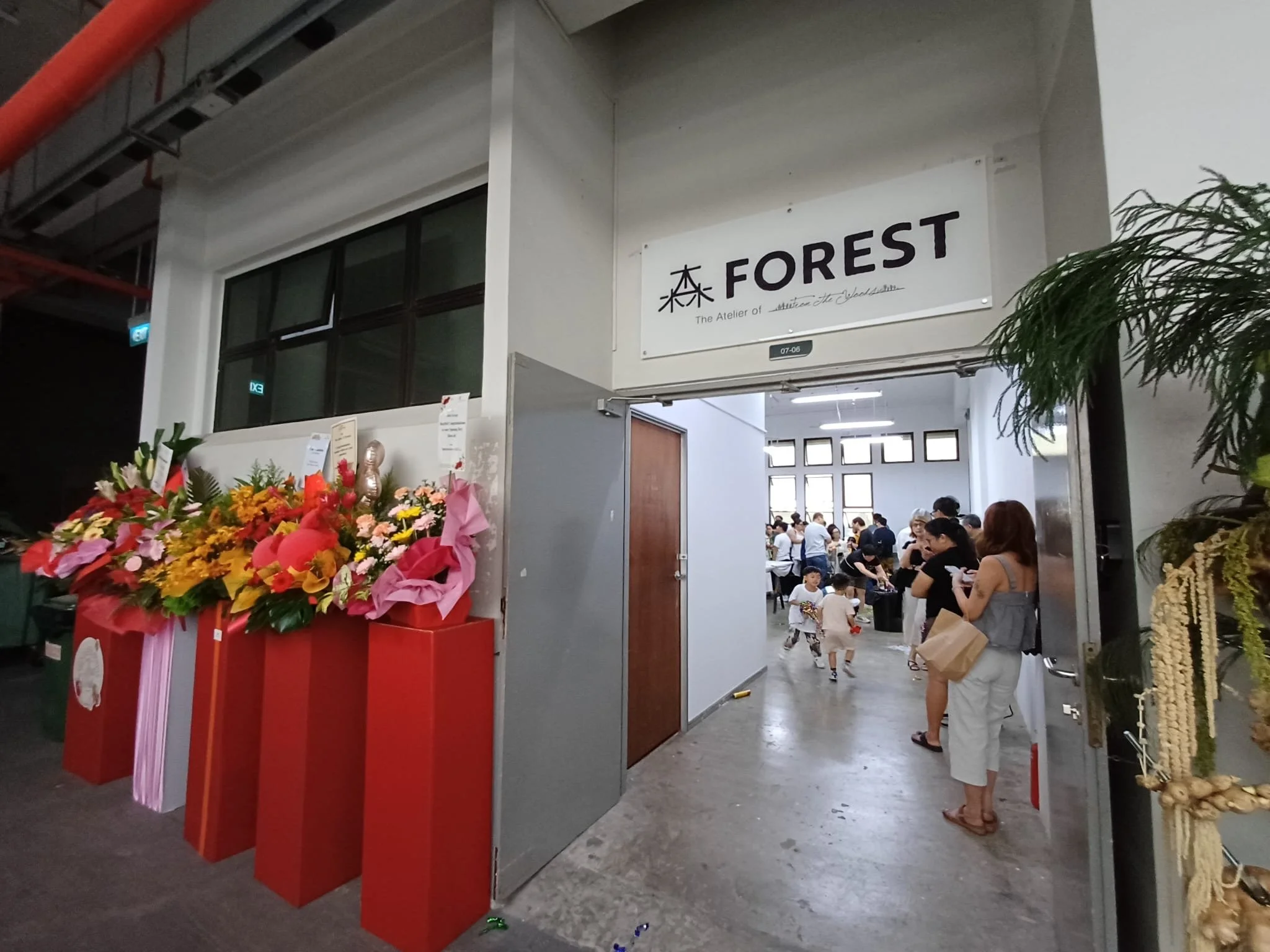
The opening of A Forest in April 2026. Image courtesy of A Forest.
What was the opening of A Forest on Saturday like for you?
It was a party to remember.
Please share more about the open call. What motivated you to push this out, and what are the criteria that will guide your selection?
It is about making more options available to creatives. I serve on the jury panel of the Art Outreach Hearth programme and I have witnessed first-hand the incredible difference having a space to present can make to an artist’s development. I want to play a part in that even more proactively. At the same time, I think A Forest’s most notable lack–comfortable air conditioning and gallery lighting–will also be its greatest strength. It opens up opportunities for the presentation of new works that may perhaps be ill-suited for the typical “clean” environments.
In the open call application form, the selection criteria are laid out quite simply as: “Proposals are evaluated on the basis of artistic merit, capacity for realisation of the proposed project, timeliness (if the space is available during your desired dates), and entirely at the discretion of the Director (John Z.W. Tung).”
In common parlance, they are assessed based on the authenticity of the proposed work, the tenacity of the artist in delivering it, whether we have the space at the requested time, and whether it fits well into my vision of A Forest.
For readers of this interview, I would leave a pro tip that will make a proposal stand out. I remain guided by the wisdom of late theatre doyen Kuo Pao Kun: “A worthy failure is more valuable than a mediocre success.” Take from that what you will.
“For readers of this interview, I would leave a pro tip that will make a proposal stand out. I remain guided by the wisdom of late theatre doyen Kuo Pao Kun: “A worthy failure is more valuable than a mediocre success.” Take from that what you will.”
Could you talk about how A Forest fits into the evolution of your practice as a whole? You noted, for example, that you had registered From the Woods LLP for it to function as a curatorial atelier more than a decade ago.
From the Woods was registered in 2011, and from the get-go, the goal was to establish it as a one-stop shop for curatorial and creative production needs. In the in-between years, there have been numerous side-quests, serving my National Service, completing my undergraduate and Master’s degrees, being an Assistant Curator at the Singapore Art Museum… but by and large, my philosophy and approach towards curatorial work has remained largely unchanged. It is not just about the conceptual work, but the hands-on physical elements as well.
A Forest emerged from a need. Frankly, the tools and equipment I had amassed had reached a point where I could no longer continue using my home as storage. As projects became larger and more complex, performing fabrication in my “man-cave” was becoming an absolute nightmare. With additional team members, we also needed a regular space where we could gather and meet.
Prior to this, we had a small office in Ubi where carpentry work was done right next to our desks. It maddened me to the point that when I decided on a new space, I decided on one that could have discreet zones, and would also give room for growth.
To have excess capacity, whether to make, think, show, or just not do anything with it, is a luxury. I think the arts deserve that little bit of luxury. Since we are not engaged in fabrication all the time, during those lull periods I want it to be a gathering space for like-minded individuals too.

Soh Chihiro, John Tung and Edith M. Lee. Image courtesy of A Forest.
How do you see A Forest and its activities serving—and advancing—the Singapore art landscape, or even beyond?
It goes back to the idea of capacity I have just raised, and Kuo Pao Kun’s sentiments pertaining to worthy failures. It has become ingrained in the Singaporean psyche that failure is a horrendous thing.
If all makers are confined to a small space of creation, imagination is consequently curtailed. If the cost of picking up every new skill is the cost of new equipment, that is the death of learning and experimentation.
The real luxury of excess capacity is the luxury to fail. I hope A Forest can aid in more worthy failures, and their subsequent successes.
More information about A Forest here. A Forest is available for venue hire. It is also holding a year-round open call.