Weaving as a way of gathering
This article is part of Art & Market’s coverage beyond Southeast Asia. If you would like to work with us to reach audiences from the region, please email us at info@from-the-margins.org.
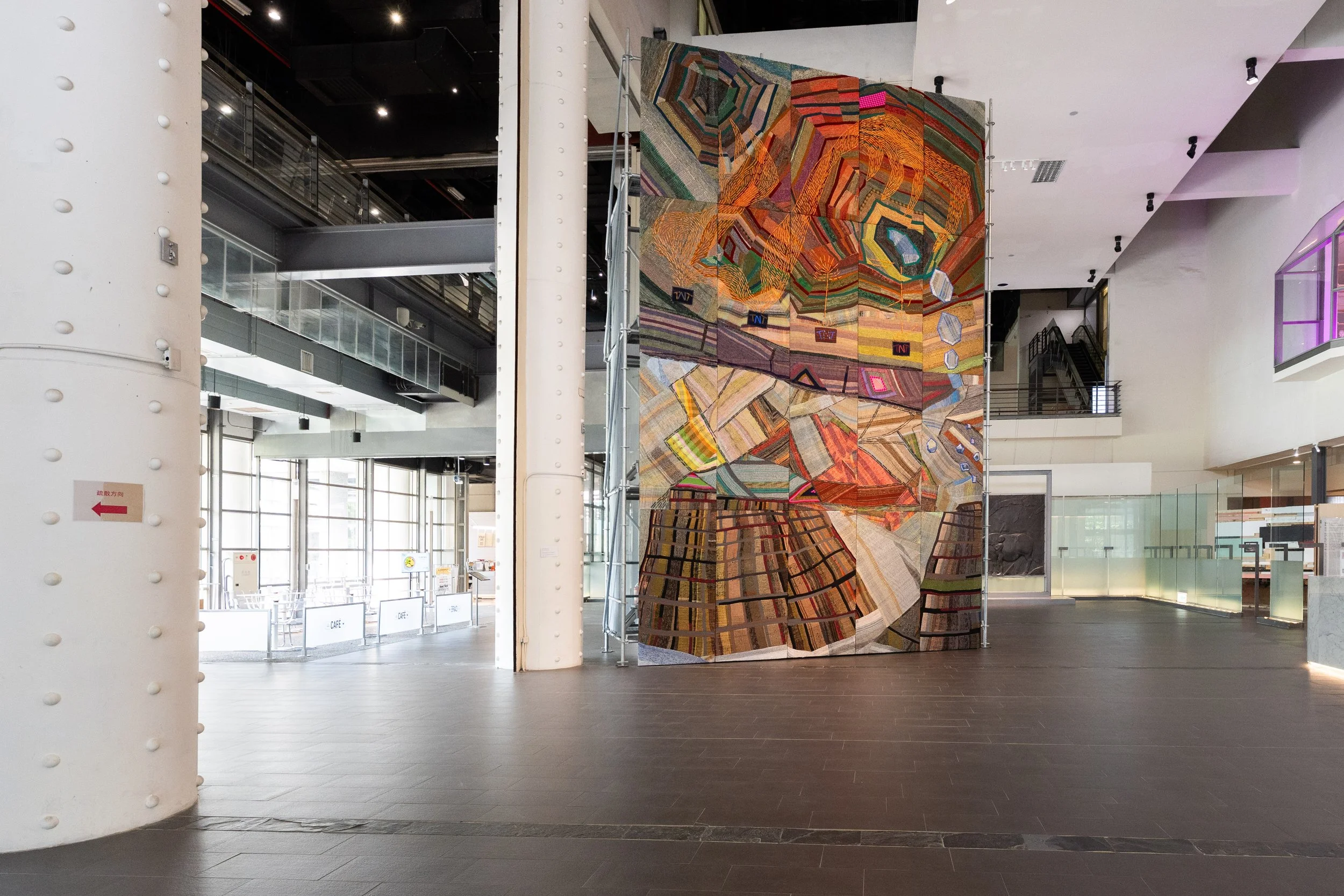
Labay Eyong, Weaving Mountain, 2024, wool yarn, cotton yarn, raffia, hand-spun ramie yarn, plastic cord, fabric strips, mixed-fiber yarns, 800 × 500 × 4cm (200 × 100 × 4 cm each x 20). Installation view at the 2026 Asian Art Biennial. Photo by Wei-tsan Liu. Image courtesy of the artist and NTMoFA.
Walk into the main lobby of the National Taiwan Museum of Fine Arts (NTMoFA) for the 10th Asian Art Biennial and the first work is Weaving Mountain (2024), an eight-metre-long piece by Taiwanese Indigenous artist Labay Eyong, made using traditional Truku weaving. It is a fitting introduction to the biennial. Eyong's practice was one of the starting points for curator Lu Pei-Yi's research, which eventually developed into the exhibition's central concept of co-weaving. The main title, Mrahul Tminun, comes from Truku, an Indigenous language of Taiwan. Tminun means to weave, while Mrahul refers to a crowd or gathering. Weaving here goes beyond cloth. It becomes a way of thinking about how people come together and learn from one another.
The biennial brings together 30 artists and artist groups from Asia and beyond. "The concept emerged from my research that I began in 2020, during the pandemic," Lu says. With international travel restricted, she took the chance to "look inwards", towards Taiwan's Indigenous communities. "Through visits to artists' studios and villages, I became interested in how everyday practices sustain cultural identities and how care can become a form of resistance," she elaborates. Lu kept returning to the image of women gathering to weave, talk, and swap stories. That image shaped her idea of the museum as a place where artists, collectives, and communities can gather and share knowledge. She sees artists as weavers, bringing communities, histories and ways of knowing into conversation.
Her curatorial premise covers a broad geographical spread, encompassing Indigenous weaving in Hualien, community practices in northeastern Thailand, a collaboration between art spaces from Taiwan and Vietnam, and research on Malaysian garment workers. How do these practices and histories, shaped by different experiences of colonisation, come together without being reduced to a single story about Asia?
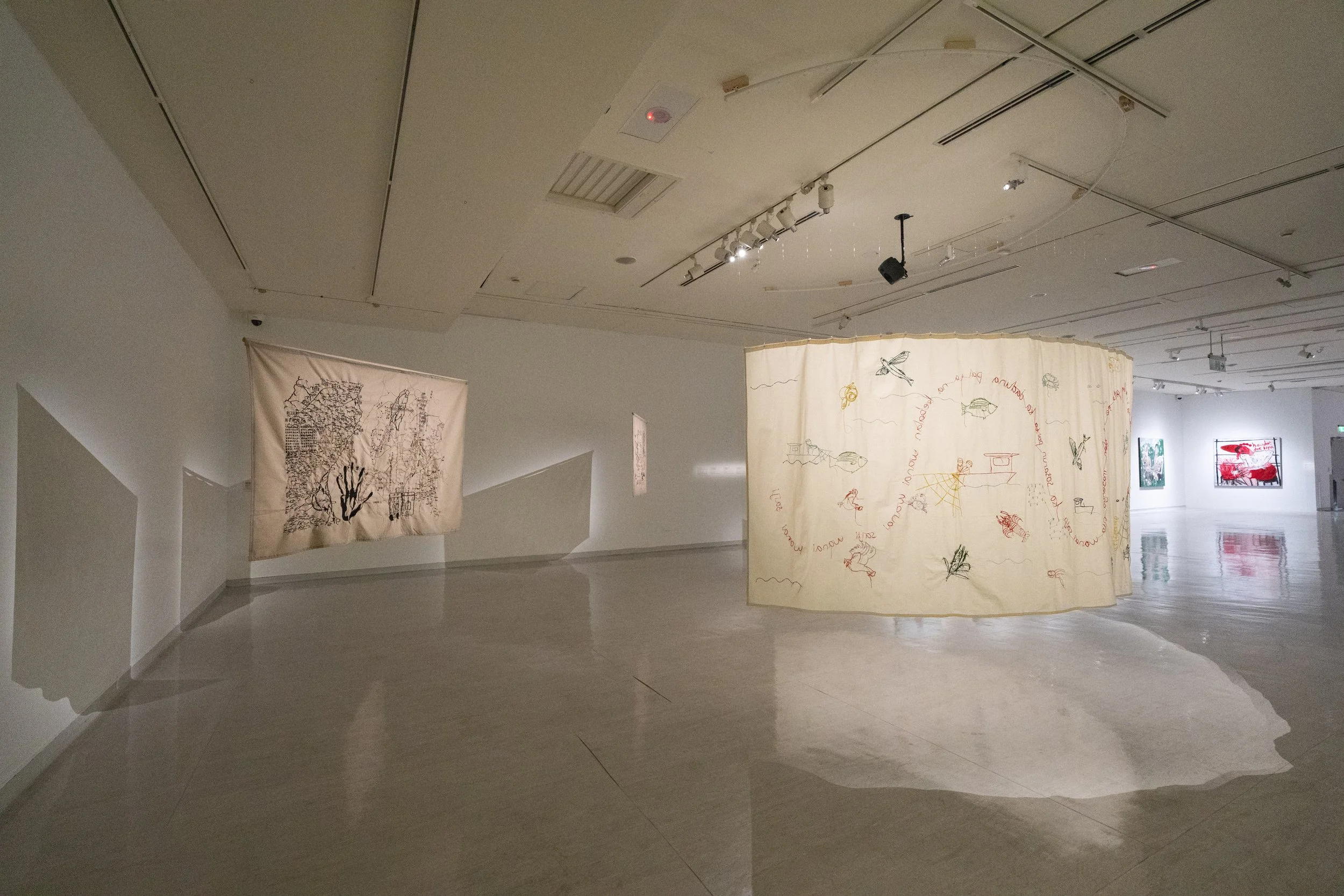
Meita Meilita, Wanai Saiji: The Shape of Being, 2025, embroidery on cotton, 250 x 800 x 150cm. Installation view at the 2026 Asian Art Biennial. Photo by Wei-tsan Liu. Image courtesy of the artist and NTMoFA.
The notion of co-weaving makes space for recognising connections without assuming that communities share a single identity. Indonesian artist Meita Meilita's Wanai Saiji: The Shape of Being (2025), a cotton tapestry embroidered with banana fibre, was made with Kavalan women elders during a residency in Hualien. Through the collaboration, she recognised shared Austronesian roots between the Kavalan and Indonesian communities. This includes a linguistic connection: tenun is the word for weaving in both languages. "The project prompted me to look past a single group and explore the wider connections between Austronesian peoples, opening up new questions about what communities across the region share," Meilita says. By recognising these shared roots, the collaboration opens up possibilities for connections across Austronesian communities, while allowing each to retain its distinct identity.

Womanifesto, SAAN SENSE, 2026, mixed media, dimensions variable. Installation view at the 2026 Asian Art Biennial. Photo by Wei-tsan Liu. Image courtesy of the artist and NTMoFA.
Connections can also emerge through shared practices and experiences. The collective Womanifesto worked with Mahasarakham Mid-field Artspace in northeastern Thailand to create SAAN SENSE (2026), drawing inspiration from the hammocks found in nearly every village home. 16 artists swapped new hammocks, bought from a local women's workshop, for villagers' old ones. Through workshops, artists and villagers learned to weave together while sharing family memories and local stories. The hammocks are installed inside the museum and out in the courtyard, where folk songs from the villages are also played. Visitors were using them as intended, resting after walking around the museum, and I spoke with Jamilah Preenan Nana of Womanifesto while sitting in one myself. "We want the work to become a space where people can sit, relax, and begin talking to one another, even if they are strangers," she says. The hammocks bring this communal practice into the exhibition space, inviting visitors to experience another way of coming together through everyday objects and shared traditions.

Open Contemporary Art Center (OCAC), Meander Maps: The Salvaged that Continue to Speak, 2025, dimensions variable. Installation view at the 2026 Asian Art Biennial. Photo by Wei-tsan Liu. Image courtesy of the artist and NTMoFA.
Across borders, co-weaving demonstrates how relationships can develop through sustained artistic exchange, even without shared cultural roots or identities. Open Contemporary Art Center (OCAC), an artist-run space in Taipei, presents Meander Maps, an ongoing collaboration with Hanoi's Nhà Sàn Collective. Since 2023, the two groups have developed their relationship through reciprocal visits and residencies. The project takes the Red River, which flows from Yunnan in southwestern China through northern Vietnam, as a guiding image for movement and exchange across borders. At the biennial, this dialogue continues through Meander Maps: The Salvaged that Continue to Speak (2025), an iteration made up of notes, sounds, scents and images accumulated along the way. The ongoing exchange has helped build a regional network of artists and organisations, allowing knowledge and artistic practices to circulate beyond national boundaries.
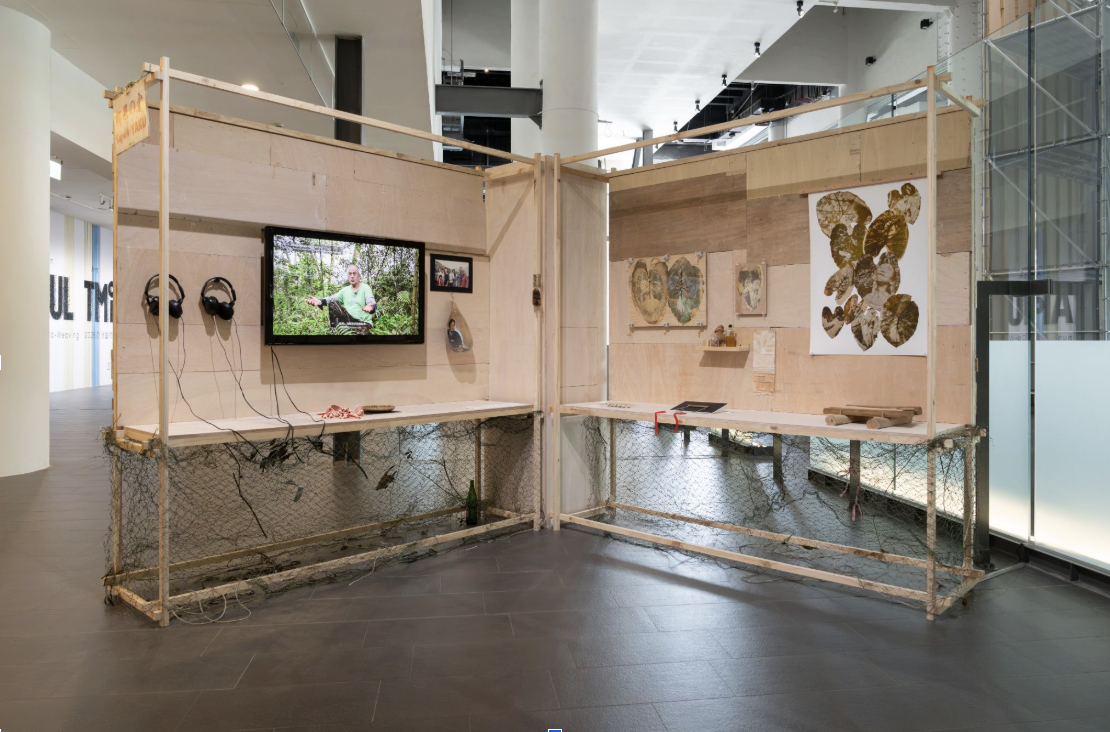
Installation view of co-learning project, Zero Experience — Learning from Plants: Tree Tree Tree Person × Datong Community Co-Learning Intensive. Image courtesy of NTMoFA.

Installation view of co-learning project, Sewing Lives: Stories of Malaysia Garment Factory Women in the 1970s. Image courtesy of NTMoFA.
The biennial creates opportunities for audiences to engage directly with the people and practices behind the works. On opening day, a live performance took place at the entrance gate, where a group of 30 weavers from different ethnic groups across Taiwan sat down to work alongside Labay Eyong. Those gathered did not simply watch from a distance. I watched visitors ask about the process, and the weavers explained it as they demonstrated. Lu sees value in moments like this. "Conversations like these can become the starting point for further research, allowing histories that have remained undocumented to be brought into the record," she says. The public programme provides further opportunities for exchange. The Asian Art Forum, held on 7 and 8 November, brought together artists, curators, and researchers to discuss collective practice and how knowledge travels across Asia, with keynotes from curator Binna Choi, Farid Rakun of ruangrupa, and researcher Kenichiro Egami. Seven co-learning projects also extend this exchange through workshops and community stays, exploring subjects from language and translation in Southeast Asia to the histories of Malaysian garment workers and art archives.
This raises a broader question: once the performance is over, how much of the knowledge and history behind a work can visitors access through the exhibition itself? The relationships and learning processes behind many of the works take place over longer periods and beyond the museum. Learning from Plants by Tree Tree Tree Person illustrates this distance. While visitors encounter an installation in the museum, the learning itself takes place in the Datong community, where beginners learn foraging and farming from residents, following the calendar of the plants rather than the museum's opening hours. The installation offers an entry point into this process, but cannot fully convey the experience of learning from the community or the knowledge developed through that ongoing exchange. The exhibition introduces visitors to these practices and perspectives, but offers only partial access to the contexts that give them meaning.
At the 10th Asian Art Biennial, co-weaving felt most tangible in the conversations I had with the artists and Lu herself. Asking about their work meant becoming part of the exchange it describes. The title suggests one kind of gathering, but the works show at least three: shared roots in Hualien, shared work in Isan, and sustained exchange between Taipei and Hanoi. Many of the relationships and learning processes behind the works extend beyond the exhibition, rooted in communities and exchanges that visitors may only encounter in part. While the public programme offers opportunities to engage with them more deeply, the exhibition cannot fully accommodate these experiences. As a result, visitors may leave with an understanding of co-weaving as a curatorial idea, without necessarily gaining a deeper understanding of the distinct histories and relationships that give each project its meaning. The challenge, then, lies in bringing these different perspectives together without losing sight of the contexts from which they emerge.
The author was invited on a press trip to the 2026 Asian Art Biennial in Taichung.
The 10th Asian Art Biennial, Mrahul Tminun · 共織 · Co-Weaving, is on view at the National Taiwan Museum of Fine Arts (NTMoFA) from 7 November 2026 to 28 February 2027.